THE WHEATLEIGH PLANS — TWO
What Happened to the Trees Olmsted Ordered
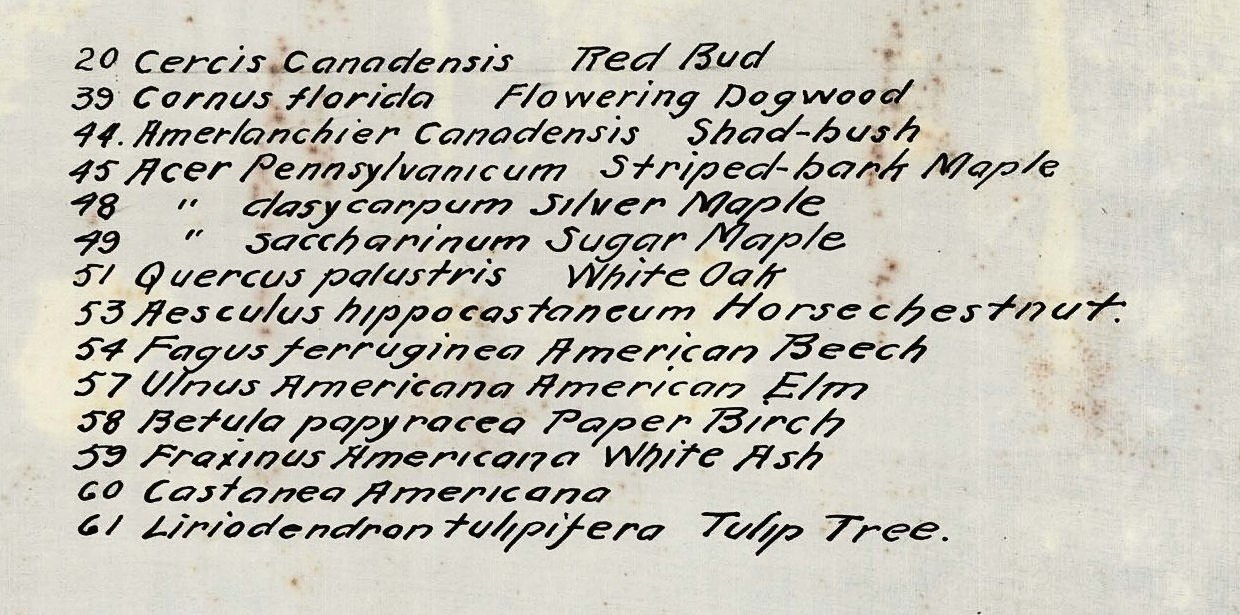
Twenty-seven American chestnut. Eleven American elm. Thirty-five white ash. Read the 1894 list now and it is a casualty report.
On 11 October 1894 the Brookline office of Olmsted, Olmsted & Eliot sent Henry H. Cook a typed planting schedule to go with the plan for his Stockbridge estate. Thirty-one groups of shrubs and about forty specimen trees, each with a number, a count and a spacing. Group thirty-one is the trees: six beds, one hundred and seventy-six of them, eighteen kinds, set four feet on center.
It is an ordinary list. Red maple, silver maple, sugar maple, striped maple, box elder. Pin oak and scarlet oak. Tulip tree. Gray birch. Shadbush, redbud, flowering dogwood, hazelnut, staghorn sumach. A European beech, because one was fashionable.
Group thirty-one is not the whole story. The boundary plantations on plan 66 carry their own canopy, bed by bed, and adding those in gives the estate its full complement of American trees. Four entries on that combined list are the ones a landscape architect in 1894 would have thought the safest things on the page.
| As written in 1894 | Modern name | No. | What came for it |
|---|---|---|---|
| Castanea Americana | American chestnut | 27 | Blight identified at the Bronx Zoo in 1904; in Massachusetts by 1908; virtually every mature tree dead by the 1950s |
| Ulmus Americana | American elm | 11 | Dutch elm disease arrived on unpeeled veneer logs; dying elms first seen at Cleveland in 1930, through most of the country by 1977 |
| Fraxinus Americana | White ash | 35 | Emerald ash borer entered Massachusetts at Dalton, in this county, on 31 August 2012 |
| Abies Canadensis | Eastern hemlock | 1 | Woolly adelgid reached the eastern states in the 1950s and Massachusetts in 1988 |
I The Chestnut
Twenty-seven trees. In 1894 the American chestnut was not a specimen, it was the backbone of the eastern forest — a quarter of the hardwoods in some stands, rot-resistant, straight-grained, and reliable enough that a farmer could count on the nut crop to finish his hogs.
In the summer of 1904 Hermann Merkel, the head forester at the Bronx Zoo, found cankers on a few scattered chestnuts. By the following June the disease was on trees of every size across the grounds. It moved roughly twenty-four miles a year. It was in Massachusetts by 1908, fourteen years after this list was typed, and by the 1950s essentially every mature American chestnut in the country was dead. The species survives as stump sprouts that reach twenty feet and die back.
The 1886 survey of the farm Cook bought fixes one corner of the property on a chestnut tree. The boundary was witnessed by a species that would be functionally extinct within a lifetime.
II The Elm
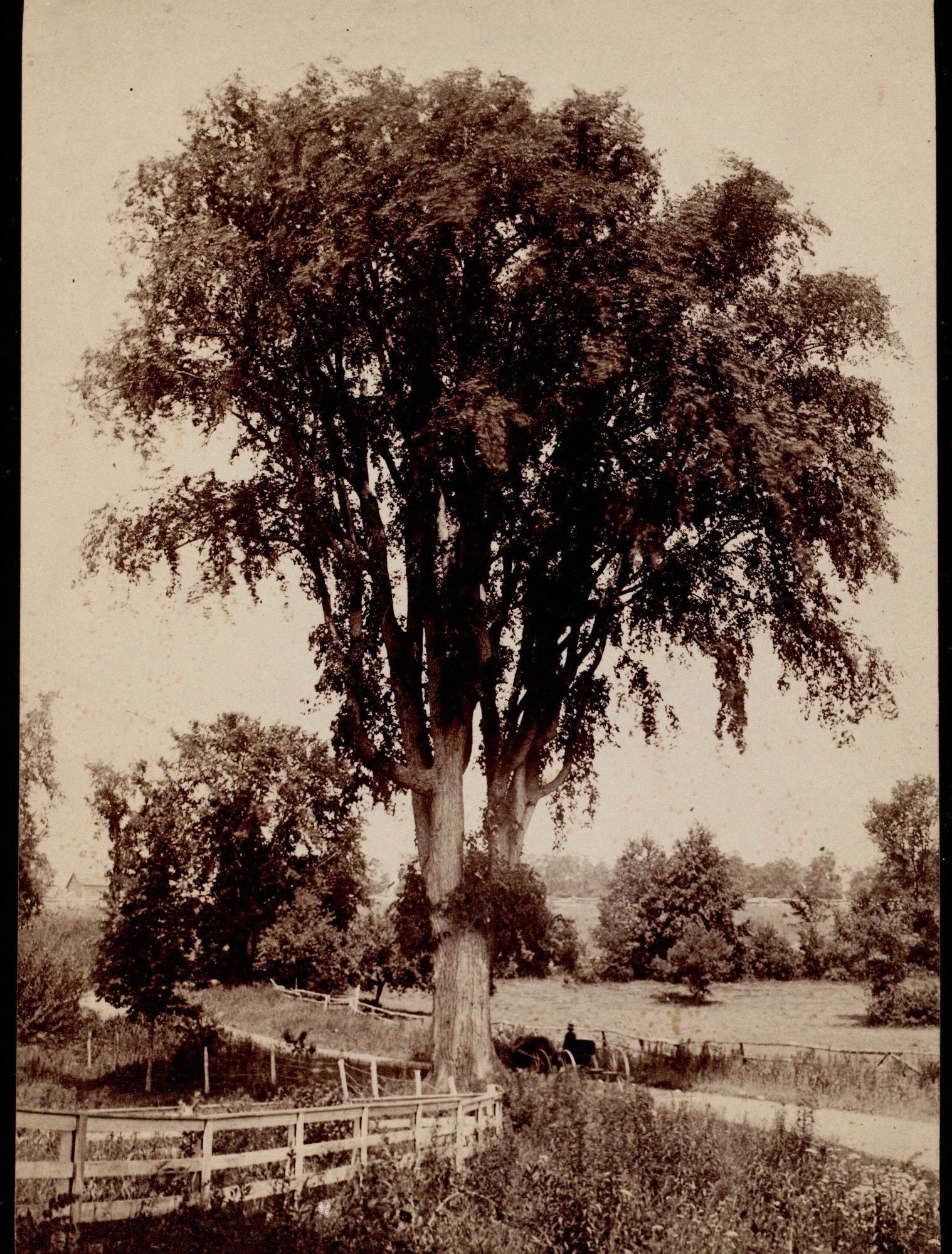
Five in group thirty-one, five more in the boundary beds, one in the tree bed, and one as a standing specimen — number 57 on the schedule. Two further elms appear on the lodge sheet, drawn into the islands at the entrance gate, one to each bed. Olmsted's firm used the American elm the way a composer uses a held note. It was the tree the whole New England street picture was built on.
The fungus came in on unpeeled veneer logs shipped from Europe. Dying American elms were first noticed at Cleveland in 1930 and the disease had worked through most of the country by 1977. What it took was not only the trees but a form — the vase-shaped canopy arching over a road, which is what the entrance at this estate was drawn to produce.
III The Ash
Thirty-five white ash across the estate, plus specimen 59. Ash was the utility infielder of American planting: fast, tolerant, straight, good in the ground and good on a lathe.
The emerald ash borer was found in Michigan in 2002. It reached Massachusetts on 31 August 2012, and it did not arrive in Boston or on the coast. It was found in Dalton, in Berkshire County — the same county as these ash trees, a short drive up the valley from the ground they were planted in. Federal officials confirmed it six days later. Ash is still being planted in some places; nobody in this county plants it without a plan to treat it.
IV The Hemlock
One tree, specimen 56, listed as Abies Canadensis and called Hemlock Spruce, which is what the eastern hemlock was called then. The woolly adelgid reached the eastern states in the 1950s and was first detected in Massachusetts in 1988, spreading from an infestation reported in Connecticut three years earlier. An untreated hemlock in southern Berkshire County today is a tree on a clock.
V What It Means for Putting Any of It Back
Four species, specified by the most consequential landscape office in American history, and a person trying to execute that sheet in 2026 cannot buy three of them in the form the drawing intends. The chestnut is not commercially available as a forest tree. The elm exists only as resistant cultivars that are not quite the tree. The ash can be planted and then must be treated, chemically, on a schedule, for as long as it stands.
That is worth saying plainly, because the romance of restoring a historic landscape is that you follow the document. You mostly can. Bed outlines, grades, spacings, the shape of a mass against a lawn — all of that is still executable exactly as drawn. But the canopy is not a design problem. It is an ecological one, and the four entries above are the difference between a landscape you restore and a landscape you can only translate.
The office that wrote this list had no way to know. That is the point of keeping the list.
Sources: Olmsted Archives, Frederick Law Olmsted National Historic Site, job #01295, planting schedule sheets 121-sh3 and 121-sh4, and plans 1, 66 and 72. Connecticut Agricultural Experiment Station on the 1904 Bronx Zoo outbreak. USDA Forest Service, Southern Research Station, on Dutch elm disease. Massachusetts Introduced Pests Outreach Project on the 2012 Dalton detection. UMass Center for Agriculture, Food and the Environment on hemlock woolly adelgid. Image courtesy of the United States Department of the Interior, National Park Service, Frederick Law Olmsted National Historic Site.