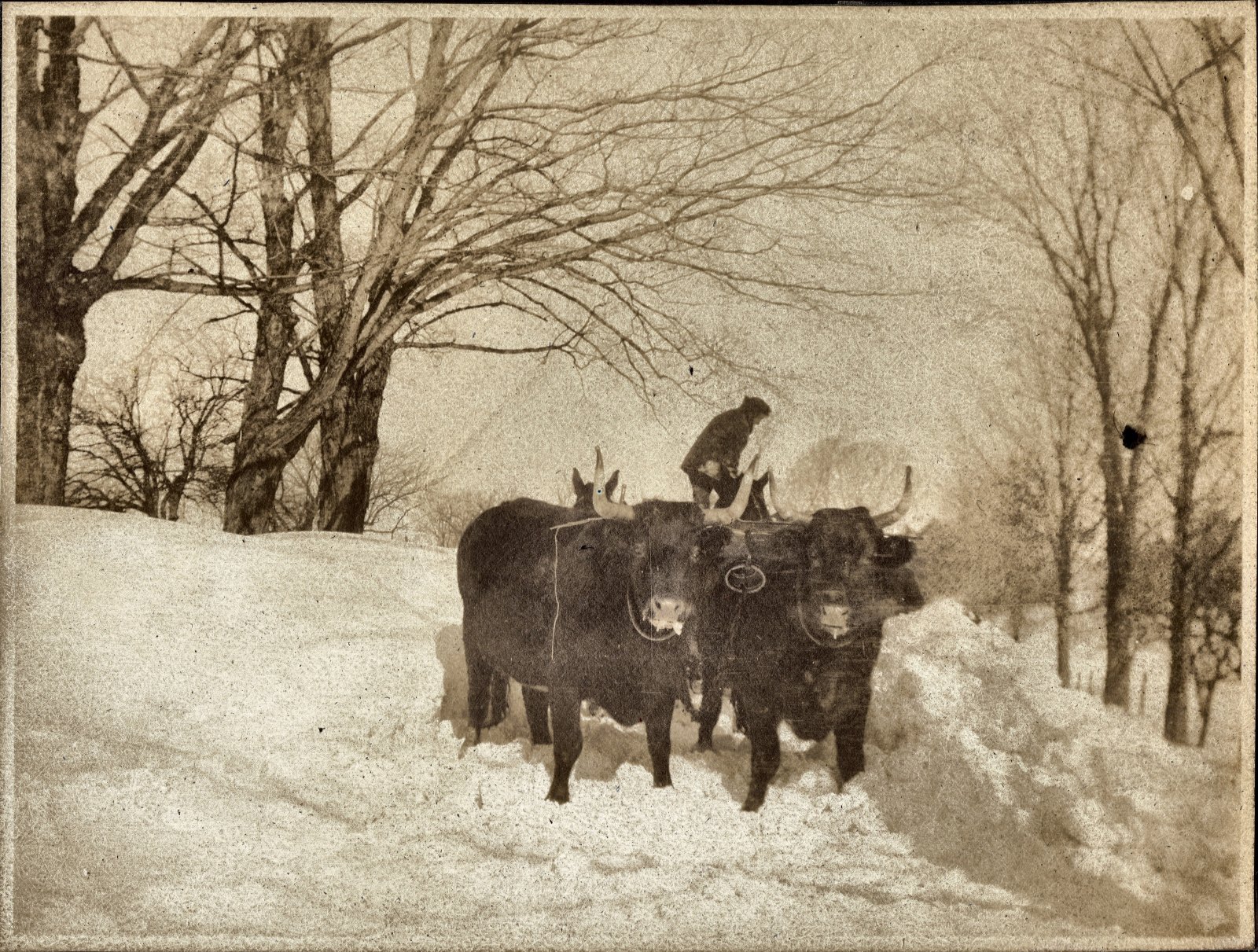
Two photographs in one family album, and a practice that every road in the county depended on and almost nobody now remembers.
I. The last thing you wanted was a plow
Picture a Berkshire road in February 1900 and you probably picture somebody trying to get the snow off it. Nobody was. Snow was not the obstacle. Snow was the pavement.
A sleigh runs on runners, and runners want a hard, smooth, continuous bed. Scrape a road down to frozen dirt and you have wrecked it — you have turned a fast surface into a rutted one and stranded every vehicle in town, because in January the vehicles all had runners under them. The disaster of the season was not a blizzard. It was a thaw.
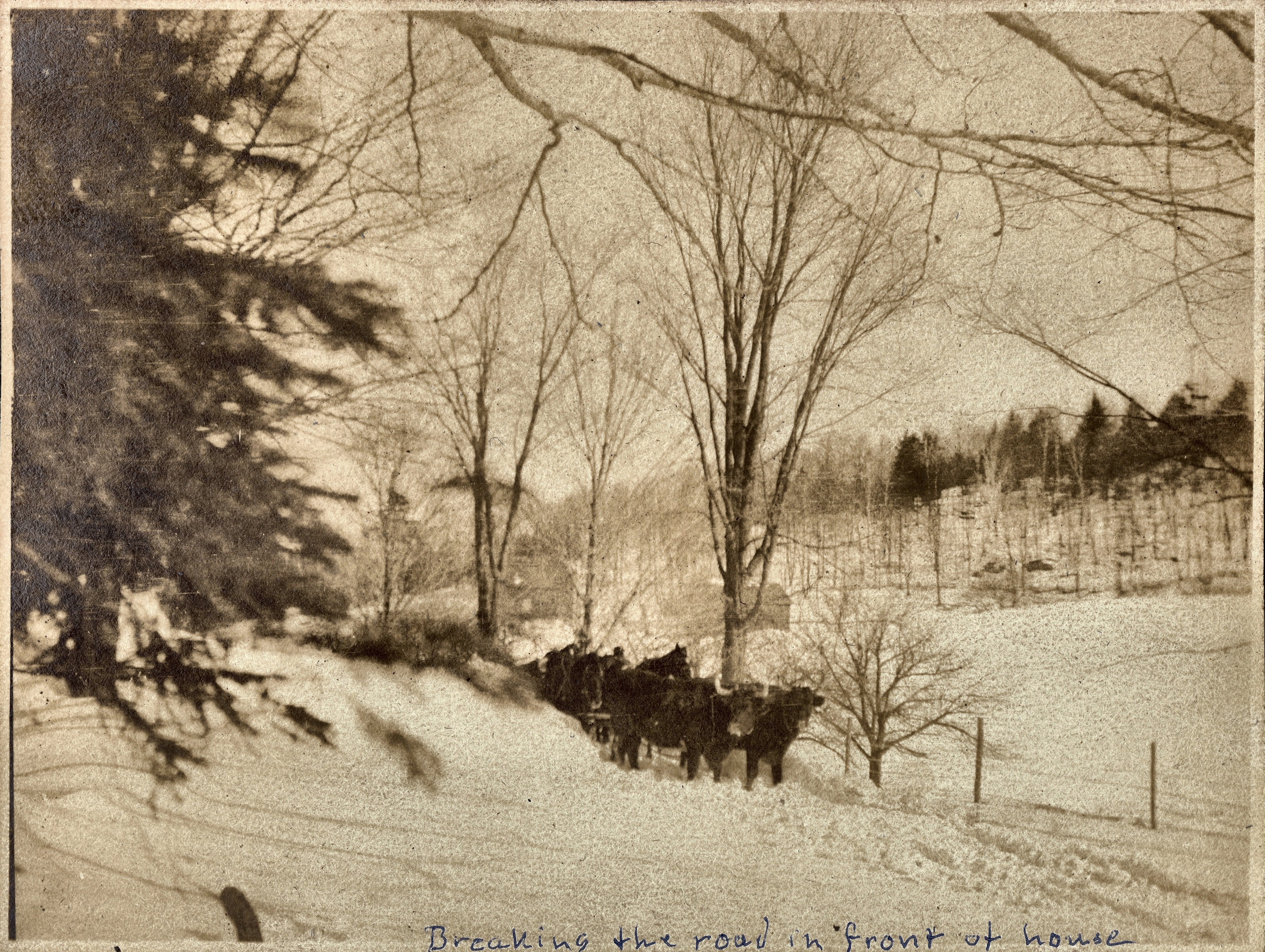
So when the snow came, the town went out and packed it. The period phrase is not clearing the roads. It is breaking out the roads, and it is written on the back of the photograph below in the hand of the family that took it.
II. A five-foot drum with a man riding on top
The machine was a snow roller: a large wooden drum, or more often a pair of them side by side, dragged up and down the road to compact the fall into a running surface. Mary Stokes Waller, turning the pages of the album at Orleton Farm, describes the one in these photographs as about five feet in diameter, with a seat on top for the man driving it.
That is the real thing, close to the inch. Westford, Massachusetts, still owns its antique roller and records the local range: two to six feet in diameter, four to twelve feet long, an iron core with wood panels, a driver’s seat attached. A roller packed snow to roughly half its own diameter. Westford voted to try them in 1902 and had two by 1908.
III. Oxen in front, horses behind
Now the detail worth the story. In the photograph at the top of this page the animals nearest the roller are horses. The two in the lead are oxen.
You do not expect that. Oxen and horses are different animals doing different jobs. An ox is slow, enormously strong, pulls from a yoke across the shoulders and simply keeps going. A horse is quicker, lighter in the collar, and answers the rein. Hitching them together is a bit like putting a tractor and a sports car on one tow rope.
The general accounts of snow rollers say oxen usually drew them and horses sometimes did. They do not describe both in a single hitch. This one has the weight of the pull out front and the steering at the back, which is what you would want if you were placing a five-foot loaded drum along the edge of a road. That is a reading of the photograph rather than a documented practice, and it is offered as the former.
IV. Why the bells
A cart on a dirt road is a racket — iron tires on stone, the whole frame working, you hear it coming around the bend. Put the same horse on packed snow in front of a sleigh on runners and the noise stops. A sleigh at a trot is close to silent, and it is moving a considerable mass at a speed no pedestrian can judge by ear.
Hence bells. Not ornament and not festivity: a required noisemaker fitted to a dangerously quiet vehicle. New Jersey put the requirement into statute in 1928 and has not taken it out — no person shall drive a horse attached to a sleigh or sled on a highway unless there are a sufficient number of bells attached to the harness to give warning of its approach. The law declines to say how many. It says enough to be heard.
Which means the sound now filed under Christmas spent most of its working life as a safety regulation. Somewhere between the statute book and the department store, a warning device became a carol.
V. Why there were that many horses to begin with
The animals in these photographs were not kept for the snow. Thirty years before the Procters bought the place it was a trotting-stock farm, and it advertised as one.
Under Henry W. T. Mali, who held it from 1871 to 1877, the farm was called Edge-Hill Farm, and its stallion was a bay horse named Robert Bonner — foaled 1860, sired by Rysdyk’s Hambletonian, 15.3 hands, with a public record of 2:33. The 1874 advertisement puts him at a hundred dollars the season, payable in advance, and makes the claim the farm was selling: that he was the only direct representative of Rysdyk’s Hambletonian in the southern part of Berkshire County.
There was a first annual sale of twenty-eight head in May 1874 and a second sale of brood mares and colts, without reserve, in November 1875. The yearlings offered that autumn were all named with a C — Cockfighter, Cruiser, Cub, Castaway, Calista, Carolina, Cowslip. Mali built a breeding barn, which burned, and a small race track across the road. A newspaper notice records a match at Curtisville between Robert Bonner and a mare brought over from Lee, watched by about a hundred and fifty people.
So the oxen are the farm’s own and the horses have a pedigree, and the road they are packing runs past a field that had a track on it. By the time these photographs were taken the trotting stock was gone and the work was the work. The coachmen story follows the other end of it, into the motor cars.
The two photographs: Procter family album, Orleton Farm, Stockbridge, reproduced by permission of Mary Stokes Waller, who scanned them from the original album. The caption on the first is the album’s own. Her account of the roller, the team and the bells was recorded at Orleton Farm on 3 October 2026 and is given as family testimony and recollection; the size of the roller and the make-up of the team are read from the photographs with her. Snow rollers — dimensions, construction, draft animals and the reason towns rolled rather than plowed: Westford Museum, Westford, Massachusetts, on that town’s surviving roller, including the 1902 vote and the two rollers owned by 1908. Sleigh bells as a warning requirement: New Jersey Revised Statutes 39:4-15, adopted 1928, through the Animal Legal and Historical Center at Michigan State University College of Law; the statute is cited because it states the rule plainly and is still in force, not because it governed Massachusetts. Edge-Hill Farm, Henry W. T. Mali, the stallion Robert Bonner, the 1874 and 1875 sales and the Curtisville match: advertisements and notices in a file of clippings held with the album and supplied by the family; the clippings carry their own printed dates — September 1873, March and April 1874, October and November 1875, April 1876 — but the newspaper is not identified on them, and that has not been established here. The sequence of ownership before the Procters is written out in Mary Stokes Waller’s hand and is family record rather than deed.