I. Dandy rolls and fourdrinier wires
The 1926 Central Berkshire directory gives three towns a classified section: Lee, Lenox and Dalton. Read Lee’s and it becomes clear very quickly that it is not a resort town with some industry attached. It is an industrial town that happens to be next door to one.
Lenox has headings for antiques, florists, ladies’ tailors, livery stables and a stone quarry. Lee has those too, and then it has these: brass wire cloth. Dandy rolls. Fourdrinier wires. Foundry and machine works. Marble quarries. Lime manufacturers. Wire manufacturers. Paper manufacturers. Saw mills. Grist mills. Brick dealers. Gravel and sand.
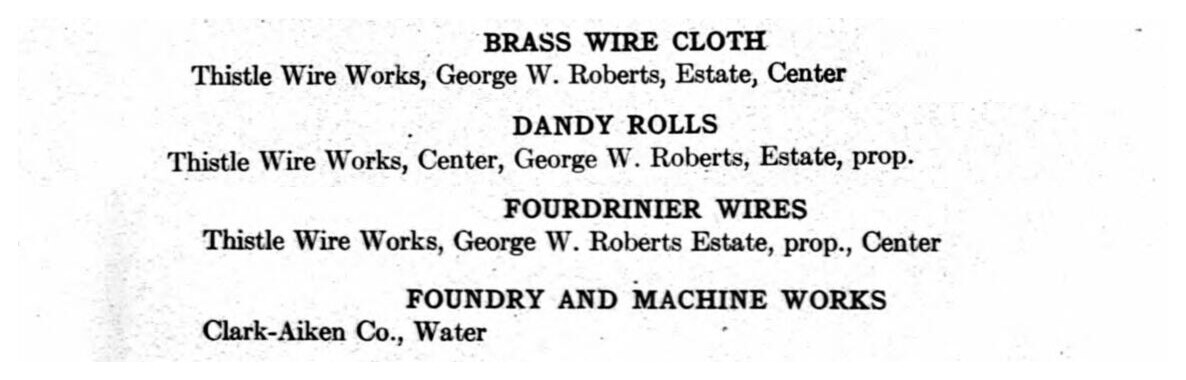
A fourdrinier wire is the endless woven belt a paper machine forms its sheet on. A dandy roll is the cylinder that rides on the wet sheet and presses the watermark into it. Brass wire cloth is what both are woven from. These are not general trades. They exist in a town because paper machines exist in it, and they are printed in the Lee directory in the same six-point capitals as dentists and dressmakers.
Under all three headings is one name.
BRASS WIRE CLOTH
Thistle Wire Works, George W. Roberts, Estate, Center
DANDY ROLLS
Thistle Wire Works, Center, George W. Roberts, Estate, prop.
FOURDRINIER WIRES
Thistle Wire Works, George W. Roberts Estate, prop., Center
The entire paper-machine supply trade of the town is one firm on Center Street, and in 1926 that firm is being carried on by a dead man’s estate. The heading immediately below is foundry and machine works, and it has one name under it as well: Clark-Aiken Co., Water.
Neither entry carries a See p. In a book paid for by advertising, where the grocers and the undertakers and the hardware stores all bought space, the two firms that made and mended the machinery of the county’s largest industry bought none. They did not need to. There were four customers in town and all four knew where Center Street was.
II. The empty slot
The directories have a fixed shape. Surname, given name, wife in parentheses, trade, emp and the employer, then the house. This site has spent a good deal of time on that trade slot, because it is where a gardener becomes a gardener rather than a name.
For the mill hands of Lee the slot is empty.
Counting the lines of the machine-read text that name each firm as an employer, and asking of each whether a trade is printed before the word emp:
| Employer | Entries | With a trade |
|---|---|---|
| Lee Lime Co. | 49 | 5 |
| Lee Marble Works | 45 | 3 |
| Smith Paper Co. | 43 | 12 |
| Mountain Mill Paper Co. | 34 | 2 |
| Eaton-Dikeman Co. | 27 | 6 |
| Clark-Aiken Co. | 16 | 7 |
| Hurlbut Paper Mfg. Co. | 11 | 2 |
| Thistle Wire Works | 4 | 1 |
Two hundred and twenty-nine entries; thirty-eight trades. And look at which trades they are. Bookkeeper, stenographer, clerk, chemist, accountant, draftsman — the office. Engineer, fireman, machinist, electrician, millwright, carpenter — the powerhouse and the shop. Moulder, at the foundry. Weaver, at the wire works.
Almost nobody in these entries is given a papermaking trade, and the vocabulary of the trade is nearly absent from the whole four hundred and ninety-six pages. Machine tender occurs six times in the volume. Beaterman, rag sorter, calender man, couch man, back tender — the ordinary names for the jobs on a paper machine — do not occur at all. Four of the six are in Lee, and not one of them is entered against any of the four Lee paper companies — they are credited to the Columbia, the Housatonic and the Valley. The other two are in Dalton, where Byron Weston’s men are given the trade and a boss finisher appears twice besides.
The comparison to make is not between rich and poor. It is between two ways of being recorded. A man who dug in a Lenox flower border is gardener, emp Elm Court. A man who made the paper is emp Smith Paper Co. and that is the whole of him. The house tells the book what its people are. The mill tells the book only that they are its.
III. The marble and the lime

Lee marble came out of the ground at West Park and went into buildings all over the country. In 1926 the trade is two firms: Lee Marble Works, William N. Gross president, and The White Marble & Terazzo Co., by the railroad track. Under lime manufacturers there is Lee Lime Co., (M. Deely Estate) off Marble n Railroad — a second business, like the wire works, being run by an estate.
Forty-five entries name the marble works. One of them says quarryman. One says engineer. One says stenographer. The other forty-two say nothing. At the lime works it is forty-nine entries and five trades, two of them laborer.
The names in those entries are worth reading as a group: Angioletti, Bartini, Bonafini, Barea, Adamoli, Airoldi, Bianco, Sembanotti, Pisapia, Camarco. A great many of them board together at Fairview on the South Lee road. The directory does not record where anyone was born, so what those names indicate cannot be settled from this book. The census does record it — and section VII below is what the census says.
IV. None at present
The classified section has a habit that is easy to miss and hard to forget once you have seen it. When a trade has gone out of the town, the book prints the heading anyway.
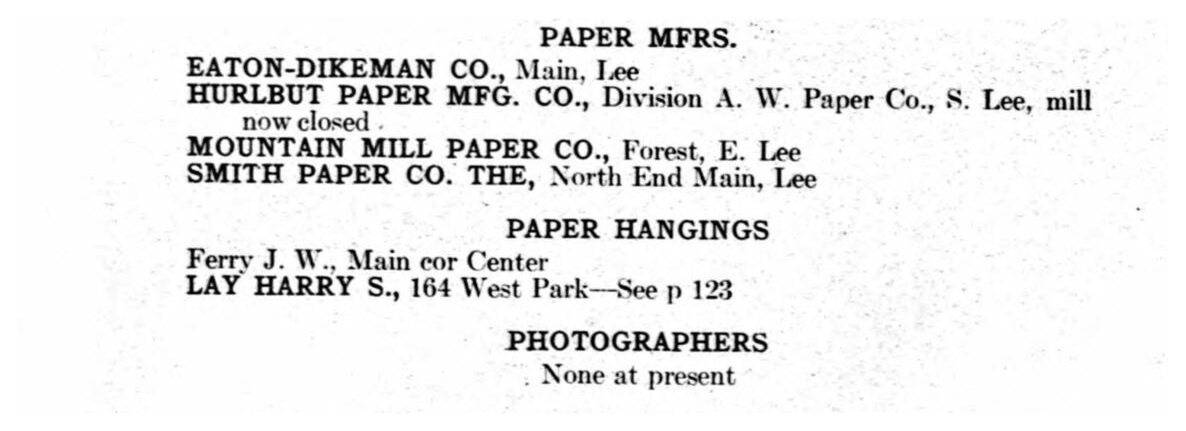
PAPER MFRS.
EATON-DIKEMAN CO., Main, Lee
HURLBUT PAPER MFG. CO., Division A. W. Paper Co., S. Lee, mill now closed
MOUNTAIN MILL PAPER CO., Forest, E. Lee
SMITH PAPER CO. THE, North End Main, Lee
Mill now closed — and eleven men still listed in the alphabet as employed there, because the canvasser asked them in the autumn what they did and that is what they said. Two headings further on:
PHOTOGRAPHERS
None at present
Lenox does the same thing in its hotel list: Gray House The, Church, closed. The book will not silently drop a thing that used to be there. It prints the heading and admits the gap, which is a more useful habit than it sounds — it is the difference between a record that says no and a record that says nothing.
V. Lenox Dale
Lenox Dale is in the town of Lenox. It is a mile and a half from the Curtis Hotel and it is in the same section of the same book as Elm Court and Wheatleigh and the Aspinwall. The assumption a reader brings to it is that it is where the servants lived.
Two hundred and seventy-one lines of the Lenox section carry a Lenox Dale address. Where an employer is named, this is who it is:
| Employer | Entries |
|---|---|
| Valley Mill (Smith Paper Co.) | 22 |
| General Electric, Pittsfield | 10 |
| Niagara Mill | 5 |
| Centennial Mill (Smith Paper Co.) | 5 |
| Berkshire Gravel Co. | 3 |
| Lenox Coal Co. | 3 |
| Elm Court | 3 |
| Eagle Mill | 2 |
| Columbia Mill | 2 |
Thirty-six entries at the paper mills. Three at Elm Court. In the whole village, one gardener.
The Lenox street section explains the geography in one line, describing Mill Street as running from East Main westerly near Smith Paper Co., Valley Mill. Both the Valley and the Centennial belong to the Smith Paper Co. of Lee. The largest employer of the town of Lenox’s working village is a Lee paper company, and the second largest is a factory in Pittsfield.
The twenty-two Valley Mill entries include six women. Marie Bard, a Mrs., on East Main. Lontine and Florentine, two Misses, on Elm and East Main. And on Elm Street, boarding together, Emily, Lena and Leonie Lauber, all three emp Valley Mill. The book does not say what any of them did there either.
VI. What Lenox had left
Turn from Lee’s classified section to Lenox’s and the change is not that Lenox is smaller. It is that Lenox no longer makes anything.
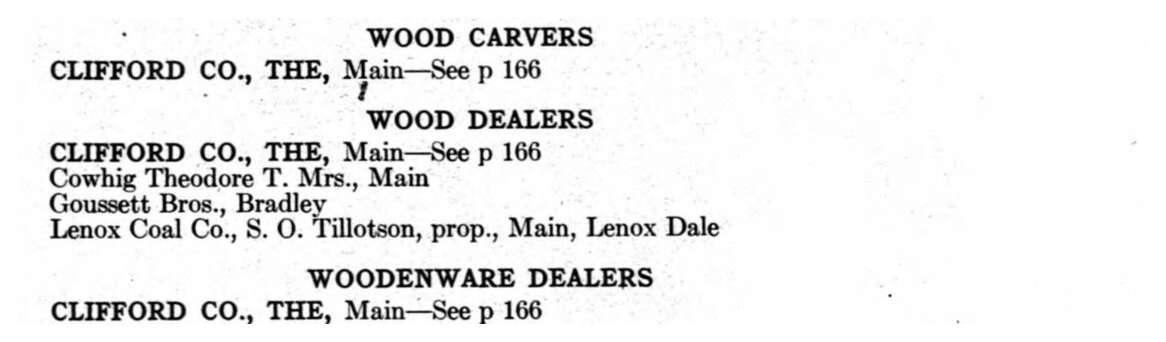
Seven Lenox headings have exactly one entry and it is the same entry every time: CLIFFORD CO., THE, Main—See p 166. Carpets. House furnishings. Lumber. Pictures and frames. Planing and molding. Stair builders. Wood carvers.
Those last three are the finish trades. In the years these houses were going up they meant a shop, a bench, a set of gouges and men who had served an apprenticeship. In 1926 they mean a hardware store that will order it in for you. The heading wood carvers survives in the Lenox directory after the wood carvers have gone, in exactly the way photographers survives in Lee’s — and it is the same information, arrived at from the opposite direction. Lee prints the heading and says there is nobody. Lenox prints the heading and puts the hardware store under it.
The rest of the Lenox section reads the same way once you are looking for it. The town’s only roofer, Adolph H. Roy, lives in Pittsfield. Its only tiling firm is Willey Bros. Its only stone quarry is entered as Cowhig T. T. Mrs., quarry Hubbard — a widow, listed under wood dealers as well, holding two of the town’s extractive trades between them.
Three miles apart, in the same volume: one town where the trades are still in the hands of the men who practice them, and one where what is left of them has been consolidated into a shop on Main Street and a telephone number in another city.
VII. Marble Street, 1910
Sixteen years before this directory was canvassed, a federal enumerator walked the same town and asked the questions the directory does not ask: where were you born, what year did you come, what language do you speak, and what exactly is it that you do.
He reached Marble Street — the street the lime works is entered from and the marble works sits at the end of — on sheets of enumeration district 41. Here is one boarding house on it.
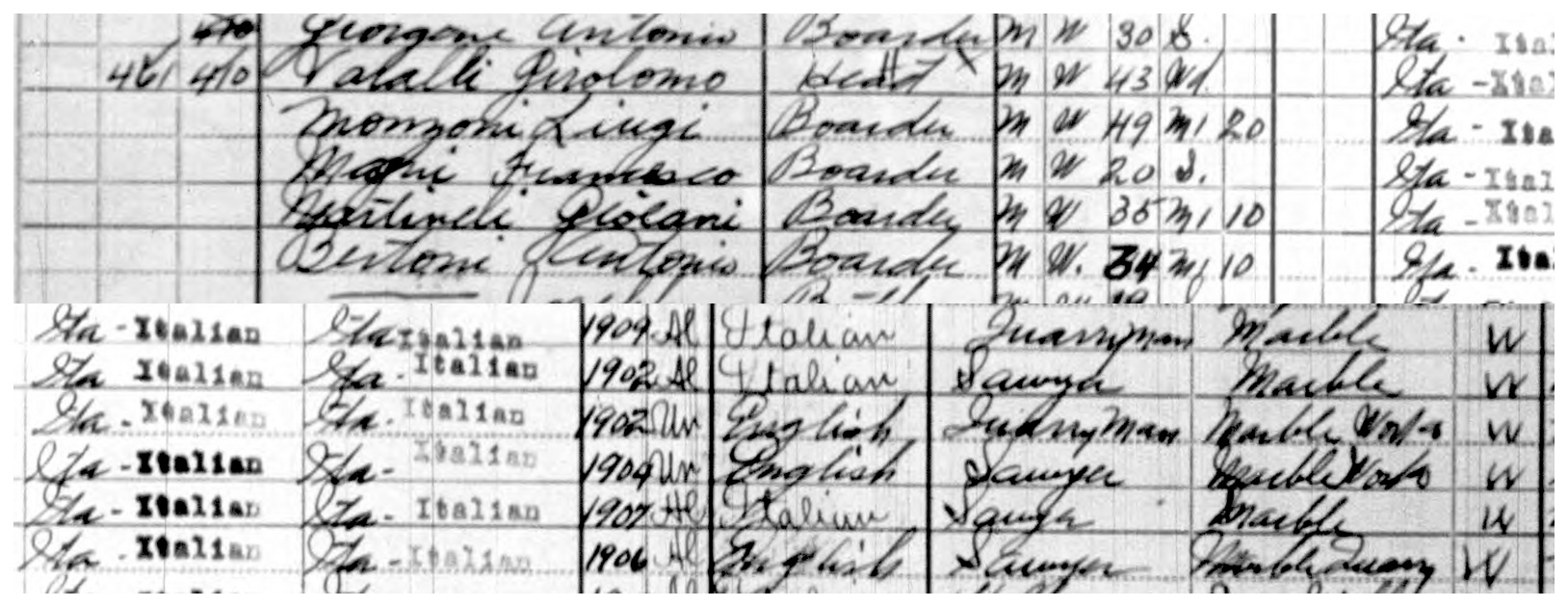
461/410 Valalli Girolomo, head, 43, Italy, arrived 1902 — Sawyer — Marble
Monzoni Luigi, boarder, 49, Italy, 1902 — Quarry Man — Marble Works
Matri Francisco, boarder, 20, Italy, 1904 — Sawyer — Marble Works
Martinelli Giolani, boarder, 35, Italy, 1907 — Sawyer — Marble
Bertoni Antonio, boarder, 34, Italy, 1906 — Sawyer — Marble Quarry
The whole run of sheets reads that way. Colotti Joe, Quarry Man. Sammie John, Sawyer — Quarry. Sammie Pete, sixteen years old, arrived that same year, Quarry Man — Marble. Del Cormo Santo, Quarry Man — Lime Works. Travaini Giovani, Quarry Man — Lime Works. Zanotti Battista, Lime Carrier — Kiln, with his wife Maria entered as Mistress — Boarding House and a servant, Beatrice Tavagi, twenty-two, Servant — Boarding House. Aili Erminio, nineteen, Helper — Lime Kiln. Ramasoni John, twenty-one, Helper — Lime Kiln. Household after household of men who came between 1899 and 1910, boarding six and eight to a house kept by one of their own.
So the question section III left open is answered, and it is answered by the other book. The men behind the ninety-odd trade-less lines at the Lee marble and lime works were Italian, most of them within a few years of arriving, and the work they did had names: quarry man, sawyer, lime carrier, helper, lime kiln.
Which is the same finding this section keeps arriving at from different directions, and it is worth stating plainly. The directory of 1926 is a commercial book. It sells advertising to businesses, and it records a working man by the business that employs him. The census of 1910 is a government instrument with a different purpose, and it records him by what he is and where he came from. Put one on top of the other and a person appears. Use either alone and you get half.
The same reading has been done for the mill village on the other side of the Lenox line, where the trades turn out to be rag cutter, sorter, finisher and operator, and the arrivals French rather than Italian.
All of it from the Central Berkshire County Directory, 1926 — the Lee classified section at pages 134–145 of the printed book, the Lenox classified section at pages 217–225, and the alphabetical sections of both towns. The plates are the pages themselves: brass wire cloth from printed page 135, dandy rolls and fourdrinier wires from 137 and 138, the foundry from 138, the marble quarries from 141, the lime works from 140, the paper manufacturers and photographers from 142, and the Lenox wood carvers from 225. Counts of entries and of trades are taken from the machine-read text of the volume, which is imperfect: a line broken across a column, or a word misread, will be counted wrong, and the figures should be read as close rather than exact. Where a count carries the argument it has been checked against the page image. The volume can be read and searched here. Section VII is from the Thirteenth Census of the United States, 1910: Population, Massachusetts, Berkshire County, town of Lee, enumeration district 41, the Marble Street sheets, NARA T624 reel 572, read by eye from the Internet Archive scans; names, ages, years of immigration and occupations are given as the enumerator wrote them.