This site keeps making the same argument: the people who ran these houses were not written down. Eastover is where the argument can be given a number.
I. Sixty-four, and eight
Harris Fahnestock Jr., a New York banker’s son, built Eastover about 1910. The architect was Francis L. V. Hoppin, who had built The Mount for Edith Wharton a decade earlier; the sunken garden was laid out by Beatrix Farrand. Thirty rooms. Four hundred acres at the start and nine hundred and thirty by the time Fahnestock died in 1939. And, at its height, sixty-four staff.
Thirteen years before he died, the canvassers for the Central Berkshire directory walked Lenox and wrote down who lived where. This is everyone in that book who is connected to Eastover:
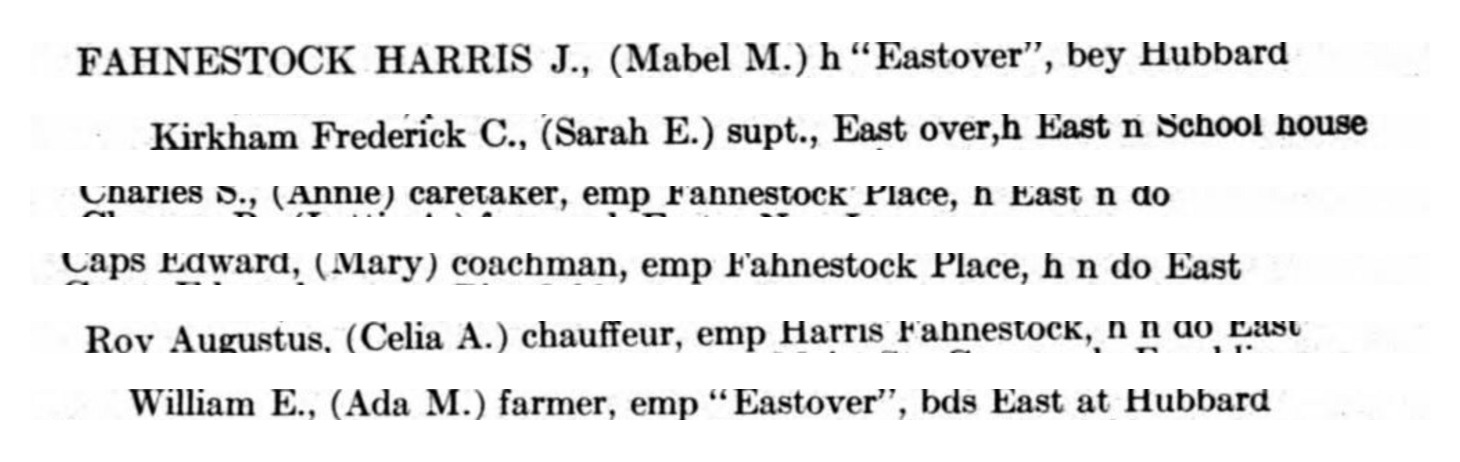
FAHNESTOCK HARRIS J., (Mabel M.) h “Eastover”, bey Hubbard
Kirkham Frederick C., (Sarah E.) supt., East over, h East n School house
Hutchinson Charles S., (Annie) caretaker, emp Fahnestock’ Place, h East n do
Caps Edward, (Mary) coachman, emp Fahnestock Place, h n do East
Roy Augustus, (Celia A.) chauffeur, emp Harris Fahnestock, h n do East
Henderson William E., (Ada M.) farmer, emp “Eastover”, bds East at Hubbard
Goudey Alphonse, (Emily) emp Eastover, h High
Fiehrer George V., (Anna) emp Fahnestock Place, h Housatonic c Willow
Pagery Frank, emp Eastover, bds East n do
Nine lines, eight of them employees. Against sixty-four. The book is not careless — it is the most thorough record of working people this county has — and it captures one in eight.
Notice also what the house is called. “Eastover.” East over, two words, in the superintendent’s own entry. Fahnestock Place. Fahnestock’ Place, with a stray apostrophe. Harris Fahnestock. Four names and a typographical accident for one address, which is the same trap the West Street story falls into at Highwood, in the same volume, seven pages away. Search this book for “Eastover” and you find three of the eight.
II. Four doors, past the schoolhouse
The addresses look vague until you open the street list, which walks East Street from Lenox Dale north to the Pittsfield line, with the left-hand side of the road set flush and the right-hand side indented.
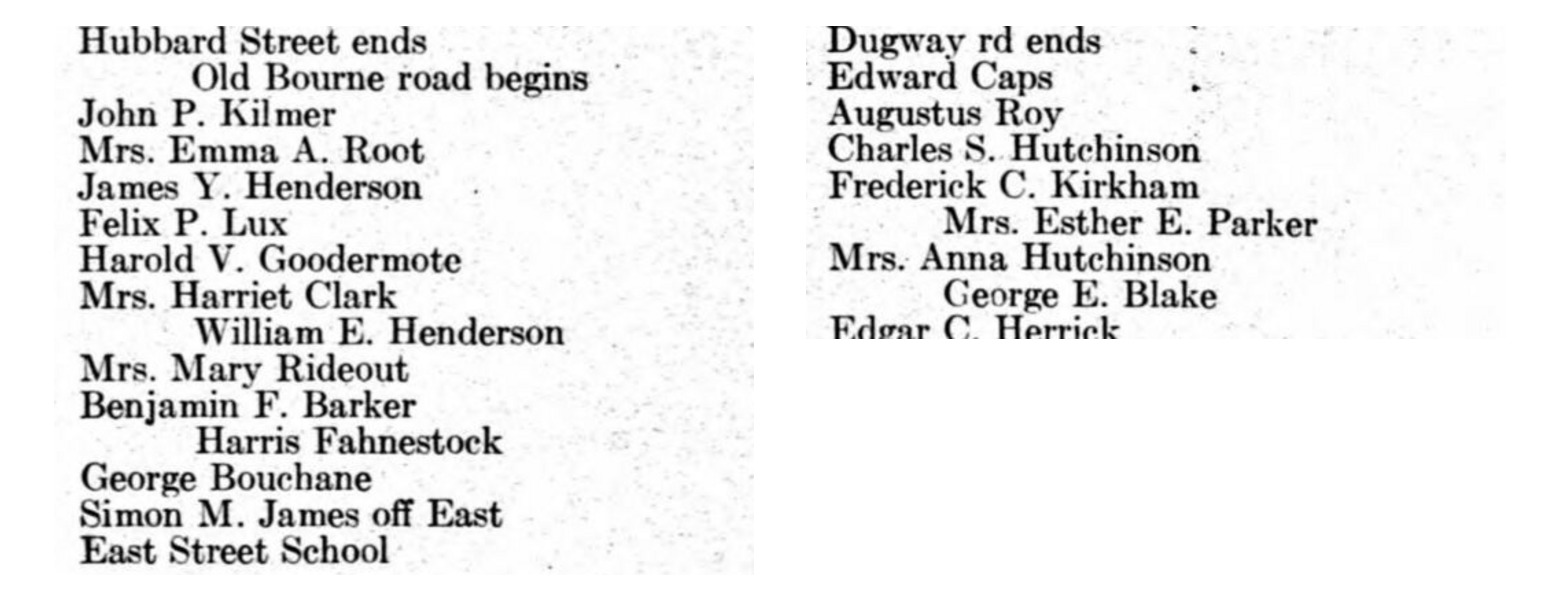
… Hubbard Street ends · Old Bourne road begins · John P. Kilmer · Mrs. Emma A. Root · James Y. Henderson · Felix P. Lux · Harold V. Goodermote · Mrs. Harriet Clark · William E. Henderson · Mrs. Mary Rideout · Benjamin F. Barker · Harris Fahnestock · George Bouchane · Simon M. James off East · East Street School · Dugway rd ends · Edward Caps · Augustus Roy · Charles S. Hutchinson · Frederick C. Kirkham · Mrs. Esther E. Parker · Mrs. Anna Hutchinson …
There it is, in the order you would pass them. The gate, then the schoolhouse, then four houses in a row holding the coachman, the chauffeur, the caretaker and the superintendent of the same estate. Kirkham’s address — h East n School house — stops being vague the moment you have the list: he lived by the school, and the school is two doors from the gate.
The indents matter too. Fahnestock is on the right-hand side of the road. His four men are on the left. So is the arrangement you would expect: the estate on one side, its staff houses facing it. William E. Henderson, the farmer, is indented — on the estate’s side, among a run of Hendersons at East and Hubbard, three of whom the book calls farmers and only one of whom it connects to Eastover.
III. A coachman and a chauffeur, in 1926
The coachmen story argues that one body of knowledge replaced another inside the working life of one man: eight coachmen left in South County by 1923 against seventy-eight chauffeurs, and the 1926 book still finding twelve coachmen in the hill towns. Eastover is that argument on a single payroll.
Caps Edward, (Mary) coachman, emp Fahnestock Place, h n do East
Roy Augustus, (Celia A.) chauffeur, emp Harris Fahnestock, h n do East
Next-door neighbors, working for the same man, doing the same job by two different methods, sixteen years after the house was built. Eastover never had a carriage era to speak of — it went up around 1910, when the motor car had already arrived on these hills — and it kept a coachman anyway. Whatever Edward Caps was still driving in 1926, the household wanted it driven, and wanted Augustus Roy next door for everything else.
IV. The fifty-six who are not here
Where are the rest? The answer is in the addresses, and the story on where they lived has it: a directory lists householders and the people who board with them. Everyone in the list above has an address of his own — a house on East Street, a room on High, a corner at Housatonic and Willow. Every one of them went home at night.
The indoor staff of a thirty-room house did not go home at night. Maids, cooks, kitchen and scullery maids, laundresses, footmen, a butler, a housekeeper, ladies’ maids, nursery staff — they lived at Eastover, and at Eastover the book records one household: FAHNESTOCK HARRIS J., (Mabel M.). The people sleeping on the top floor are inside that entry, uncounted and unnamed.
So the eight are not a sample of the sixty-four. They are a category: the outdoor and mechanical staff, the men with families and cottages, the ones a canvasser could find by knocking. The other fifty-six were in the house he had just walked past.
That is the shape of the whole problem, and it is why the census matters so much to this section. The census enumerator went inside. He wrote down the servants sleeping under the roof, with their ages and their birthplaces and what they did. The directory canvasser stood at the door.
V. After 1939
Fahnestock died in 1939 and the place was sold at auction in 1941, to the Virgilio family, who leased it to the Duncan School for Boys. The school failed in 1944. In 1946 George Bisacca bought the buildings and five hundred acres for $41,000 and turned them into a resort, which his family ran until 2009. In 2010 the six-hundred-acre estate sold again, for $3.6 million, and reopened in 2015 as a retreat.
Seventy years of continuous use, which is more than most of the houses in the estates section managed. And in all of it, the one document that names the men who kept the place running is a directory that found eight of them.
Directory entries, street list and the addresses in section II from the Central Berkshire County Directory, 1926, from the Pittsfield + Berkshire County MA Directory Collection at the Internet Archive. Lenox street list, East Street, printed page 169; the alphabetical entries from printed pages 185, 191, 195, 197, 199 and 208 of the Lenox section, each quoted as printed, abbreviations, spacing and stray apostrophe included. The reading of flush-left and indented names as the two sides of the road follows the book’s own Left Right heading at the top of each street; surnames supplied in square-bracket-free form for entries the book prints as continuation lines without a surname are taken from the line above them, which is how the book is meant to be read. The whole volume can be read and searched here; the two plates are unretouched crops from the Internet Archive scan, which is not in copyright, enlarged and set side by side as their captions describe. Construction about 1910, the architect Francis L. V. Hoppin, the sunken garden by Beatrix Farrand, thirty rooms, four hundred acres growing to nine hundred and thirty, sixty-four staff, Fahnestock’s death in 1939, the 1941 auction to the Virgilio family and the lease to the Duncan School for Boys, the school’s failure in 1944, George Bisacca’s purchase of the buildings and five hundred acres for $41,000 in 1946, the resort’s closing in 2009 and the 2010 sale of six hundred acres for $3.6 million are from The Berkshire Eagle, “The Cottager: Eastover: A grand house reimagined as a holistic retreat.” The figure of sixty-four staff is that story’s and is given here as reported; this site has not found a payroll or a census sheet to check it against, and the argument in section IV holds at any household of that order. No photograph of Eastover in the Fahnestock years has been found in the collections this site works from; the Library of Congress holds a run of mid-century postcards of the resort, which are a different building’s worth of story and are not reproduced here. Eastover does not appear on the Olmsted office’s Berkshire job list.