I. The gap in the record
Every estate on this site has an architect on record and most have a landscape office. Not one has a decorator.
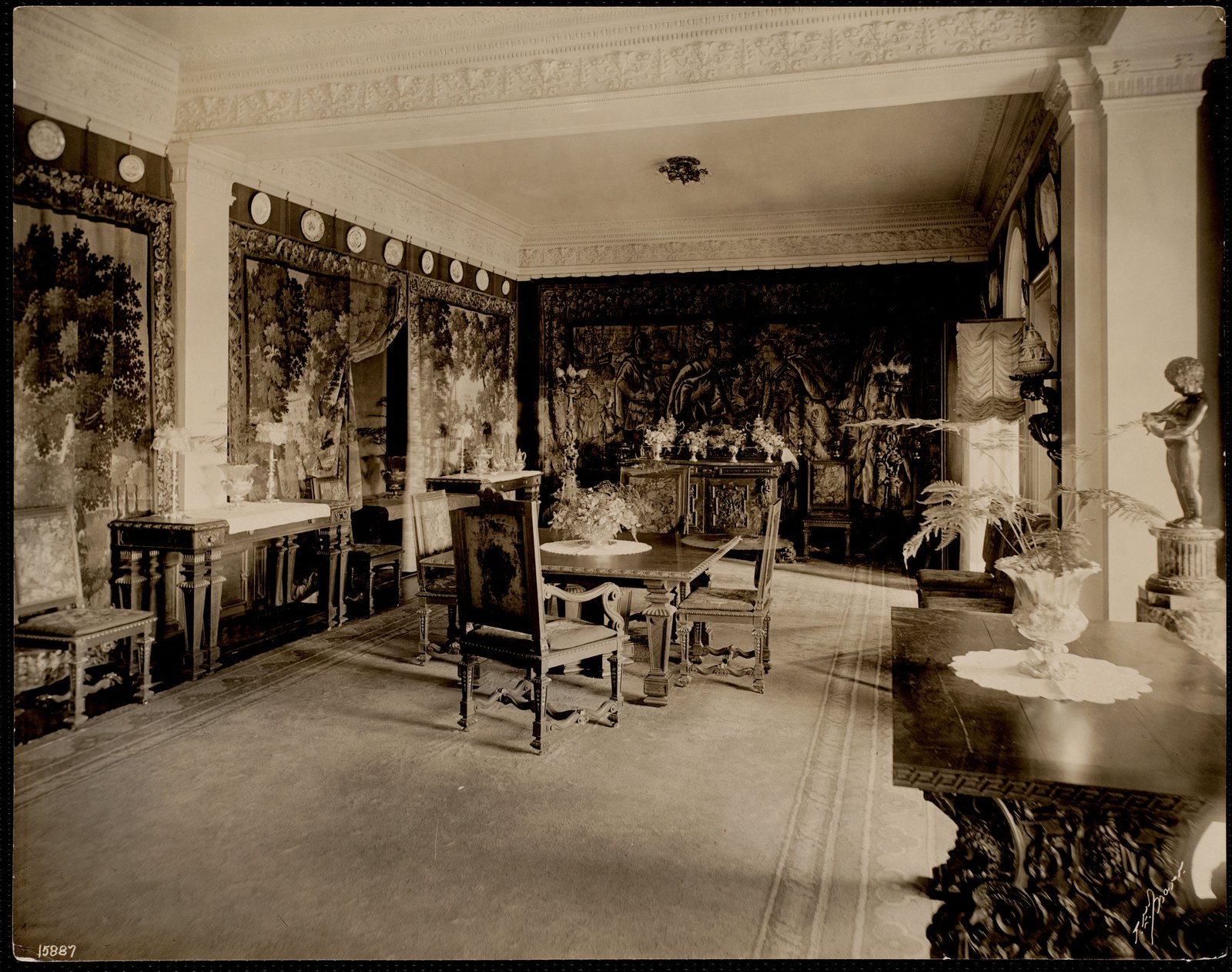
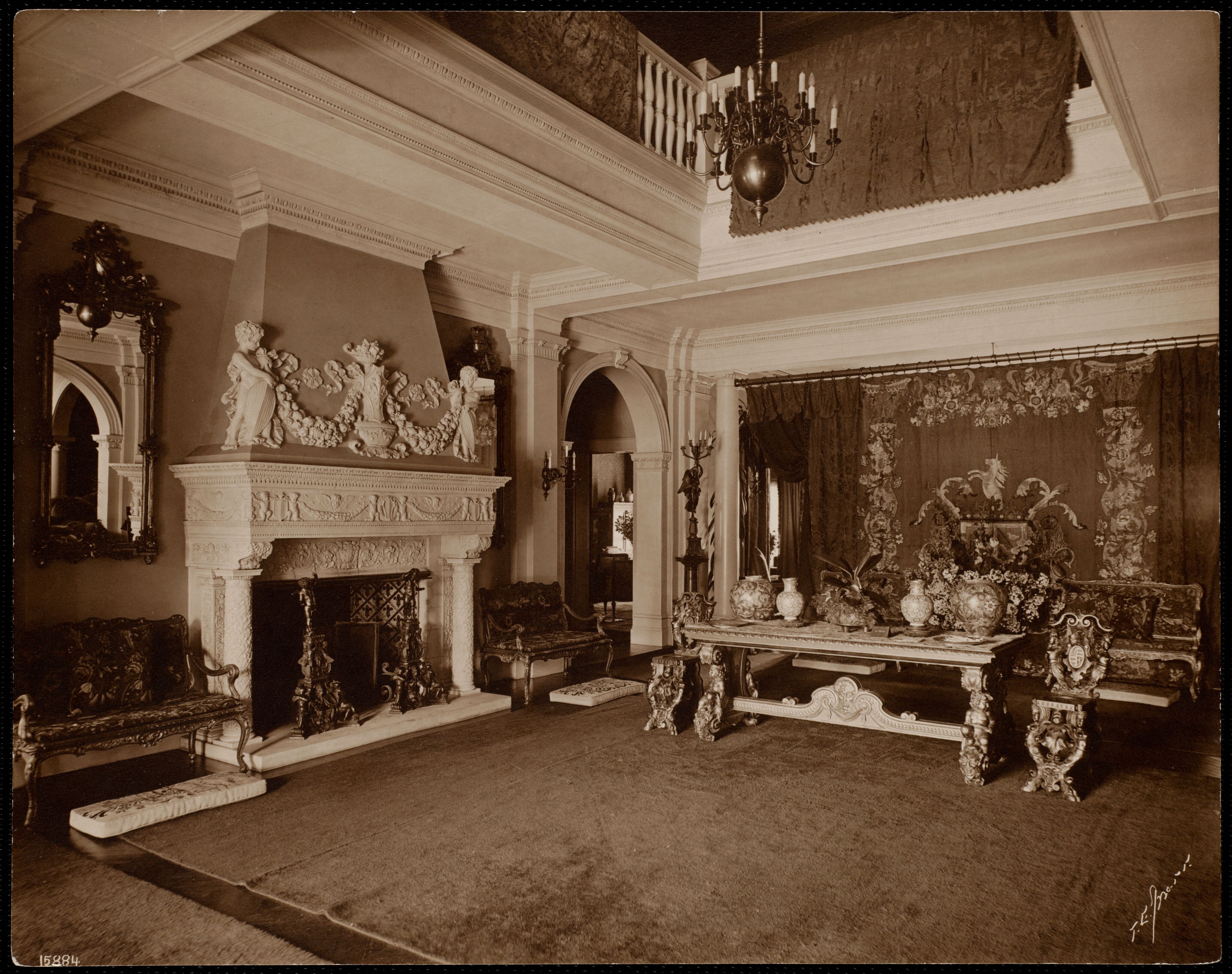
And yet look at the photographs. Carved mantels. Paneled and coffered ceilings. Tapestries hung above wainscot. Fitted bookcases. Suites of furniture chosen to sit together. Curtains, carpets, portières, lighting fixtures, hardware. None of that comes out of an architect’s office, and none of it was bought item by item by the lady of the house on an afternoon in town.
It came from a decorating firm, and in the 1890s that meant one of a handful of New York houses that would take a set of rooms, design them, make most of what went in them, buy the rest in Europe, and install the whole thing.
II. What a decorating firm actually was
The word “decorator” now means someone who chooses. Then it meant someone who made.
The New York firms ran cabinet shops, carving shops, upholstery shops, gilding and finishing rooms, and drafting rooms of their own. They employed designers, carvers, cabinetmakers, upholsterers, painters, paperhangers and varnishers on the payroll, and they bought abroad on their own account. A designation report on William Baumgarten’s own house lists his firm’s trade plainly — varnishing, painting, wallpapering and decorating, alongside custom cabinetwork and furnishings for wealthy Manhattan residences.
In other words, the same range of trades that appears in the rest of this section, assembled under one roof in New York rather than one site in the Berkshires, and shipped.
III. Herter Brothers, and 1891
The firm at the top of that trade was Herter Brothers, and its story runs straight into everything else in this section.
In 1881 William Baumgarten became head of Herter Brothers and ran it for a decade, at the height of its prestige. In 1891 the firm was reorganized as a stock company — and Baumgarten left, opening William Baumgarten & Company at 321 Fifth Avenue with his younger brother Emile as partner. His clients included William Rockefeller and Isaac Stern.
Hold those dates against the Berkshires. Elm Court from 1885. Ventfort Hall 1893. Wheatleigh 1893. Wyndhurst 1894. Shadow Brook 1893. The decade in which Lenox and Stockbridge were being filled with rooms that needed finishing is exactly the decade in which the leading decorator in America changed firms and then went into manufacturing on his own account.
Because that is what happened next. In January 1893 Baumgarten set up a loom in a room at 321 Fifth Avenue. By May he had taken a house on the Bronx River. Within a few years the works at Williamsbridge employed over eighty weavers, and the whole of it is told in another story here.
A decorating firm that could not buy what it wanted built a factory to make it. That is the scale these businesses worked at.
IV. W. & J. Sloane, and two Berkshire houses
The firm with the closest tie to this county is the one nobody thinks of as a decorator, because its name is on carpets.
W. & J. Sloane was founded in 1843 and became the first company to import oriental carpets into the United States. It kept staff in the Middle East to buy rugs for the Broadway showrooms. It controlled the output of a great many domestic and foreign carpet mills and imported from Germany, Switzerland, Scotland, England and France. It added an antiques department, began making its own furniture, and eventually billed itself, without qualification, as W. & J. Sloane Interior Decorators and Home Furnishers. Its customers included the Rockefellers, the Whitneys and the Vanderbilts.
And the men who ran it built here. John Sloane, the firm’s president, bought Wyndhurst in 1893. His brother William Douglas Sloane, married to Emily Thorn Vanderbilt, had built Elm Court from 1885. Both engaged Peabody & Stearns.
Two principals of the largest furnishing house in the United States, at two ends of one Lenox road, in one decade. Whatever went into those two houses did not have far to travel through the trade.
V. The rest of the trade
A 1912 survey of the tapestry business names, in its acknowledgements, most of the firms an American with money dealt with, and it doubles as a directory of the decorating trade at the top end.
Tiffany Studios — which before 1902 was the Tiffany Glass and Decorating Company, the second word being the point. The window that opens the glass story in this section was made by that firm for a private house.
Pottier & Stymus, cabinetmakers and decorators, who by about 1910 had put tapestry looms of their own on Lexington Avenue.
The Herter Looms, founded on East 33rd Street in February 1908 by Albert Herter — a painter, and a son of the Herter Brothers firm — who wove a hanging fifty feet long for the hall of Mrs E. H. Harriman’s house at Arden, filled with the trees, flowers, birds, rabbits and foxes native to Arden itself.
P. W. French & Co., the New York dealers through whom antique tapestries reached American walls.
Between them, those firms furnished most of the great American houses of the period. All of them were within a mile of each other in New York.
VI. Why it arrived crated
This is the part that matters for the rest of this section.
Everything else in these stories was made within a few miles of where it sits. The stone came out of Berkshire quarries. The plaster was mixed on site and had to dry through a Berkshire winter. The carpenters lived on Church Street and Main Street. The water came out of a spring at the bottom of the hill.
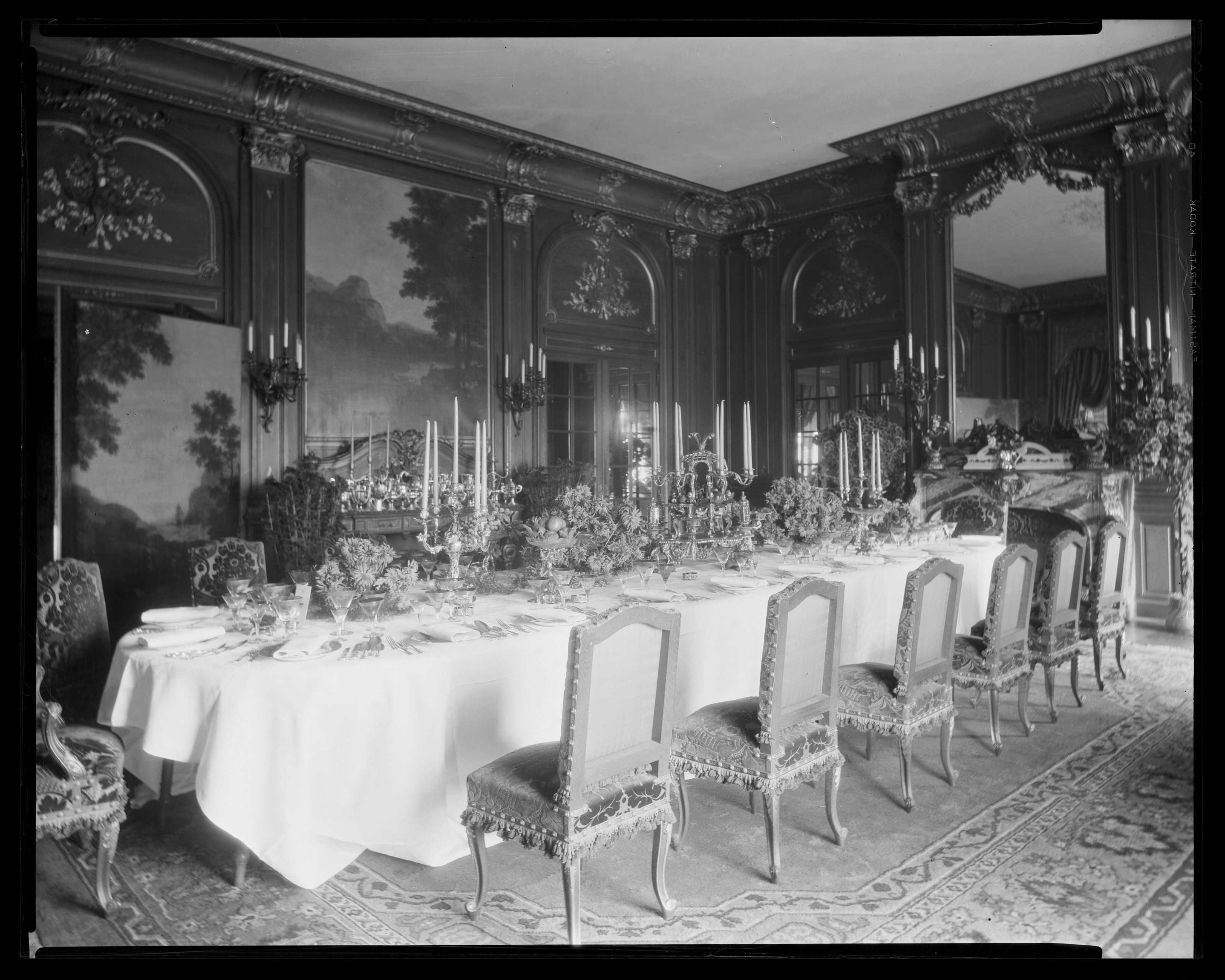
The finish did not. The paneling, the furniture, the hangings, the carpets and the fixtures were designed in New York, made in New York shops by New York tradesmen, crated, put on a train, carried up a Berkshire road in a waggon, and set in place by men who had come with them.
So the last stage of building one of these houses — the stage everybody photographs — is the one stage in which the local trades had almost no part. The room in the photograph at the top of this page was framed by Berkshire carpenters, plastered by Berkshire plasterers, and then finished by a firm four hours away by rail.
VII. And why we cannot name them
Nothing in these rooms is signed where a photograph can see it.
A tapestry carries a mark in its selvage. A frame carries a plaque on its lower rail. A drawing carries a title block. Furniture from these firms is usually stamped or stencilled — but on the underside of a rail, the back of a drawer, or a gummed label inside a case, and no photographer in 1900 was photographing the underside of a chair.
The firms’ own records would settle it. Herter Brothers’ and Baumgarten’s contract books, where they survive, name the house and the room. Nobody has yet gone through them for Lenox and Stockbridge.
Until somebody does, the correct thing to say about these interiors is what the photographs support and no more: that they were decorated, comprehensively, by professionals, in the years when three or four New York houses had that work almost entirely to themselves — and that the answer is probably sitting in a ledger.
William Baumgarten’s career — head of Herter Brothers from 1881, the 1891 reorganization, the founding of William Baumgarten & Company at 321 Fifth Avenue with his brother Emile, the range of trades, the Williamsbridge weaving works and the eventual staff of over eighty weavers, and the Rockefeller and Stern commissions — from the New York City Landmarks Preservation Commission designation report for the William and Clara Baumgarten House, 294 Riverside Drive. W. & J. Sloane’s founding date, oriental carpet importing, buying staff, mill contracts, antiques department and the “Interior Decorators and Home Furnishers” billing from published accounts of the firm and of its Broadway building. Tiffany Glass and Decorating Company, Pottier & Stymus, the Herter Looms and P. W. French & Co. as named in George Leland Hunter, Tapestries: Their Origin, History and Renaissance (New York, 1912), together with the Arden hanging. Interiors: Lenox Library Association, via Digital Commonwealth, titles quoted as catalogued. No decorating firm is attributed to any Berkshire house here, because no source consulted attributes one.