1890s
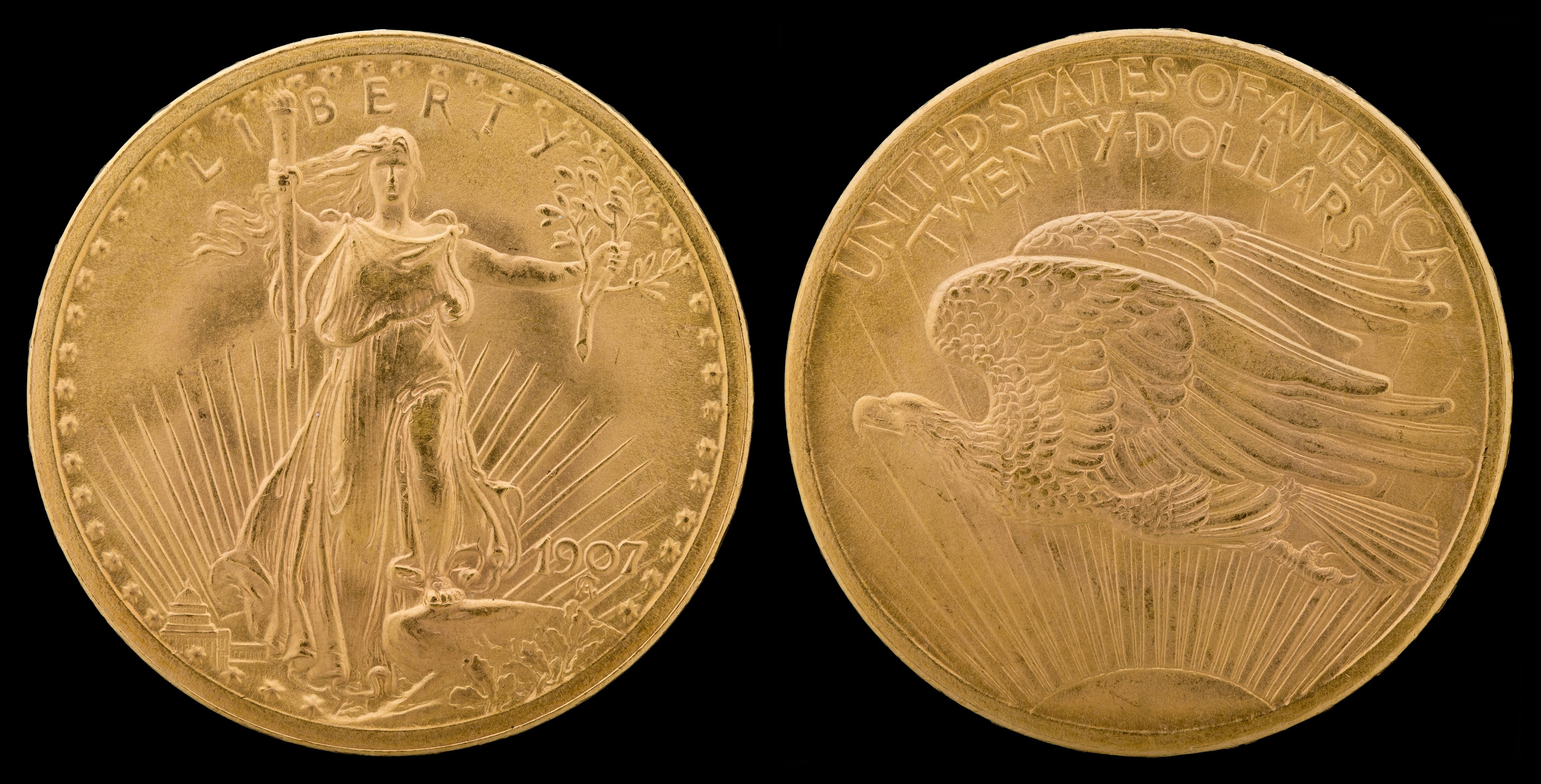
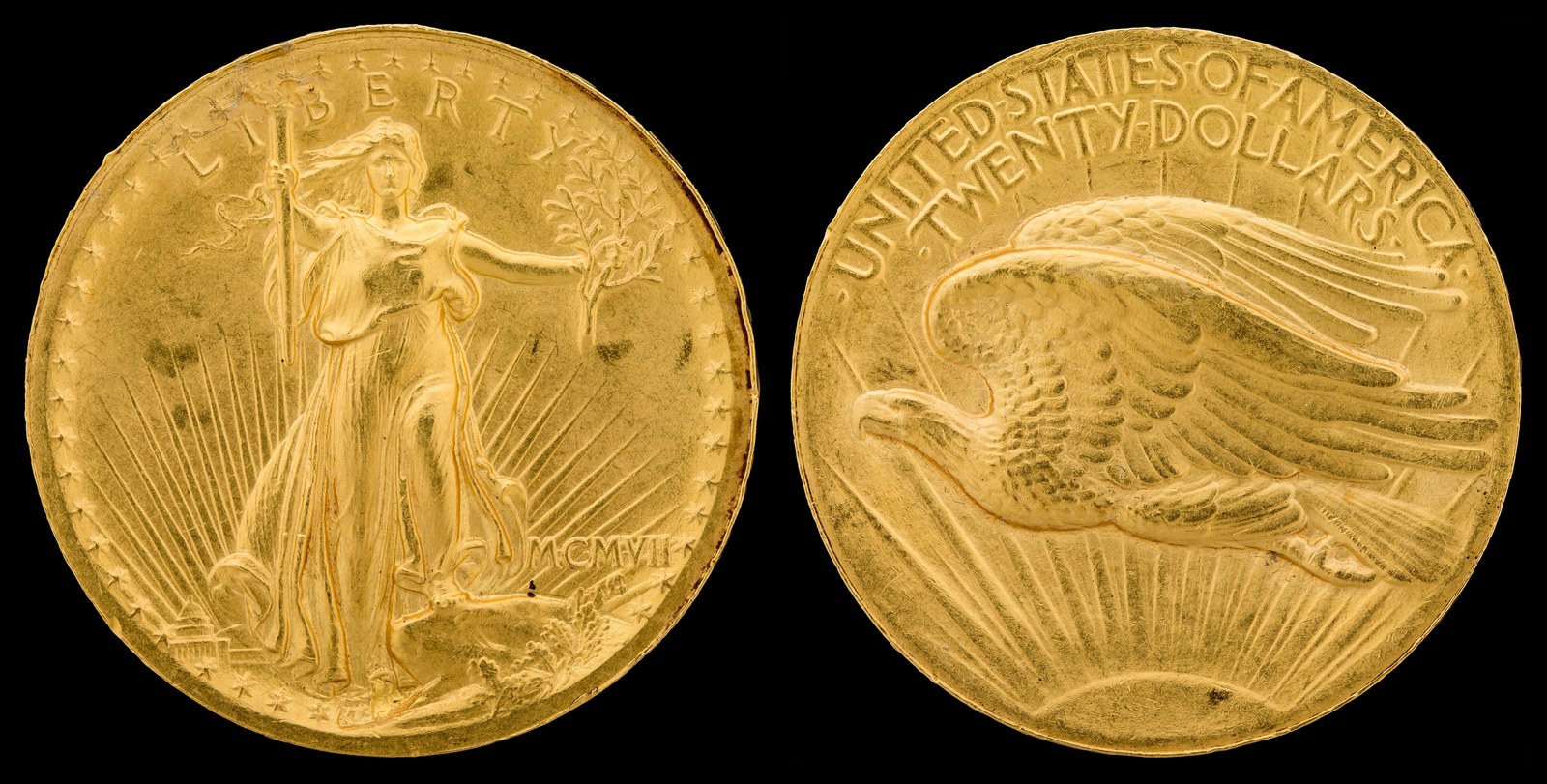
The 1907 high relief double eagle, obverse and reverse: Liberty striding forward with a torch, and an eagle flying over a rising sun
The 1907 high relief double eagle, dated MCMVII. Twenty dollars in gold, and the coin Augustus Saint-Gaudens and Theodore Roosevelt actually wanted. It took three blows of the press to strike, which is why it lasted one year.National Numismatic Collection, Smithsonian National Museum of American History; photograph by Jaclyn Nash. Public domain.

The Work · A rumor, and what it would have been

The coin of the realm

It is said at Elm Court that every employee was given a gold coin at the end of the season. This site has not found a document that says so. What it can do is say exactly what the coin would have been — and what it was worth against a month’s wages.

The rumor is untraceable and the coins are not. That turns out to be the better story.

I. The story, and what is not behind it

The story is that Emily Thorn Vanderbilt — who built Elm Court with William Douglas Sloane and lived there until her death in 1946 — handed each member of the staff a gold coin when the season closed.

No published source has been found that records it. Not the Elm Court literature, not the Vanderbilt and Sloane material, not the Lenox and Stockbridge local histories, not the general accounts of Gilded Age service. Nor has any comparable season-end gold custom been found named at another American estate. That is not proof it did not happen. Household customs are exactly the sort of thing that never reaches print, and this site has spent a great deal of time on how badly the record treats the people who worked in these houses — the Eastover story finds a directory catching one employee in eight. A gift nobody wrote down is entirely consistent with a workforce nobody wrote down.

So it stays a rumor here, and it is labeled one. What can be done instead is to take it seriously as a question of fact: if it happened, what was in the hand?

II. There are only four answers

Between 1890 and 1933 the United States struck gold in five denominations, and the gold dollar is barely one of them — the Act of 26 September 1890 abolished it along with the three-dollar piece and the three-cent nickel. After 1889 no gold dollar was made for circulation. That leaves four coins a person could be handed, and a Lenox season that ended in 1902 would have ended with one of them in the hand. The prices and wages beside them are of the same moment.
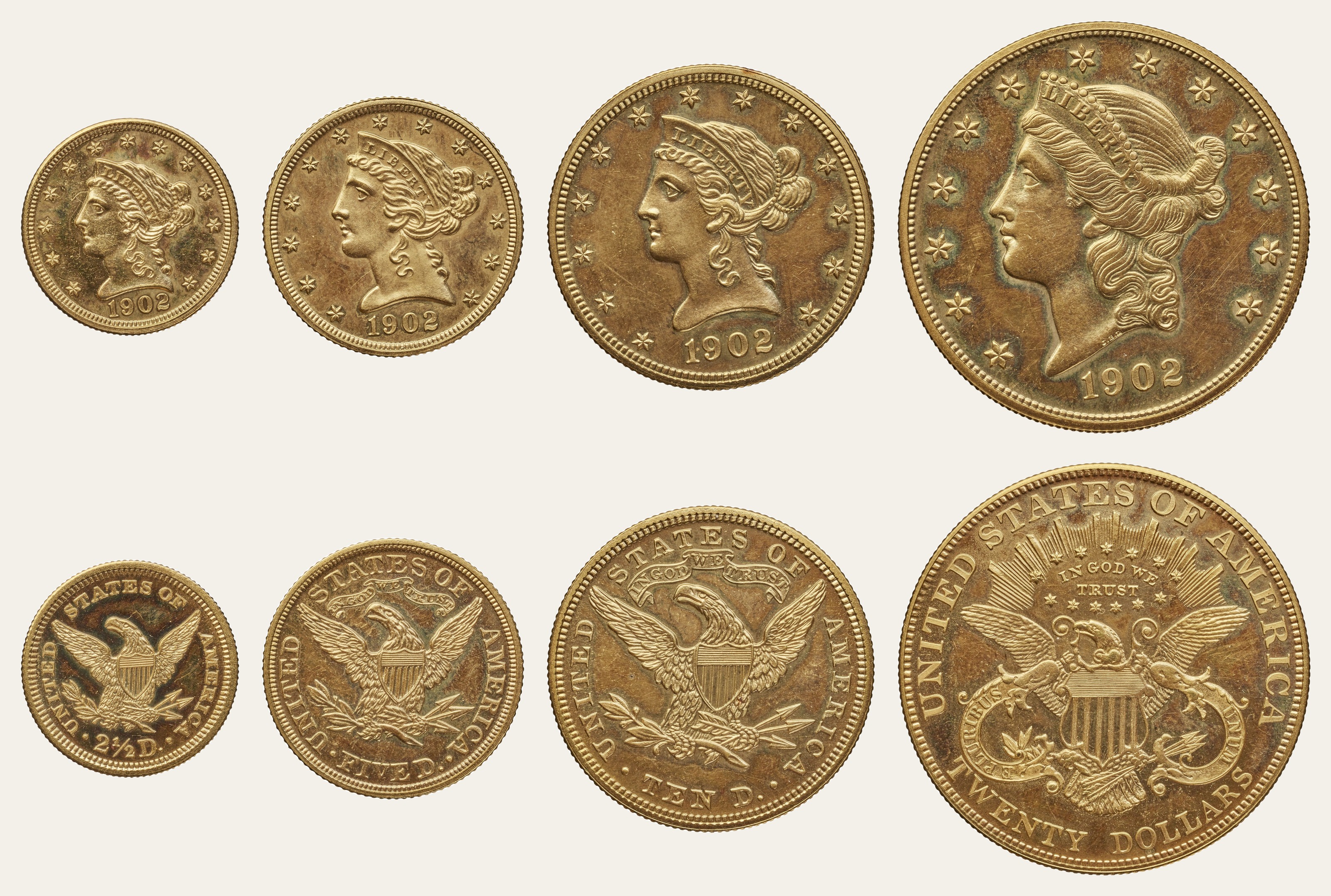
All four gold denominations of 1902 at their true relative size — obverse above, reverse below, cut to the rim and set on one scale. The reverses name themselves: 2½ D., FIVE D., TEN D., TWENTY DOLLARS. The double eagle is worth eight times the quarter eagle and holds exactly eight times the gold, 4.18 grams against 33.44, but it is nothing like eight times as wide. Gold is bought by weight, weight goes with volume, and volume goes with the cube of the width — so eight times the metal is only twice across. The coin worth a month of somebody’s life is an inch and a third.
All four gold denominations of 1902 at their true relative size — obverse above, reverse below, cut to the rim and set on one scale. The reverses name themselves: 2½ D., FIVE D., TEN D., TWENTY DOLLARS. The double eagle is worth eight times the quarter eagle and holds exactly eight times the gold, 4.18 grams against 33.44, but it is nothing like eight times as wide. Gold is bought by weight, weight goes with volume, and volume goes with the cube of the width — so eight times the metal is only twice across. The coin worth a month of somebody’s life is an inch and a third.Bibliothèque nationale de France, département Monnaies, médailles et antiques, by way of Wikimedia Commons. Public domain.
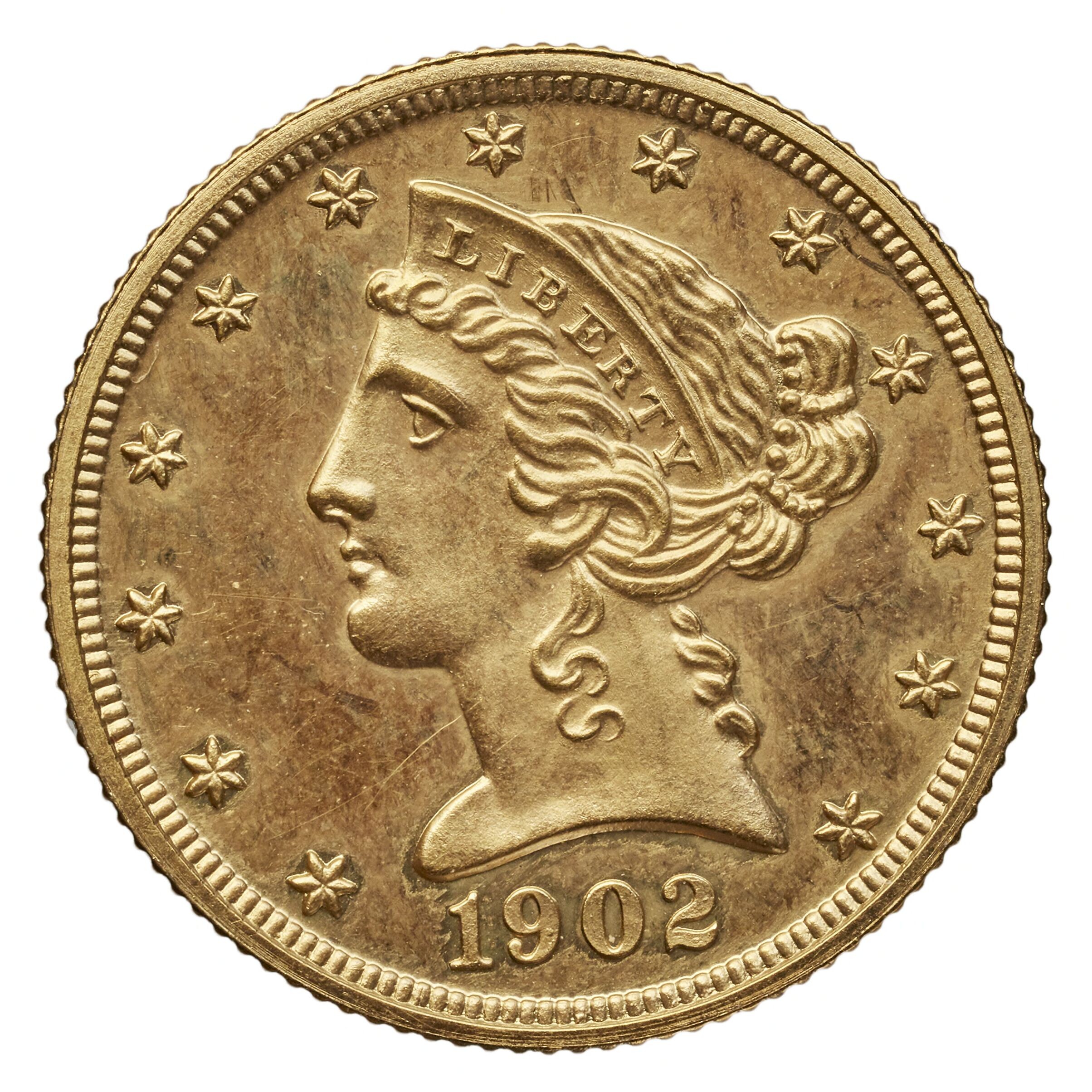
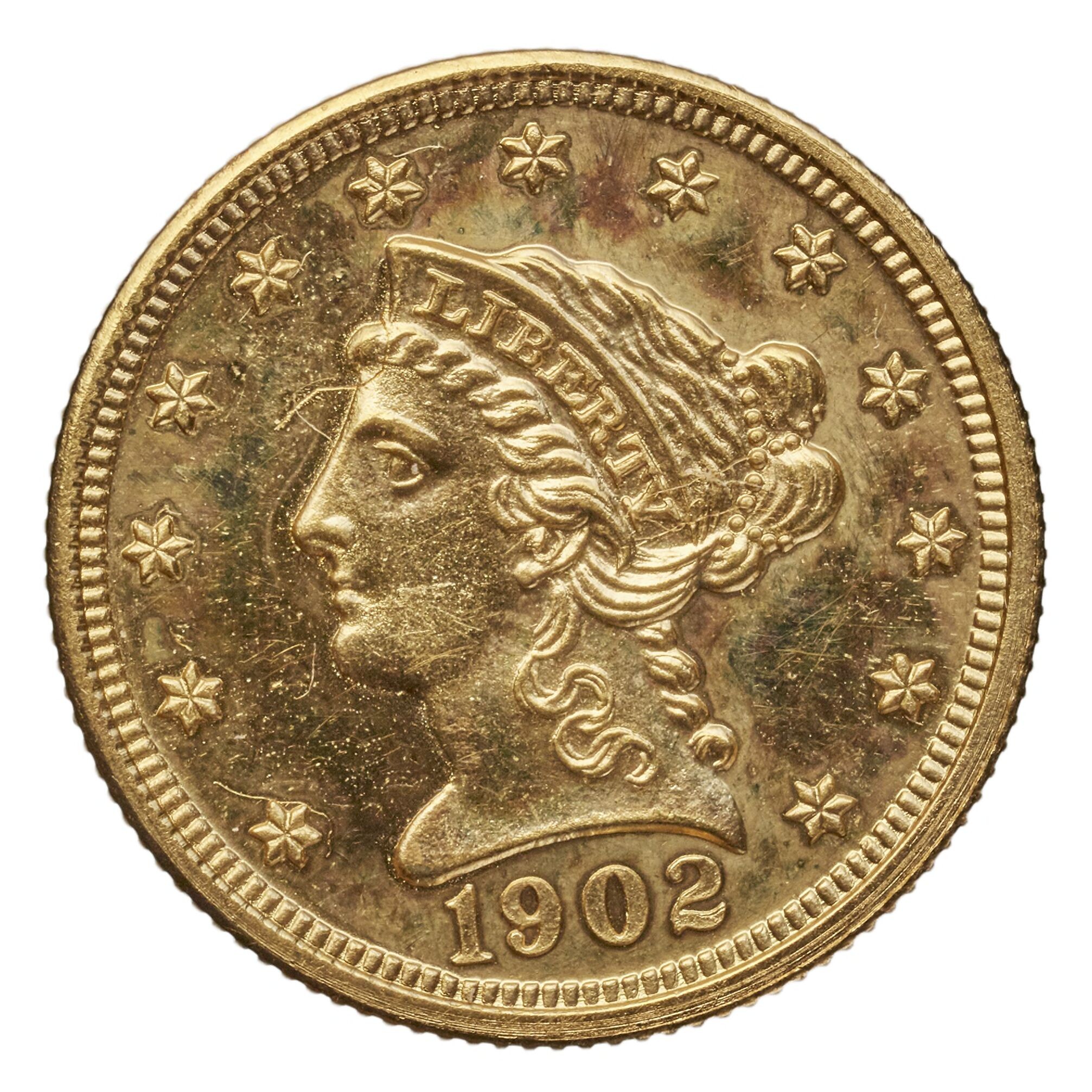
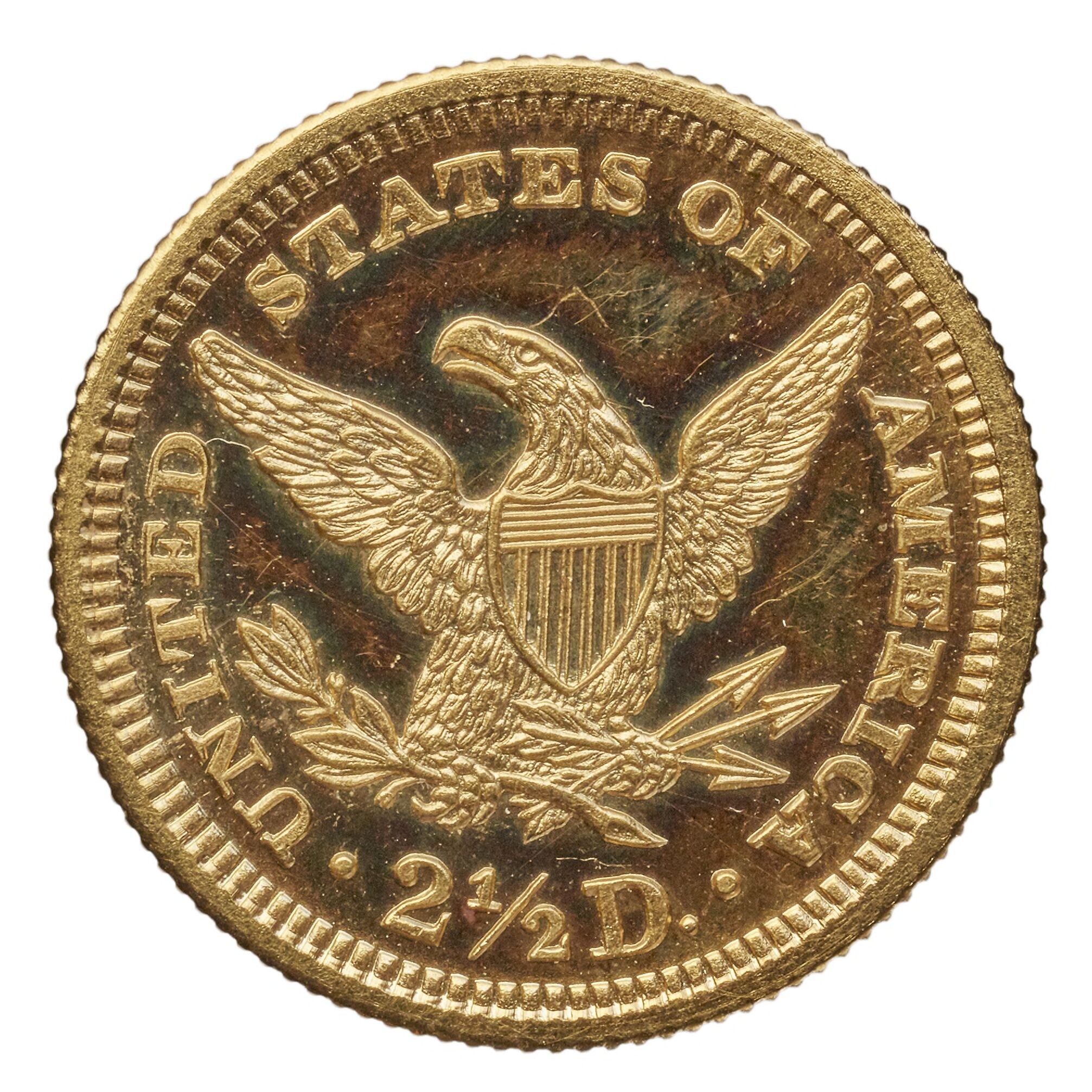
$2.50, the quarter eagle, dated 1902. Against a chambermaid at $20 a month this is four days. Against the 1900 national servant wage of $144 a year plus board, it is six days. It is the smallest gold coin anybody could be handed after 1889, and it is a gesture.
$2.50, the quarter eagle, dated 1902. Against a chambermaid at $20 a month this is four days. Against the 1900 national servant wage of $144 a year plus board, it is six days. It is the smallest gold coin anybody could be handed after 1889, and it is a gesture.Bibliothèque nationale de France, département Monnaies, médailles et antiques, by way of Wikimedia Commons. Public domain.
$5, the half eagle, 1902. A week of a chambermaid’s month. At the common-labor rate recorded in Pittsburgh steel in 1910 — 16½ cents an hour, 55 hours a week — it is a little over five days at the furnace.
$5, the half eagle, 1902. A week of a chambermaid’s month. At the common-labor rate recorded in Pittsburgh steel in 1910 — 16½ cents an hour, 55 hours a week — it is a little over five days at the furnace.Bibliothèque nationale de France, département Monnaies, médailles et antiques, by way of Wikimedia Commons. Public domain.
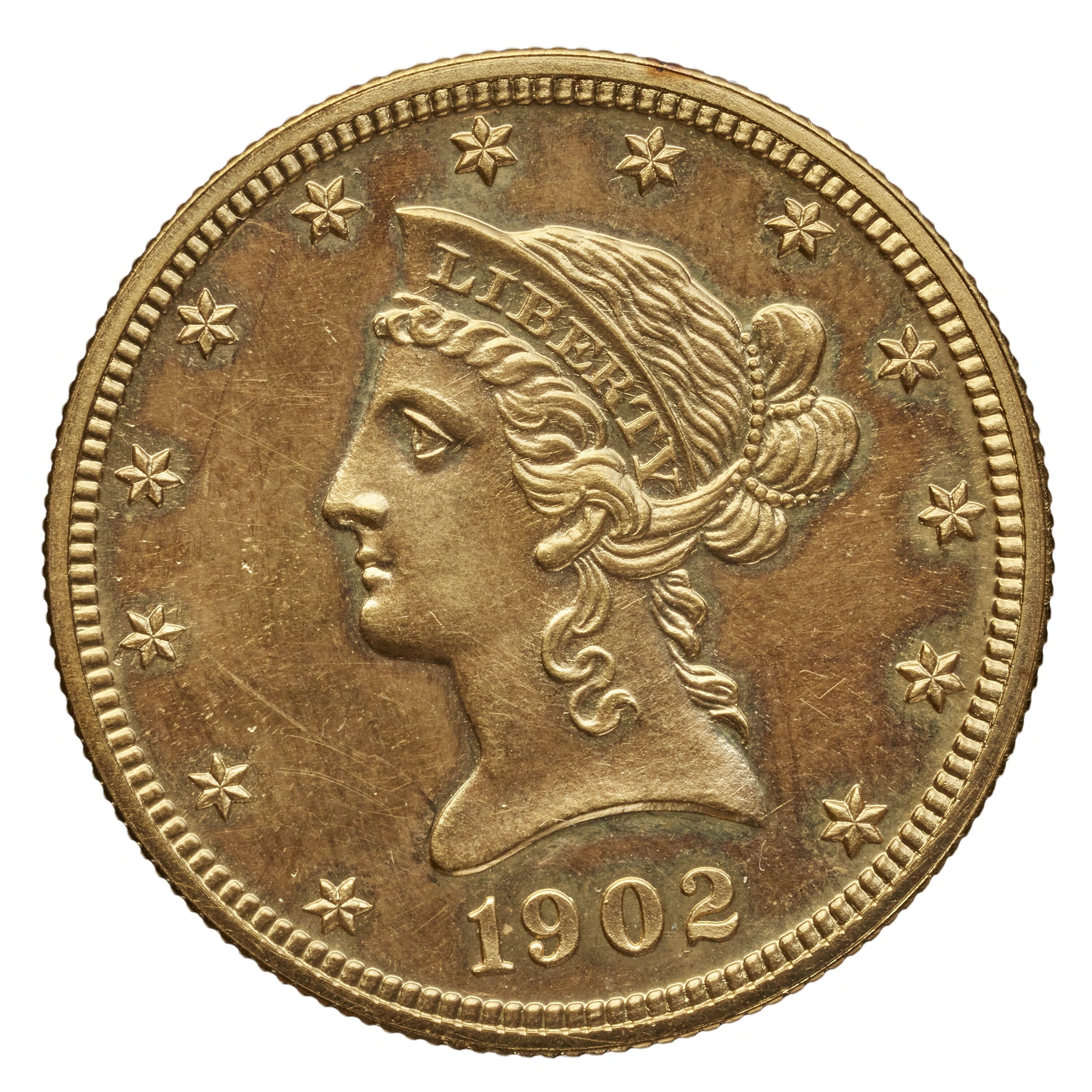
$10, the eagle, 1902. A fortnight. Also, at 1915 grocery prices, twenty-seven pounds of butter, or a hundred and forty loaves of bread.
$10, the eagle, 1902. A fortnight. Also, at 1915 grocery prices, twenty-seven pounds of butter, or a hundred and forty loaves of bread.Bibliothèque nationale de France, département Monnaies, médailles et antiques, by way of Wikimedia Commons. Public domain.
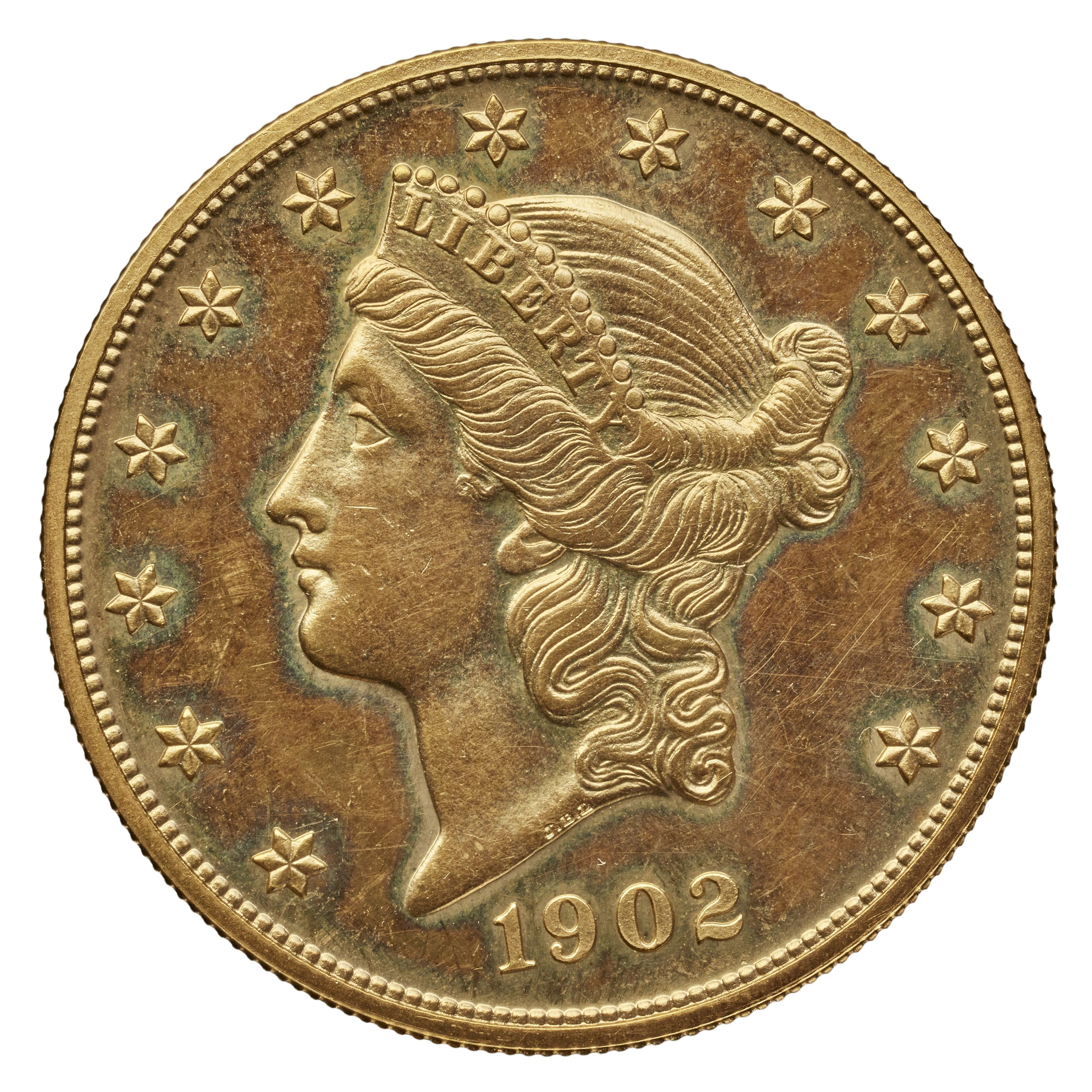
$20, the double eagle, 1902 — an ounce of gold, and very nearly a chambermaid’s month. At the 1900 servant rate it is seven weeks’ cash wage. A two-dollar-fifty tip is not the sort of thing anyone still repeats a century later. A month’s wages, handed to everybody, is.
$20, the double eagle, 1902 — an ounce of gold, and very nearly a chambermaid’s month. At the 1900 servant rate it is seven weeks’ cash wage. A two-dollar-fifty tip is not the sort of thing anyone still repeats a century later. A month’s wages, handed to everybody, is.Bibliothèque nationale de France, département Monnaies, médailles et antiques, by way of Wikimedia Commons. Public domain.

And the silver, for scale, because a gold coin means nothing without the change it broke into. These are 1915 prices, recorded by the Bureau of Labor Statistics: bread seven cents a pound loaf, butter thirty-six cents a pound, eggs thirty-four cents a dozen, coffee thirty cents a pound, potatoes fifteen cents for ten pounds.
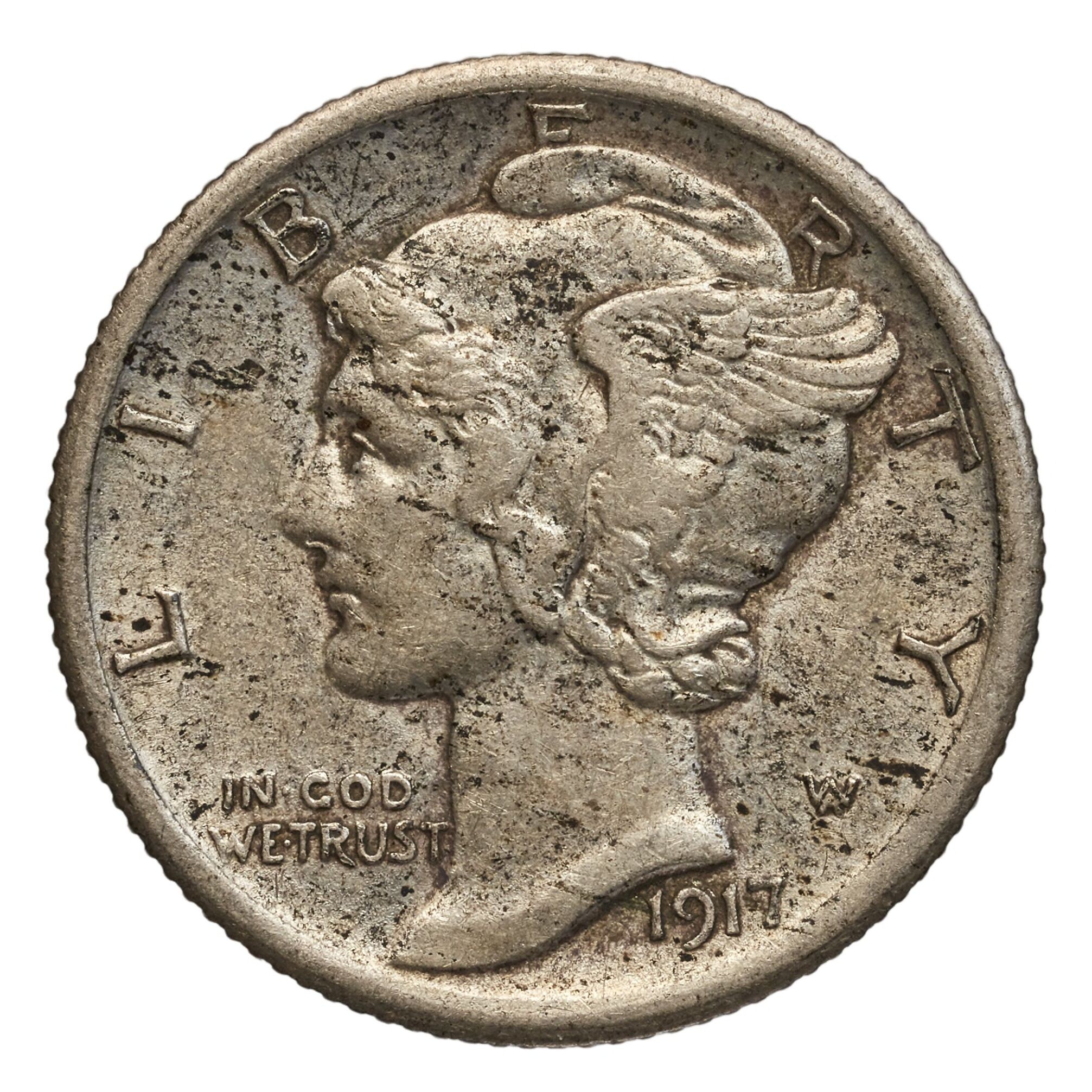
A dime. A loaf and a half of bread, or six pounds of potatoes. This is the 1916 design, a year after those prices; at 16½ cents an hour it is a little over half an hour’s work.
A dime. A loaf and a half of bread, or six pounds of potatoes. This is the 1916 design, a year after those prices; at 16½ cents an hour it is a little over half an hour’s work.Bibliothèque nationale de France, département Monnaies, médailles et antiques, by way of Wikimedia Commons. Public domain.
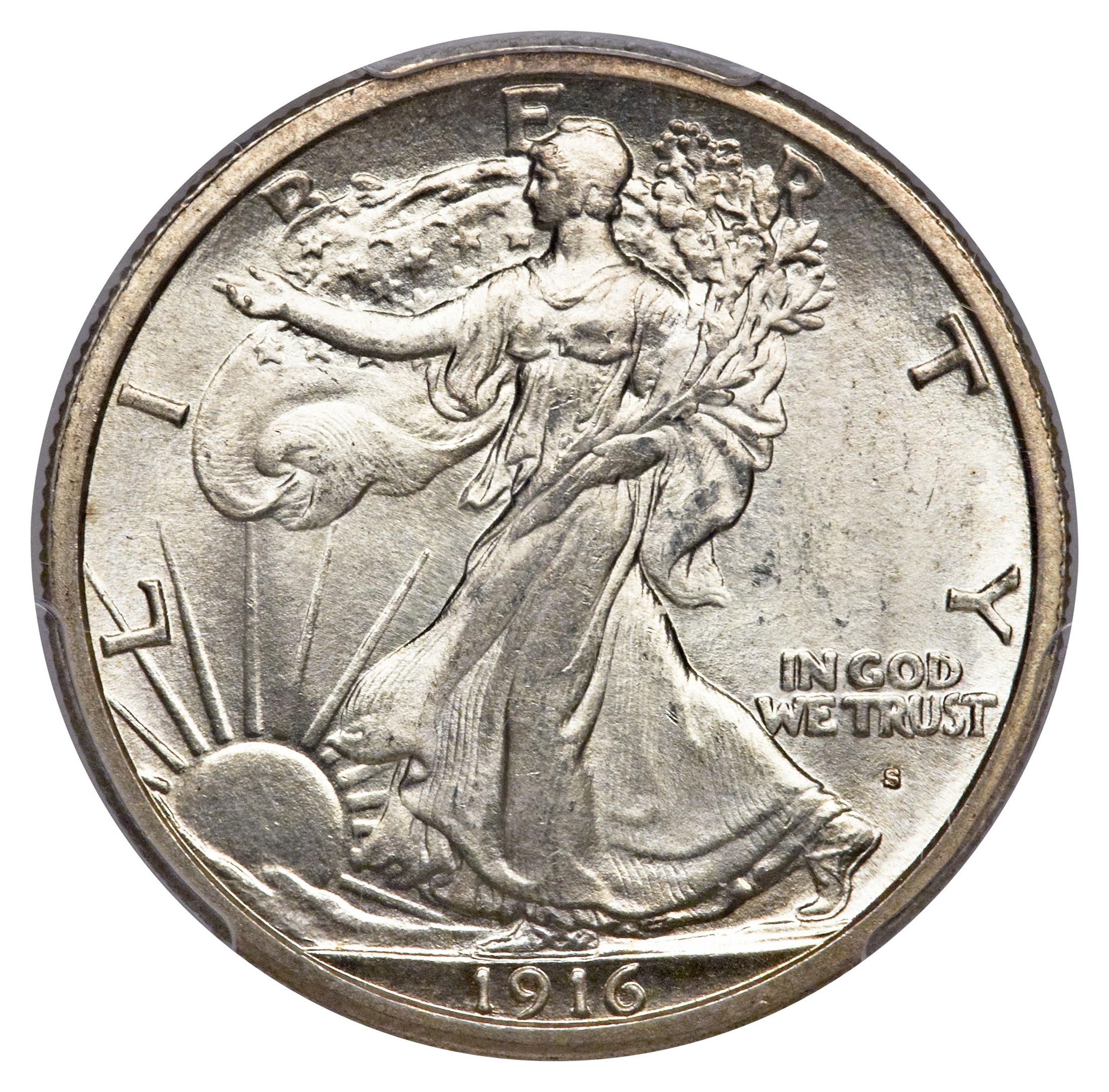
A half dollar, the 1916 Walking Liberty. A pound of butter and two pounds of bread, and fourteen cents left. Forty of these make the double eagle above.
A half dollar, the 1916 Walking Liberty. A pound of butter and two pounds of bread, and fourteen cents left. Forty of these make the double eagle above.Heritage Auctions, by way of Wikimedia Commons, where the photograph is published as public domain.

The whole plausibility of the rumor is in those four gold coins. A quarter eagle at the end of the season is a Christmas-box gesture, the sort of thing a large house did without anyone thinking about it. A double eagle to every employee is a different act entirely — and at the twenty-eight people the 1926 directory can name at Elm Court, it is five hundred and sixty dollars a season; at the sixty a house that size actually ran, twelve hundred. Not absurd for Elm Court. Not casual, either. It is precisely the kind of thing that becomes a story and stays one.

III. What was in the drawer in 1890

Whatever the coin was, its design was not chosen by anyone with an eye. The gold Emily Vanderbilt could have handed out in the 1890s was drawn in 1838, 1840 and 1849 and had been struck, essentially unaltered, ever since. Liberty in a coronet, a heraldic eagle on the back, competent and tired.
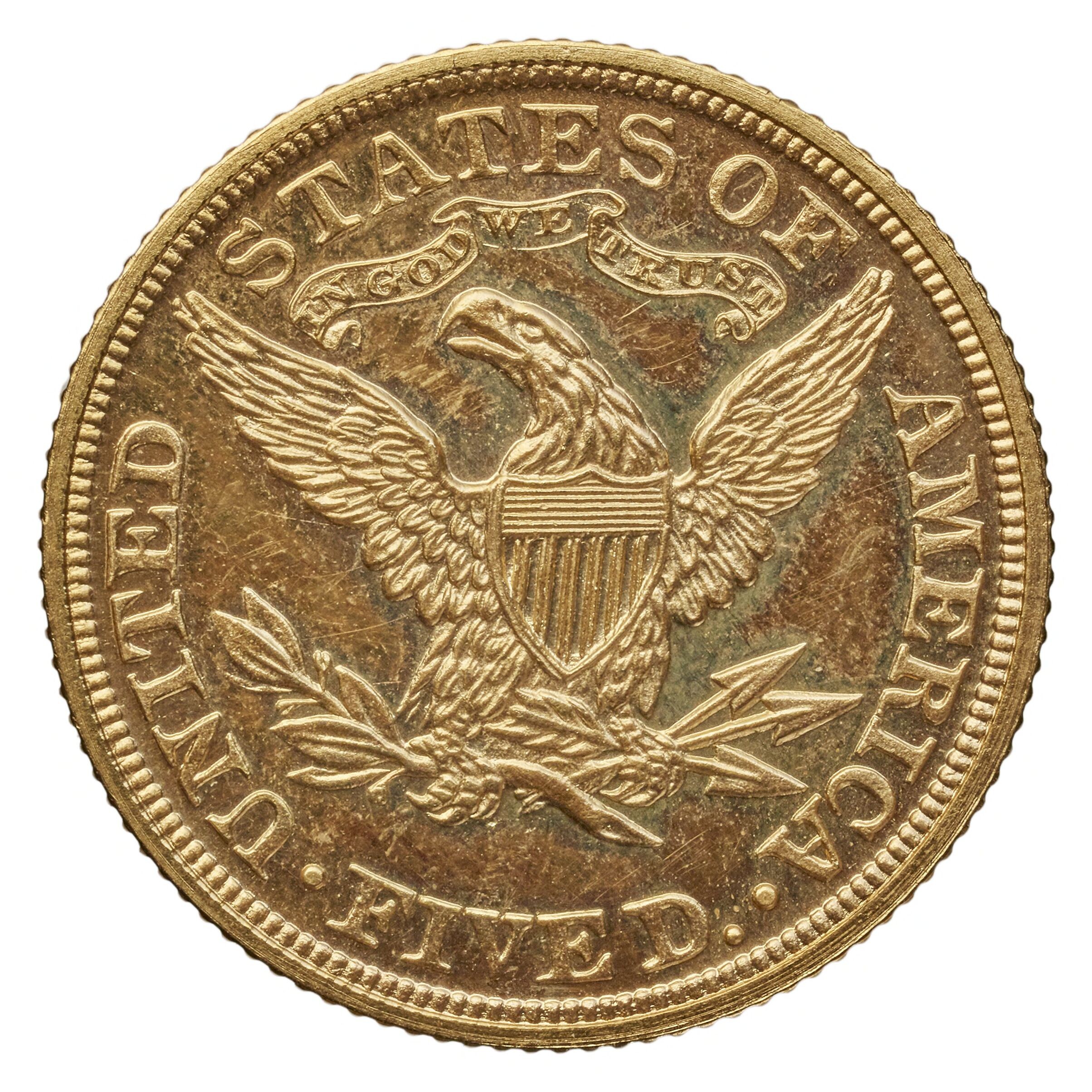
The reverse: a left-facing eagle, Union shield on the breast, olive branch in the right claw and three arrows in the left.
The reverse: a left-facing eagle, Union shield on the breast, olive branch in the right claw and three arrows in the left.Bibliothèque nationale de France, département Monnaies, médailles et antiques, by way of Wikimedia Commons. Public domain.
IN GOD WE TRUST was added above the eagle from 1866; the denomination went from “5 D.” to “FIVE D.”
IN GOD WE TRUST was added above the eagle from 1866; the denomination went from “5 D.” to “FIVE D.”Bibliothèque nationale de France, département Monnaies, médailles et antiques, by way of Wikimedia Commons. Public domain.
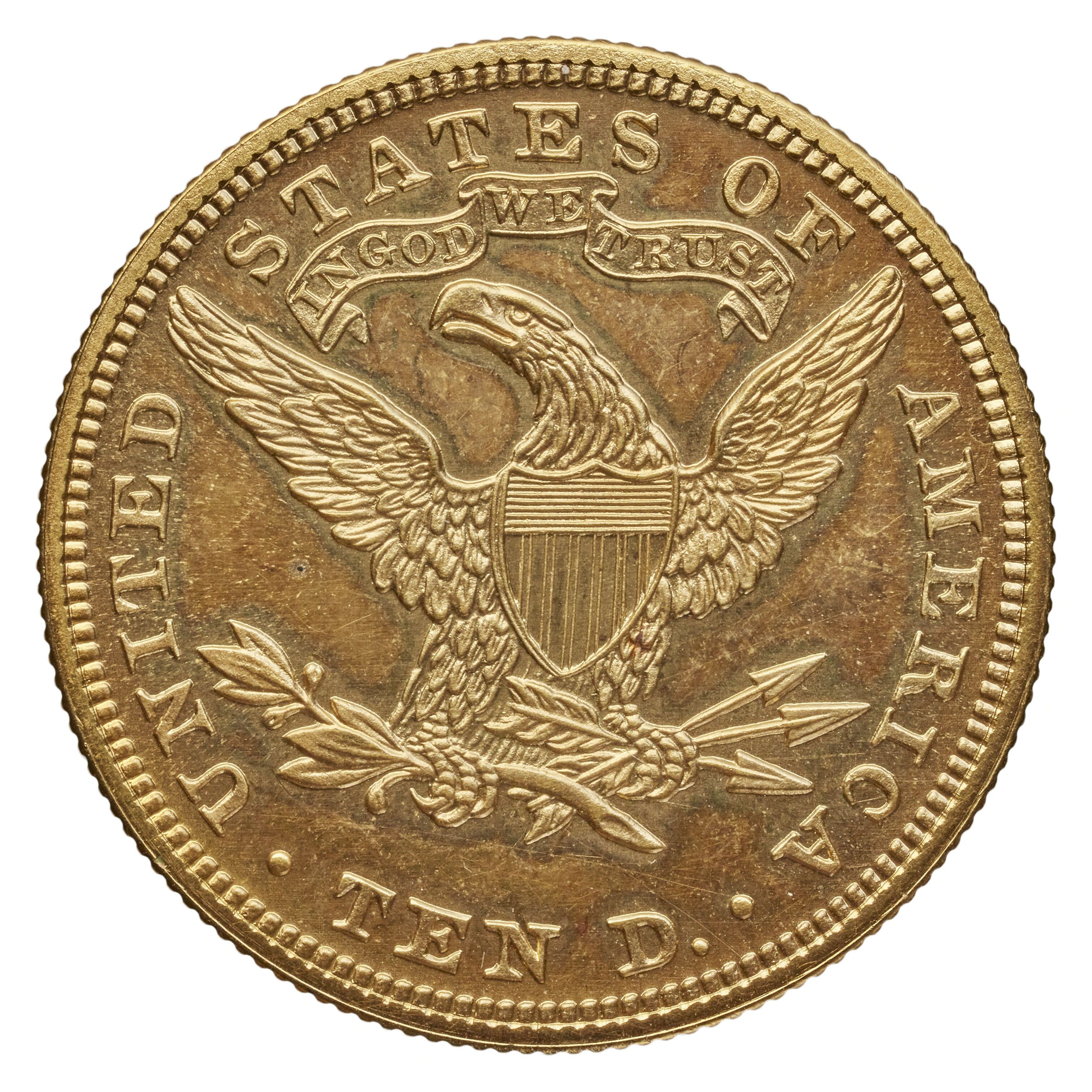
The reverse of the eagle, in the same arrangement the quarter and half eagle use.
The reverse of the eagle, in the same arrangement the quarter and half eagle use.Bibliothèque nationale de France, département Monnaies, médailles et antiques, by way of Wikimedia Commons. Public domain.
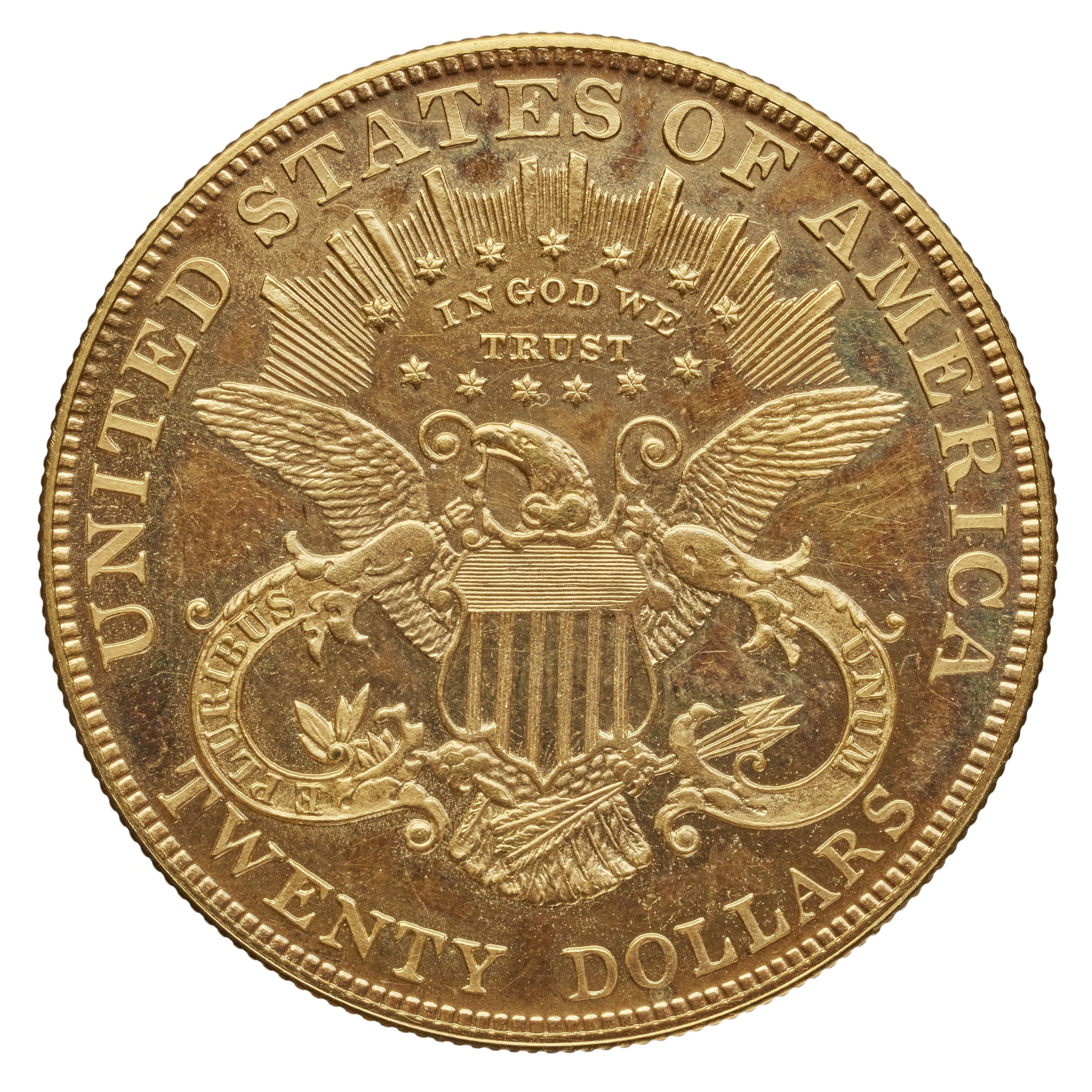
The reverse: heraldic eagle, a double ribbon reading E PLURIBUS UNUM, thirteen stars in a halo above and an arc of rays. From 1877 the denomination is spelled out, TWENTY DOLLARS.
The reverse: heraldic eagle, a double ribbon reading E PLURIBUS UNUM, thirteen stars in a halo above and an arc of rays. From 1877 the denomination is spelled out, TWENTY DOLLARS.Bibliothèque nationale de France, département Monnaies, médailles et antiques, by way of Wikimedia Commons. Public domain.
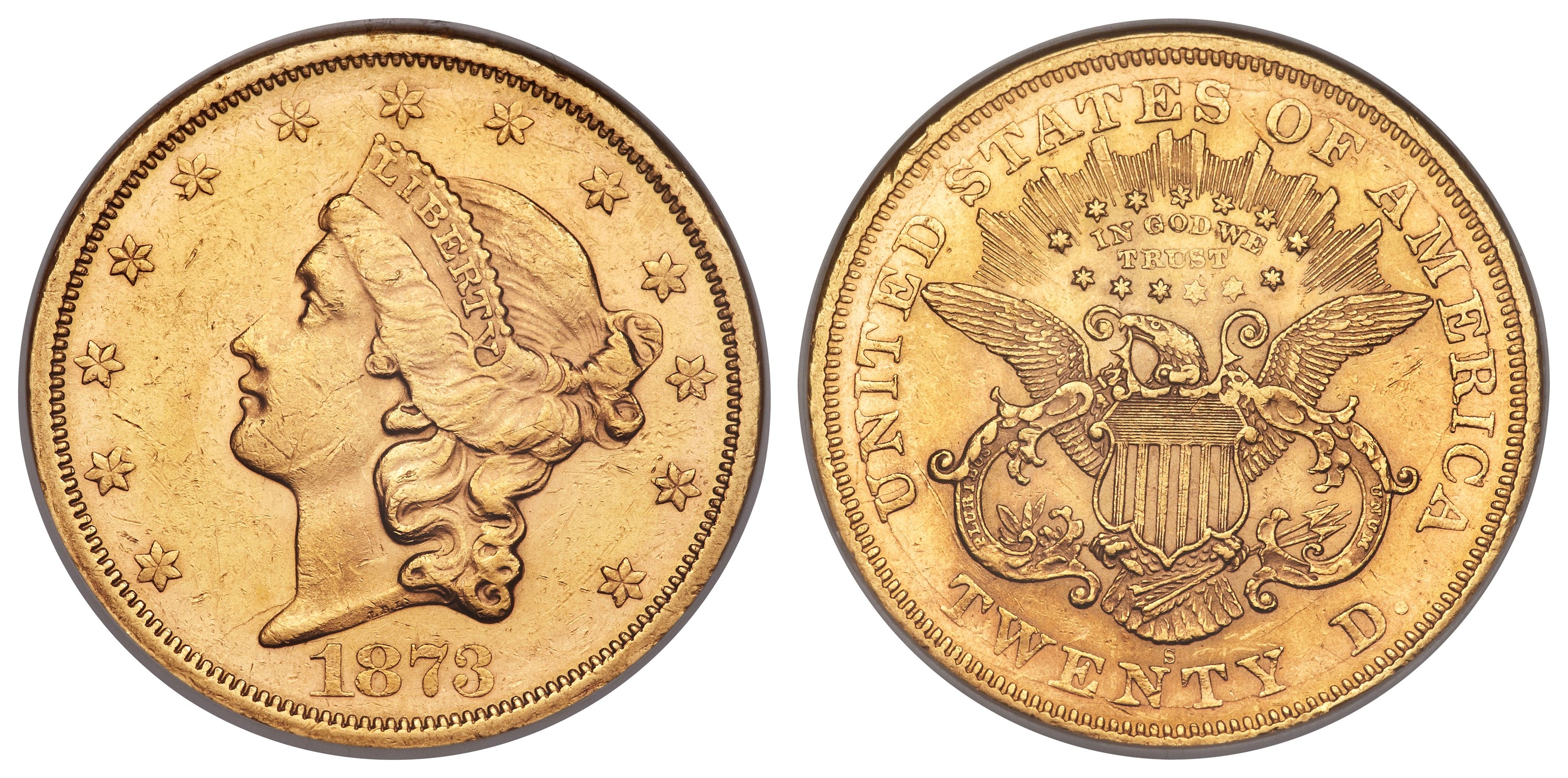
The earlier Type II double eagle of 1866–76, with the motto inside an enlarged circle of stars and the denomination still abbreviated “TWENTY D.”
The earlier Type II double eagle of 1866–76, with the motto inside an enlarged circle of stars and the denomination still abbreviated “TWENTY D.”Heritage Auctions, by way of Wikimedia Commons, where the photograph is published as public domain.

The silver was worse, and newer. In 1891 Mint Director Edward O. Leech ran a public competition for new designs, offering five hundred dollars. Saint-Gaudens and Daniel Chester French were invited and declined. Of some three hundred public entries the committee found almost nothing usable, and Leech wrote it off: “The one just ended was too wretched a failure.” In June 1891 he told his own Chief Engraver, Charles E. Barber, to do it himself. Benjamin Harrison approved the design on 6 November 1891 and the first coins were struck at Philadelphia on 2 January 1892.
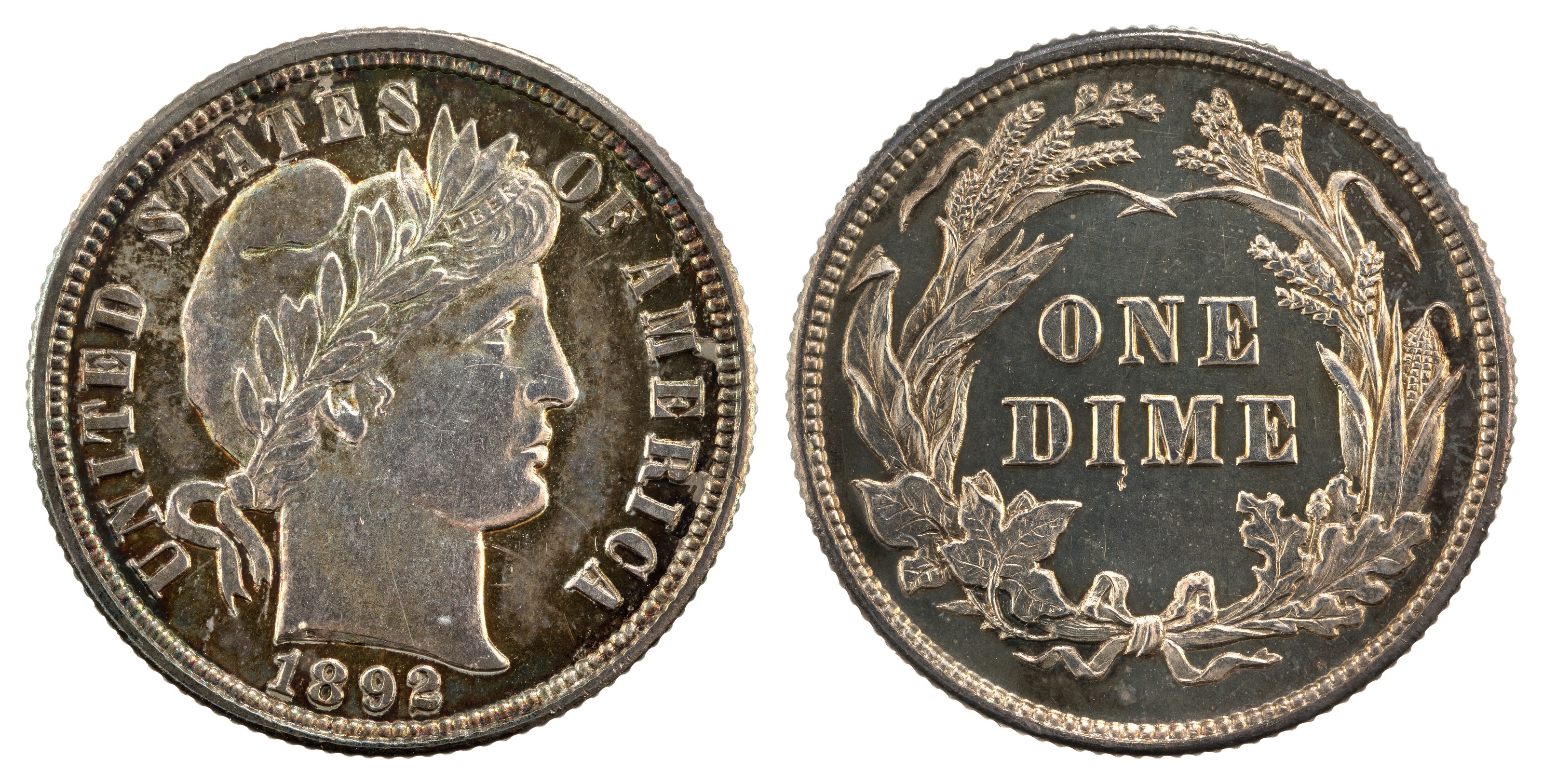
The result, and the reason the next twenty years happened: the Barber dime of 1892. Liberty in a pileus and a headband, facing right, in the flattest possible relief, with a wreath of corn, wheat, maple and oak on the back. It is not incompetent. It is a coin drawn by a man who had been told on short notice to produce something, by a Mint that had just failed to find anybody better, and it went into every pocket in the country for twenty-four years.
The result, and the reason the next twenty years happened: the Barber dime of 1892. Liberty in a pileus and a headband, facing right, in the flattest possible relief, with a wreath of corn, wheat, maple and oak on the back. It is not incompetent. It is a coin drawn by a man who had been told on short notice to produce something, by a Mint that had just failed to find anybody better, and it went into every pocket in the country for twenty-four years.National Numismatic Collection, Smithsonian National Museum of American History; photograph by Jaclyn Nash. Public domain.

IV. “Artistically of atrocious hideousness”

On 27 December 1904 Theodore Roosevelt wrote to his Treasury Secretary, Leslie Mortier Shaw: “I think the state of our coinage is artistically of atrocious hideousness,” and asked whether Augustus Saint-Gaudens might be employed on it. Saint-Gaudens had made Roosevelt’s inaugural medal that year, which is how the two came to be talking about metal at all.

In January 1906 Roosevelt put the model in front of him: strike the coins in high relief, with a high rim to protect them, the way the ancient Greeks had. Saint-Gaudens proposed “a (possibly winged) figure of Liberty, striding forward as if on a mountaintop, holding aloft on one arm a shield bearing the stars and stripes… in the other hand perhaps a flaming torch.”

Barber’s answer, on 26 November 1906, was that the relief would “never coin.” He was right about the machinery and wrong about the ambition, and the argument between those two positions is the whole story of American coinage for the next ten years.
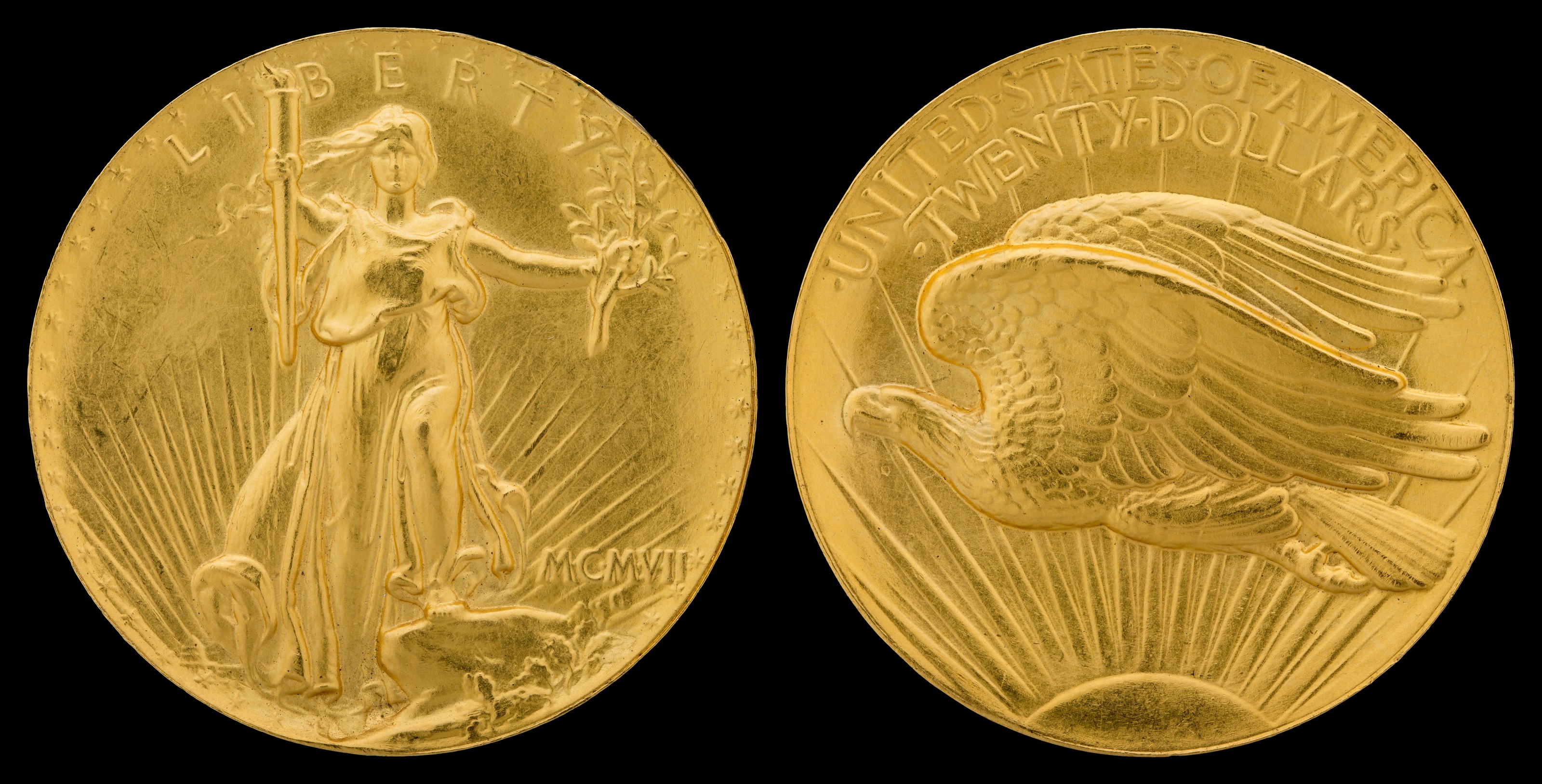
The ultra high relief pattern of 1907. About twenty-four were made. Each one needed up to nine blows of the press.
The ultra high relief pattern of 1907. About twenty-four were made. Each one needed up to nine blows of the press.National Numismatic Collection, Smithsonian National Museum of American History; photograph by Jaclyn Nash. Public domain.
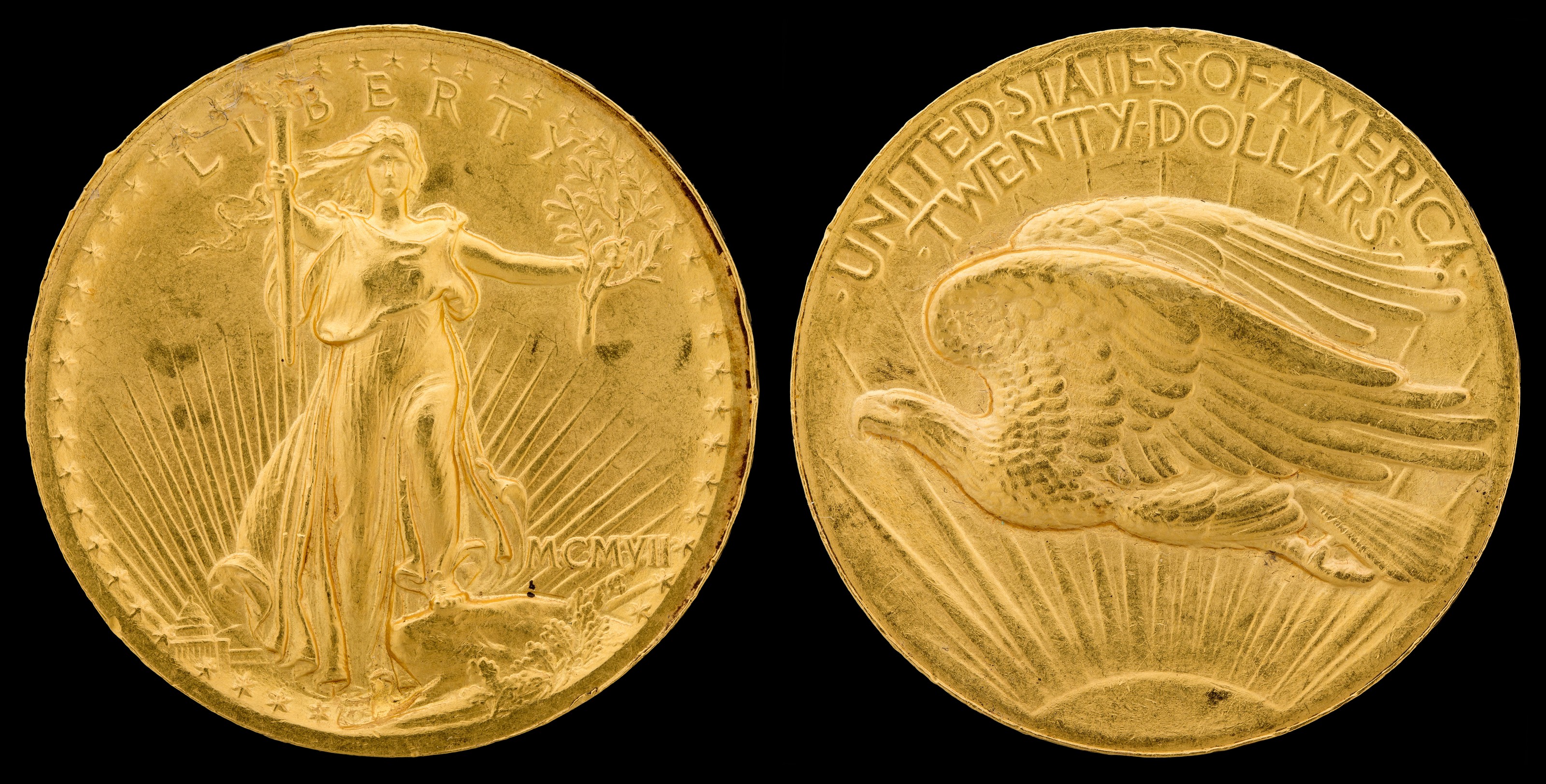
The high relief coin as issued, dated MCMVII in Roman numerals: over twelve thousand struck across 1907 and 1908, three blows each.
The high relief coin as issued, dated MCMVII in Roman numerals: over twelve thousand struck across 1907 and 1908, three blows each.National Numismatic Collection, Smithsonian National Museum of American History; photograph by Jaclyn Nash. Public domain.
The low relief production coin, Arabic numerals, released at the end of December 1907: 361,667 pieces, and one blow of the press. This is the coin that actually circulated.
The low relief production coin, Arabic numerals, released at the end of December 1907: 361,667 pieces, and one blow of the press. This is the coin that actually circulated.National Numismatic Collection, Smithsonian National Museum of American History; photograph by Jaclyn Nash. Public domain.
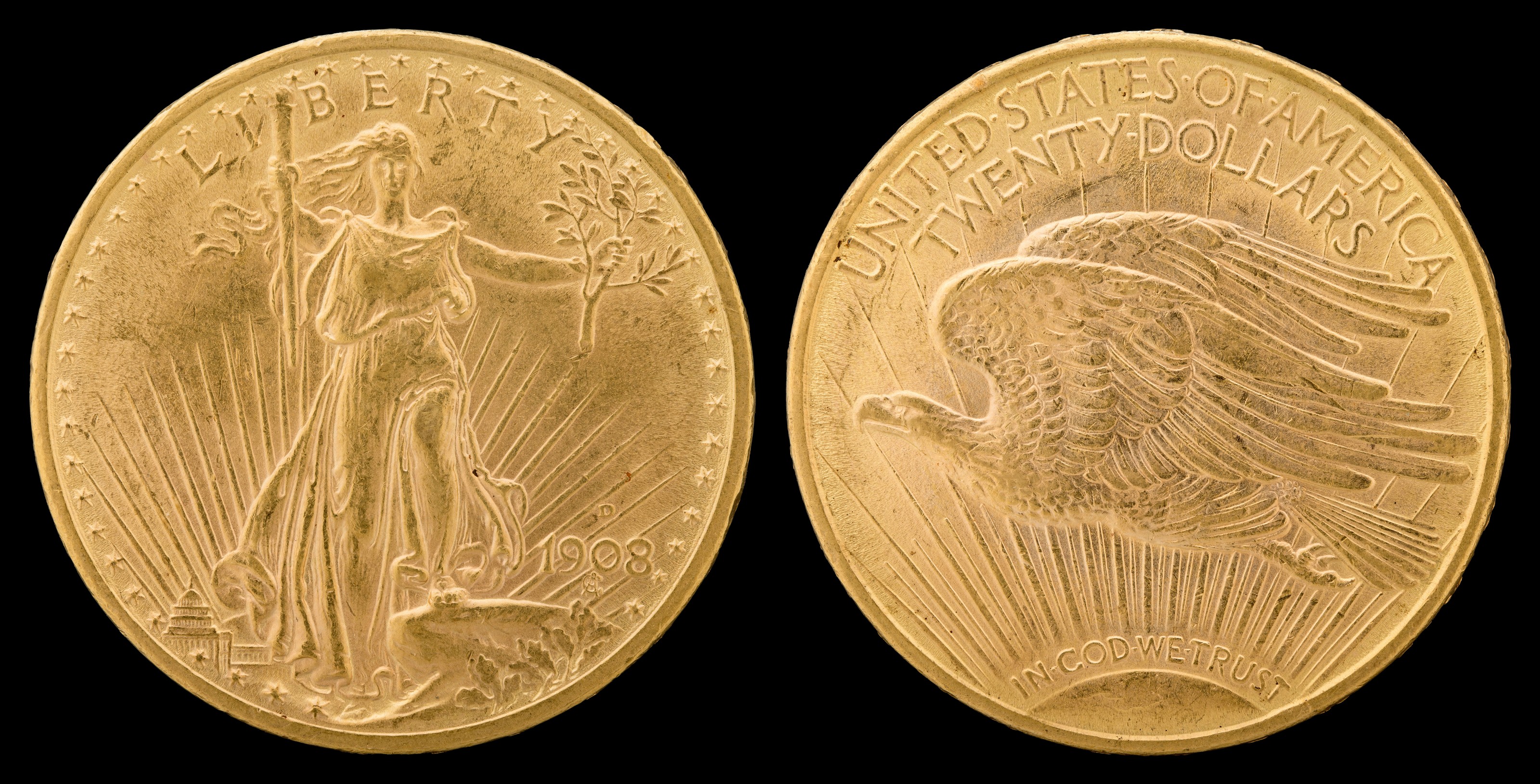
1908, with IN GOD WE TRUST restored. Saint-Gaudens and Roosevelt had left the motto off; Congress put it back by the Act of 18 May 1908, and Barber added it.
1908, with IN GOD WE TRUST restored. Saint-Gaudens and Roosevelt had left the motto off; Congress put it back by the Act of 18 May 1908, and Barber added it.National Numismatic Collection, Smithsonian National Museum of American History; photograph by Jaclyn Nash. Public domain.
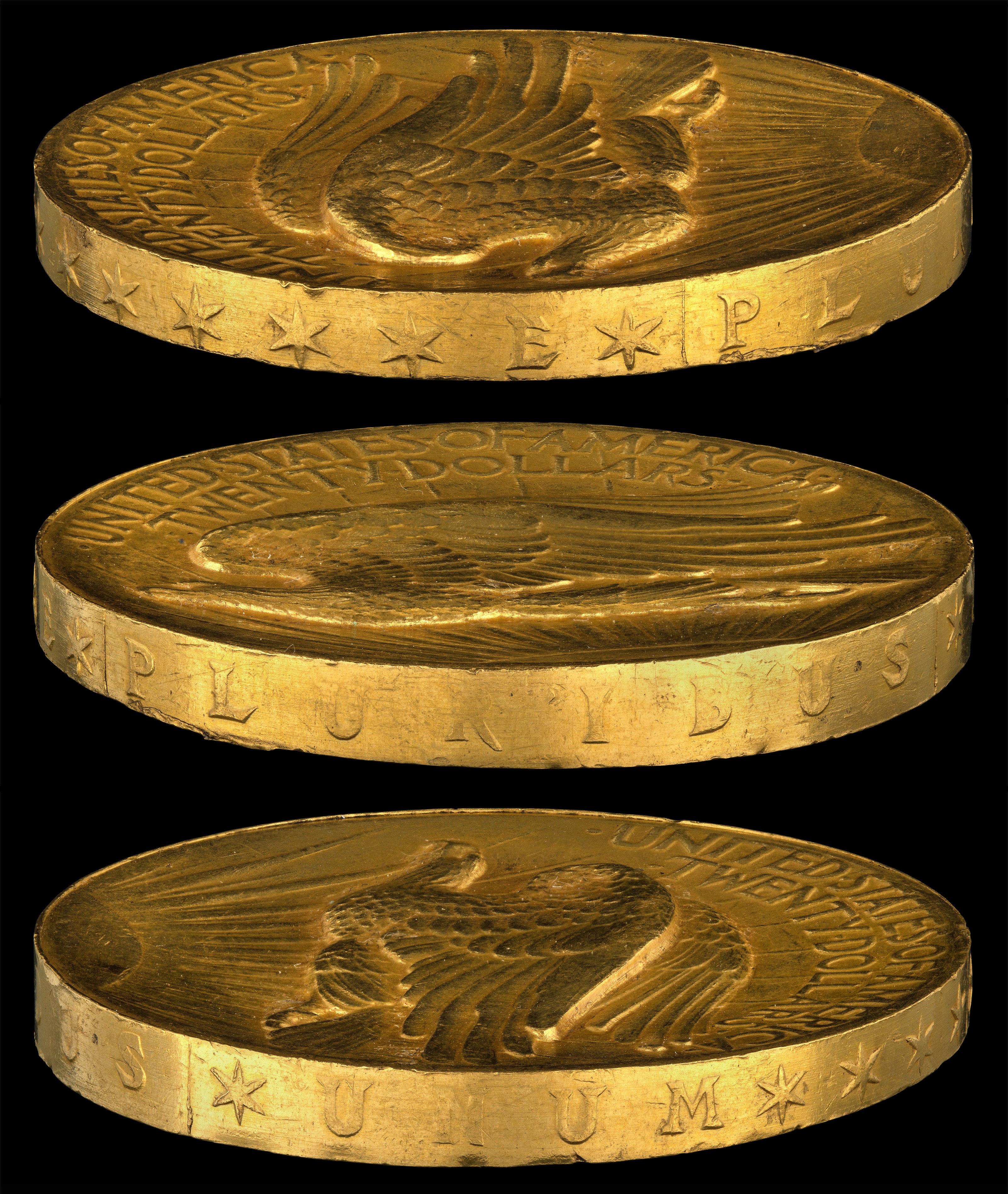
The edge of the high relief piece, photographed three times round: E PLURIBUS UNUM, lettered into the rim because there was no room left for it on either face.
The edge of the high relief piece, photographed three times round: E PLURIBUS UNUM, lettered into the rim because there was no room left for it on either face.National Numismatic Collection, Smithsonian National Museum of American History; photograph by Jaclyn Nash. Public domain.

Saint-Gaudens did not see the coins issued. He was dying of cancer while the dies were being fought over, and died in August 1907.

A word about that eagle, because once it is noticed it cannot be unnoticed. The arrows and the olive branch come straight off the Great Seal, where the bird holds them — thirteen arrows gripped in one talon, the branch in the other, aloft and heraldic. Saint-Gaudens put his eagle standing on them. The arrows have become a bundle of sticks and the bird is on top of the pile, feet planted, wings folded, for all the world like something that has come down to scratch about in the yard. An eagle takes its prey from the air and carries it back up. This one looks like it is about to build a fire.
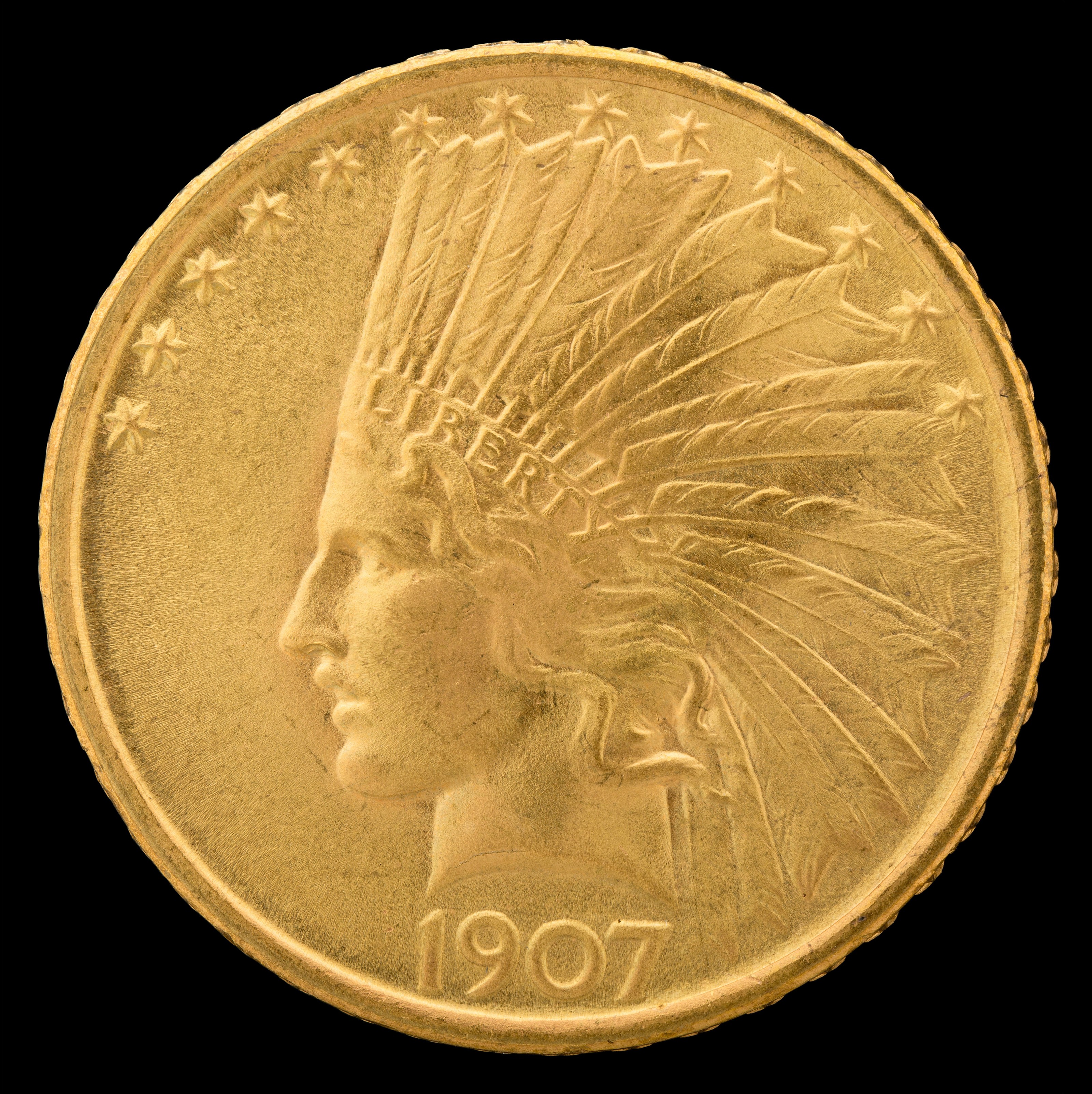
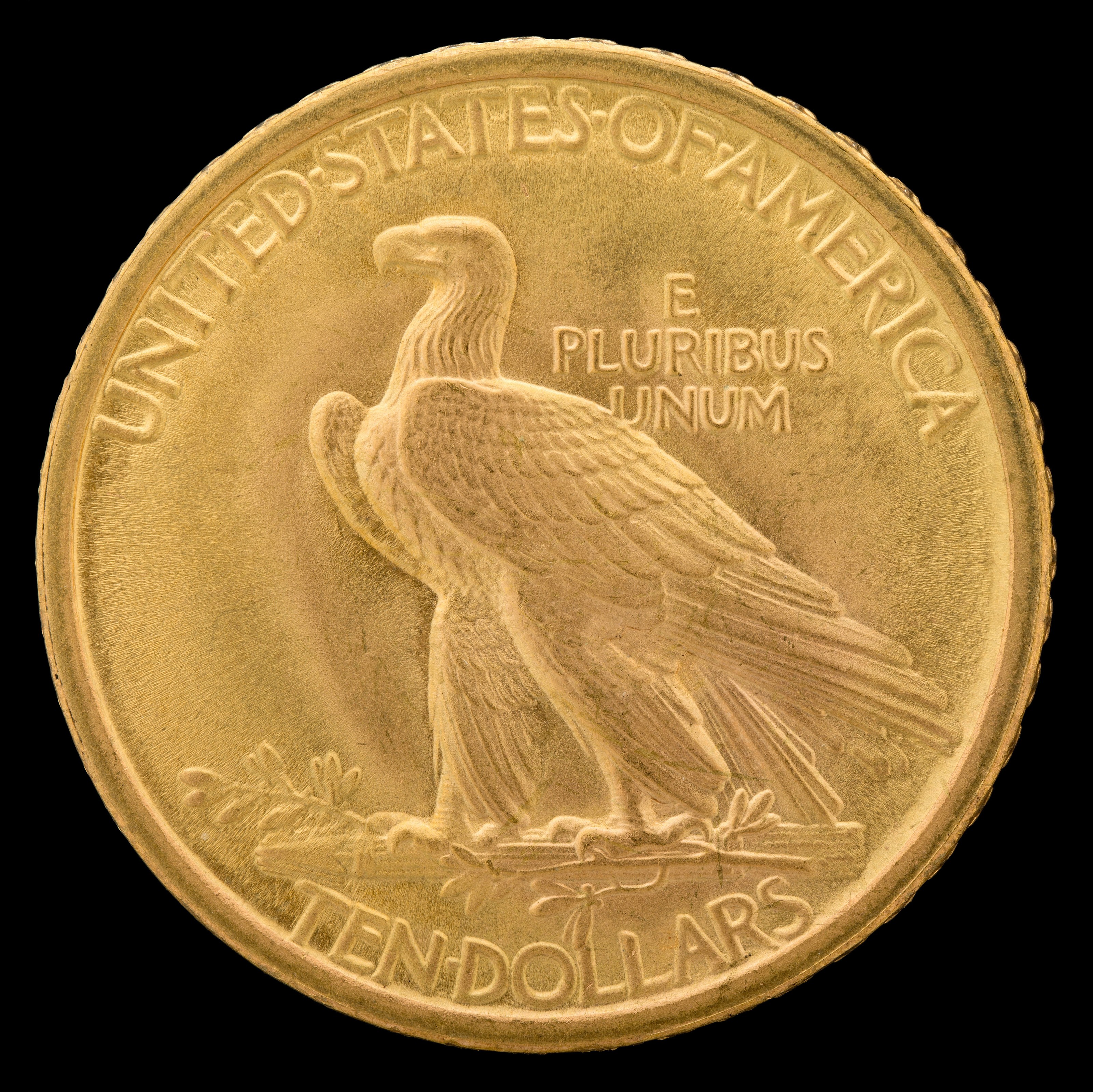
The Indian Head eagle, $10, 1907. Roosevelt asked for the feather war bonnet; Saint-Gaudens put it on a classical Liberty, which is a stranger object than it first looks.
The Indian Head eagle, $10, 1907. Roosevelt asked for the feather war bonnet; Saint-Gaudens put it on a classical Liberty, which is a stranger object than it first looks.National Numismatic Collection, Smithsonian National Museum of American History; photograph by Jaclyn Nash. Public domain.
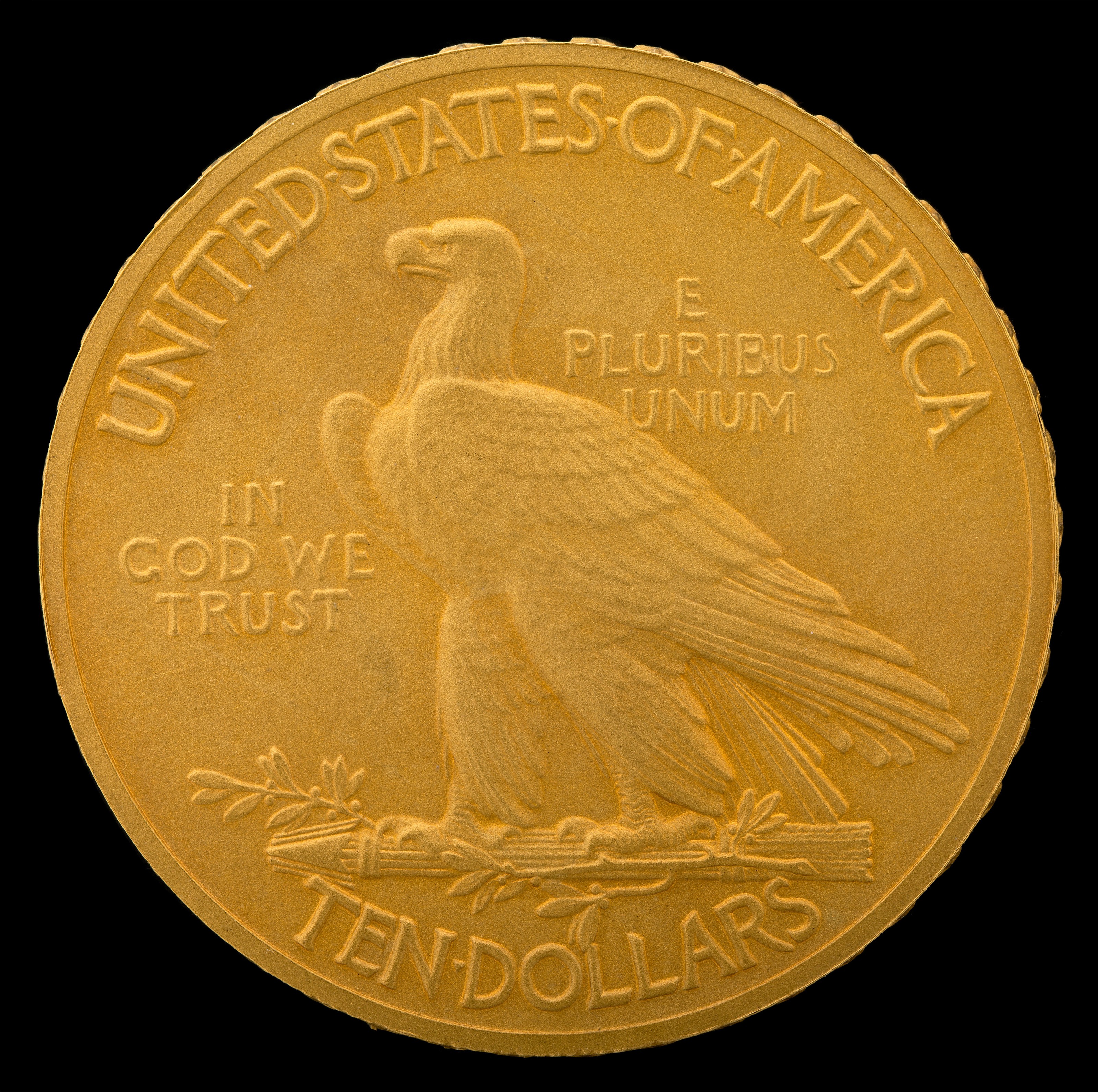
The reverse: an eagle standing on a sheaf of arrows with an olive branch, a design worked up first for the double eagle and moved across. Anyone have a match?
The reverse: an eagle standing on a sheaf of arrows with an olive branch, a design worked up first for the double eagle and moved across. Anyone have a match?National Numismatic Collection, Smithsonian National Museum of American History; photograph by Jaclyn Nash. Public domain.
The same reverse in 1908 with IN GOD WE TRUST added at the left. Forty-six edge stars until 1911, forty-eight from 1912, after New Mexico and Arizona.
The same reverse in 1908 with IN GOD WE TRUST added at the left. Forty-six edge stars until 1911, forty-eight from 1912, after New Mexico and Arizona.National Numismatic Collection, Smithsonian National Museum of American History; photograph by Jaclyn Nash. Public domain.

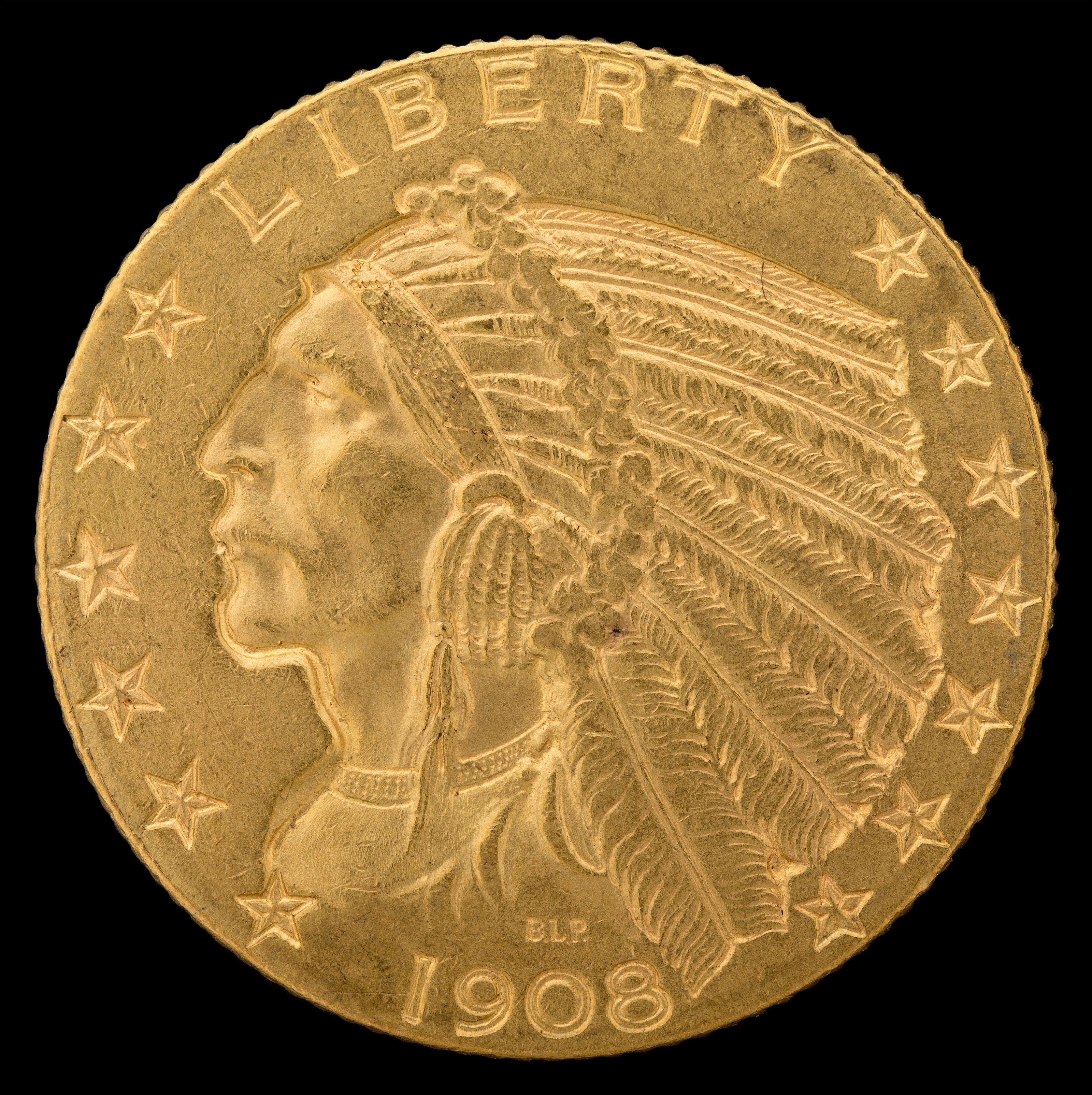
The other half of Barber’s objection — that sculpture does not stack in a bank drawer — got answered by a different route. In early 1908 William Sturgis Bigelow, a Boston physician back from Japan, put to Roosevelt the idea of sinking the design into the coin. Roosevelt approved it over lunch with Bigelow and the Mint Director on 3 April 1908, and Bela Lyon Pratt executed it: the lines and letters incused instead of raised, so the field is the highest surface and the design cannot wear.
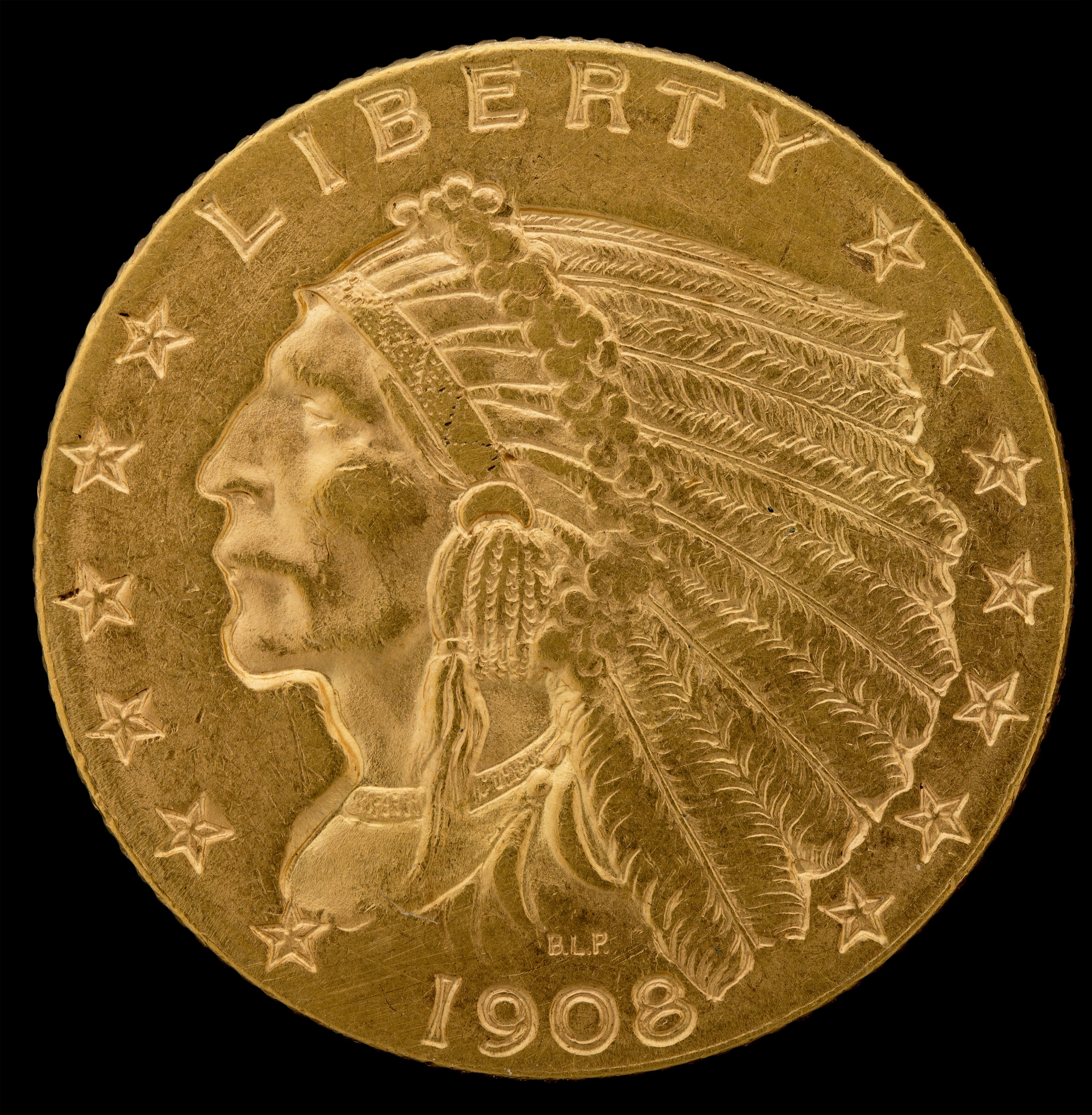
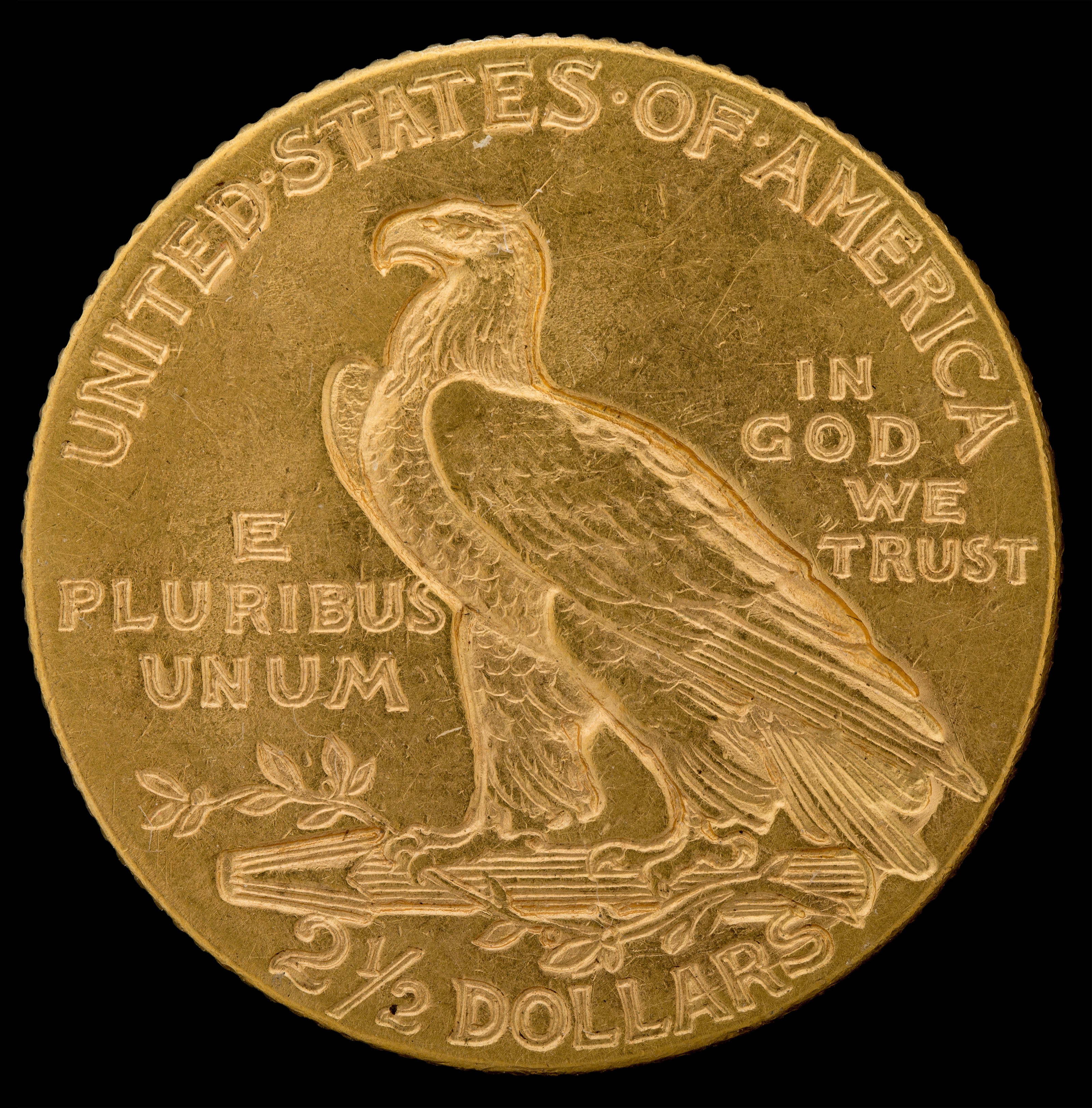
Pratt’s incuse quarter eagle, 1908. The head is sunk below the field rather than standing above it — the only United States coins ever made this way.
Pratt’s incuse quarter eagle, 1908. The head is sunk below the field rather than standing above it — the only United States coins ever made this way.National Numismatic Collection, Smithsonian National Museum of American History; photograph by Jaclyn Nash. Public domain.
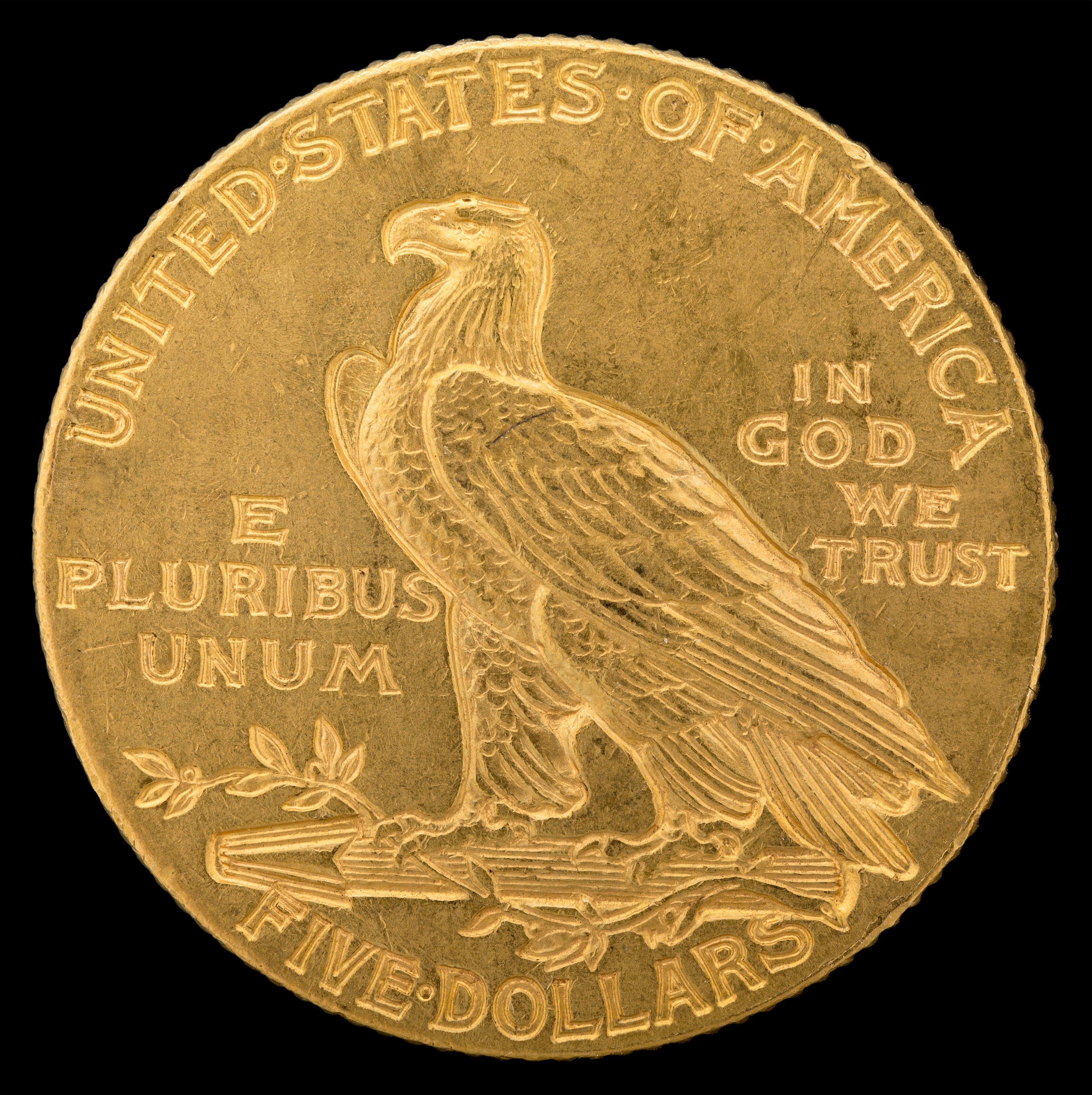
The incuse reverse: a standing eagle on a bunch of arrows, an olive branch in the left talon.
The incuse reverse: a standing eagle on a bunch of arrows, an olive branch in the left talon.National Numismatic Collection, Smithsonian National Museum of American History; photograph by Jaclyn Nash. Public domain.
The half eagle in the same treatment, struck 1908–16 and again in 1929.
The half eagle in the same treatment, struck 1908–16 and again in 1929.National Numismatic Collection, Smithsonian National Museum of American History; photograph by Jaclyn Nash. Public domain.
Barber altered the designs during die preparation. Pratt wrote that he had “changed it from a thing that I was proud of to one [of which] I am ashamed.”
Barber altered the designs during die preparation. Pratt wrote that he had “changed it from a thing that I was proud of to one [of which] I am ashamed.”National Numismatic Collection, Smithsonian National Museum of American History; photograph by Jaclyn Nash. Public domain.

V. The law that set the clock

The same Act of 26 September 1890 that killed the gold dollar is the reason the rest of this happened when it happened. It let the Mint adopt new designs with the Treasury Secretary’s approval — but “no change in the design or die of any coin shall be made oftener than once in twenty-five years from and including the year of the first adoption.”

That single clause governs everything. Roosevelt could reach the gold in 1907 because those designs dated from 1838 to 1849. He could not touch the silver, because Barber’s dime, quarter and half were adopted in 1892 and locked until 1916 — and in 1916, the twenty-fifth year, the Commission of Fine Arts replaced all three at once. Adolph Weinman took the dime and the half dollar; Hermon Atkins MacNeil took the quarter.

VI. The migrations

What follows is each denomination in sequence, obverse and reverse, from what was in circulation when these houses were built to what replaced it. The period of this site is 1890 to 1933; where a design that is still current begins inside or just after that window, it closes the row.

The cent
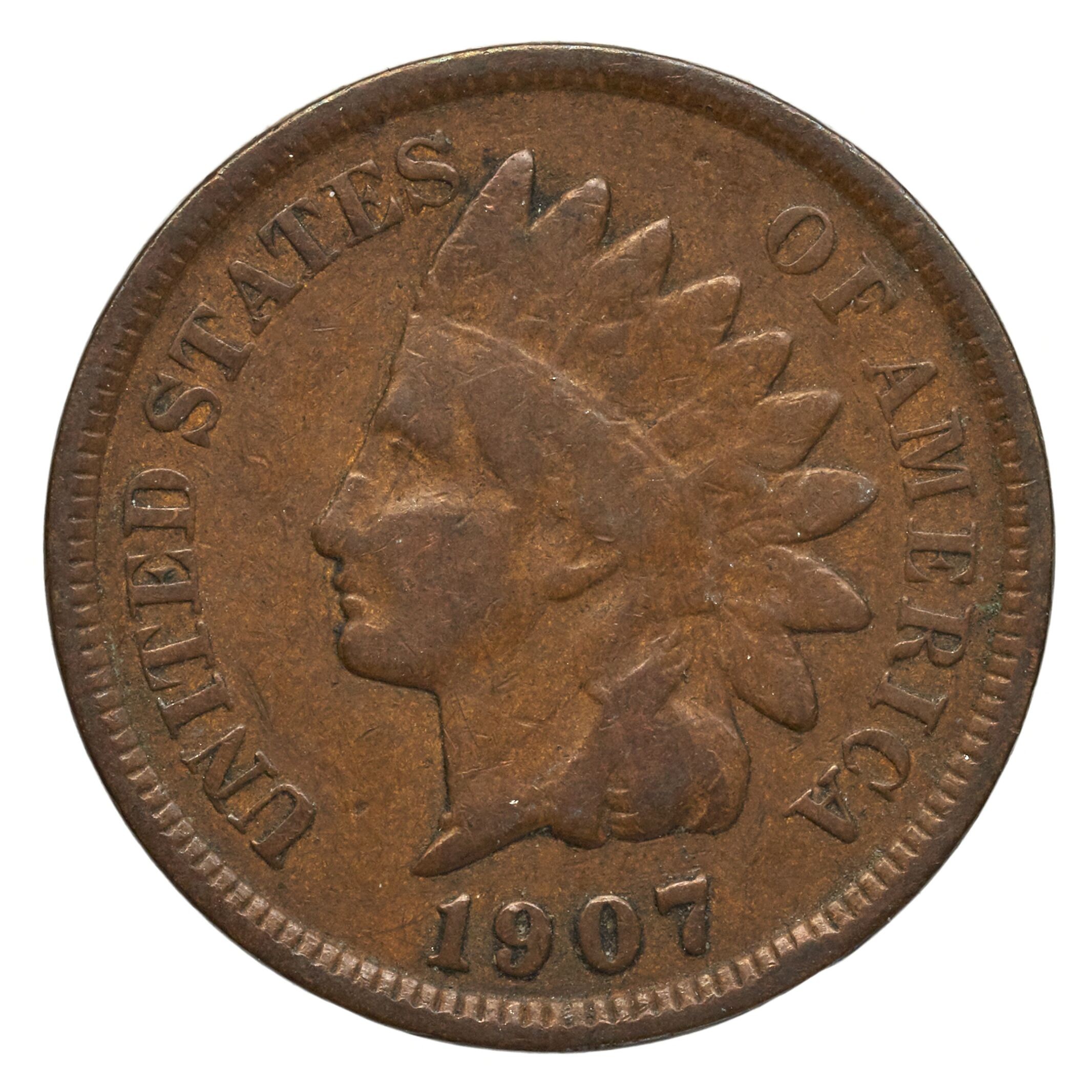
Indian Head cent, 1859–1909. Liberty in an eagle-feathered headdress, by James B. Longacre.
Indian Head cent, 1859–1909. Liberty in an eagle-feathered headdress, by James B. Longacre.Bibliothèque nationale de France, département Monnaies, médailles et antiques, by way of Wikimedia Commons. Public domain.
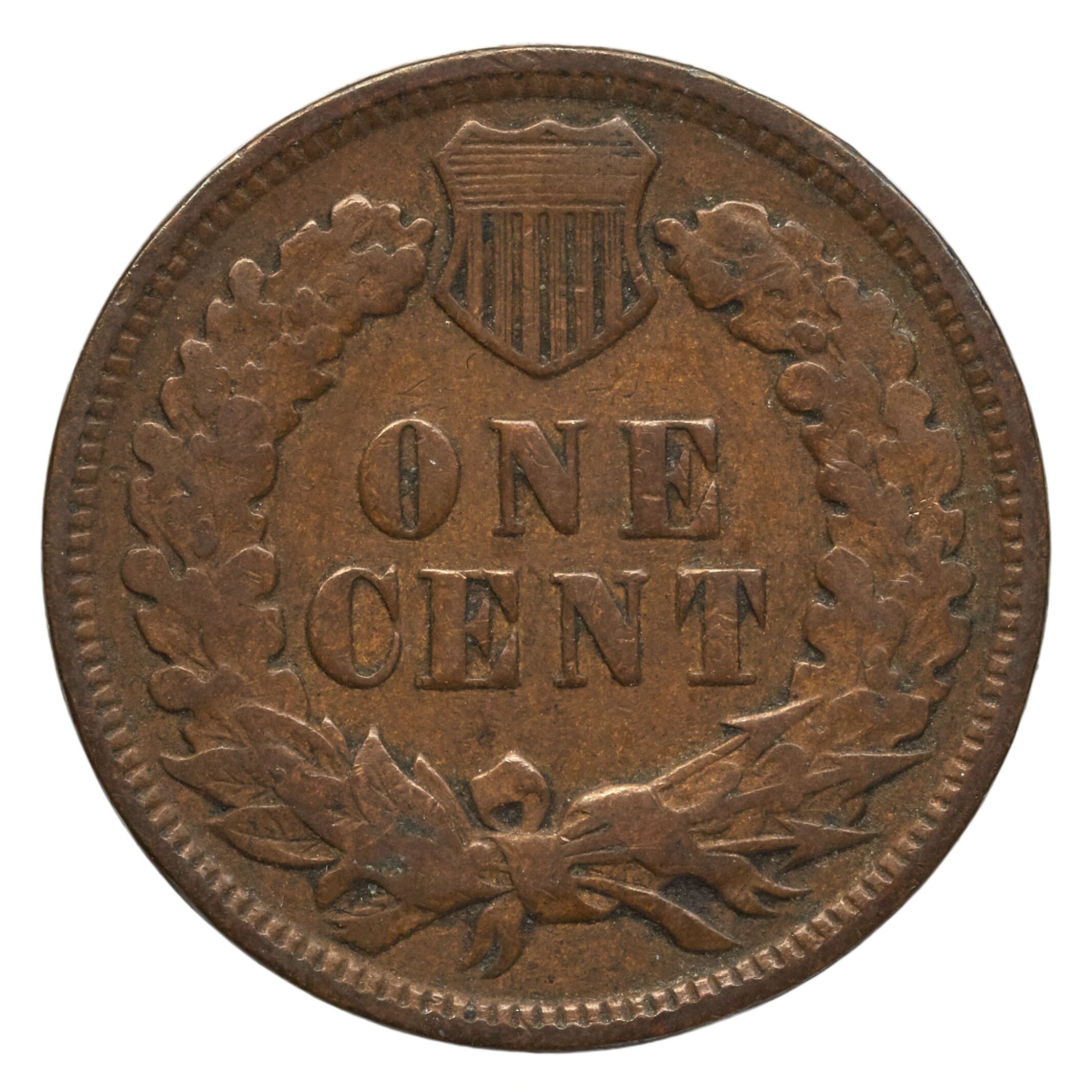
The oak wreath and shield reverse, used from 1860.
The oak wreath and shield reverse, used from 1860.Bibliothèque nationale de France, département Monnaies, médailles et antiques, by way of Wikimedia Commons. Public domain.
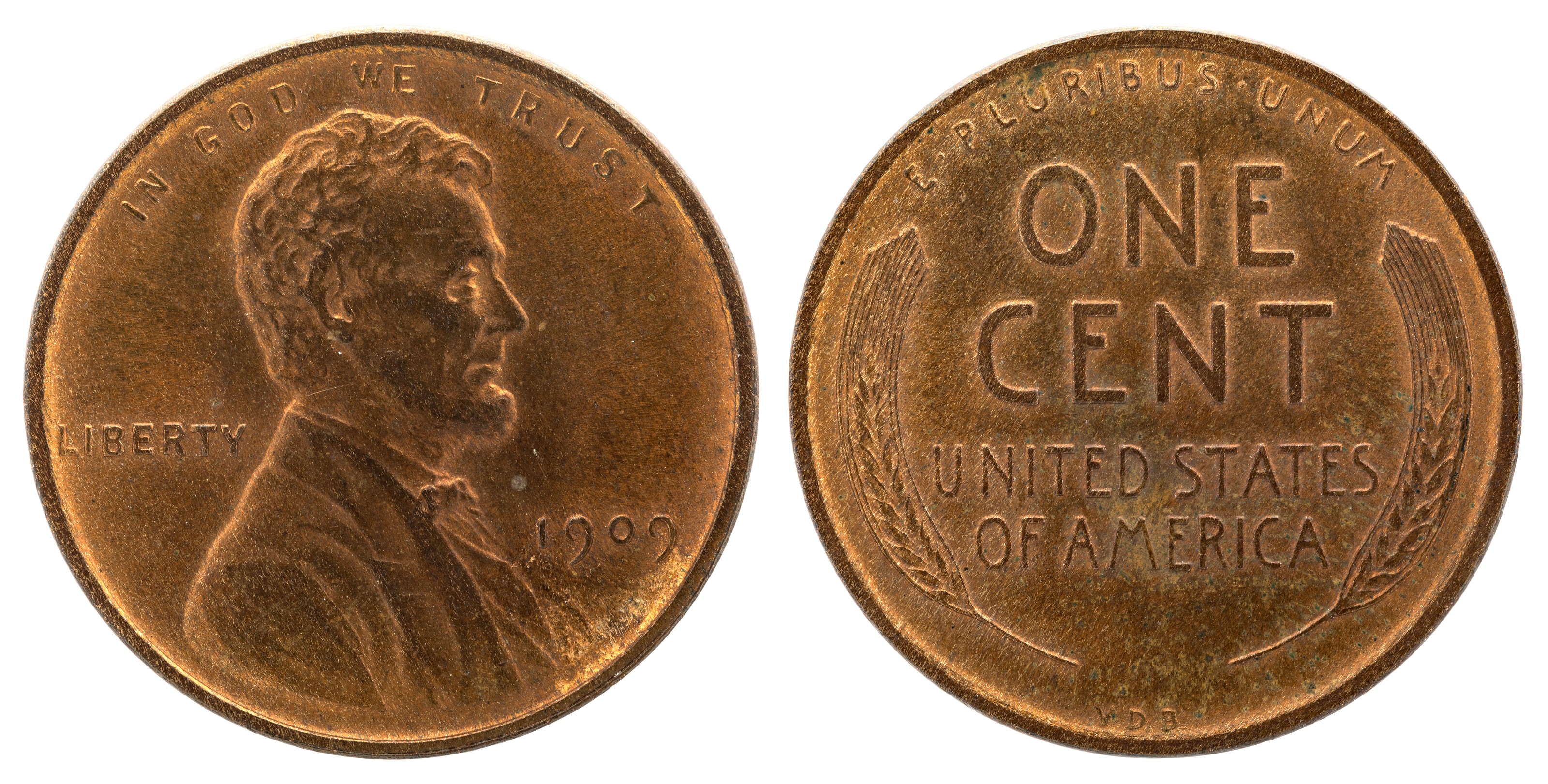
The Lincoln cent, 1909 — Victor D. Brenner’s obverse, the first widely circulating United States coin to carry a president, with the wheat-ears reverse used until 1958. Brenner’s initials on the reverse caused enough noise that the Treasury suspended production on 5 August 1909; coins without them were being struck by the twelfth. The initials came back, small, on the shoulder, in 1918. This obverse is still in your pocket.
The Lincoln cent, 1909 — Victor D. Brenner’s obverse, the first widely circulating United States coin to carry a president, with the wheat-ears reverse used until 1958. Brenner’s initials on the reverse caused enough noise that the Treasury suspended production on 5 August 1909; coins without them were being struck by the twelfth. The initials came back, small, on the shoulder, in 1918. This obverse is still in your pocket.National Numismatic Collection, Smithsonian National Museum of American History; photograph by Jaclyn Nash. Public domain.

The five-cent piece

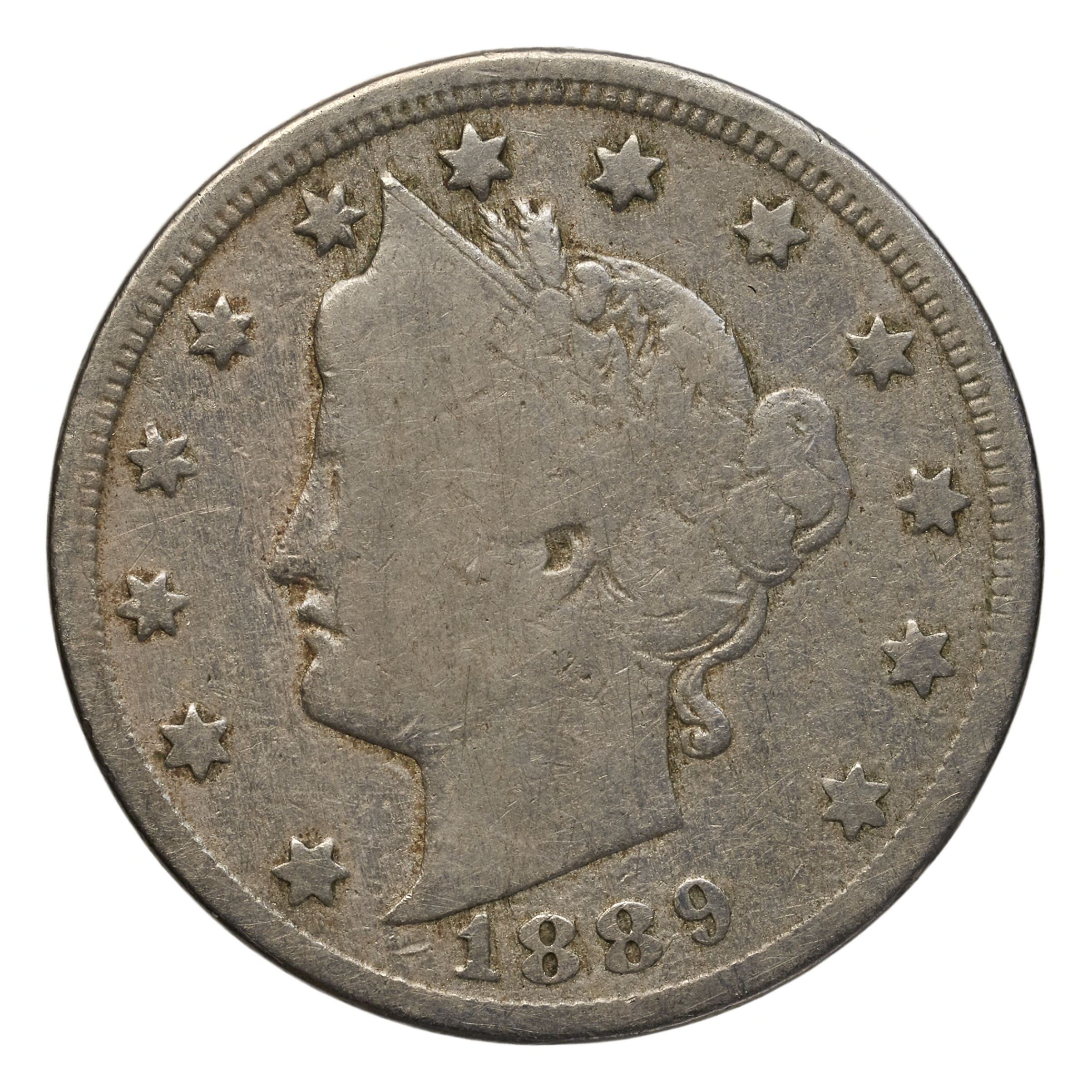
Liberty Head nickel, 1883–1912, by Charles Barber.
Liberty Head nickel, 1883–1912, by Charles Barber.Bibliothèque nationale de France, département Monnaies, médailles et antiques, by way of Wikimedia Commons. Public domain.
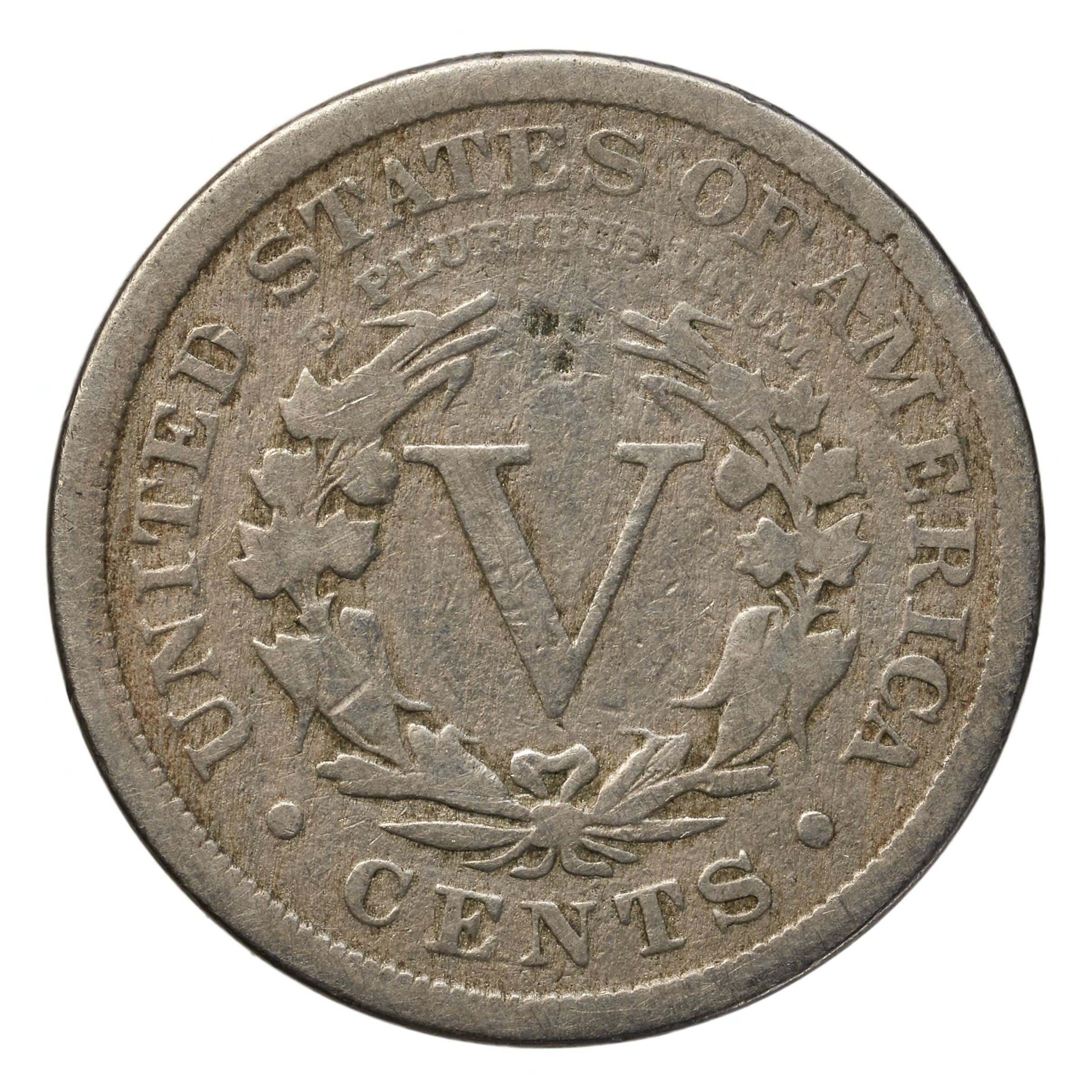
The Roman numeral V in a wreath. The first 1883 coins omitted the word CENTS and were gold-plated and passed as five-dollar pieces; CENTS was added on 26 June 1883.
The Roman numeral V in a wreath. The first 1883 coins omitted the word CENTS and were gold-plated and passed as five-dollar pieces; CENTS was added on 26 June 1883.Bibliothèque nationale de France, département Monnaies, médailles et antiques, by way of Wikimedia Commons. Public domain.
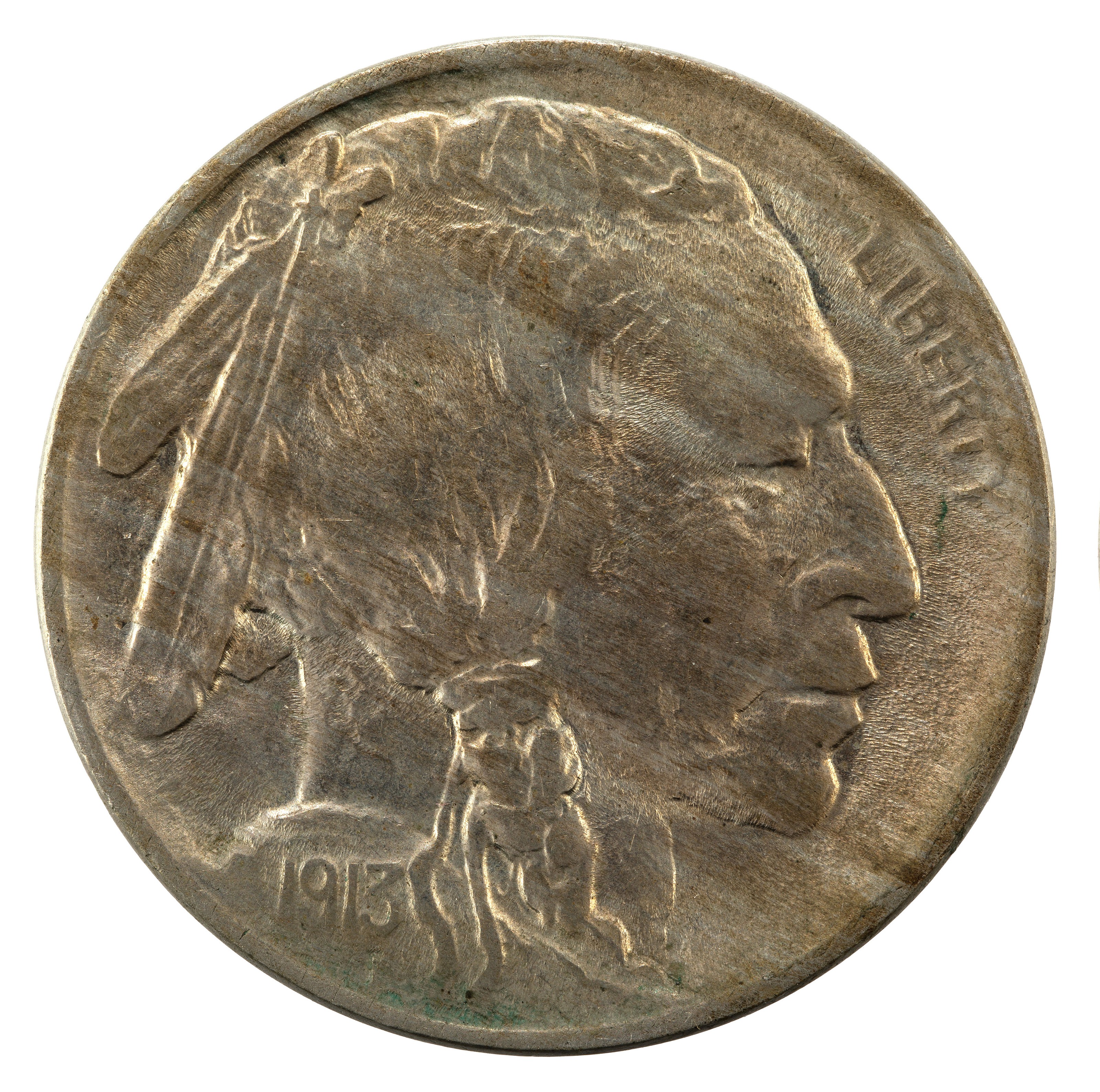
The Buffalo nickel, 1913, by James Earle Fraser. He named Iron Tail, Big Tree and Two Moons among his models and wrote that “my purpose was not to make a portrait but a type.”
The Buffalo nickel, 1913, by James Earle Fraser. He named Iron Tail, Big Tree and Two Moons among his models and wrote that “my purpose was not to make a portrait but a type.”National Numismatic Collection, Smithsonian National Museum of American History; photograph by Jaclyn Nash. Public domain.
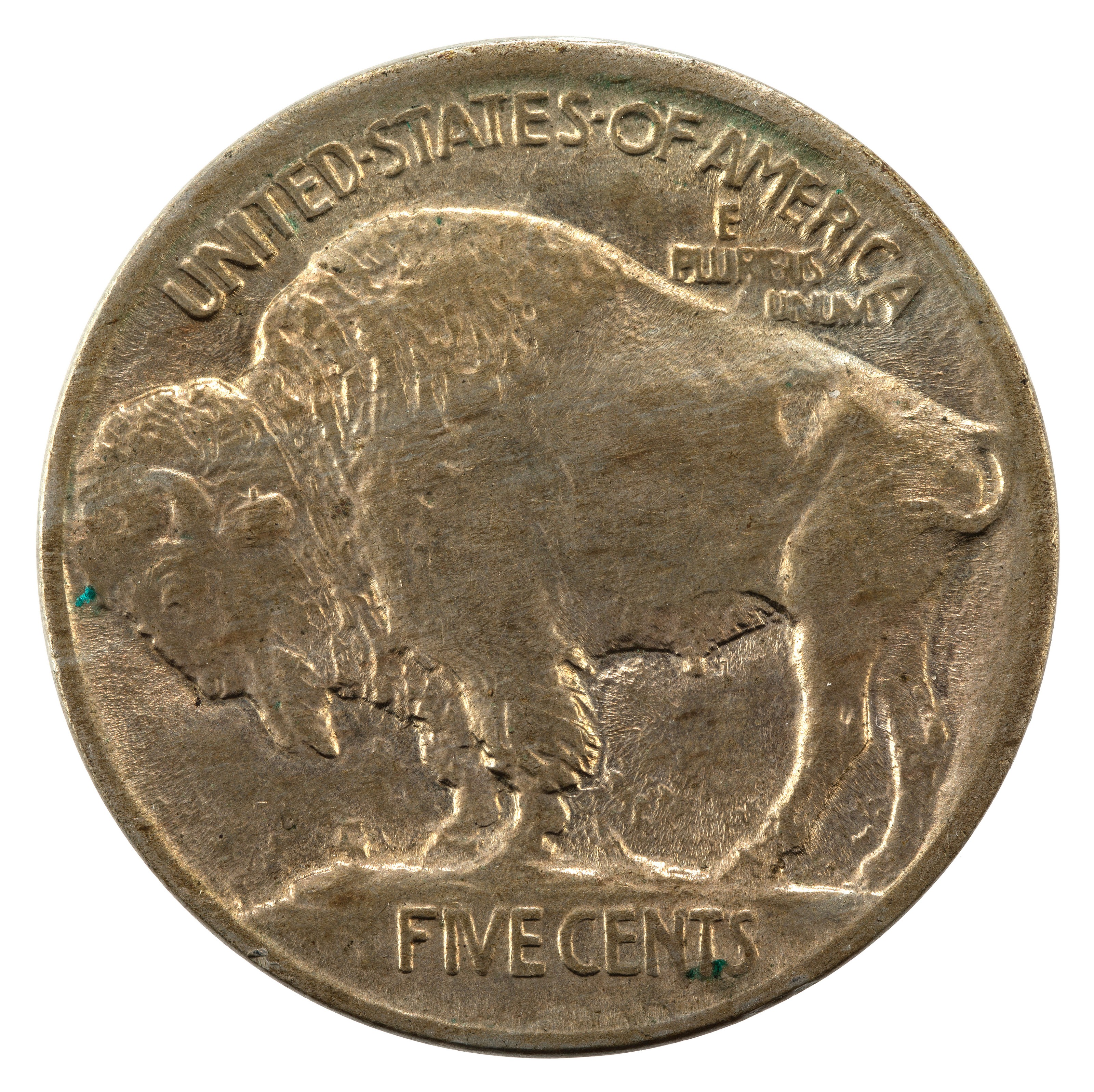
Type 1: the bison stands on a raised mound. Fraser said the animal was Black Diamond of the Bronx Zoo, although the bull of that name appears to have lived in the Central Park menagerie. The accounts do not agree.
Type 1: the bison stands on a raised mound. Fraser said the animal was Black Diamond of the Bronx Zoo, although the bull of that name appears to have lived in the Central Park menagerie. The accounts do not agree.National Numismatic Collection, Smithsonian National Museum of American History; photograph by Jaclyn Nash. Public domain.
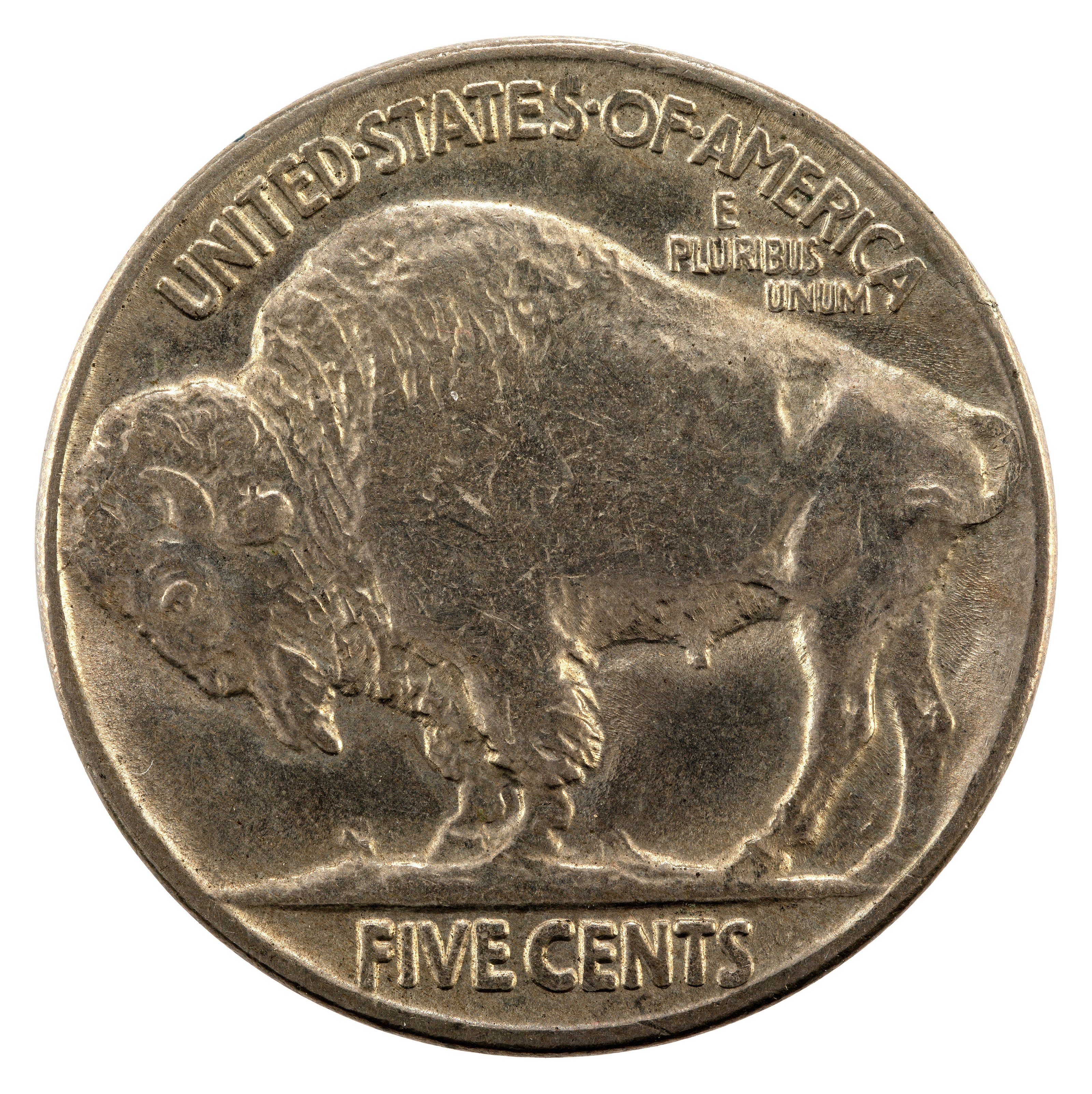
Type 2, later the same year: the ground flattened and FIVE CENTS enlarged, to keep the denomination from wearing away. It did not work.
Type 2, later the same year: the ground flattened and FIVE CENTS enlarged, to keep the denomination from wearing away. It did not work.National Numismatic Collection, Smithsonian National Museum of American History; photograph by Jaclyn Nash. Public domain.

The dime

The Barber dime, 1892–1916, obverse and reverse. Liberty in a pileus and a headband reading LIBERTY; the reverse is “a wreath of corn, wheat, maple and oak leaves.”
The Barber dime, 1892–1916, obverse and reverse. Liberty in a pileus and a headband reading LIBERTY; the reverse is “a wreath of corn, wheat, maple and oak leaves.”National Numismatic Collection, Smithsonian National Museum of American History; photograph by Jaclyn Nash. Public domain.
The Winged Liberty Head dime of 1916, always called the Mercury. Weinman said the wings stood for liberty of thought. He never named the model; the evidence points to Elsie Stevens, wife of the poet Wallace Stevens, from a bust he made of her in 1913, but it is not settled.
The Winged Liberty Head dime of 1916, always called the Mercury. Weinman said the wings stood for liberty of thought. He never named the model; the evidence points to Elsie Stevens, wife of the poet Wallace Stevens, from a bust he made of her in 1913, but it is not settled.Bibliothèque nationale de France, département Monnaies, médailles et antiques, by way of Wikimedia Commons. Public domain.
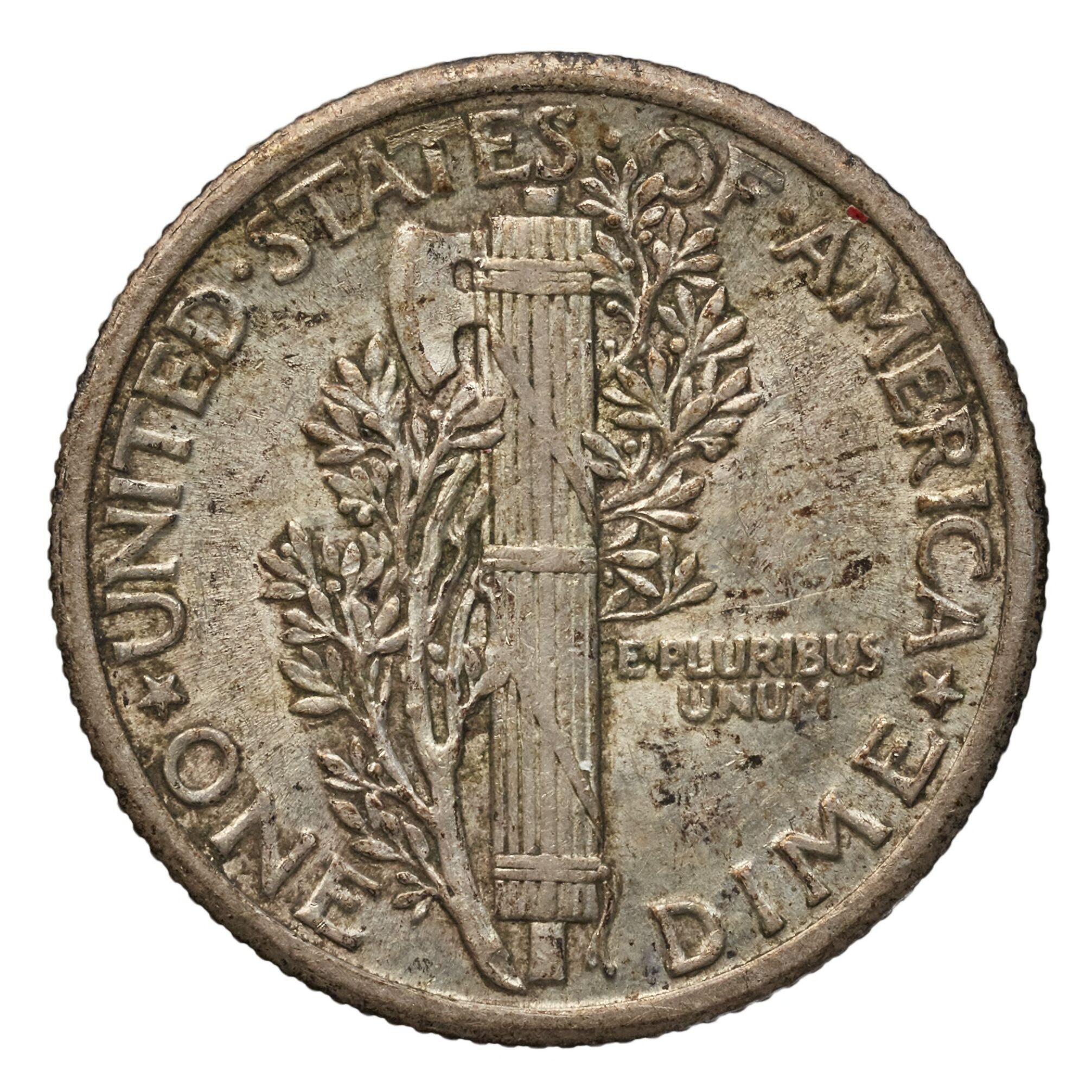
The reverse: a fasces bound beside an olive branch — strength and peace in one object, in 1916.
The reverse: a fasces bound beside an olive branch — strength and peace in one object, in 1916.Bibliothèque nationale de France, département Monnaies, médailles et antiques, by way of Wikimedia Commons. Public domain.

The quarter

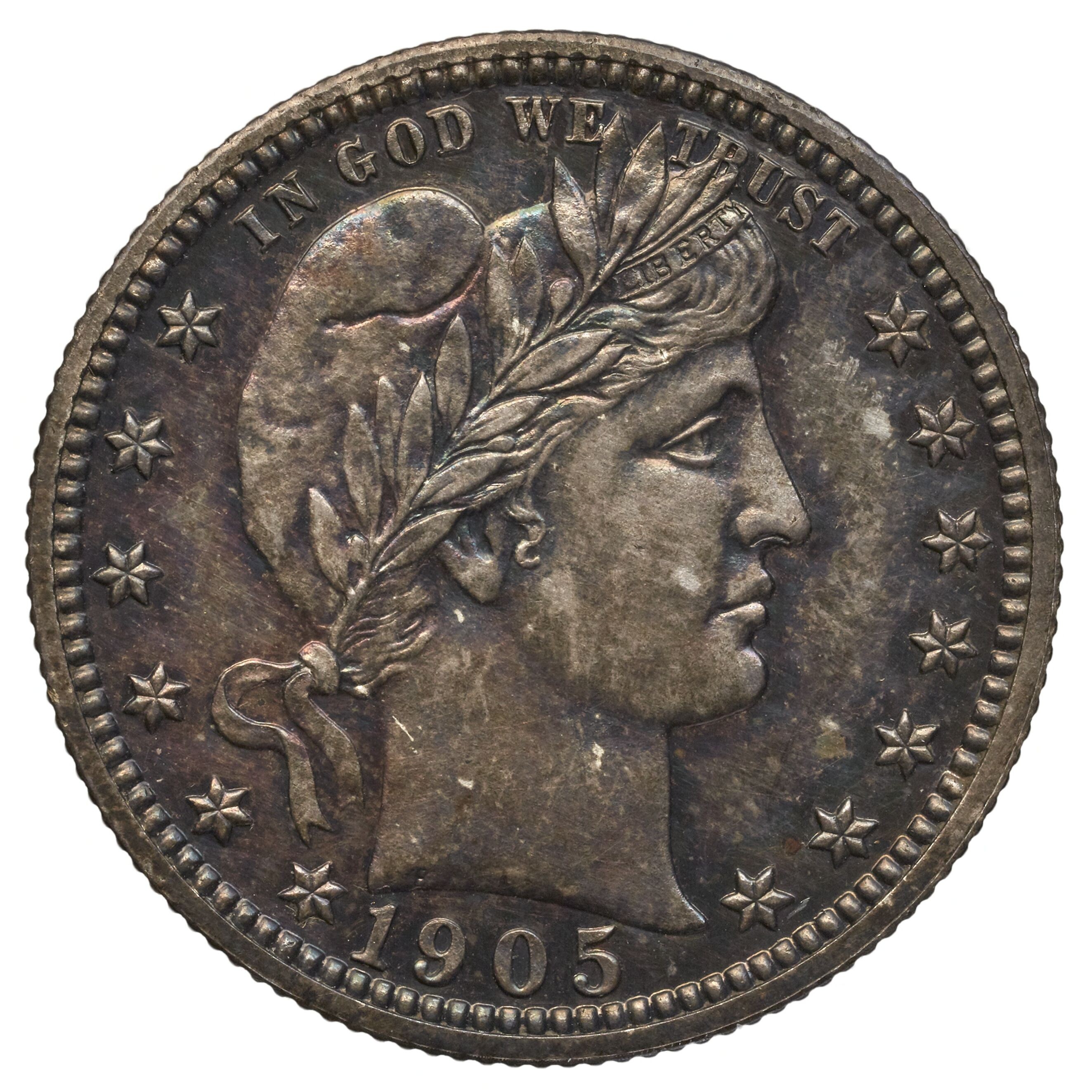
The Barber quarter, 1892–1916. The same Liberty as the dime, with IN GOD WE TRUST above and thirteen stars around.
The Barber quarter, 1892–1916. The same Liberty as the dime, with IN GOD WE TRUST above and thirteen stars around.Bibliothèque nationale de France, département Monnaies, médailles et antiques, by way of Wikimedia Commons. Public domain.
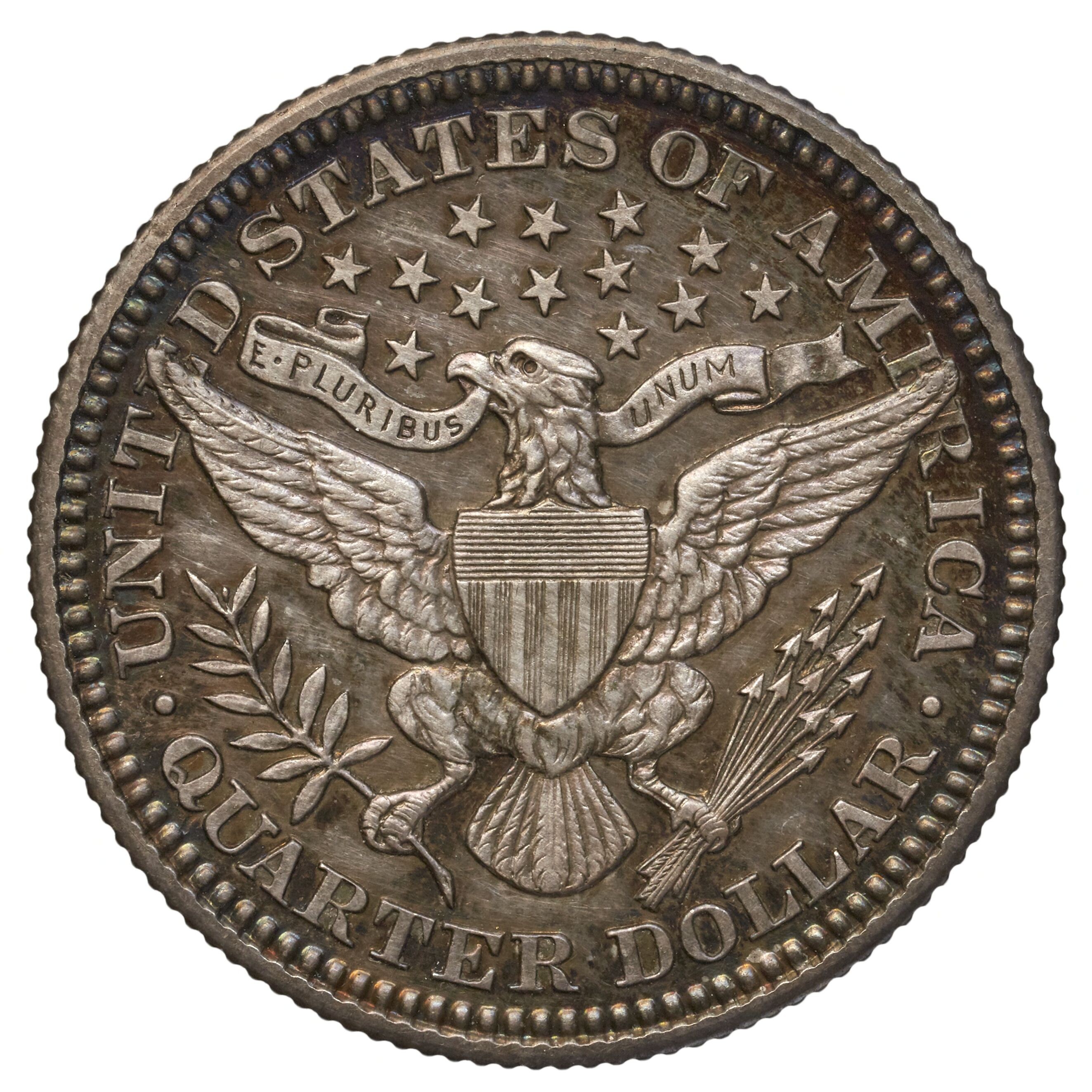
The heraldic eagle taken from the Great Seal, a scroll reading E PLURIBUS UNUM in its beak.
The heraldic eagle taken from the Great Seal, a scroll reading E PLURIBUS UNUM in its beak.Bibliothèque nationale de France, département Monnaies, médailles et antiques, by way of Wikimedia Commons. Public domain.
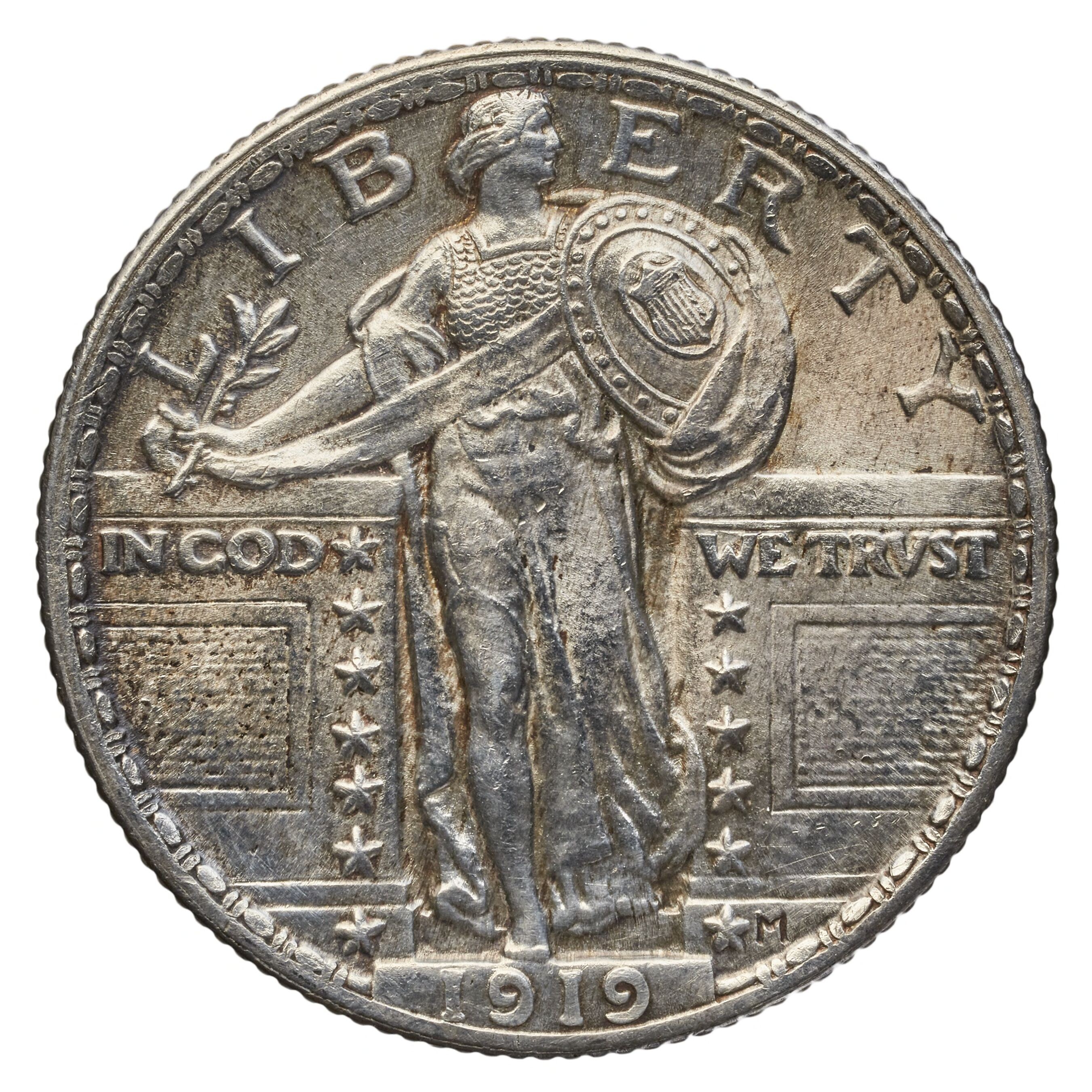
MacNeil’s Standing Liberty quarter, here the Type 2 of 1917 onward, Liberty in a chain-mail shirt. On the 1916 and early 1917 coins her right breast is bare. Why it was changed is disputed: there is no evidence of public outcry, and one historian reads the mail as wartime symbolism — Liberty should face her enemies protected.
MacNeil’s Standing Liberty quarter, here the Type 2 of 1917 onward, Liberty in a chain-mail shirt. On the 1916 and early 1917 coins her right breast is bare. Why it was changed is disputed: there is no evidence of public outcry, and one historian reads the mail as wartime symbolism — Liberty should face her enemies protected.Bibliothèque nationale de France, département Monnaies, médailles et antiques, by way of Wikimedia Commons. Public domain.
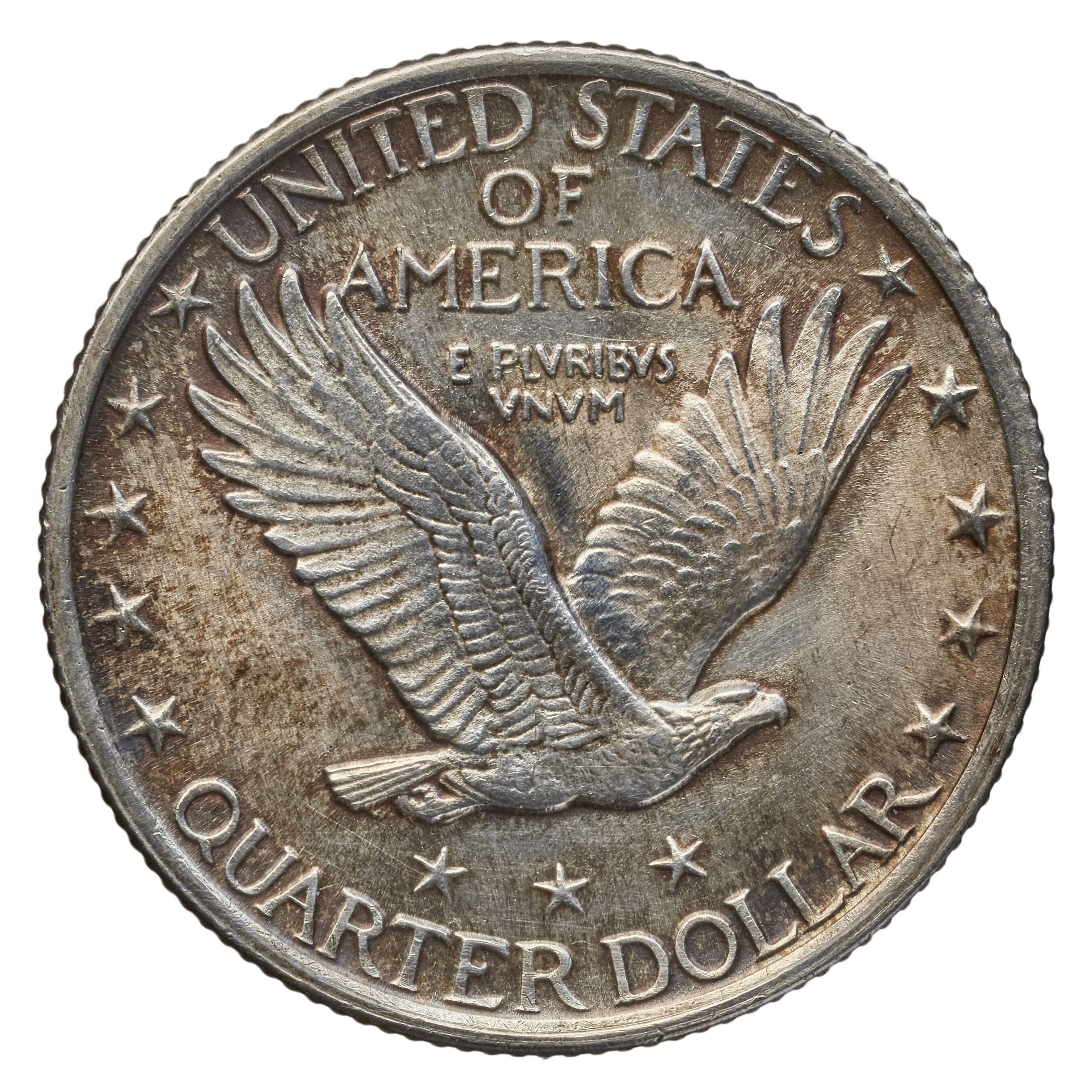
The reverse, an eagle in flight. By 1924 the date was wearing off the coin in circulation, and in 1925 the Mint recessed it into the design.
The reverse, an eagle in flight. By 1924 the date was wearing off the coin in circulation, and in 1925 the Mint recessed it into the design.Bibliothèque nationale de France, département Monnaies, médailles et antiques, by way of Wikimedia Commons. Public domain.

The half dollar

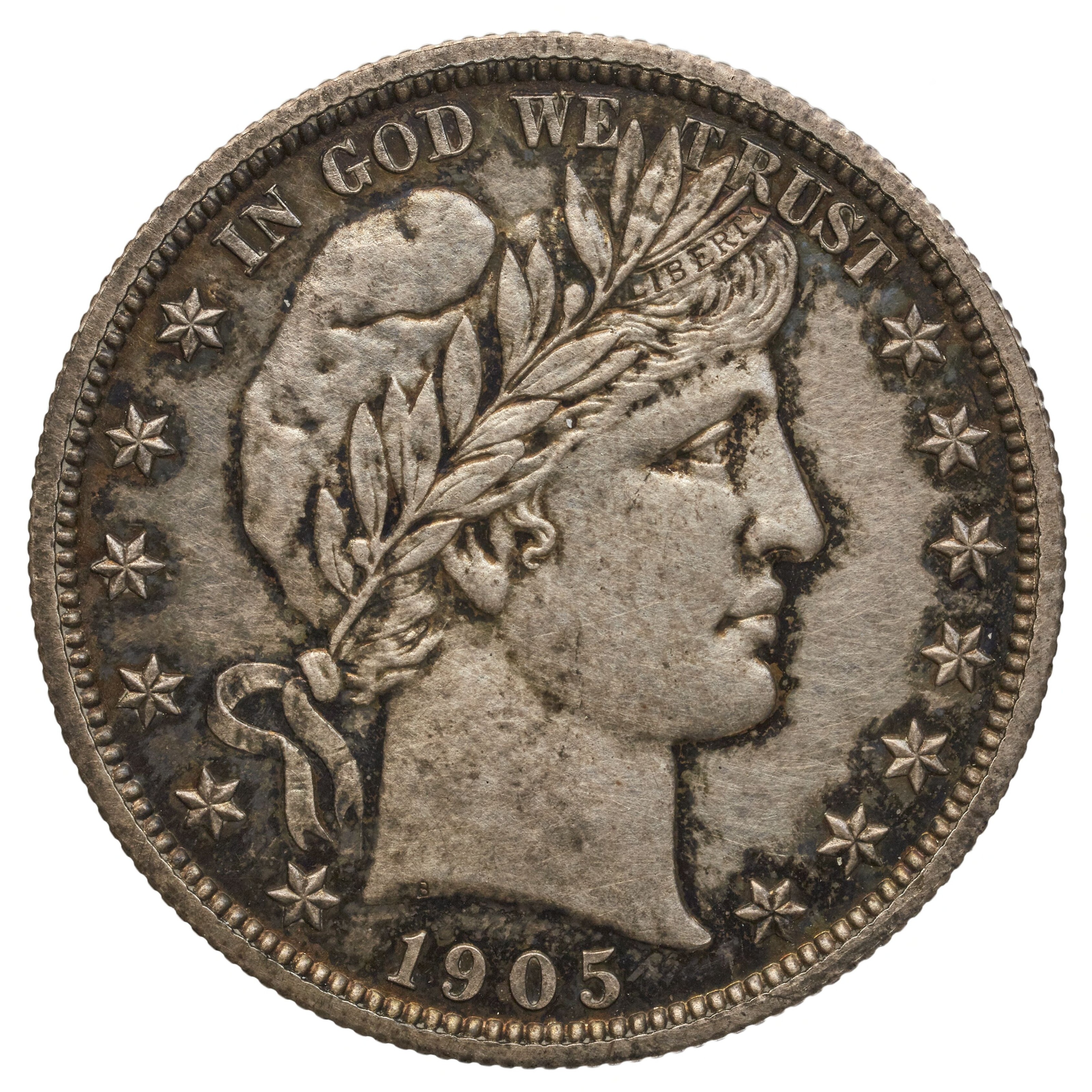
The Barber half dollar, 1892–1915. None were struck in 1916.
The Barber half dollar, 1892–1915. None were struck in 1916.Bibliothèque nationale de France, département Monnaies, médailles et antiques, by way of Wikimedia Commons. Public domain.
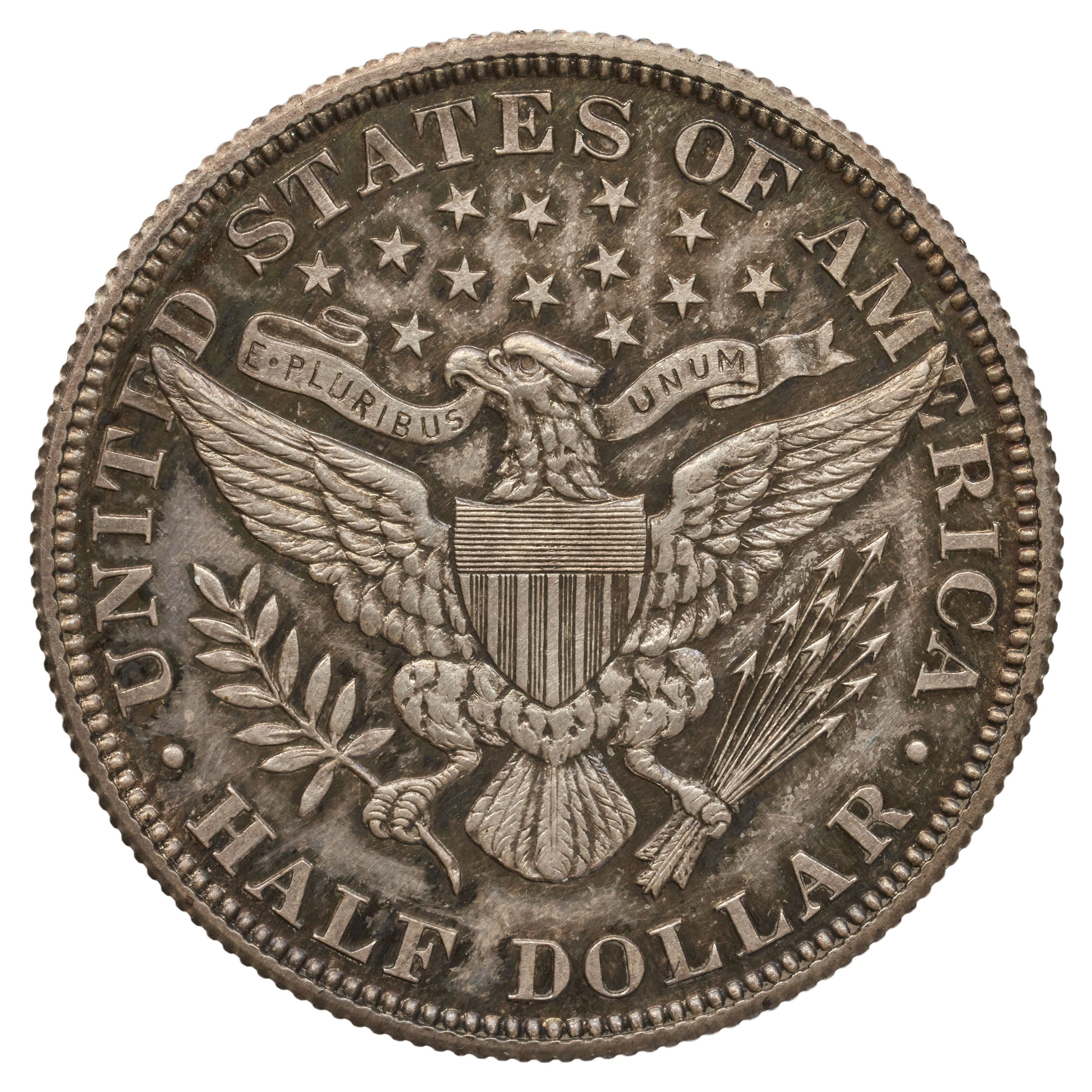
The same eagle as the quarter, at fifty-cent size.
The same eagle as the quarter, at fifty-cent size.Bibliothèque nationale de France, département Monnaies, médailles et antiques, by way of Wikimedia Commons. Public domain.
Weinman’s Walking Liberty half dollar, 1916: Liberty walking toward the sunrise with the flag over her shoulder and branches in her hand. The mint mark stood on the obverse for 1916 and part of 1917, then moved to the reverse — the Director said it “had the appearance of a die defect.”
Weinman’s Walking Liberty half dollar, 1916: Liberty walking toward the sunrise with the flag over her shoulder and branches in her hand. The mint mark stood on the obverse for 1916 and part of 1917, then moved to the reverse — the Director said it “had the appearance of a die defect.”Heritage Auctions, by way of Wikimedia Commons, where the photograph is published as public domain.
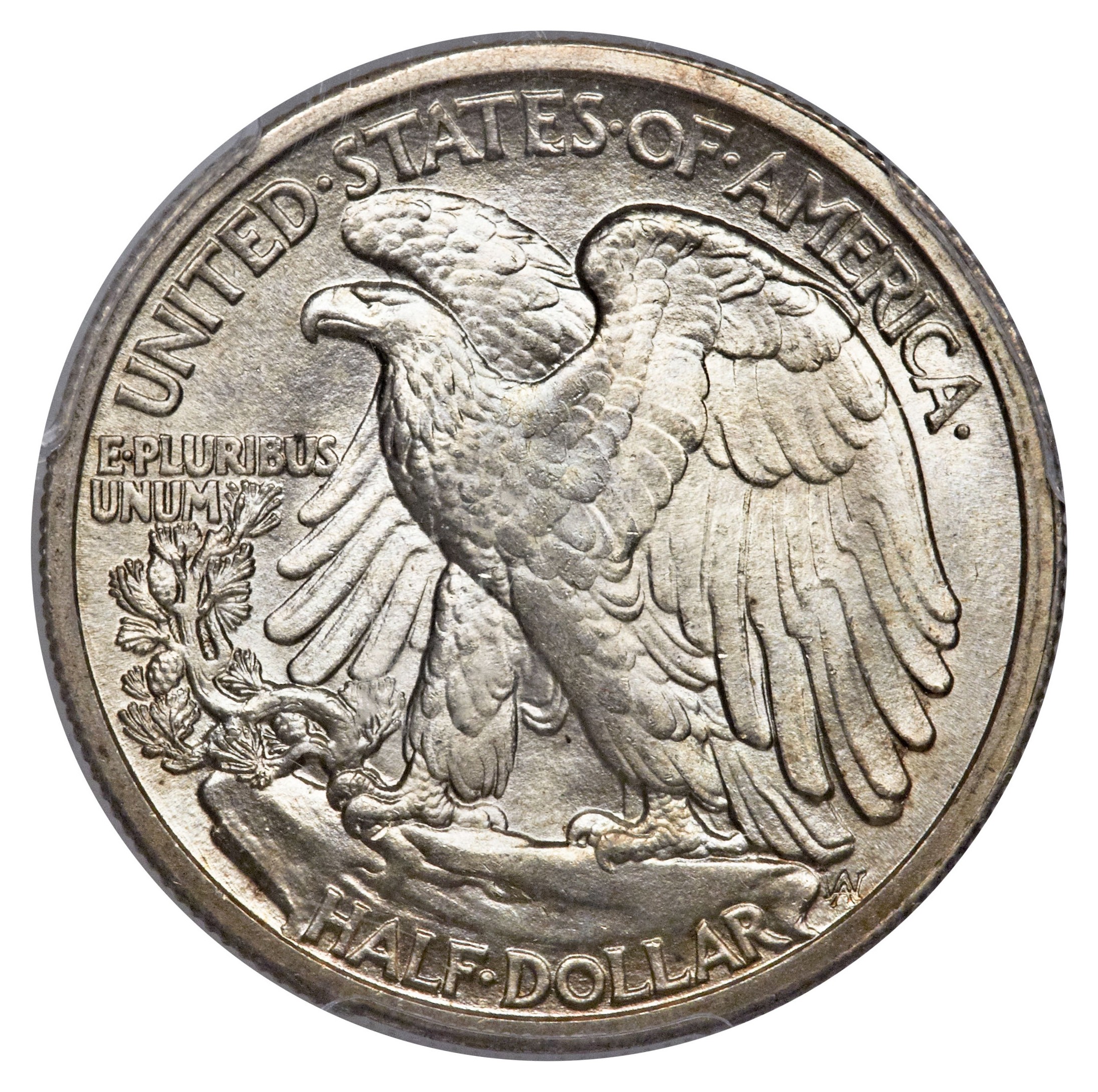
The reverse: a bald eagle rising from a mountain crag. This design was revived for the American Eagle bullion coin in 1986 and is still being struck.
The reverse: a bald eagle rising from a mountain crag. This design was revived for the American Eagle bullion coin in 1986 and is still being struck.Heritage Auctions, by way of Wikimedia Commons, where the photograph is published as public domain.

The dollar

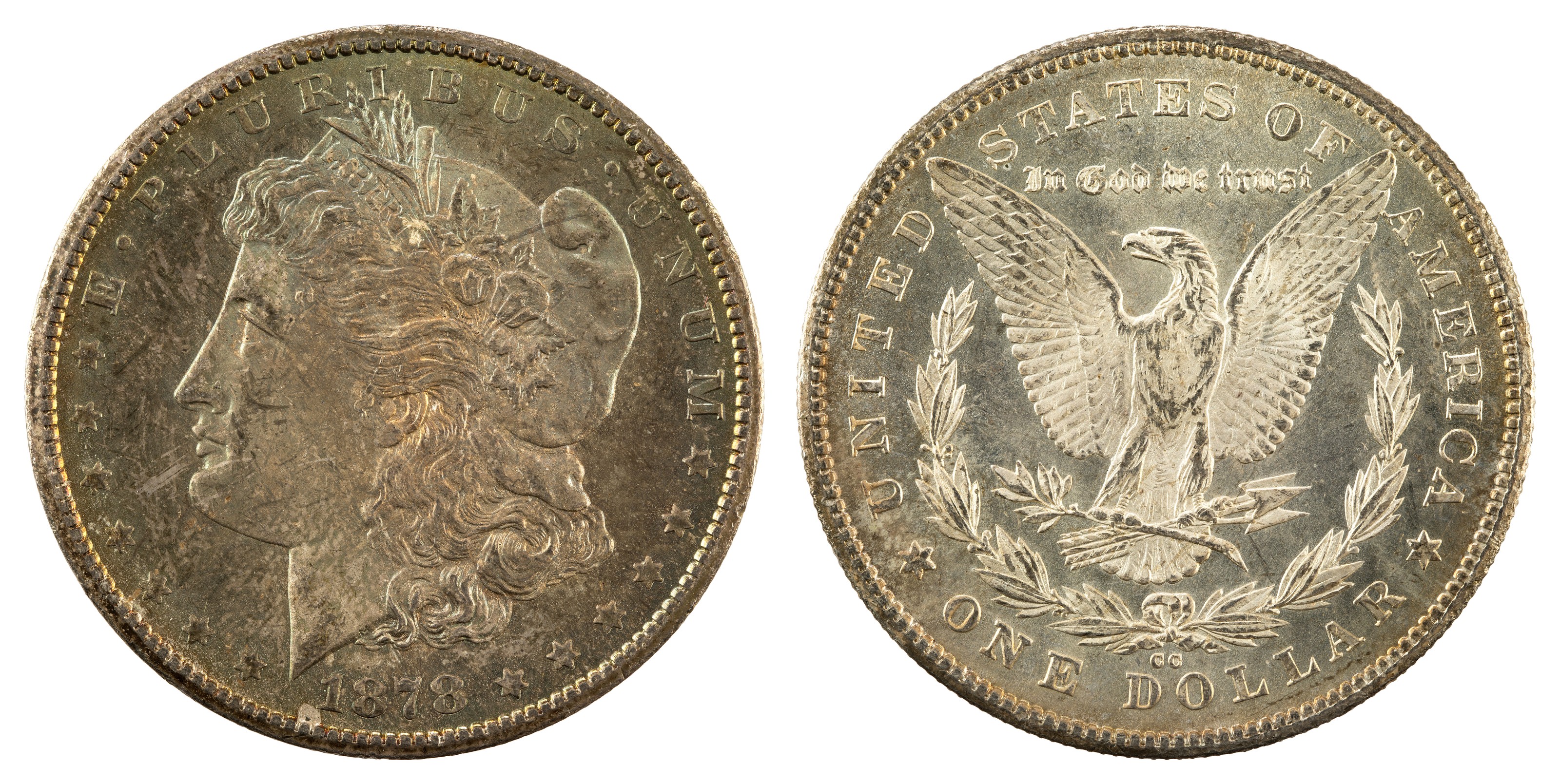
The Morgan dollar, 1878–1904 and 1921, by George T. Morgan. The model was Anna Willess Williams of Philadelphia; Morgan enlisted Thomas Eakins in the choice and called her profile the most perfect he had seen. It exists because the Bland–Allison Act of 1878 obliged the Treasury to buy silver.
The Morgan dollar, 1878–1904 and 1921, by George T. Morgan. The model was Anna Willess Williams of Philadelphia; Morgan enlisted Thomas Eakins in the choice and called her profile the most perfect he had seen. It exists because the Bland–Allison Act of 1878 obliged the Treasury to buy silver.National Numismatic Collection, Smithsonian National Museum of American History; photograph by Jaclyn Nash. Public domain.
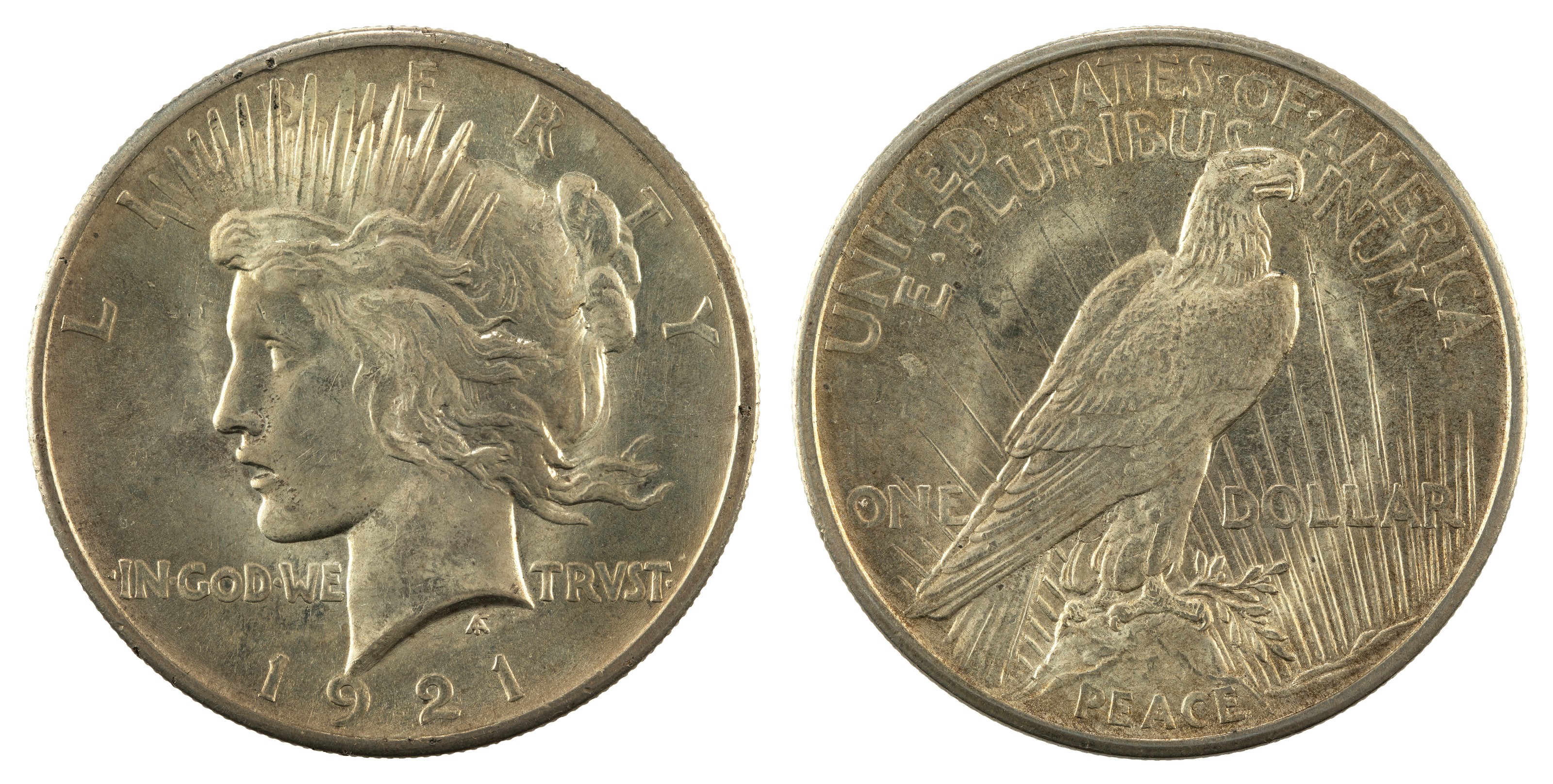
The Peace dollar of 1921, in high relief. The dies did not survive the run; production stopped on 10 January 1922 and the relief was cut down. A broken sword beneath the eagle had already been removed in December 1921, after criticism that it “carries with it only unpleasant associations.”
The Peace dollar of 1921, in high relief. The dies did not survive the run; production stopped on 10 January 1922 and the relief was cut down. A broken sword beneath the eagle had already been removed in December 1921, after criticism that it “carries with it only unpleasant associations.”National Numismatic Collection, Smithsonian National Museum of American History; photograph by Jaclyn Nash. Public domain.
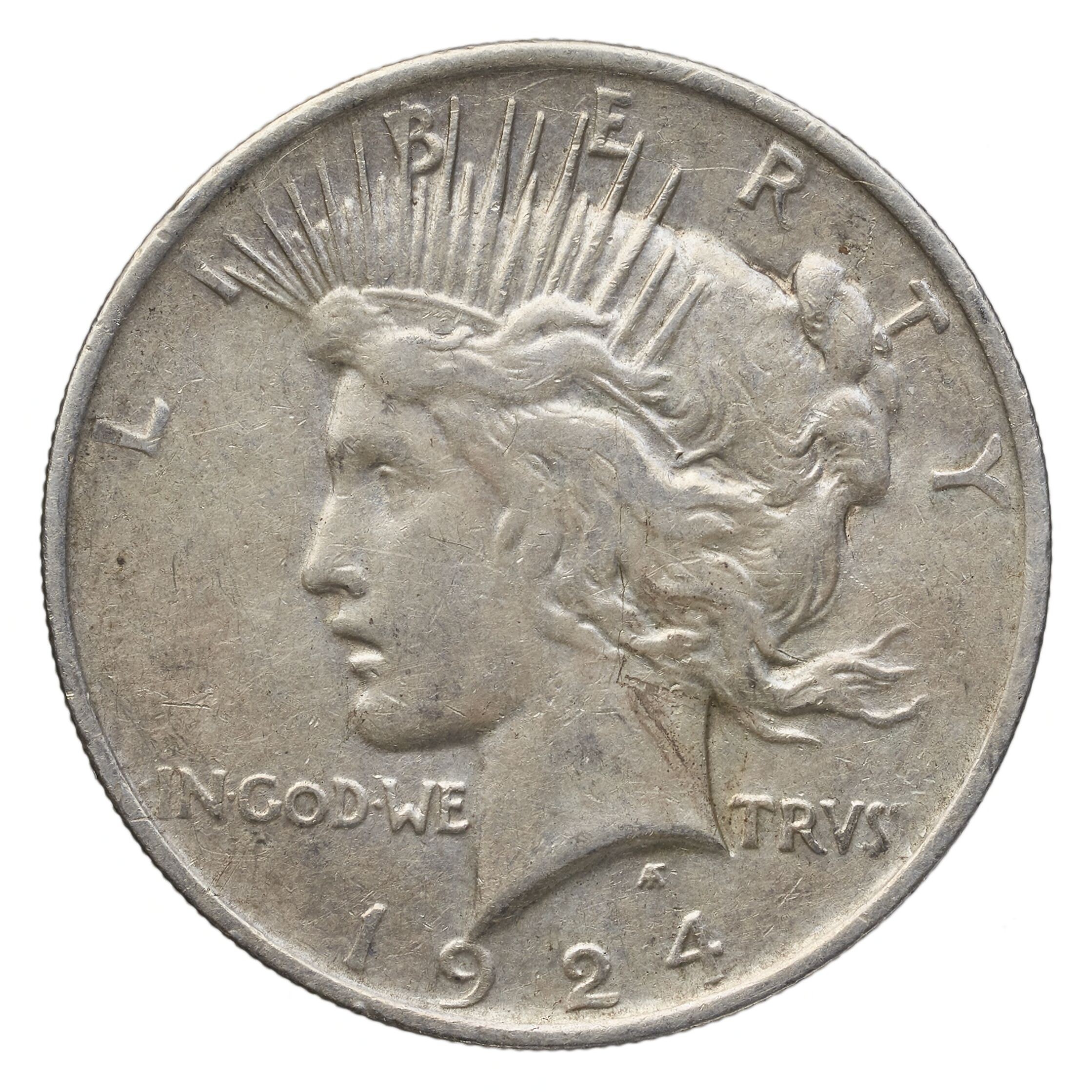
The low relief Peace dollar from 1922. The model was the designer’s wife, Teresa de Francisci.
The low relief Peace dollar from 1922. The model was the designer’s wife, Teresa de Francisci.Bibliothèque nationale de France, département Monnaies, médailles et antiques, by way of Wikimedia Commons. Public domain.
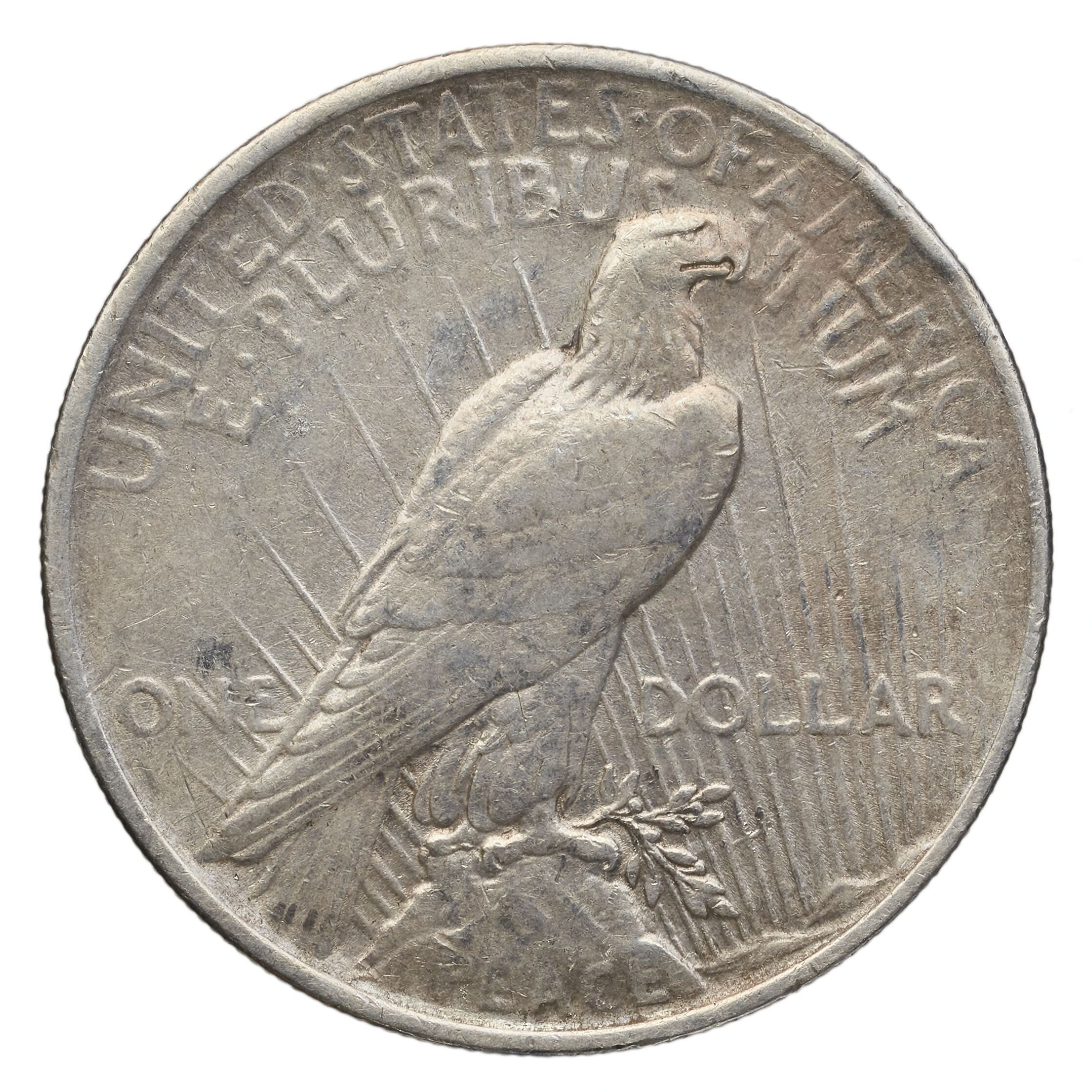
The reverse: an eagle at rest on a rock, an olive branch in its talons, and the word PEACE.
The reverse: an eagle at rest on a rock, an olive branch in its talons, and the word PEACE.Bibliothèque nationale de France, département Monnaies, médailles et antiques, by way of Wikimedia Commons. Public domain.

The gold, to the end

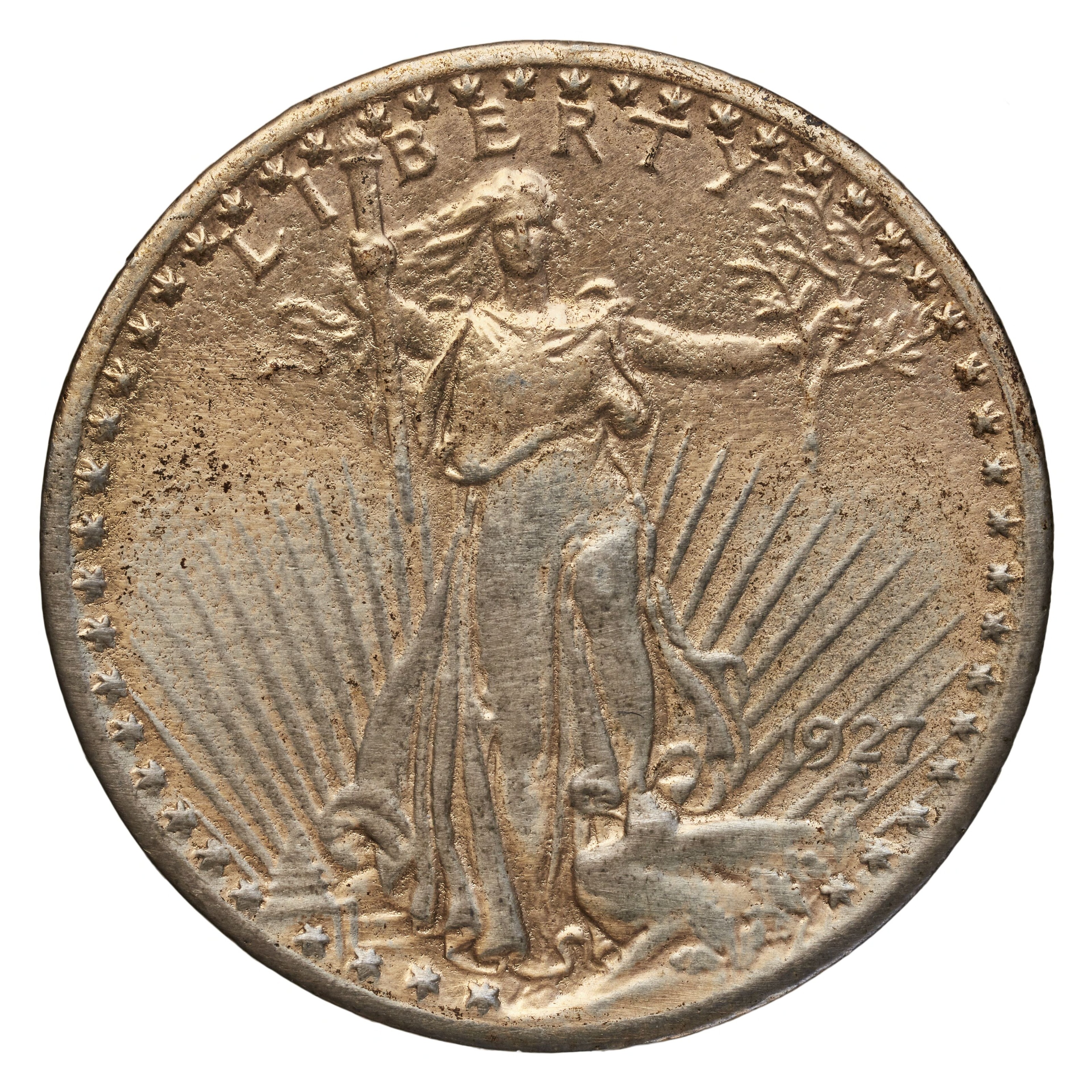
A Saint-Gaudens double eagle of 1927 — the coin as it was actually handed over a counter for a quarter of a century. Forty-eight stars now.
A Saint-Gaudens double eagle of 1927 — the coin as it was actually handed over a counter for a quarter of a century. Forty-eight stars now.Bibliothèque nationale de France, département Monnaies, médailles et antiques, by way of Wikimedia Commons. Public domain.
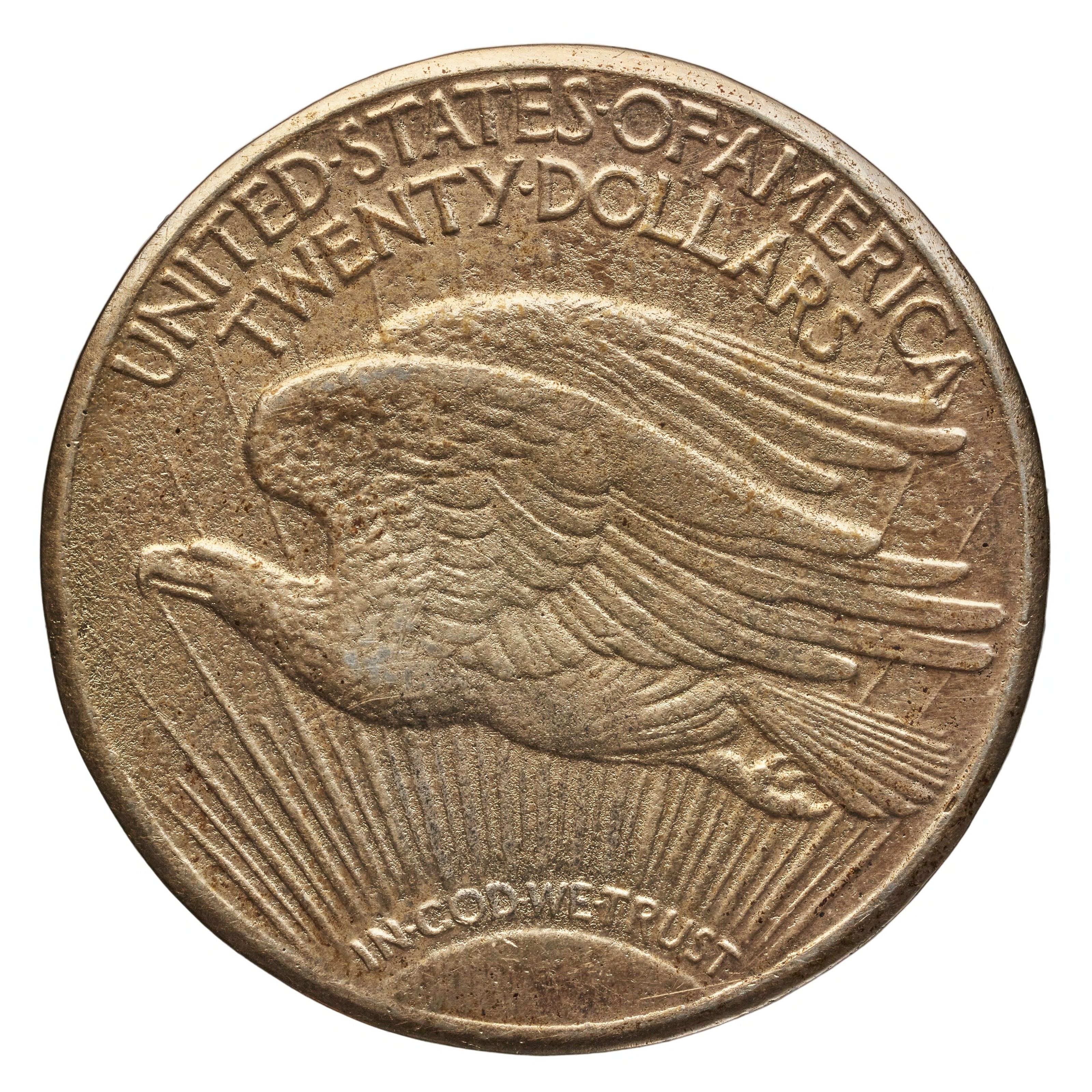
The flying eagle over a rising sun. This reverse went back into production in 1986 on the American Eagle gold bullion coin and is still struck.
The flying eagle over a rising sun. This reverse went back into production in 1986 on the American Eagle gold bullion coin and is still struck.Bibliothèque nationale de France, département Monnaies, médailles et antiques, by way of Wikimedia Commons. Public domain.
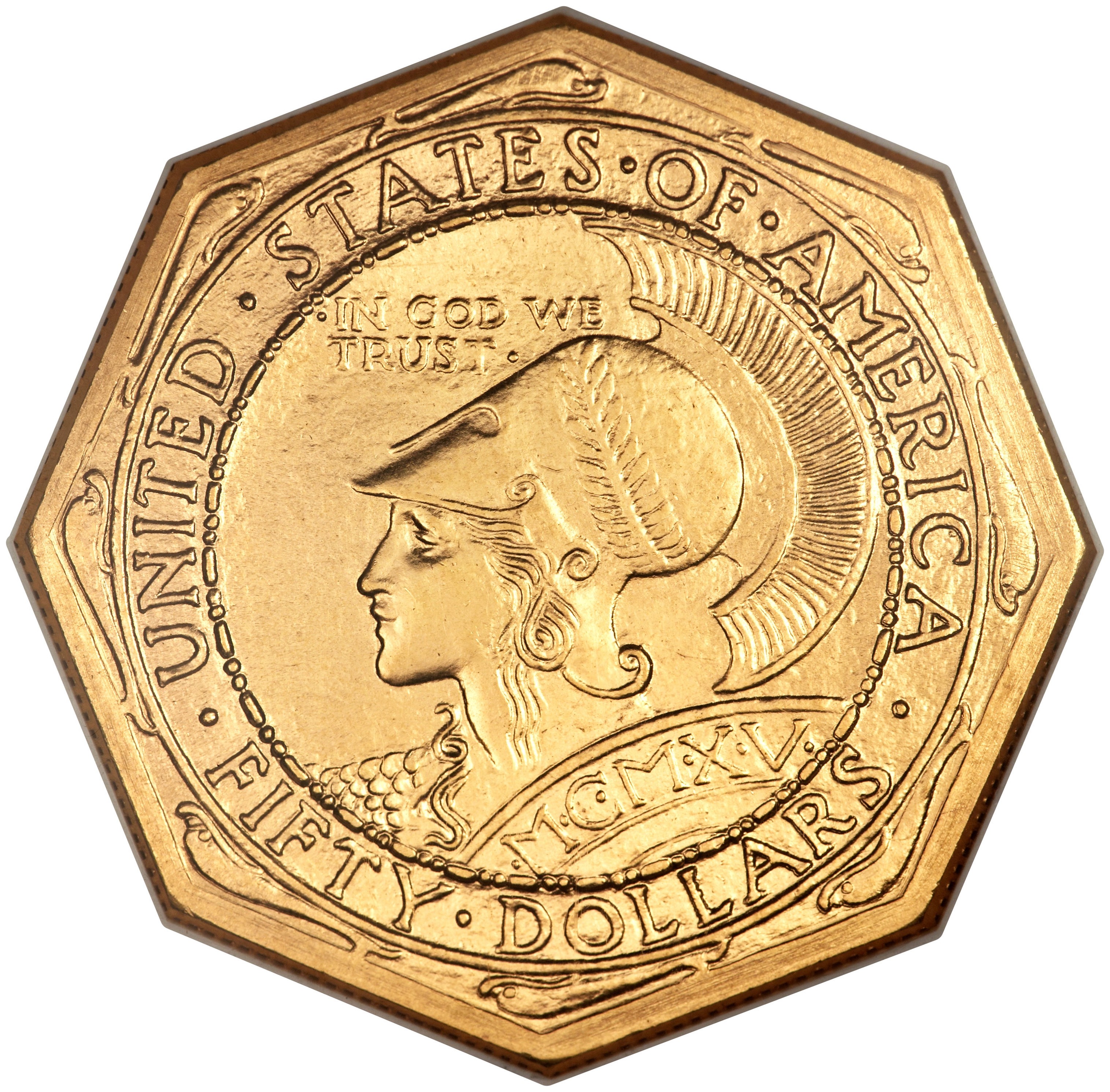
The Panama-Pacific fifty-dollar piece of 1915, octagonal — the largest denomination the United States has struck for public issue.
The Panama-Pacific fifty-dollar piece of 1915, octagonal — the largest denomination the United States has struck for public issue.Heritage Auctions, by way of Wikimedia Commons, where the photograph is published as public domain.
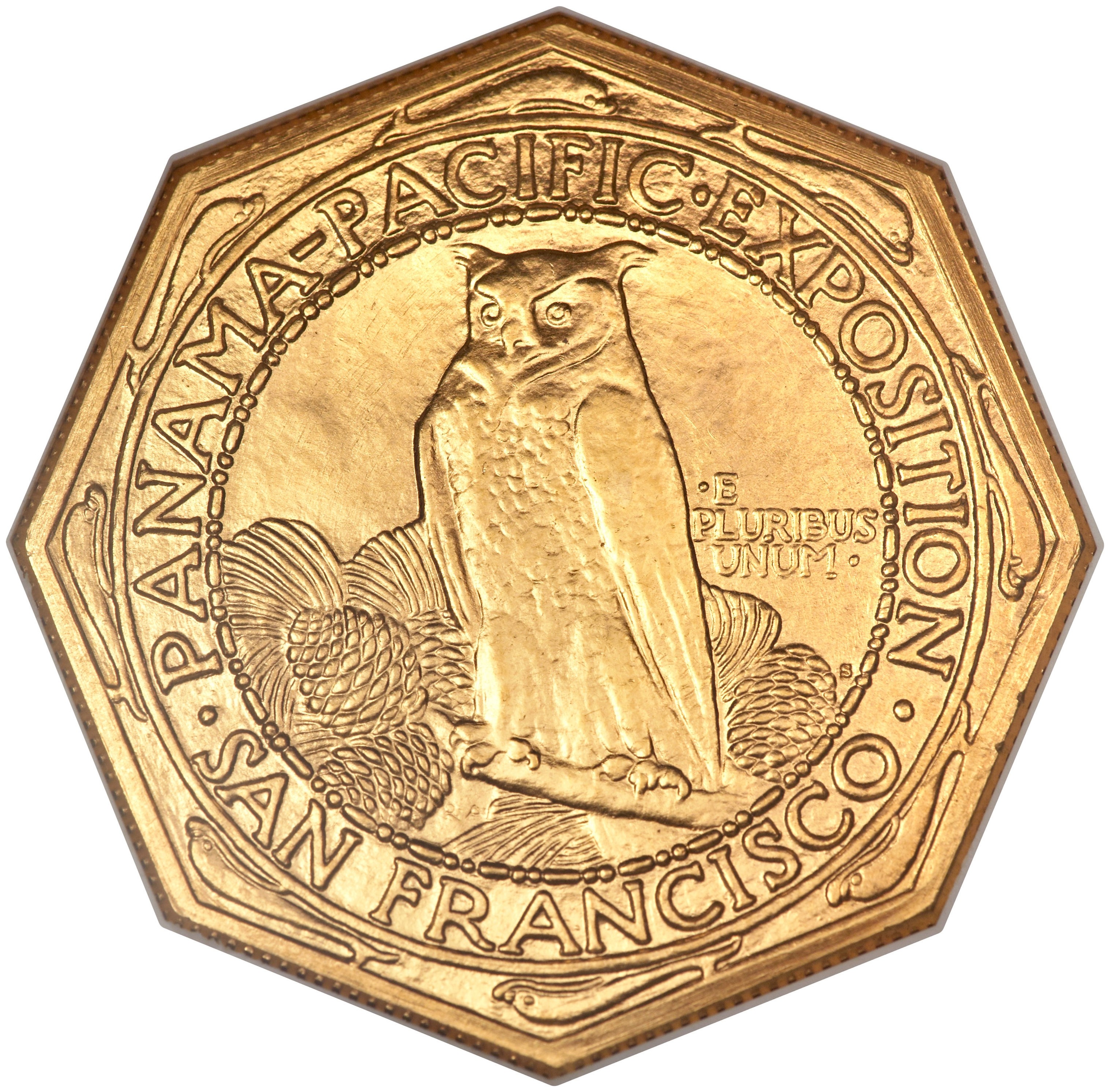
The reverse of the octagonal fifty. A round version was struck in the same year.
The reverse of the octagonal fifty. A round version was struck in the same year.Heritage Auctions, by way of Wikimedia Commons, where the photograph is published as public domain.
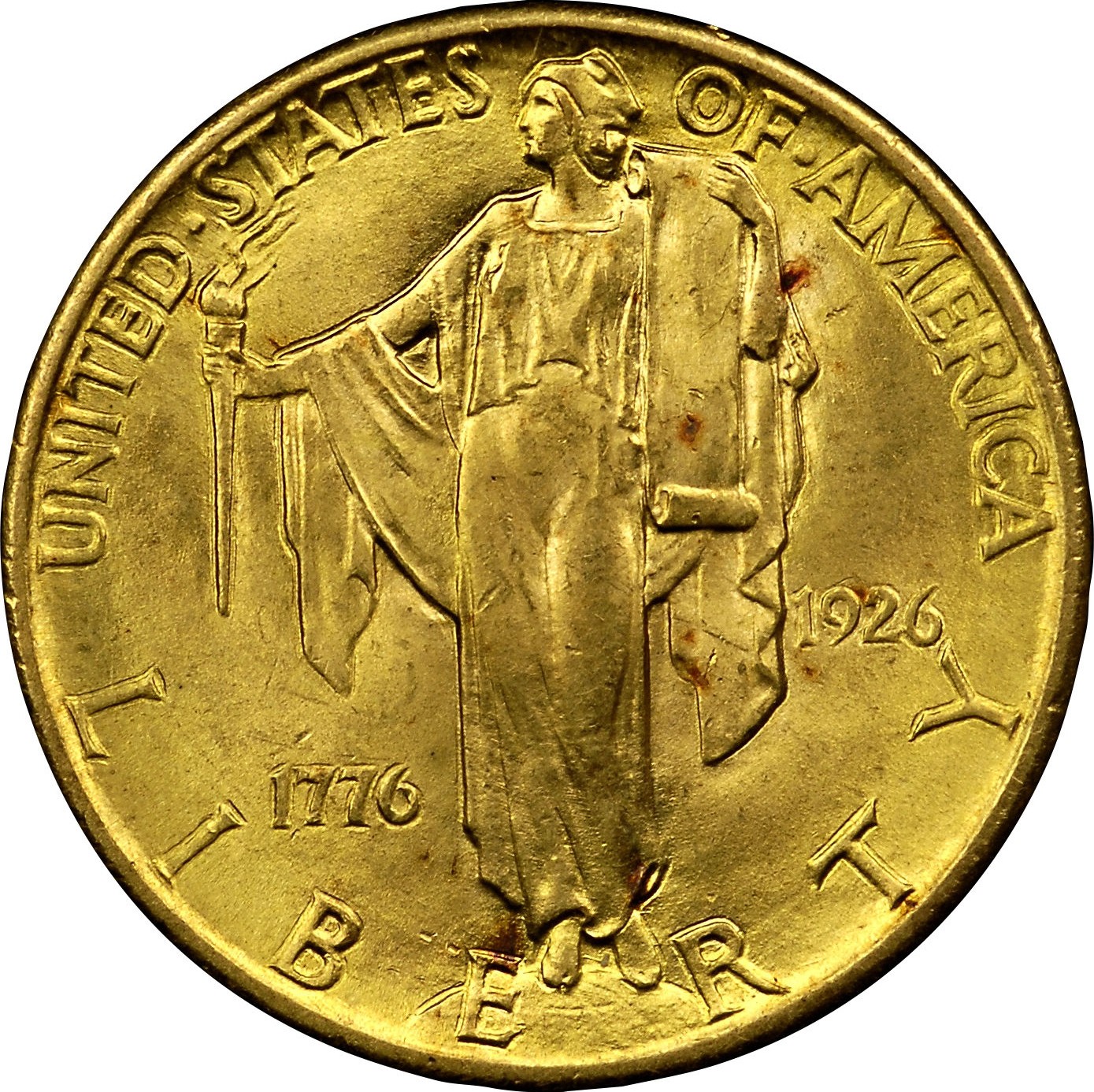
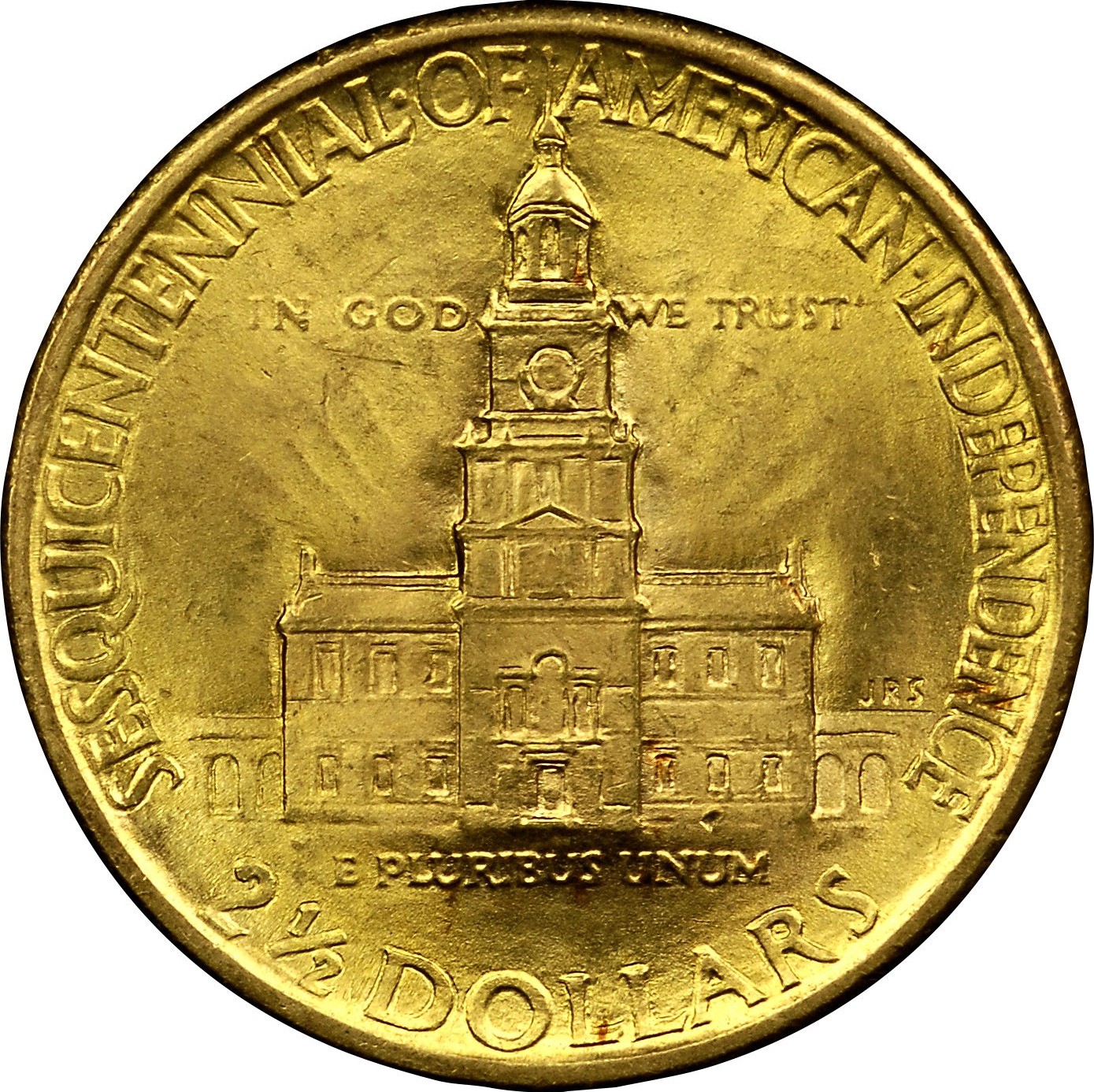
The Sesquicentennial quarter eagle of 1926 — the last commemorative gold coin of the era and the last new gold design authorized before the recall.
The Sesquicentennial quarter eagle of 1926 — the last commemorative gold coin of the era and the last new gold design authorized before the recall.Heritage Auctions, by way of Wikimedia Commons, where the photograph is published as public domain.
Independence Hall on the reverse. Seven years later it was illegal to hold one without a reason.
Independence Hall on the reverse. Seven years later it was illegal to hold one without a reason.Heritage Auctions, by way of Wikimedia Commons, where the photograph is published as public domain.

VII. Paper

Coin was the small change of the era. Wages, rents and bills of any size moved as paper, and in the cottage era the paper came in many kinds. A wallet in the 1890s could hold five: United States notes, the greenbacks first issued in 1862; national bank notes, issued by chartered banks in their own names; gold certificates and silver certificates, each a receipt for metal held in the Treasury; and the Treasury notes of 1890. Federal Reserve notes, the kind issued today, did not appear until Series 1914.

Every one of them was larger than a modern bill: seven and seven-sixteenths inches by about three and an eighth. The small size came with Series 1928, as a paper saving. Twelve notes to a sheet instead of eight.

The national bank notes were the local money. A bank bought United States bonds, deposited them with the Treasury, and could issue notes up to ninety per cent of their value, each one carrying the bank’s name, its charter number, and the signatures of its own cashier and president. Stockbridge had one. The Housatonic National Bank of Stockbridge, charter 1170, was chartered on 19 May 1865 and issued 315,240 notes, worth $2,122,230, from its first series to the small notes of 1929. Daniel R. Williams was its president from 1868 to 1898. For 1922 the Society of Paper Money Collectors’ register of national bank officers lists the president as A. F. Riggs — the initials of Austen Fox Riggs, whose foundation is on the Butler House page, though the record gives initials only. If it is him, any Stockbridge notes issued that year would have carried his signature. No Housatonic note has been found here to reproduce.

The watermelons

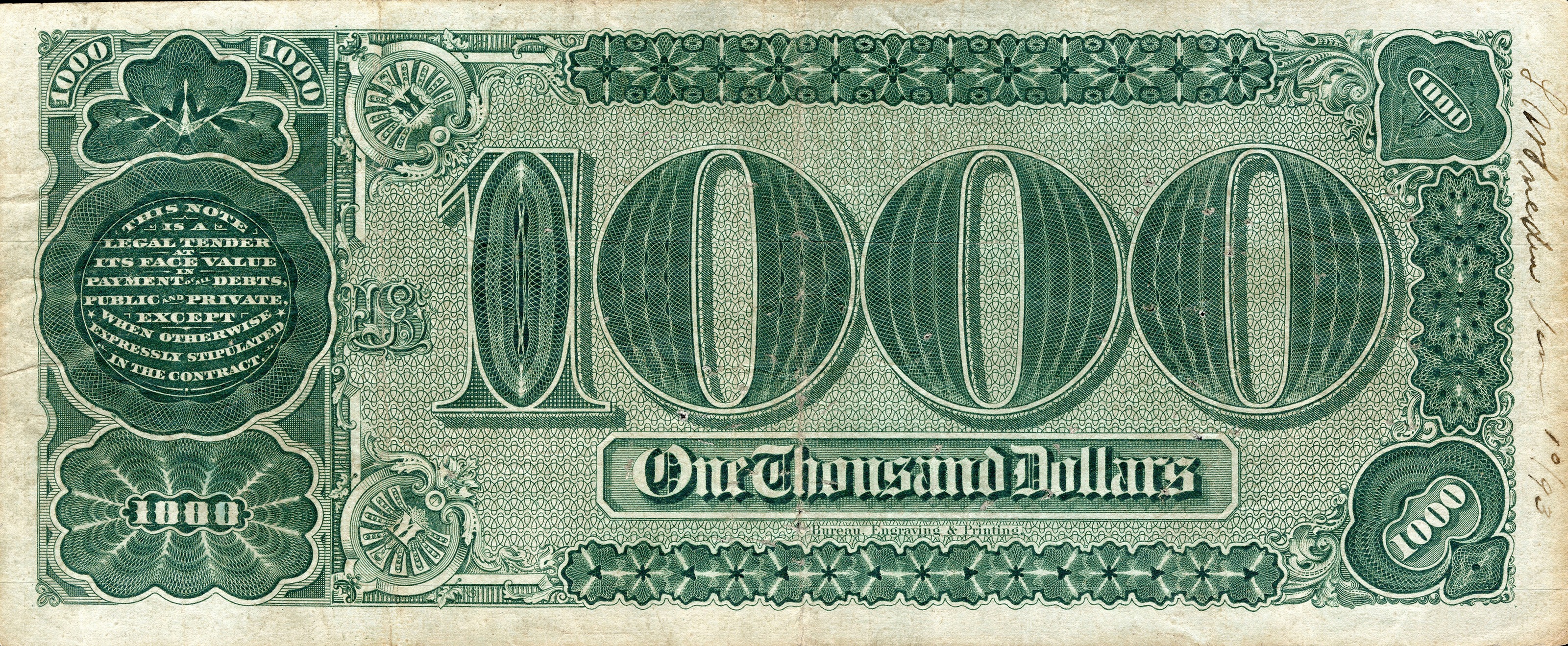
The Sherman Silver Purchase Act of 1890 made the Treasury buy silver, and the Treasury paid for it with a new kind of note. The Treasury notes of 1890 and 1891 were redeemable in coin — silver, gold or both, at the Treasury’s choice. They were issued until 1893, from one dollar to a thousand. Five of the eight portraits are Civil War generals or an admiral.
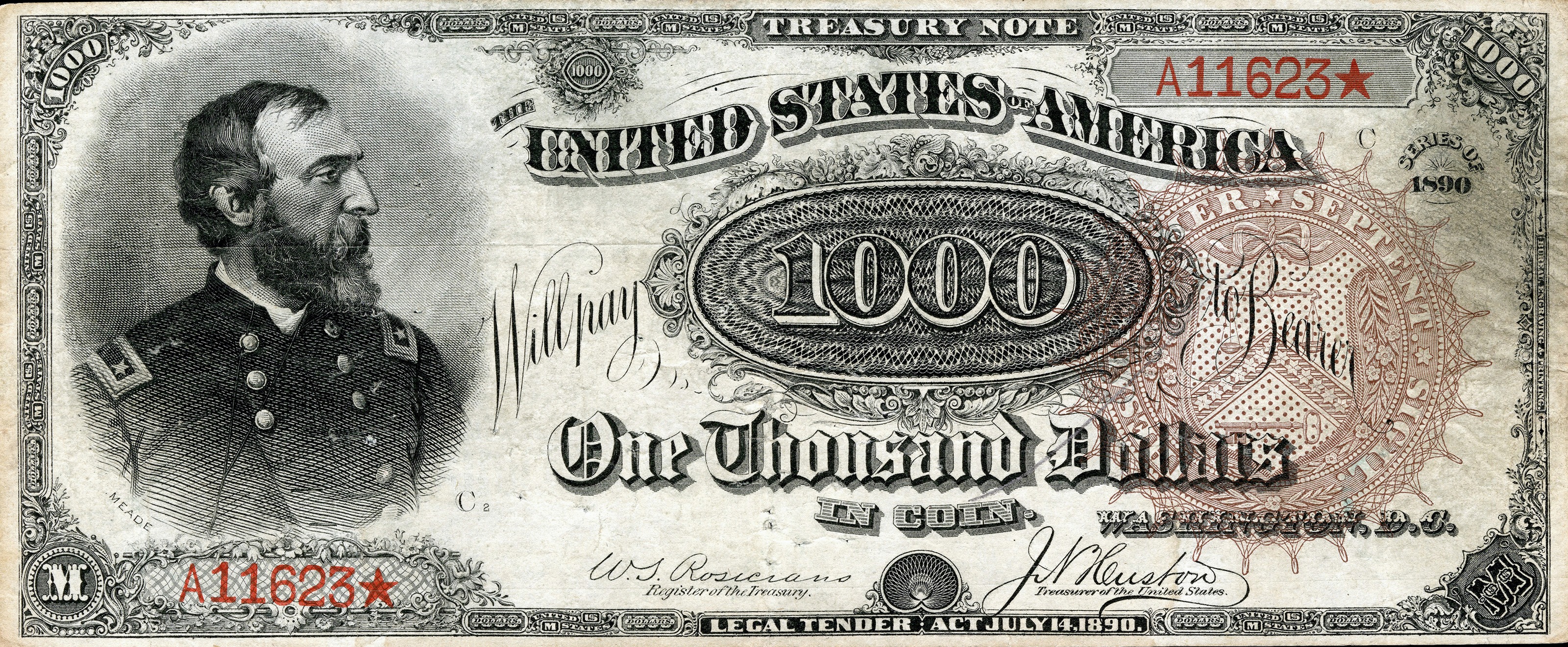
One thousand dollars, Treasury note, Series 1890. George G. Meade. “In coin” is printed under the denomination; the Treasury decided which coin.
One thousand dollars, Treasury note, Series 1890. George G. Meade. “In coin” is printed under the denomination; the Treasury decided which coin.National Numismatic Collection, Smithsonian National Museum of American History; image by Godot13, by way of Wikimedia Commons. Public domain.
The back, and the reason for the name: the zeros look like watermelons. Collectors call the thousand the Grand Watermelon. Wikipedia’s account attaches the name to the variety catalogued Fr.379b and counts seven known, three of them in collectors’ hands; the Smithsonian’s note is Fr.379a. A Fr.379b sold at Heritage Auctions on 10 January 2014 for $3,290,000, a world record for paper currency.
The back, and the reason for the name: the zeros look like watermelons. Collectors call the thousand the Grand Watermelon. Wikipedia’s account attaches the name to the variety catalogued Fr.379b and counts seven known, three of them in collectors’ hands; the Smithsonian’s note is Fr.379a. A Fr.379b sold at Heritage Auctions on 10 January 2014 for $3,290,000, a world record for paper currency.National Numismatic Collection, Smithsonian National Museum of American History; image by Godot13, by way of Wikimedia Commons. Public domain.

The Educational series

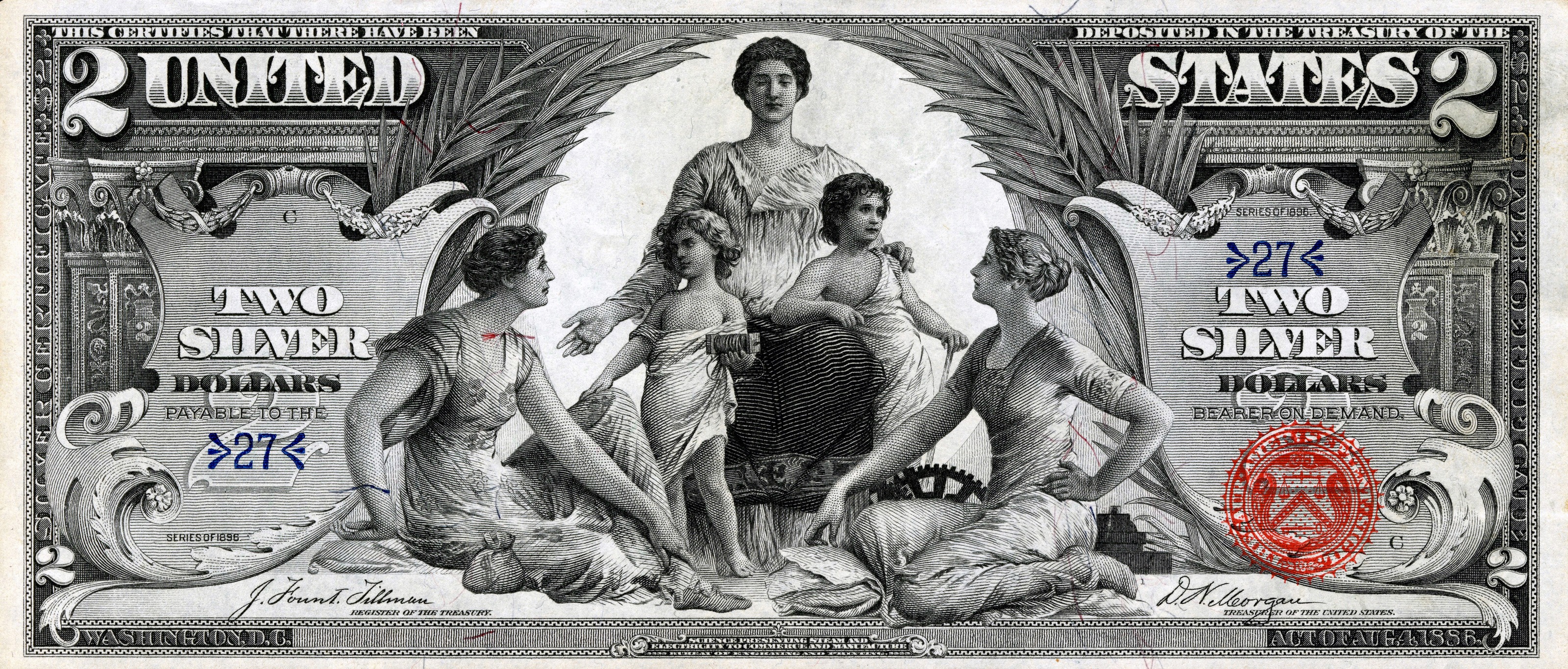
In 1896 the Bureau of Engraving and Printing commissioned four artists. The result was three silver certificates, $1, $2 and $5, each face an allegory, and many numismatists call them the most beautiful notes the United States has issued. Higher denominations were planned and never finished. The series was dropped for the Series of 1899.
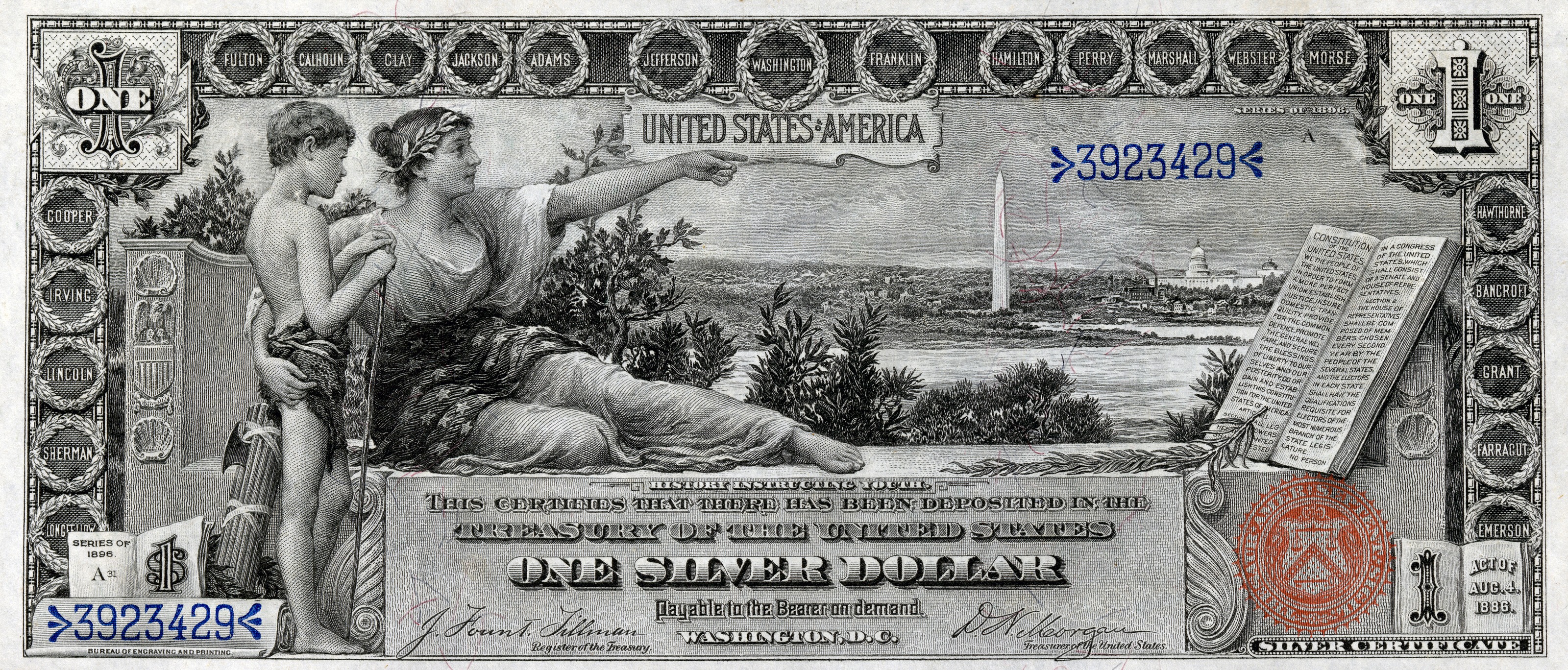
One dollar: History Instructing Youth, by Will H. Low, engraved by Charles Schlecht. The Washington Monument and the Capitol are in the distance. The back carries Martha and George Washington.
One dollar: History Instructing Youth, by Will H. Low, engraved by Charles Schlecht. The Washington Monument and the Capitol are in the distance. The back carries Martha and George Washington.National Numismatic Collection, Smithsonian National Museum of American History; image by Godot13, by way of Wikimedia Commons. Public domain.
Two dollars: Science Presents Steam and Electricity to Commerce and Manufacture. The central figures are Edwin H. Blashfield’s, engraved by G. F. C. Smillie. Robert Fulton and Samuel F. B. Morse are on the back.
Two dollars: Science Presents Steam and Electricity to Commerce and Manufacture. The central figures are Edwin H. Blashfield’s, engraved by G. F. C. Smillie. Robert Fulton and Samuel F. B. Morse are on the back.National Numismatic Collection, Smithsonian National Museum of American History; image by Godot13, by way of Wikimedia Commons. Public domain.
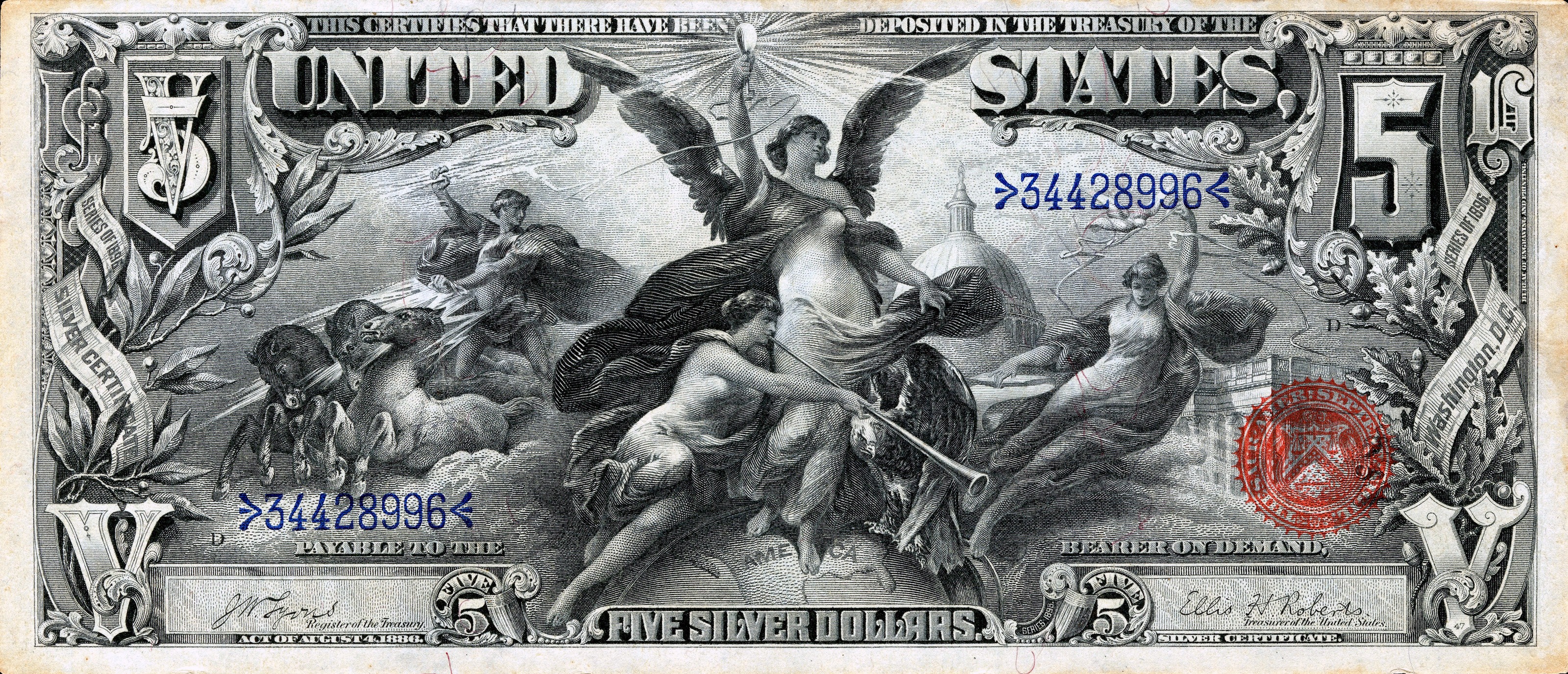
Five dollars: Electricity as the Dominant Force in the World, by Walter Shirlaw. The figures are partly bare. Boston society women are said to have objected and some bankers to have refused the note; that “banned in Boston” began here is also said, and has not been shown.
Five dollars: Electricity as the Dominant Force in the World, by Walter Shirlaw. The figures are partly bare. Boston society women are said to have objected and some bankers to have refused the note; that “banned in Boston” began here is also said, and has not been shown.National Numismatic Collection, Smithsonian National Museum of American History; image by Godot13, by way of Wikimedia Commons. Public domain.
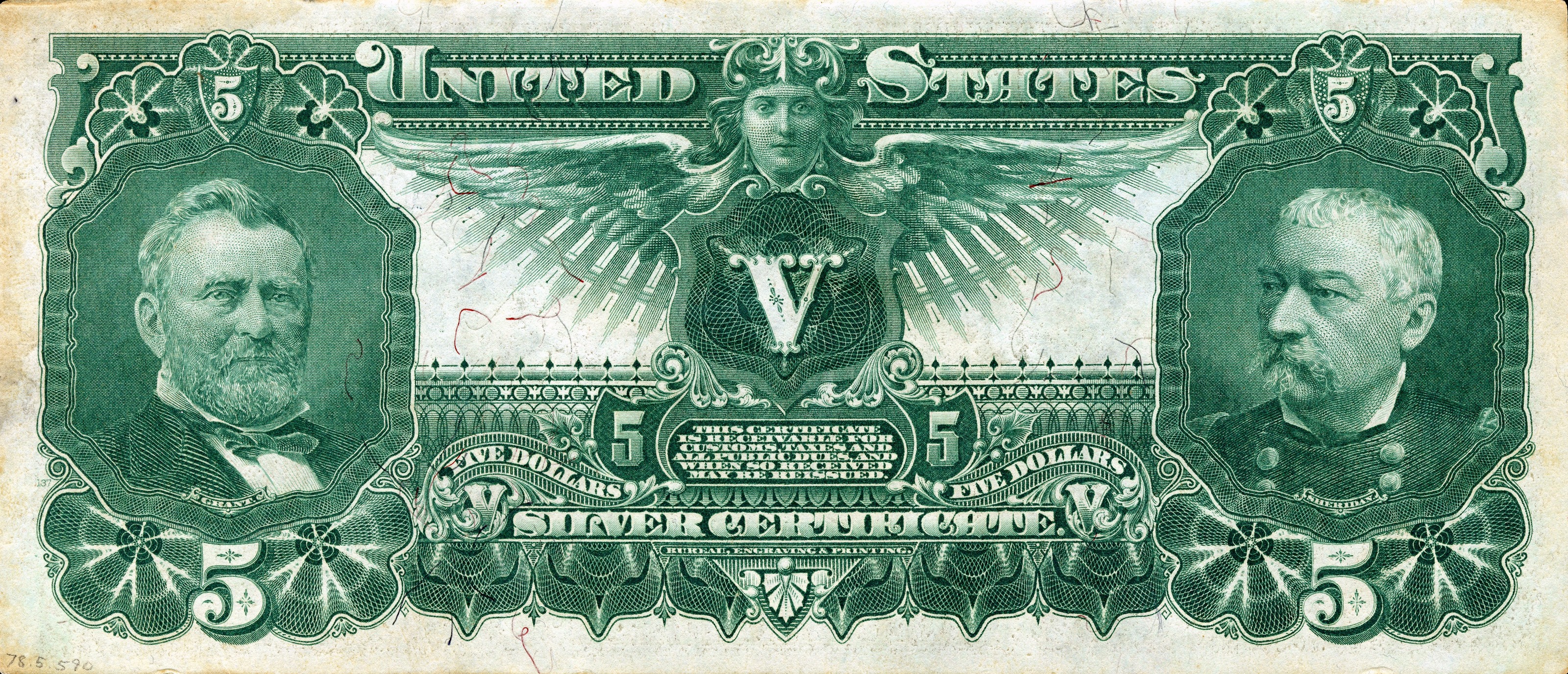
The back of the five: Ulysses S. Grant and Philip Sheridan.
The back of the five: Ulysses S. Grant and Philip Sheridan.National Numismatic Collection, Smithsonian National Museum of American History; image by Godot13, by way of Wikimedia Commons. Public domain.

The big notes

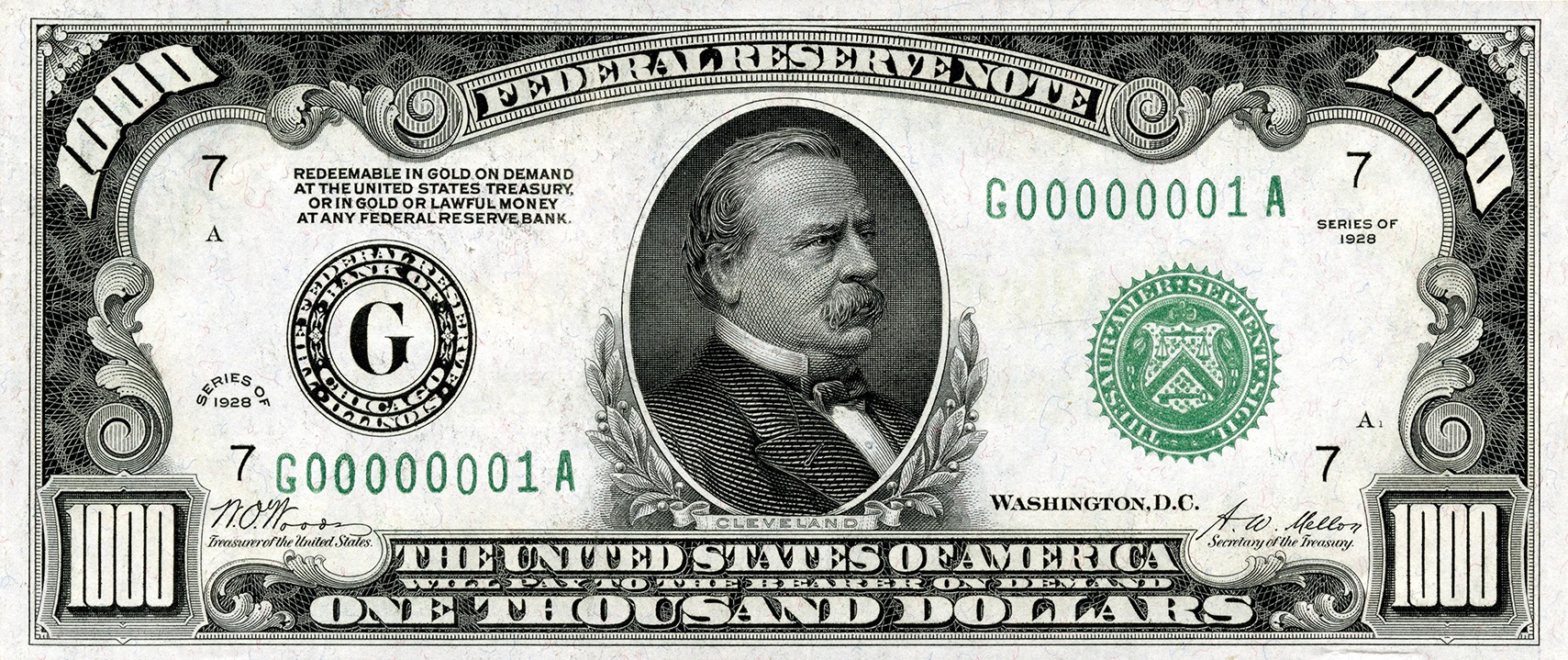
Then the big ones: five hundred, one thousand, five thousand and ten thousand dollars, used mainly by banks and the government for large transactions. The Series 1918 Federal Reserve notes put John Marshall on the $500, Alexander Hamilton on the $1,000, James Madison on the $5,000 and Salmon P. Chase on the $10,000. The small notes of 1928 and 1934 kept Madison and Chase and moved William McKinley and Grover Cleveland onto the two smaller ones.
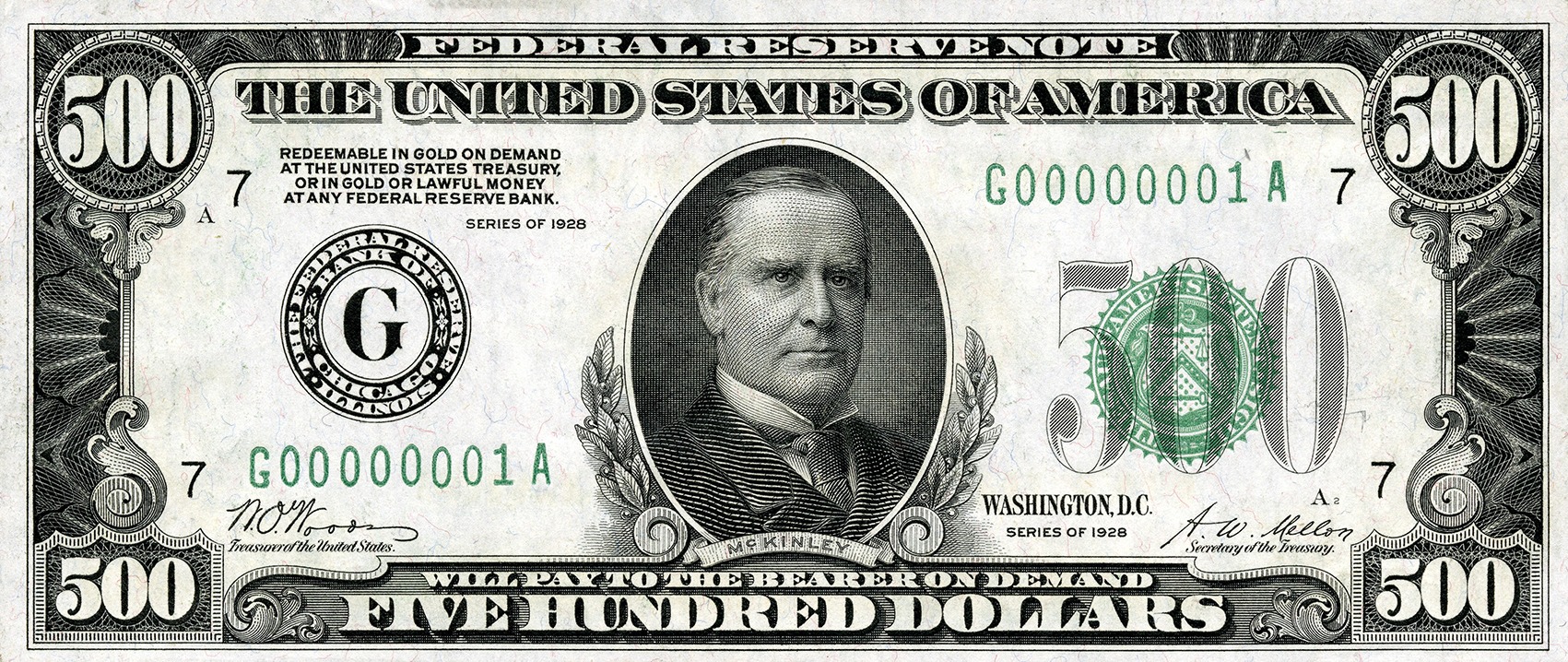
Five hundred dollars, Series 1928, William McKinley. Read the left side: “Redeemable in gold on demand at the United States Treasury, or in gold or lawful money at any Federal Reserve Bank.” Five years later Executive Order 6102 called that gold in.
Five hundred dollars, Series 1928, William McKinley. Read the left side: “Redeemable in gold on demand at the United States Treasury, or in gold or lawful money at any Federal Reserve Bank.” Five years later Executive Order 6102 called that gold in.National Numismatic Collection, Smithsonian National Museum of American History; image by Godot13, by way of Wikimedia Commons. Public domain.
One thousand dollars, Series 1928, Grover Cleveland. All four of the Smithsonian’s 1928 notes are serial number 1.
One thousand dollars, Series 1928, Grover Cleveland. All four of the Smithsonian’s 1928 notes are serial number 1.National Numismatic Collection, Smithsonian National Museum of American History; image by Godot13, by way of Wikimedia Commons. Public domain.
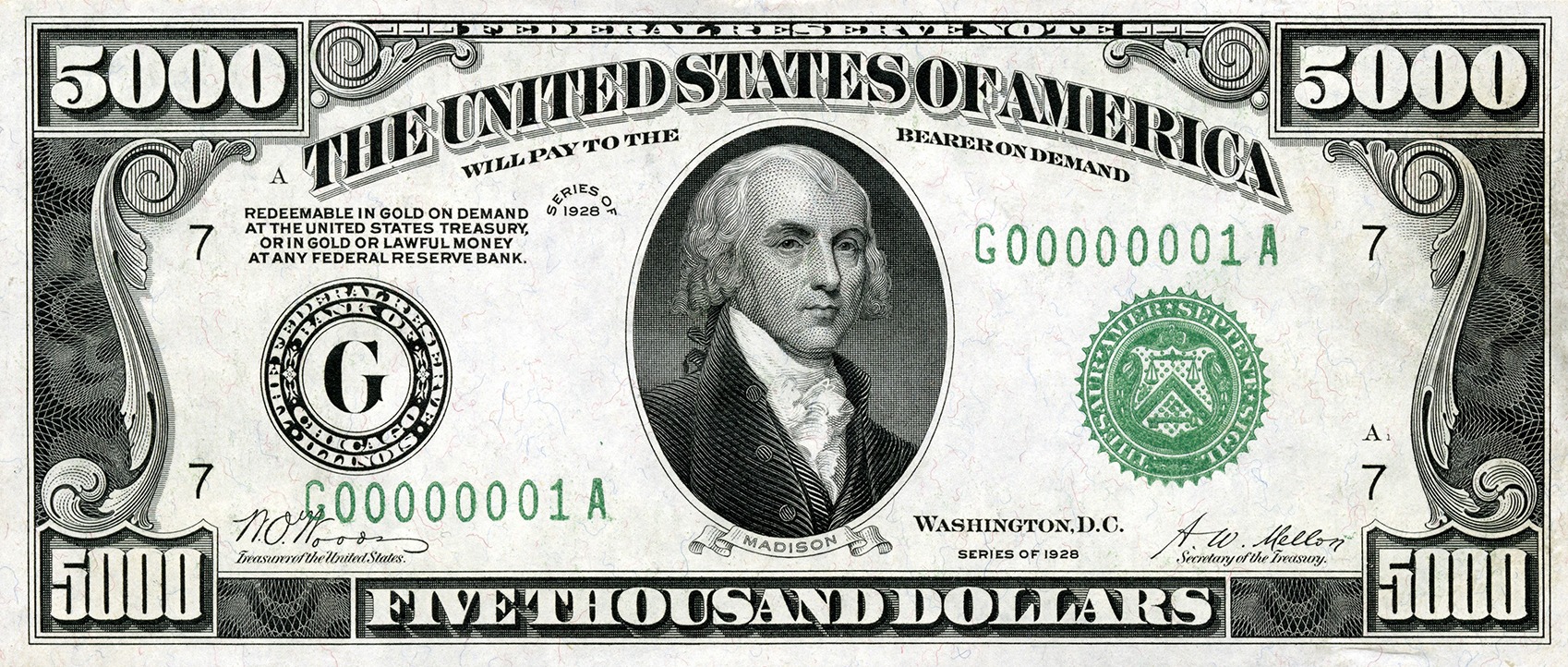
Five thousand dollars, Series 1928, James Madison.
Five thousand dollars, Series 1928, James Madison.National Numismatic Collection, Smithsonian National Museum of American History; image by Godot13, by way of Wikimedia Commons. Public domain.
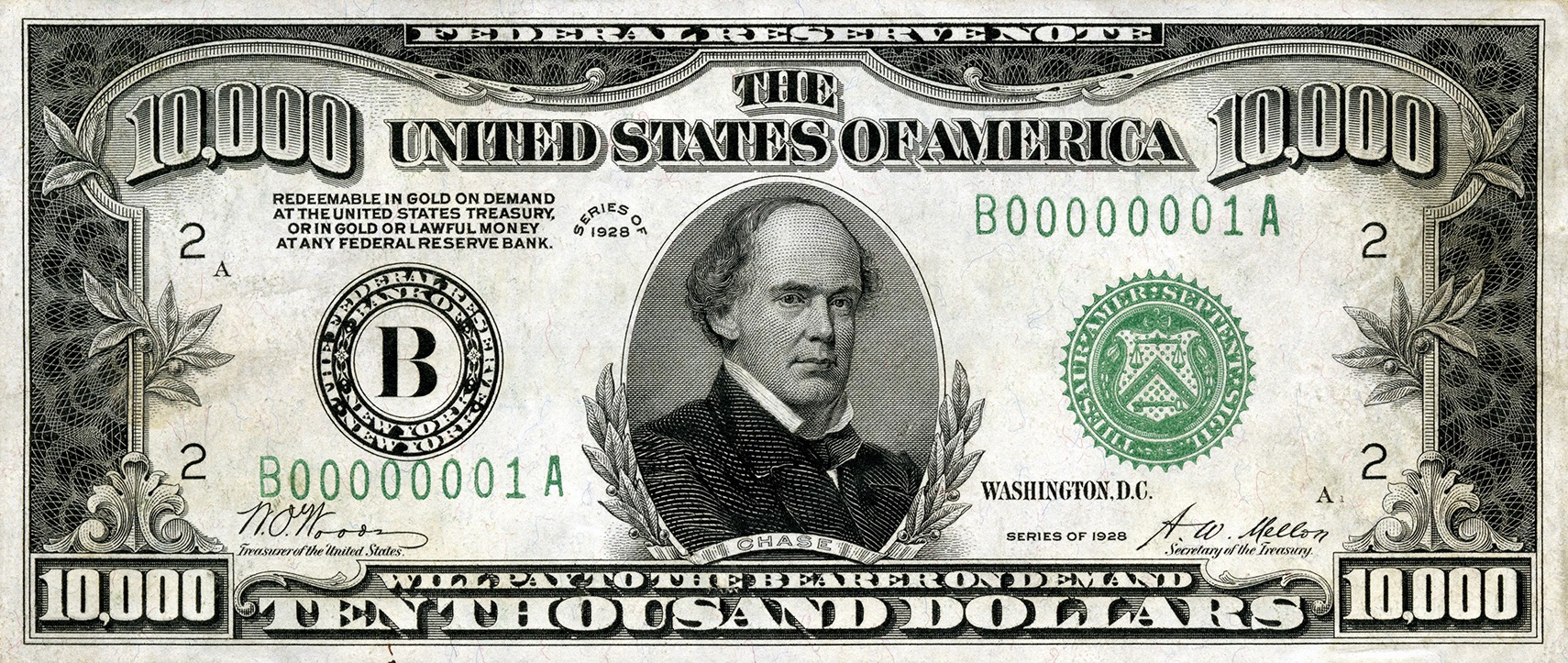
Ten thousand dollars, Series 1928, Salmon P. Chase, Lincoln’s Treasury Secretary. In 2009, 336 of the ten-thousands were known to exist, against 165,372 of the thousands.
Ten thousand dollars, Series 1928, Salmon P. Chase, Lincoln’s Treasury Secretary. In 2009, 336 of the ten-thousands were known to exist, against 165,372 of the thousands.National Numismatic Collection, Smithsonian National Museum of American History; image by Godot13, by way of Wikimedia Commons. Public domain.

They were last printed on 27 December 1945. On 14 July 1969 the Federal Reserve discontinued them for “lack of use” and began destroying the ones the banks sent back. They are still legal tender.

Above them sits one more. The Gold Reserve Act of 1934 created a special series of gold certificates to account for the gold the Federal Reserve Banks held for the United States, and the top of it was $100,000, with Woodrow Wilson. It was never in circulation. It passed only between Federal Reserve Banks, the series ended in 1940, and no example is known to have left government hands except as a specimen. It cannot legally be held privately, other than one-sided specimens.
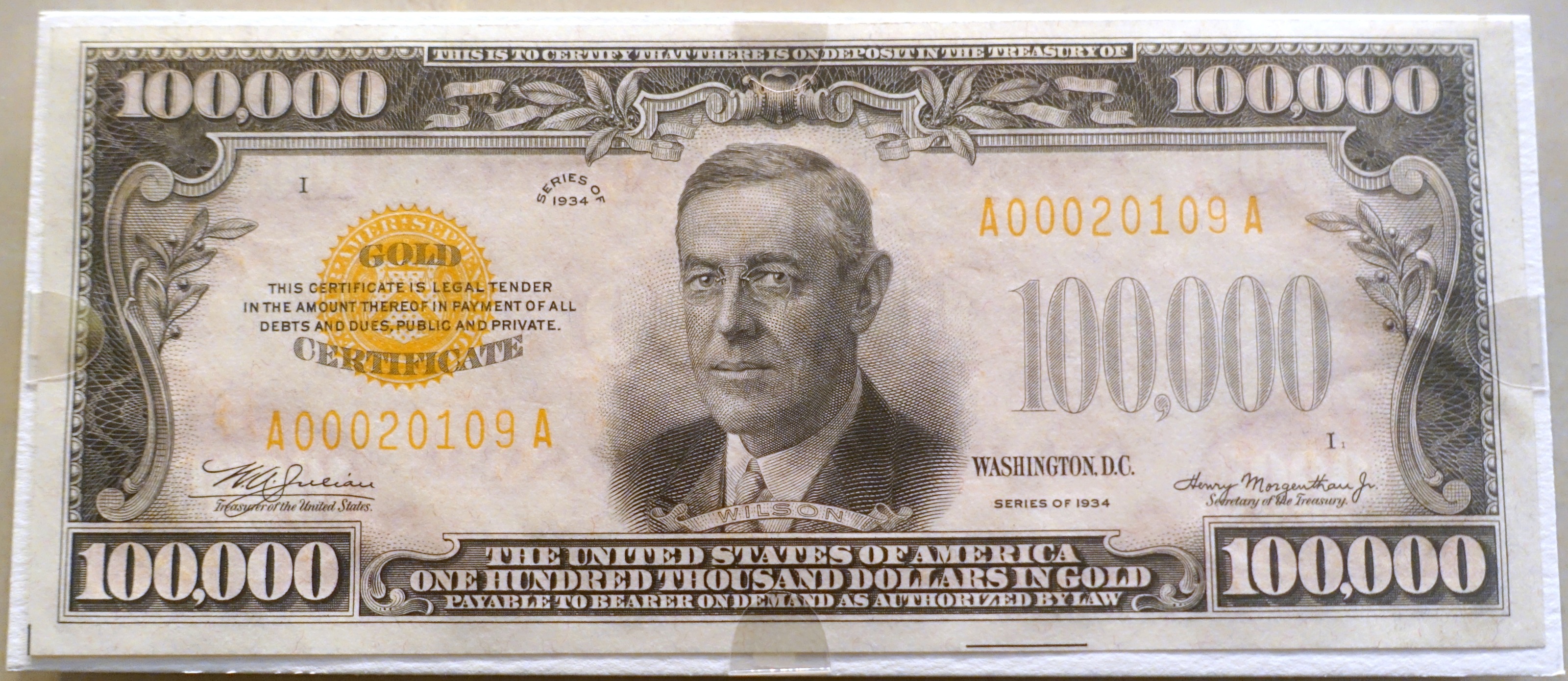
One hundred thousand dollars, gold certificate, Series 1934, as displayed at the National Museum of American History. The note says “payable to bearer on demand” and “legal tender”; it was never issued to anyone outside the Federal Reserve.
One hundred thousand dollars, gold certificate, Series 1934, as displayed at the National Museum of American History. The note says “payable to bearer on demand” and “legal tender”; it was never issued to anyone outside the Federal Reserve.Photographed on display at the National Museum of American History by Daderot, by way of Wikimedia Commons. Public domain.

The paper itself

The paper came from Dalton. In 1879 Winthrop Murray Crane won the contract to supply currency paper to the Bureau of Engraving and Printing, and the company built four new mills to make it, engineered by David H. Tower. The biography of Tower in Western Massachusetts: A History, 1636–1925, published in 1926, describes the Crane mill “in which all the money paper for the United States Government has been made for over forty years.” If that is right, every large-size note on this page from 1890 on was made on Dalton paper. The silk threads in it were a Crane method too, developed in 1844 to mark the denomination and frustrate counterfeiters. The Crane Memorial and Crane Museum pages tell the rest.

The silver behind the paper outlasted the gold. Gold certificates had to be surrendered in 1933, and holding one stayed illegal until 24 April 1964, when the Treasury let collectors have them back. Silver certificates could be exchanged for silver dollars until March 1964 and for raw silver until 24 June 1968. After that, a promise to pay in metal was a promise to pay in other paper.

VIII. 5 April 1933

Five weeks into the first term, Franklin Roosevelt signed Executive Order 6102, “Forbidding the Hoarding of Gold Coin, Gold Bullion and Gold Certificates.” Gold had to be delivered to a Federal Reserve Bank “on or before May 1, 1933” and was paid for at face value — $20.67 the ounce. The penalty for not doing it was a fine of up to ten thousand dollars, ten years’ imprisonment, or both.
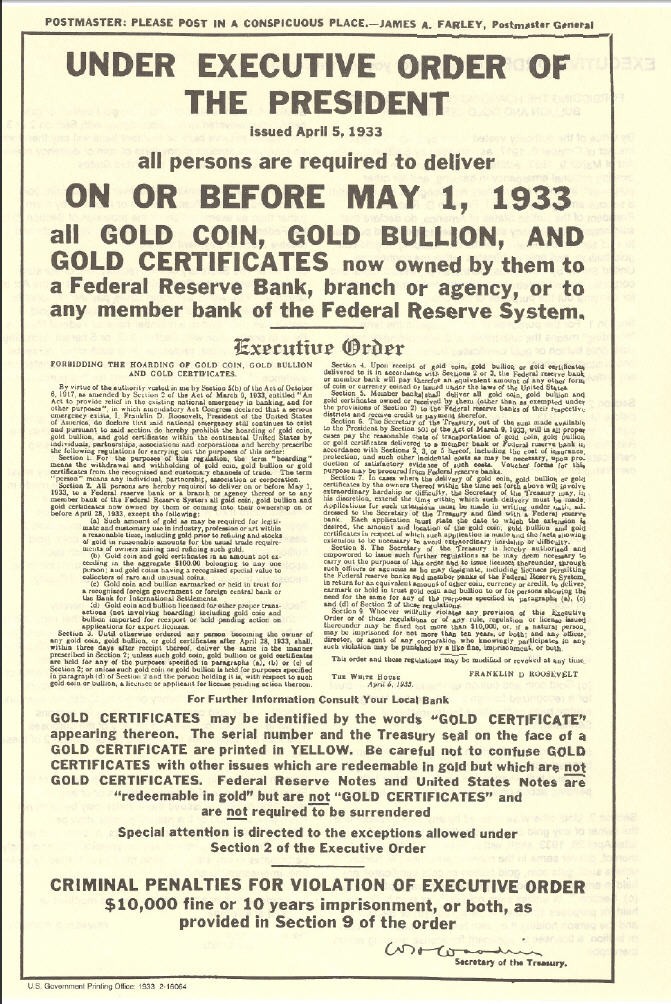
The notice as it was posted. The exemptions are section 2, and the one that mattered to a household is (b).
The notice as it was posted. The exemptions are section 2, and the one that mattered to a household is (b).United States Government Printing Office, by way of Wikimedia Commons. Public domain.
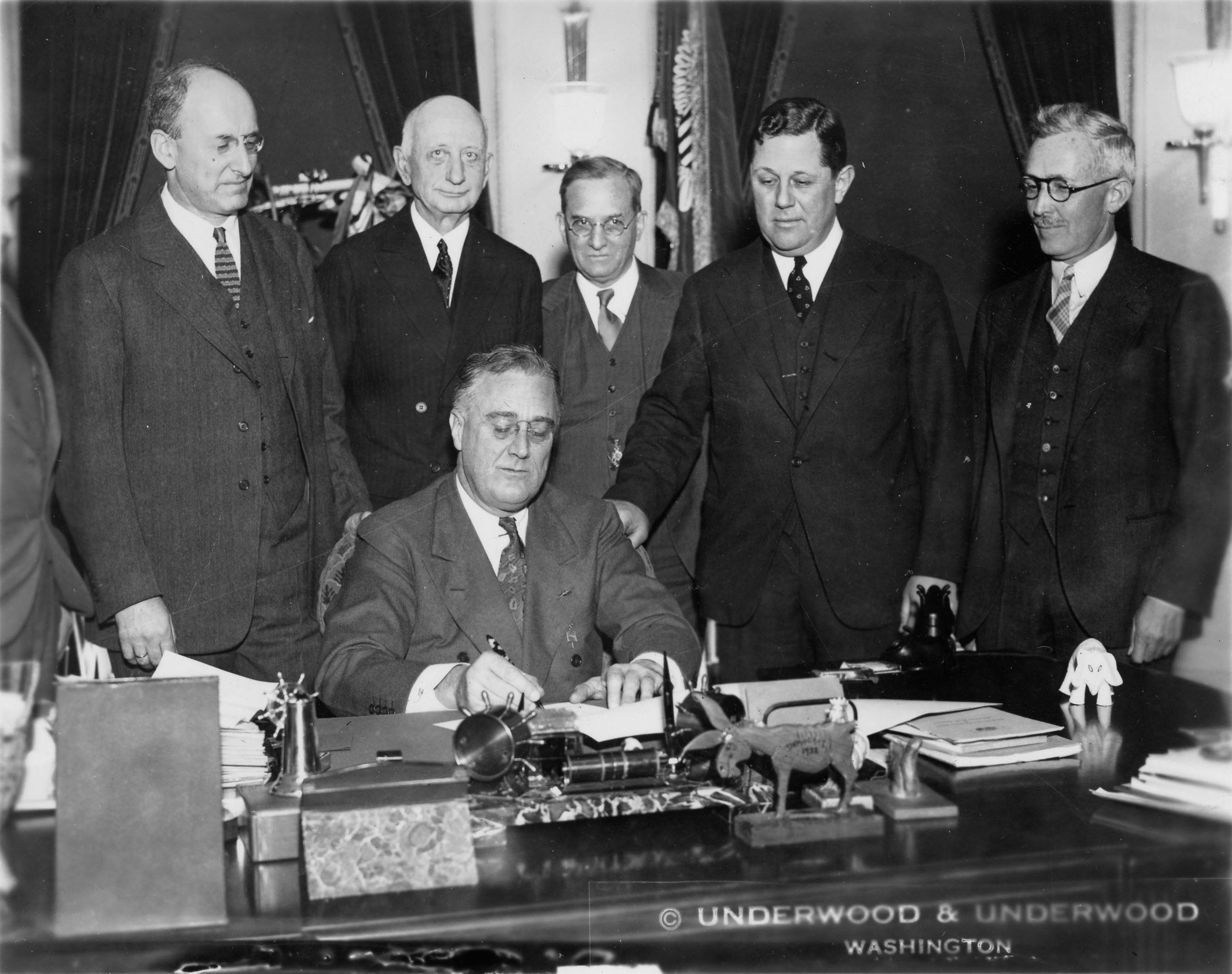
Roosevelt signing the Gold Reserve Act, 30 January 1934. It moved all monetary gold to the Treasury, revalued the dollar from $20.67 to $35 the ounce, and required that monetary gold be held as bars. Coins were forbidden.
Roosevelt signing the Gold Reserve Act, 30 January 1934. It moved all monetary gold to the Treasury, revalued the dollar from $20.67 to $35 the ounce, and required that monetary gold be held as bars. Coins were forbidden.Federal Reserve, by way of Wikimedia Commons. Public domain.

Two exemptions are the reason this story can end anywhere but a furnace. The order let a person keep “Gold coin and gold certificates in an amount not exceeding in the aggregate $100” — five double eagles — and it exempted “gold coins having a recognized special value to collectors of rare and unusual coins.”

So if a Lenox household had five gold pieces in a drawer in April 1933, they were entitled to keep all five. If they had twenty, they were not.

IX. The coin that was never issued

The Mint struck 445,500 double eagles dated 1933 and issued none of them. Almost all were melted in late 1934. Two were kept for the National Numismatic Collection, and those two are what the photograph below shows.

One of them is lawful, and that is an accident of paperwork. In 1944 King Farouk of Egypt bought a 1933 double eagle, and his ministers applied to the Treasury for a license to export it. The license was granted — days before the theft from the Mint was discovered. That clerical mistake is the whole difference between this coin and every other one, because the government had licensed this coin out of the country with its own signature on the paper.

It surfaced again in 1996, in a Secret Service sting at the Waldorf-Astoria, in the hands of the British dealer Stephen Fenton. The civil case settled in 2001: ownership reverted to the United States, and the Treasury then issued a document to “issue and monetize” that single coin — a twenty-dollar payment that made it, sixty-eight years late, legal tender. It was sold at auction on 30 July 2002 for $7,590,020, half the hammer price to the Treasury and half to Fenton, plus the twenty dollars. The same coin sold again on 8 June 2021 for $18,872,250, the most ever paid for a United States coin.
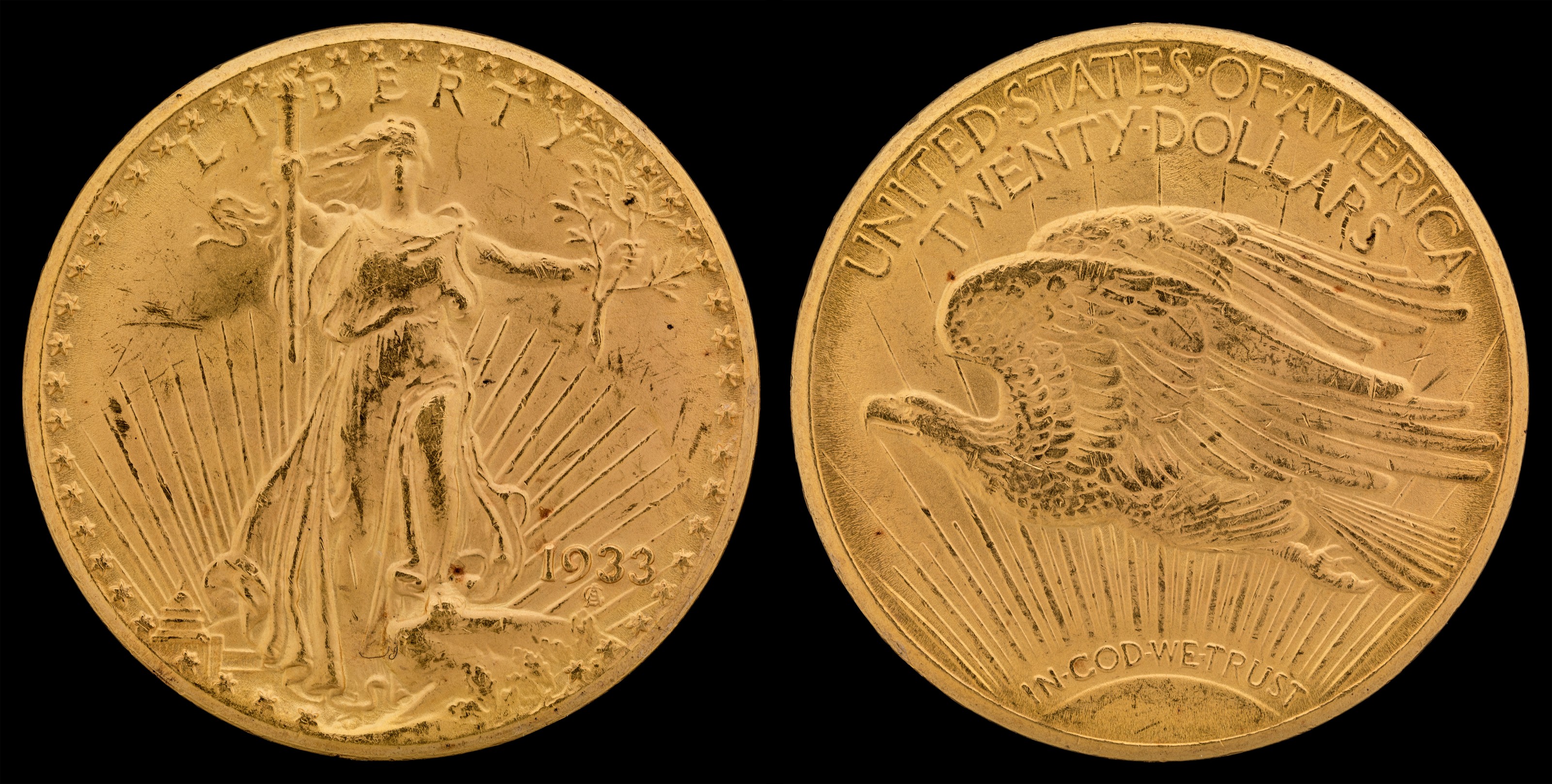
The 1933 double eagle, Smithsonian specimen — one of the two the Mint kept back when it melted the rest. Around twenty others left the building improperly; nine were recovered and destroyed between 1944 and 1952. Every one still outstanding is United States government property, and holding it is a crime.
The 1933 double eagle, Smithsonian specimen — one of the two the Mint kept back when it melted the rest. Around twenty others left the building improperly; nine were recovered and destroyed between 1944 and 1952. Every one still outstanding is United States government property, and holding it is a crime.National Numismatic Collection, Smithsonian National Museum of American History; photograph by Jaclyn Nash. Public domain.

X. What the rumor is worth

Nothing in the above proves that anyone at Elm Court was ever handed a gold coin. What it does is give the story a shape it can be tested against.

Emily Thorn Vanderbilt was at Elm Court from the 1880s until 1946, which is the entire arc of this story. A coin given in the 1890s was a Liberty Head design drawn before the Civil War. A coin given after 1908 was a Saint-Gaudens or a Pratt — the most beautiful objects the United States has ever put into general circulation, handed to a gardener at the end of August. And any coin given after the spring of 1933 was, by law, a thing that had to be handed back.

The boarding story finds sixty-two per cent of the indoor staff living where they worked, and the Eastover story finds a directory naming eight people out of sixty-four. The seasonal workforce this rumor is about is precisely the workforce the records are worst at seeing. A gift that left no paper is not evidence of nothing. It is the ordinary condition of the subject.

The Elm Court gold-coin story is given here as unverified: no published source recording it has been found in the Elm Court, Vanderbilt or Sloane literature, in Lenox and Stockbridge local history, or in general accounts of Gilded Age domestic service, and no comparable season-end gold custom has been found named at another American estate. Emily Thorn Vanderbilt (1852–1946) is distinguished here from her daughter Emily Vanderbilt Sloane Hammond (1874–1970), who is sometimes meant by the same name. Coin designs, designers, dates, mints, mintages and the quoted descriptions of obverses and reverses are from the Wikipedia articles on the Barber coinage, the Indian Head cent, the Lincoln cent, the Liberty Head nickel, the Buffalo nickel, the Mercury dime, the Standing Liberty quarter, the Walking Liberty half dollar, the Morgan dollar, the Peace dollar, the gold dollar, the half eagle, the Liberty Head double eagle, the Indian Head eagle, the Saint-Gaudens double eagle, the Indian Head gold pieces and the 1933 double eagle. The twenty-five year clause and the abolition of the gold dollar are quoted from the Act of 26 September 1890 as published by the United States Mint. Roosevelt’s “atrocious hideousness” letter of 27 December 1904 to Leslie Mortier Shaw, his January 1906 instruction on high relief, Saint-Gaudens’s description of the striding figure, Barber’s “never coin” of 26 November 1906 and Pratt’s complaint are quoted as those articles give them. The phrase “pet crime”, often attached to Roosevelt’s coinage campaign, is not quoted here because no primary text using it was found. The 1944 Farouk export license, the 1996 Waldorf-Astoria seizure from Stephen Fenton, the 2001 settlement, the Treasury document to “issue and monetize” the coin and the division of the 2002 proceeds are from the Wikipedia article on the 1933 double eagle, quoted as it gives them; the auction house for the 2002 sale is not named here because the accounts this site could check do not agree. Executive Order 6102 is quoted from the text at the American Presidency Project; the Gold Reserve Act of 1934 from the Federal Reserve History essay. Wage figures are from the National Park Service’s account of household management at the Frederick W. Vanderbilt mansion, Hyde Park, and from the University of Missouri prices-and-wages guide citing Workers of the Nation (1900); the arithmetic against them is this site’s. The Elm Court staff count of twenty-eight is from the Elm Court story. Where accounts conflict — the model for the Buffalo nickel’s bison, the reason for the Standing Liberty revision, the identity of the Mercury dime’s model — both readings are given rather than one chosen. The designer of the Liberty Head eagle is not named here because it could not be verified directly. No figure is given for how much gold coinage was melted after 1933, because none was found that could be checked. For the paper money: the kinds of note, their dates, backing and redemption are from the Wikipedia articles on United States Notes, national bank notes, gold certificates, silver certificates, Federal Reserve notes and the Treasury notes of 1890–1891; the note sizes and the Series 1928 sheet of twelve from the article on large-sized notes; the Educational series titles, artists, engravers, back portraits and the reported Boston objections, which that article gives as reported rather than established, from the article on the Educational Series; portraits, the 1945 and 1969 dates, the 2009 survival counts and the $100,000 note’s status from the article on large denominations of United States currency, with the Series 1934 gold certificates’ purpose from the article on gold certificates. The Grand Watermelon count and the 2014 Heritage sale are from the Treasury note article, which ties the nickname to Fr.379b; the Smithsonian note reproduced is Fr.379a, and the difference is left standing. The Housatonic National Bank’s charter, issues, totals and officers are from the Society of Paper Money Collectors’ National Bank Lookup, charter 1170; the lookup gives the 1922 president as “A. F. Riggs” only, and his identification with Austen Fox Riggs is this site’s inference. The 1879 currency-paper contract, the Tower mills and the 1844 silk threads are from the Wikipedia article on Crane Currency, which quotes the Tower biography in Western Massachusetts: A History, 1636–1925 (1926). The redemption clause, serial numbers and legends quoted from the notes are read from the notes themselves. Note images are from the National Numismatic Collection, digitized by Godot13, except the $100,000 certificate, photographed on display by Daderot. All coin photographs are public domain and credited individually; the Smithsonian and Bibliothèque nationale images were preferred wherever both existed. Diameters used in the scale composite are 18.00 mm for the quarter eagle (CoinWeek), 21.6 mm for the half eagle after 1840 and 27.0 mm for the eagle from 1838 (Wikipedia), and 34 mm for the Liberty Head double eagle (Wikipedia); weights 4.18 g and 33.44 g from the same. The composite is made from the four 1902 obverses reproduced beneath it, each cut to its own rim and set on one baseline at true relative diameter; the four source photographs fill their frames to within one and a half per cent of each other, so the rendered proportions are accurate to about two per cent.

Keep up with it

New properties go up here as the research turns them up.