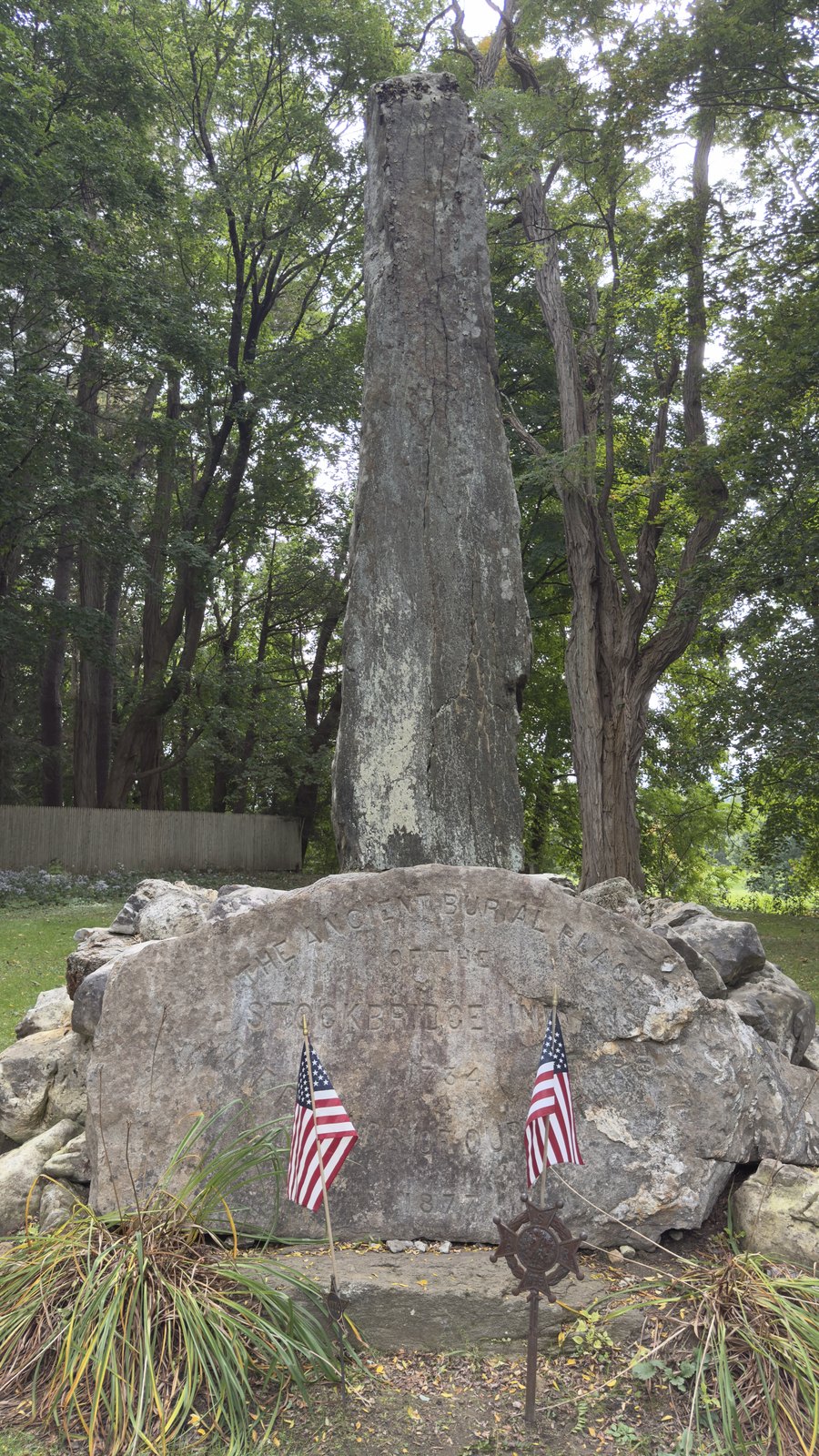
Every other page on this site begins with a document somebody filed — a deed, a plan, a schedule, a plate. This one begins with something said out loud, on a bridge, in front of people, two years ago. It is a document all the same, and it is the only one here in the language that was spoken on this ground first.
I. The text, as read
Written and read by Patrick White, then a member of the Stockbridge Select Board, at the dedication of the Ice Glen footbridge on 26 September 2024. He is also the creator of this site — which is why this page says so twice. A document reproduced here by the person who wrote it should be marked as such.
Wa’thatinik. Please, say it with me: Wa’thatinik. Translated, it means, ‘the Land Beyond the Mountains.’ What the ancient voices named this place we now know as the Berkshires. It may be hard for some of us to imagine, but for time immemorial Mohican was the language of these lands. Beyond this bridge lies an ancient forest now known as Ice Glen, so old that its same trees were already mighty when Chiefs Konkapot and Umpachene welcomed white settlers with some trepidation nearly 300 years ago.
Wa’thatinik. The words encourage us to imagine a time in this place when the forests were stewarded rather than owned. They encourage us to imagine a time in this place when we only took what was needed and gave thanks every day for that which was taken.
If these oak and hemlock and pine could talk, they might tell the story of Mohican and settler walking these same paths. Learning each other’s words and ways in the newly founded “Indian Town”. They might recount a time when Konkapot and John Sergeant together walked these woods. They would perhaps remind us to once again listen to one another, to shine a light in this modern world through a lens of timeless wisdom.
Wa’thatinik is but a fragment of the many words of these ancient, old growth woods. If the forest could speak, the stories it might tell. We are honored to take this moment to once again speak this phrase of the common tongue when these trees were young. Many of us hope that, going forward, as our Mohican friends share with us their timeless wisdom, we will together become better stewards of the rivers, meadows, lakes, and forests of Wa’thatinik — this beautiful ‘Land Beyond the Mountains’.
Thank you.
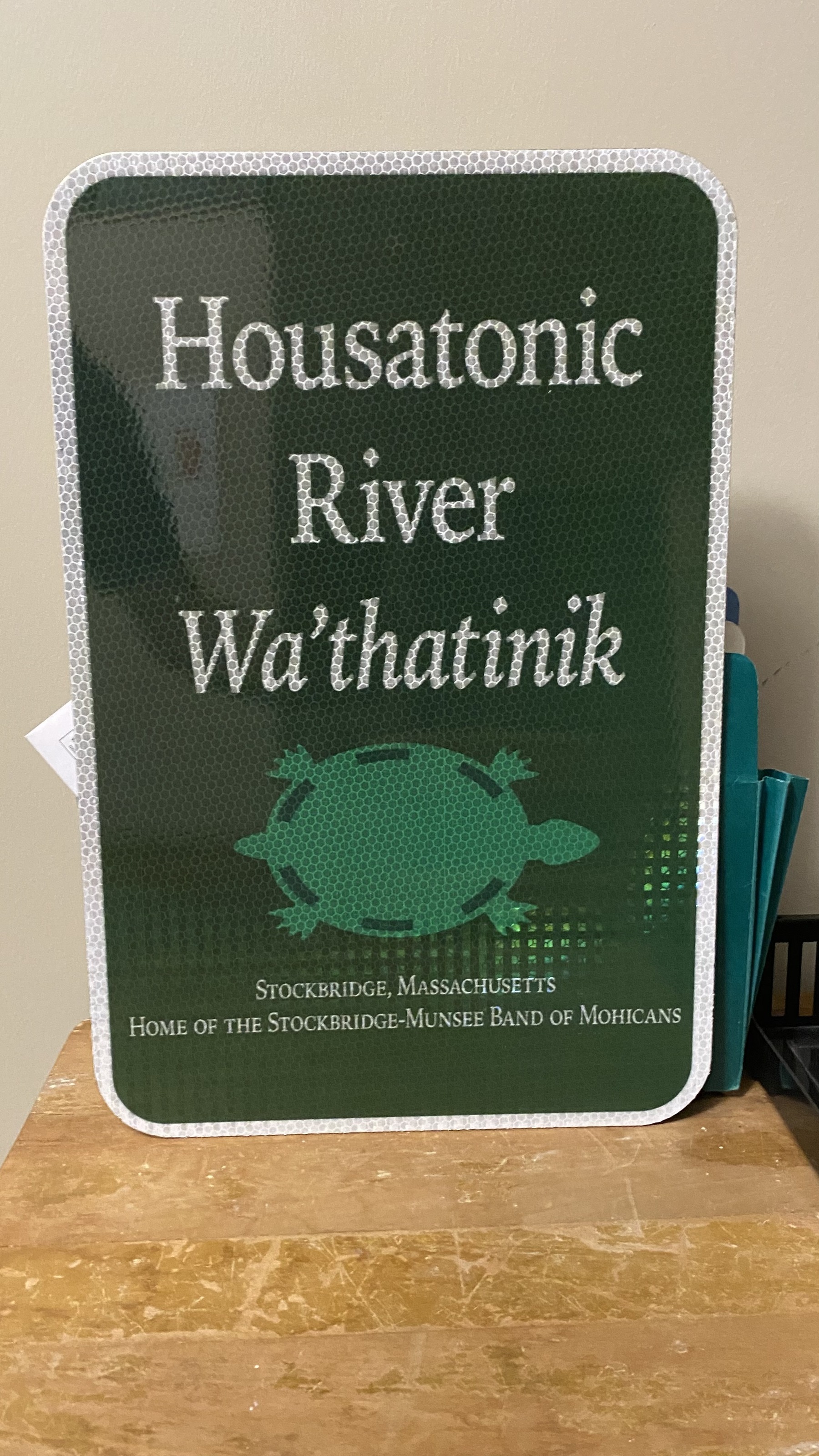
The word is not only spoken. It is posted. A Stockbridge road sign gives the Housatonic its Mohican name in the same spelling used at the dedication, under the line Home of the Stockbridge-Munsee Band of Mohicans and the Nation’s turtle. Two uses, two years apart, one of them municipal.
II. How the word got onto a road sign
When Stockbridge came to put the Mohican name on a sign at the river, Patrick White asked Bonney Hartley and others of the Stockbridge-Munsee Community which word they wanted on it. He expected the obvious answer: the Mohican name for the Housatonic.
That is not what came back. What Bonney chose was Wa’thatinik — the land beyond the mountains — the word for the whole of what is now called Berkshire County.
Which is a larger claim than a river, and a better one. A river name labels a feature. This one names the country.
III. Ten thousand years, and three hundred
People have been in these hills for something on the order of ten thousand years, and for all but the last sliver of that the land went by the name on that sign. It has been called the Berkshires for fewer than three hundred. On any honest accounting of time, the new name is the recent curiosity and Wa’thatinik is what the place is called.
That is the whole reason this page is in Before. Not as a preface to the real history — as the long middle of it, with everything else on this site arriving late.
IV. The trees were already old
In Ice Glen, many of the trees still standing in this old-growth forest were fully grown in 1734. They are still alive.
They were there to witness the first time the Mohican and English languages were spoken together — by Konkapot and John Sergeant, as they navigated this brave new world and this brave new experiment in multi-cultural governance that would start as Indian Town and become, just a few years later, Stockbridge.
The dedication in section I was read at the bridge that takes you to them.
Sources
The text in section I was written and read by Patrick White, then a member of the Stockbridge Select Board and the creator of this site, at the dedication of the Ice Glen footbridge, Stockbridge, on 26 September 2024. It is reproduced in full and verbatim from his own copy, with its punctuation and capitalization as written. It is included here as a dated document of that ceremony, and the authorship is stated plainly because this site is his. The word and its translation are the Stockbridge-Munsee Community’s, not this site’s. The spelling used throughout is the one on the Stockbridge road sign and in the dedication text, both of which read Wa’thatinik. That Bonney Hartley chose the word, when asked for the Mohican name to put on the sign and in preference to a name for the river itself, is Patrick White’s account of the exchange and is given as that. The span of human presence in these hills is given here in round figures and not from a cited excavation; what is exact is the other number, the fewer than three hundred years since the county was named Berkshire. That many Ice Glen trees standing today were full grown by 1734 is the account given locally of that old-growth stand and is not here measured or cored. Konkapot and Umpachene, the charter of 1737 and the founding of the mission town are treated with their sources on the testimony page and in the town's published history. The road sign photographed in section I is a Stockbridge municipal sign; its wording and spelling are transcribed as they appear on it. Photograph: the Indian Monument at the west end of Main Street, raised in 1877; photographed by Patrick White on 4 October 2026. Nothing on this page is published with the endorsement of the Stockbridge-Munsee Community or should be read as speaking for it.