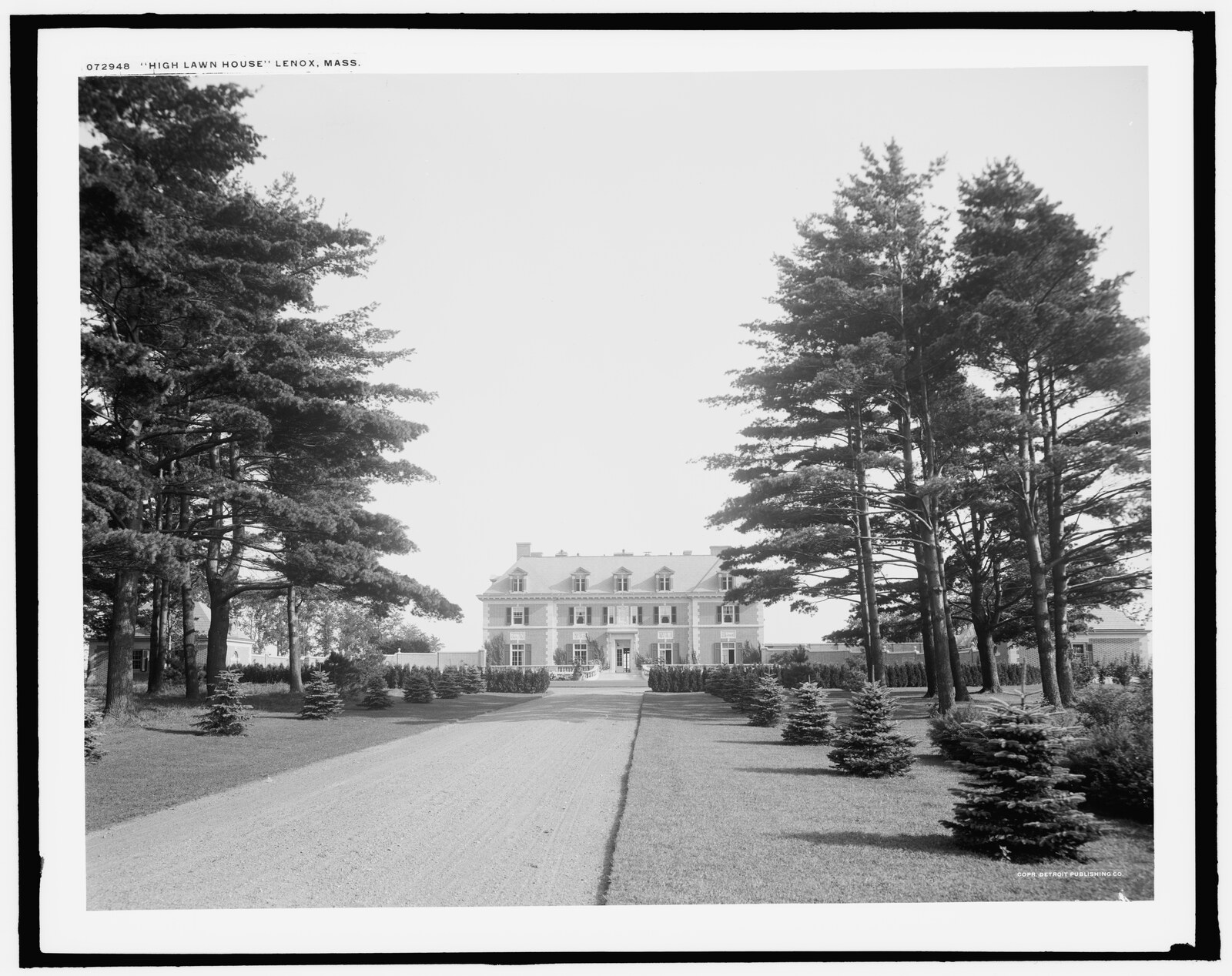
I. A wedding present on somebody else’s farm
The ground was a working farm first. It was laid out in 1870 by Elizur Smith, a Lee paper manufacturer, as a farm and summer place for breeding trotting horses. Around 1885 a part of it was sold to Emily Thorn Vanderbilt and her husband William Douglas Sloane, who were building Elm Court next door.
In 1902 their daughter Lila Vanderbilt Sloane married William Osgood Field, and her mother gave the couple a piece of the holding. The house they built on it — the one in the photograph at the top of this page — was designed by Delano & Aldrich of New York and finished in 1910: red brick, hipped roof, dormers, limestone quoins, and over the French doors of each bay a bas-relief by Lila’s cousin Gertrude Vanderbilt Whitney.
That is the whole of the relationship, and it explains everything else on this page: why the place is large, why its payroll is larger than Elm Court’s, and why it appears in the directory under three different towns.
II. Three negatives, one campaign
The Detroit Publishing Company photographed it. Three plates survive in the Library of Congress, numbered consecutively on the negatives — 072948, 072949, 072950 — which is to say one visit, one afternoon, three set-ups: the house down its drive, the road in, and the border.
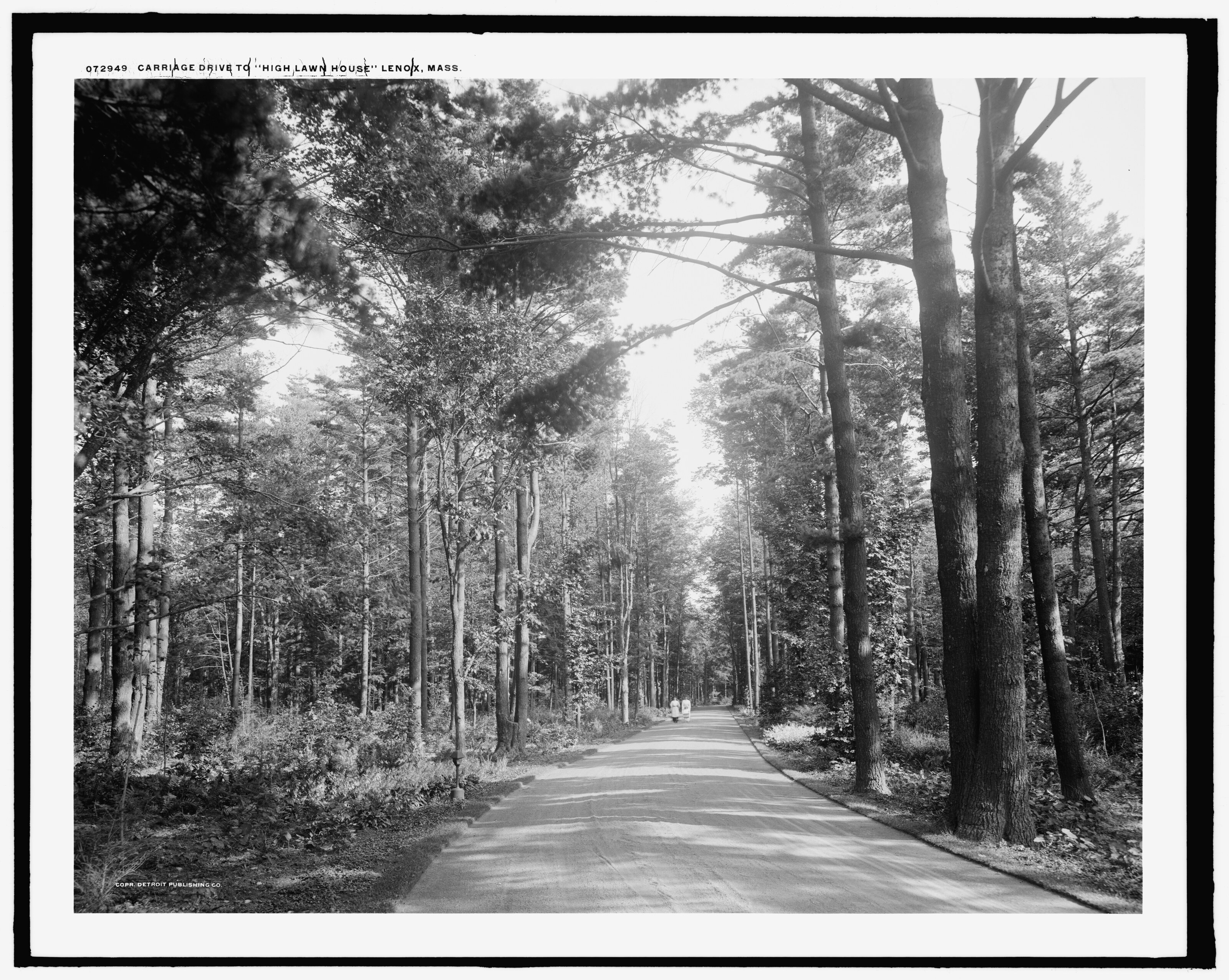
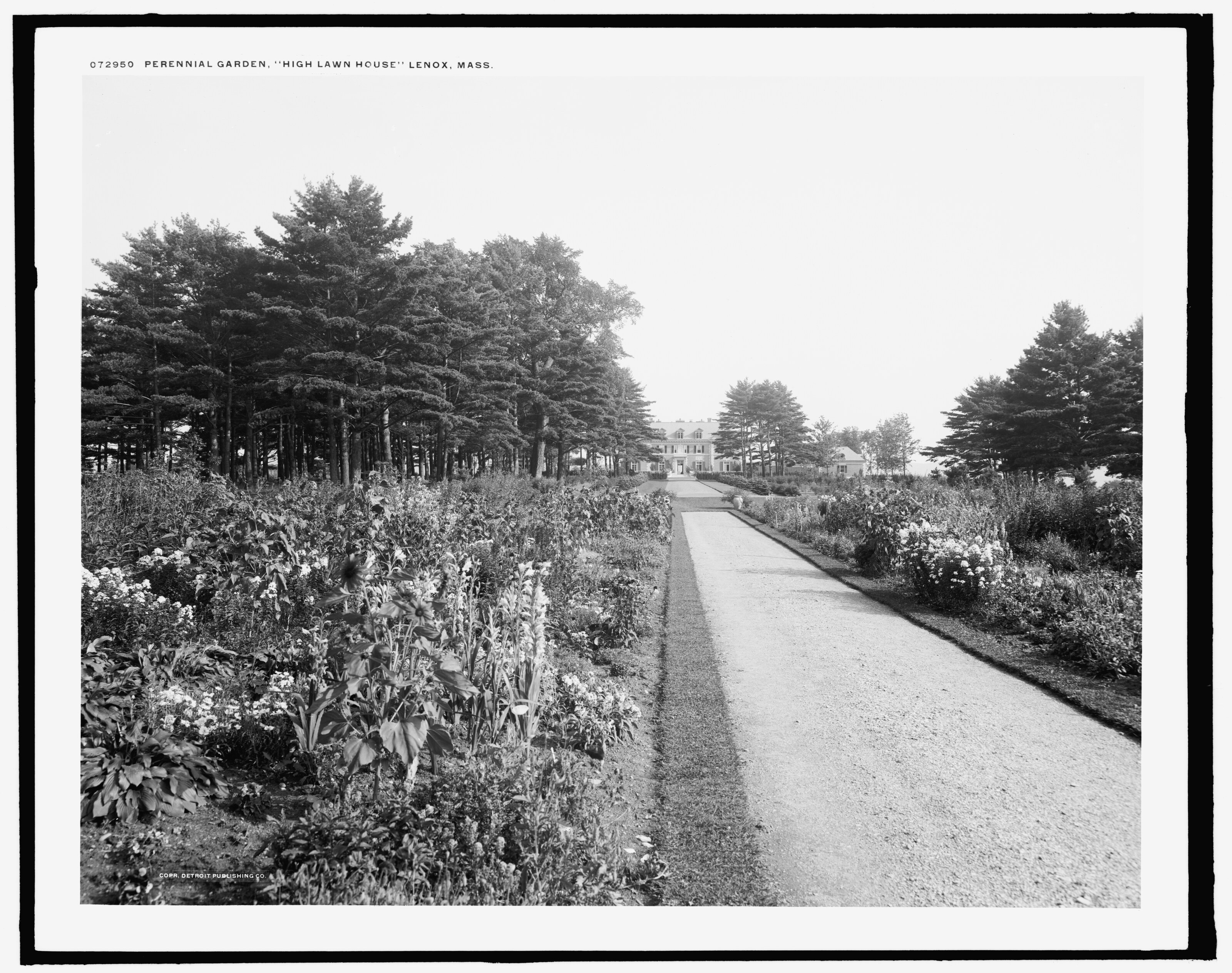
The Library of Congress dates the first two to 1910 and the third to 1900. They cannot both be right: the negative numbers run 072948, 072949, 072950 with nothing between them, and the same house stands at the end of the walk in the third that stands at the end of the drive in the first. If the house was finished in 1910, the 1900 on the perennial garden is a cataloguing slip and not a date.
What the third plate is really evidence of is the garden itself. Two borders, each the length of the walk, planted deep and in flower at once — the kind of thing that takes a head gardener, a frame yard and a staff, and that appears in this book as a name with no trade after it. The gardeners’ story is about the men who did that work. This is a photograph of it being done.
III. The other Highlawn
There is a fourth photograph, and it is a caution.
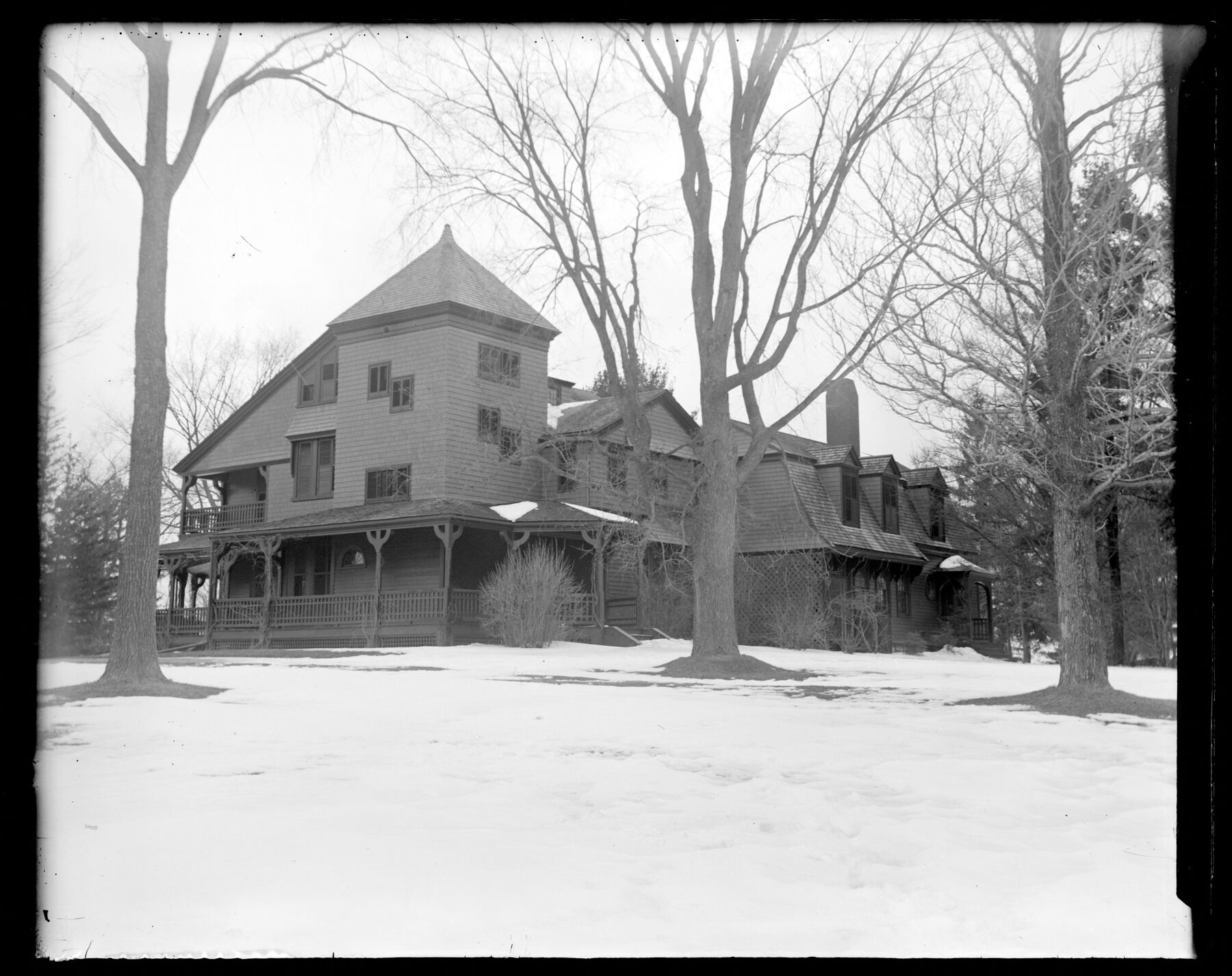
The Lenox Library has it as Highlawn in winter, a glass negative by Augustus E. Martin, dated by the cataloguer to about 1890–1904. What it shows is a shingled Queen Anne of the 1880s or early 1890s: a corner tower, a deep veranda on sawn brackets, a long service wing. It is not the brick house above, and no amount of squinting makes it one.
The cataloguer’s date range is the interesting part. It closes in 1904 — six years before Delano & Aldrich finished — and the property had been a farm with a summer house on it since 1870. So the likeliest reading is that this is the house that stood at High Lawn before the one that stands there now, photographed in the years when Lila Sloane was marrying and the new house was not yet begun. Likeliest is not established, and this site is not going to caption it as fact. What can be said is that the two photographs are of two buildings, and that whoever uses the winter view to illustrate the Field house is illustrating something else.
IV. Four names, three towns
The Elm Court story exists because of a mistake: the staff was counted out of the Lenox section alone, and Elm Court is in Lenox and Stockbridge. Half the people were missing. The rule that came out of it — search every town a house touches — gets its hardest test here, because High Lawn runs into Lee, Lenox and Stockbridge and the book will not call it the same thing twice.

Field William B. Osgood, (Lila) h “Highlawn House”, Summer — Lee
Field William B. Osgood, h “Highlawn”, Stockbridge — Lenox
Connor William B., supt. Highlawn Farm, h Summer cor Stockbridge rd — Lee
Walter J., (Elizabeth) emp High Lawn Farm, h 38 Crane av — Dalton
Highlawn. Highlawn House. Highlawn Farm. High Lawn Farm. Four strings for one place, in four towns’ pages, and only one of them has a space in it. The Lenox entry gives the owner and then points somewhere else — h “Highlawn”, Stockbridge — while the Lee entry, which is the one that names his wife, is the one a reader following Lenox cottages would never open. Lee is where the farm is, and Lee is where the payroll is.
The estate is also used as geography. Lee’s street list defines three roads by it: Summer Street, from junction Center and Laurel northwest to Highlawn; West Road, from Stockbridge north to Highlawn; Laurel Lake Cross Road, from Highlawn to Lenox line above Laurel Lake. A private house had become a place-name.
V. Thirty-seven lines
Read across all three sections and this is the establishment in 1926. Only four of them are given a trade.
Connor William B., supt. Highlawn Farm, h Summer cor Stockbridge rd
Wilkes George, (Mary) chauffeur, emp Highlawn, h Summer
Mary C. Miss, bookkeeper, emp Highlawn, res Lenox
Salvadori Amadeo, (Nunciata) laborer, emp “Highlawn”, h Lenox East rd
And then, with no trade printed at all, the rest of them: Araial Herbert J. and Mary W. · Bradford Earl · Breault Oscar · Buckler Harold · Creelin Clarence · Denault Victor · Fitzgibbons James · Giannini Mello · Grazzi Angelo and Maria, and Ernest · Koch Henry A. and Lillian L. · Kotski Theodore and Winnifred H. · LeDour John · LeMoal Yves and Jeanne · Luderitz Edward · Nugent John J. and Mary A., and Thomas · Posani Amelio · Siohan John · Tremblay Patrick and Alphonsine · Trend Douglas — with a Lureano and Albina on the West road, a William Jr. boarding at 115 Summer, and a James H. and Mary E. at 6 Laurel Avenue.
Thirty-seven lines, across three town sections. Elm Court, counted the same way out of the same volume, gives twenty-eight.
The comparison wants one qualification, and it is the superintendent’s own job title. Connor is supt. Highlawn Farm. By the early 1920s the Fields were building an all-Jersey dairy herd here, and a dairy is a payroll in a way that a lawn is not. So the thirty-seven are not thirty-seven house servants outnumbering Elm Court’s twenty-eight; they are a house and a working farm together against a house. The number is still the number. It is what the number is made of that differs.
One line explains all the others. Half of these people are recorded as bds Summer do — boarding on Summer Street, at the same address as the last person named. Lee’s pages say why:
Melbye Anna J. Mrs., boarding house, Highlawn Farm, h do
The estate ran its own boarding house and a woman named Anna Melbye kept it. That is where the unmarried men on this list slept, and it is the single most informative line about High Lawn in the entire book — printed under M, with no cross-reference to anything.
VI. Where the names come from
Set the list beside the one the Lenox Dale story produces and the same map appears. LeMoal, LeDour, Siohan are Breton. Breault, Tremblay, Denault are French-Canadian. Giannini, Grazzi, Posani, Salvadori are Italian. Nugent and Fitzgibbons are Irish, Koch and Luderitz German, Kotski Polish.
The directory records none of that, because the directory does not ask. It gives a name, sometimes a trade, an employer and a street. Everything in the paragraph above is inference from the spelling of surnames and is offered as that and nothing more — the book that settles it is the census, and for the village down the road it has been read.
VII. The Olmsted file with nothing in it
High Lawn has a job number. 03381 sits in the Berkshire register between Bernard Hoffman of Stockbridge and the Becket town improvement, and it contains no drawings whatever. What the archive holds under it is two bundles of correspondence:
W. D. SLOANE (MRS. WM. FIELD), LENOX, MASS., #3381 · CORRESPONDENCE · 1907
SLOANE, W. D., 1888 · CORRESPONDENCE · 1888
Read the heading slowly. The file is opened in W. D. Sloane’s name — the father, of Elm Court — with his daughter in parentheses after it, and it is filed at Lenox although the house the Fields lived in is entered in the same directory as being in Stockbridge, and the farm that fed it is in Lee. The date matters too: 1907, five years after the wedding present and three years before Delano & Aldrich finished. Somebody wrote to Brookline about this ground while the house was being thought about, and the office answered, and no plan came of it that has survived.
The register’s town is the address at the top of the letter. That is a habit worth knowing about before trusting any of the sixty-three.
VIII. Votes for women
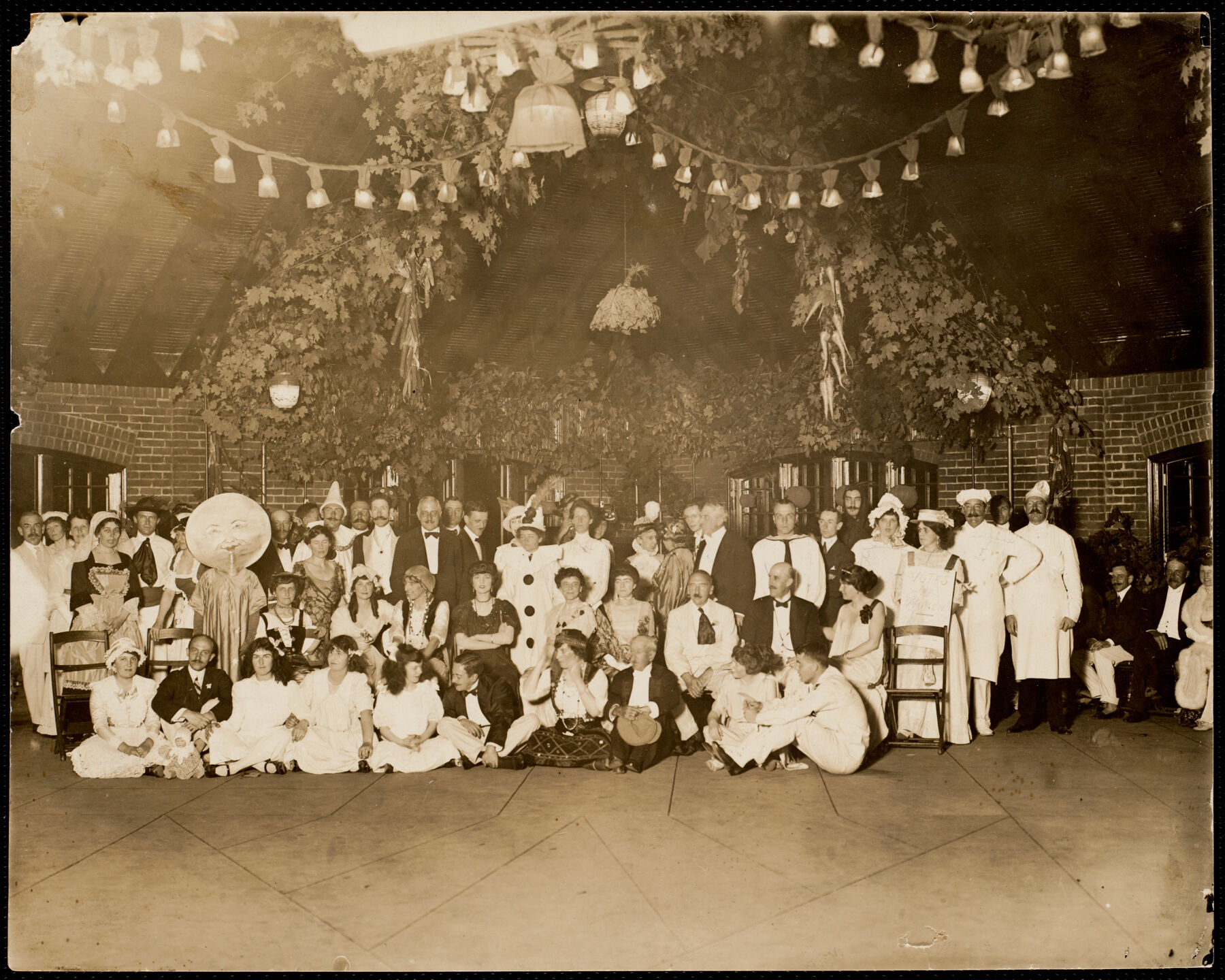
It is worth looking at this one for a while. A clown, two cooks in whites and tall hats, a man wearing an enormous painted moon, a woman in a domino, children cross-legged on a tiled floor at the front. The room has brick walls and a boarded roof open to the rafters; it is not a drawing room.
And at the right of the group, worn over the shoulders as a costume, a hand-lettered sandwich board.
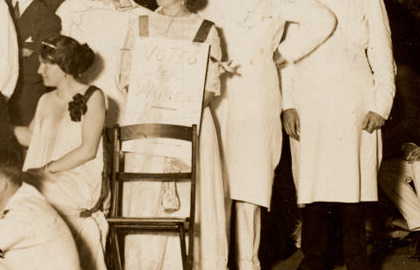
VOTES
FOR
WOMEN
The lettering is uneven and the board is homemade, the way the moon mask and the cooks’ hats are homemade. Massachusetts women would not get the vote for another decade. What the photograph shows is that the words were in the room, at a party, at the house of a Vanderbilt granddaughter, about 1910 — worn as a costume by somebody whose name the caption does not record. Whether it was meant as sympathy or as a joke the picture does not say, and this site is not going to decide for it.
Photographs: three Detroit Publishing Company negatives in the Library of Congress — “High Lawn House” Lenox, Mass. (LC-D4-72948, catalogued 1910), Carriage drive to “High Lawn House” (LC-D4-72949, catalogued 1910) and Perennial garden, “High Lawn House” (LC-D4-72950, catalogued 1900), all recorded by the Library as having no known restrictions on publication, and all three titles quoted as lettered on the negative. The disagreement between the 1900 and 1910 dates is the Library’s, not this site’s; the reading given in section II is an argument from the negative numbers and from the house itself. Lenox Library Association, Local History Photograph Collection, via Digital Commonwealth: “Highlawn in winter,” accession Am_GP_00132, a glass negative by Augustus E. Martin (1872–1961), dated by the cataloguer [ca. 1890–1904], rights stated as “No known copyright restrictions” and licensed CC BY; “Hallowe’en party at Highlawn,” accession rPR_IV_00007, dated [ca. 1910], rights status recorded as not evaluated and licensed CC BY-NC-ND. Those two titles are the cataloguer’s, not the photographer’s, and so is the identification of the house in the winter view — section III sets out why this site does not repeat it as fact. Directory entries: the Lee, Lenox, Stockbridge and Dalton sections of the Central Berkshire County Directory, 1926, which can be read and searched here; names, spellings and abbreviations are given as printed, including “Highlawn” as one word, which is how the book sets it, and the road definitions in section IV are quoted from Lee’s street list. The 1870 founding of the farm by Elizur Smith for trotting horses, the sale of part of it to Emily Thorn Vanderbilt and William Douglas Sloane about 1885, the 1902 marriage and gift, the attribution to Delano & Aldrich with completion in 1910, and the bas-reliefs by Gertrude Vanderbilt Whitney are from North American Country Estates, “High Lawn”; The Berkshire Edge, “Connections: High Lawn Farm,” also gives the marriage and the gift and the property as spanning Lee, Lenox and Stockbridge. The all-Jersey herd begun in the early 1920s, and Lila Vanderbilt Sloane Field’s death in 1934, are from High Lawn Farm’s own account of itself. Olmsted job 03381 is from the Olmsted Research Guide Online, Frederick Law Olmsted National Historic Site, National Park Service; the two file-unit headings are quoted exactly as the finding aid gives them.