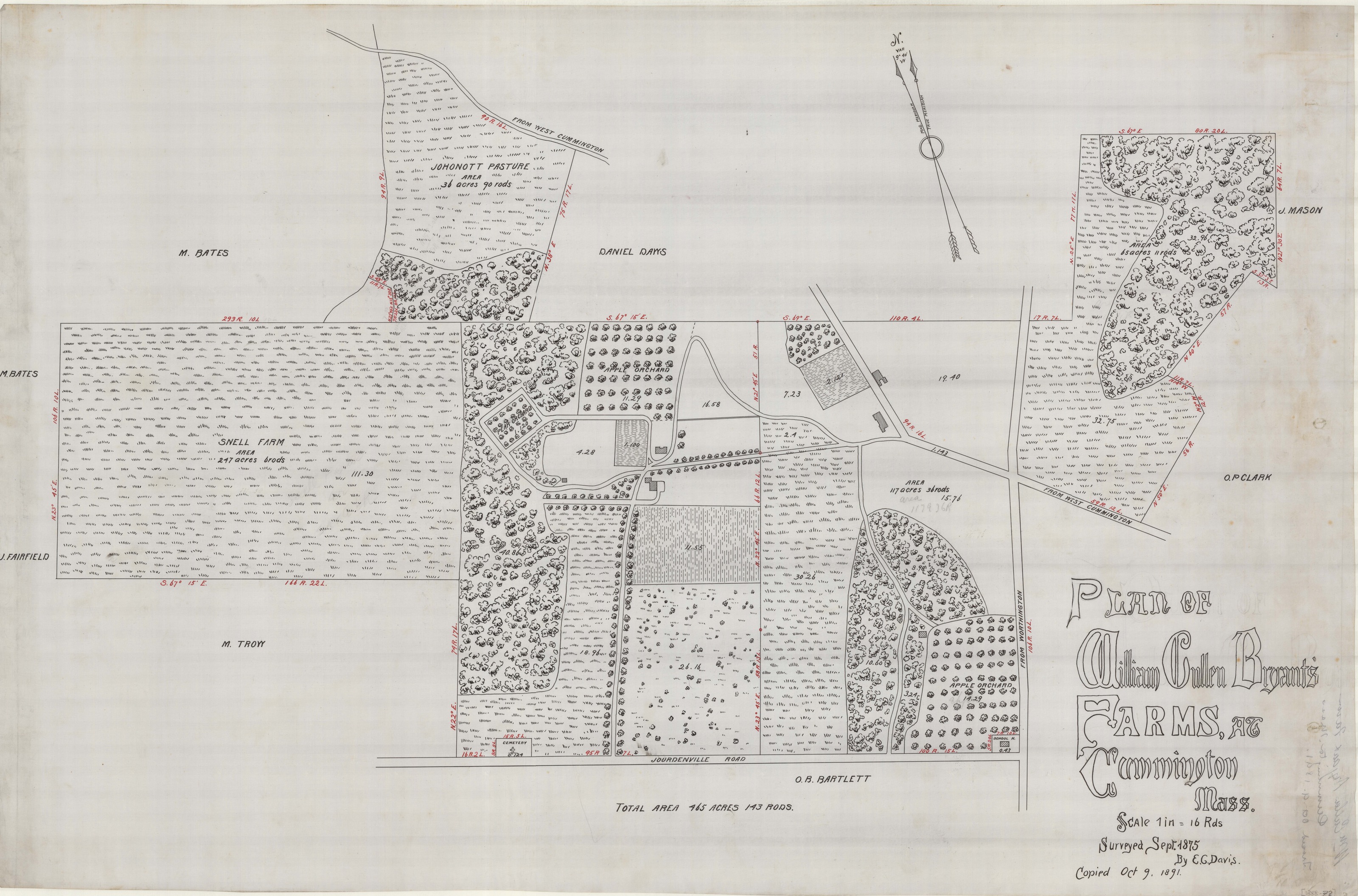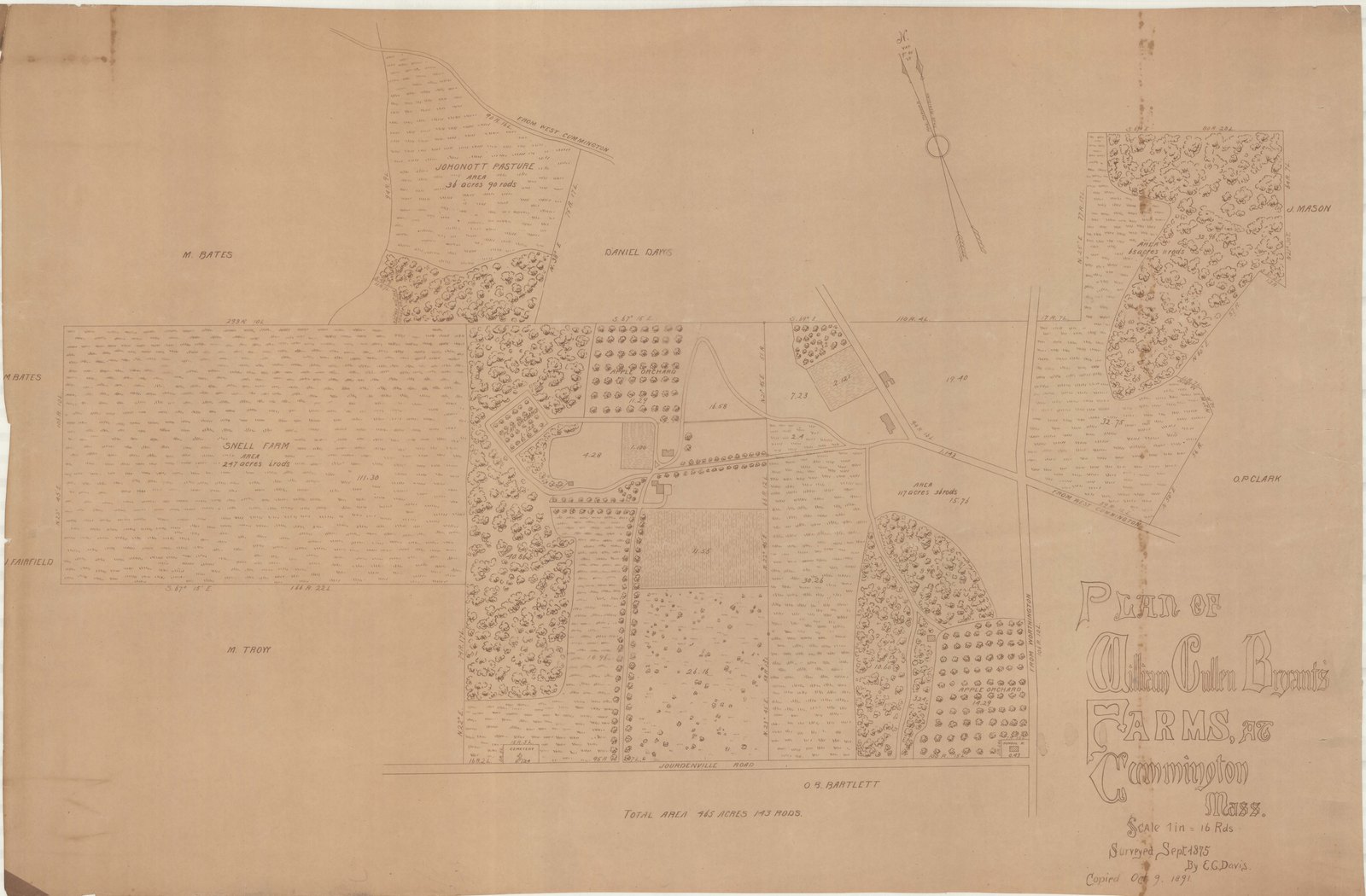
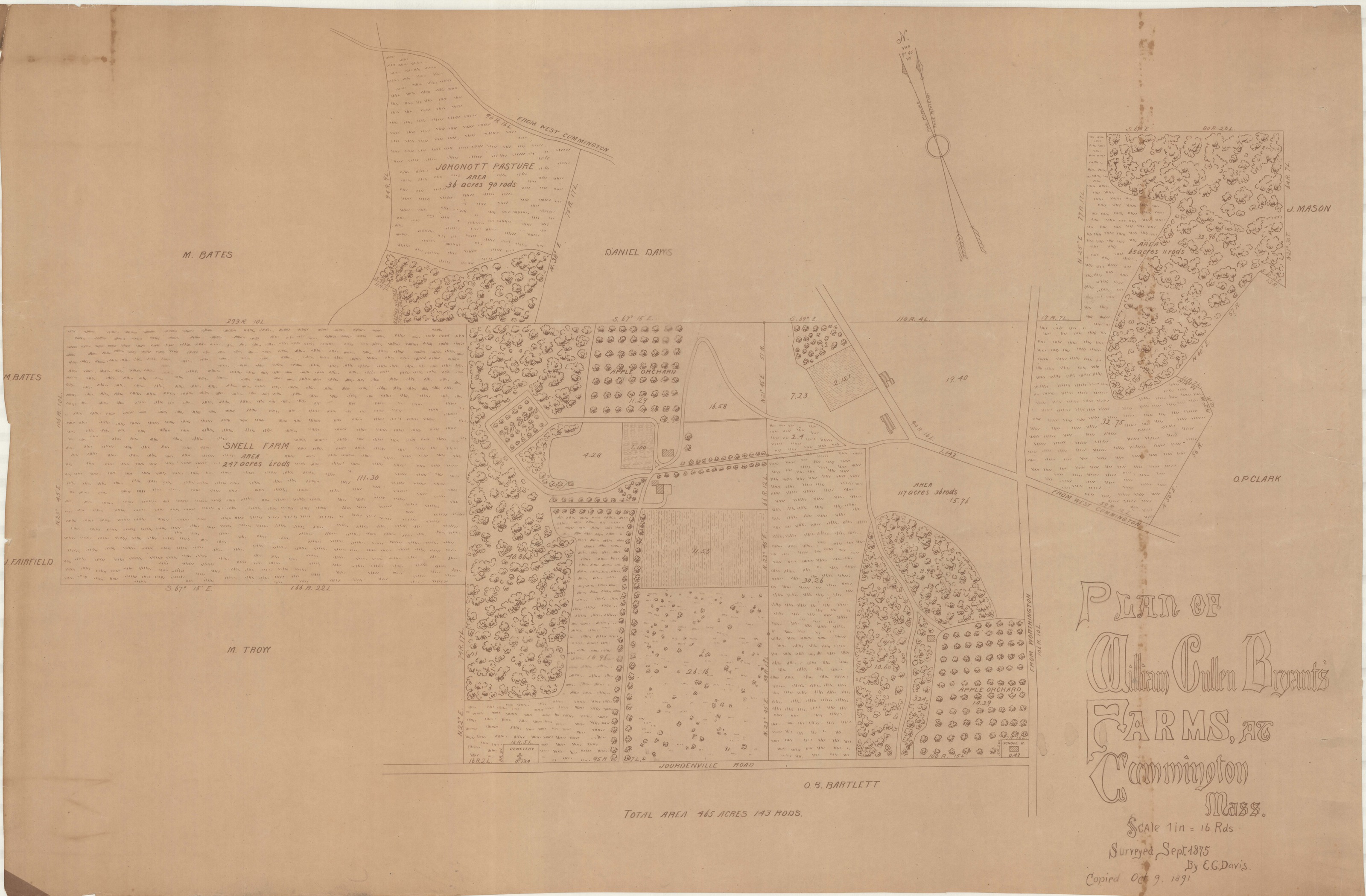
Two sheets, drawn on the same day, of the same ground, at the same scale, from a survey made sixteen years earlier. The subject is not a cottage and the town is not in Berkshire County. What makes this job worth a page is the note the cataloguer copied off the first sheet: TRUSTEES OF PUBLIC RESERVATIONS — an organization that was eight months old when the drawing was dated, founded by a man who would join the Olmsted firm two years later.
I. Why it is here
Cummington is in Hampshire County, over the line from Berkshire. It appears on this site because it appears on the Olmsted office’s Berkshire job list, which is the list this survey works from — sixty-three commissions between 1883 and 1979, of which this is number 01388, filed as Bryant, William Cullen — Cummington, MA.
Two plans, two scans, both dated 9 October 1891.
II. What the sheets are
The title is the same on both: “PLAN OF WILLIAM CULLEN BRYANT’S FARMS, AT CUMMINGTON MASS.” The scale is one inch to sixteen rods — two hundred and sixty-four feet to the inch. That is not a scale at which anyone lays out a drive or places a shrub. It is a scale for showing boundaries, fields and woodlots: the farms, as the title says, not the garden.
Both sheets carry the note “SURVEYED SEPT. 1875.” Bryant was alive in September 1875 and had been coming back to Cummington for a decade; he died in 1878. So the ground under these drawings was measured while the poet was still walking it, and the drawings themselves were made thirteen years after his death.
III. Bryant at Cummington
William Cullen Bryant was born at Cummington on 3 November 1794. “Thanatopsis” was published in 1817, while he was living there. He married and moved to New York in 1825, and in 1865 he bought his boyhood home back as a summer place.
He spent money on the town as well as the house. The Trustees’ own history credits him with paying for a new schoolhouse near the Homestead; for a library, its book collection and a residence for the librarian; for the road that joined the Homestead to that library, which became Route 112; and for a road to West Cummington that is still in use.
IV. The Trustees, and the thirty-six years
The Trustees of Public Reservations — now The Trustees of Reservations — were founded in 1891 by Charles Eliot, who had trained in Olmsted’s office and who became a partner in it in 1893, when the practice was styled Olmsted, Olmsted & Eliot. These sheets are dated in the Trustees’ founding year, and one of them carries their name.
The property did not come to them for another thirty-six years. It was Minna Godwin Goddard, Bryant’s granddaughter, who left the Homestead to The Trustees in 1927; more land was bought in 1981. The Trustees list the Bryant Homestead as one of seven of their properties shaped by the Olmsted firm, and describe the involvement as advice on acquisition across the years 1891 to 1927 — the span these drawings open.
That same Trustees page says Eliot founded the organization “in 1891, the same year Olmsted died.” Frederick Law Olmsted died in 1903. The error is noted here and not corrected in the quotation.
What the file amounts to is this: a survey of a poet’s farms, taken in his lifetime, redrawn in the year a conservation organization was founded by an Olmsted partner, and used — on the Trustees’ own account — through the thirty-six years it took to get the land.
Sources
Olmsted Archives, Frederick Law Olmsted National Historic Site, National Park Service: job 01388, two plans, with titles, dates, sheet sizes and inventory notes as recorded at olmstedonline.org; scans from the Olmsted Archives on Flickr. Titles and notes are quoted as catalogued. The Trustees of Reservations, “William Cullen Bryant Homestead History,” for Bryant’s birth on 3 November 1794, “Thanatopsis” in 1817, the move to New York in 1825, the repurchase of 1865, his death in 1878, the schoolhouse, library, librarian’s residence and the two roads, the 1927 bequest by Minna Godwin Goddard and the additional land bought in 1981. The Trustees of Reservations, “Olmsted and The Trustees,” for Charles Eliot’s training under Olmsted, his founding of the organization in 1891, the list of seven Trustees properties shaped by the firm, and the description of the Bryant Homestead involvement as advice on acquisition, 1891–1927 — and for the dating error quoted above. The 1893 partnership of Olmsted, Olmsted & Eliot is as given on the Wheatleigh pages of this site. No photograph of the Homestead is shown here: the one period image found in Digital Commonwealth is a 1947 wood engraving by Thomas W. Nason, all rights reserved.