I. A heading with one name under it
The 1926 Central Berkshire directory gives each town a classified business section — the trades of the place, set out under headings, in the order the compiler thought of them. The Lenox section runs from page 219 to page 225 and is worth reading as a document in its own right, because the headings are the town’s own taxonomy of what a person could be paid to do there.
Only three of the book’s nine towns get one at all. Lee has a hundred and ten headings over twelve pages, Lenox eighty-two, Dalton seventy-one. Stockbridge, Becket, Richmond, Washington, Hancock and Hinsdale get no business directory whatever — Stockbridge is given churches, lodges, a golf club and a post office instead. The publisher classified the trades of the two mill towns and the cottage town, and left the town with Naumkeag in it as a list of institutions.
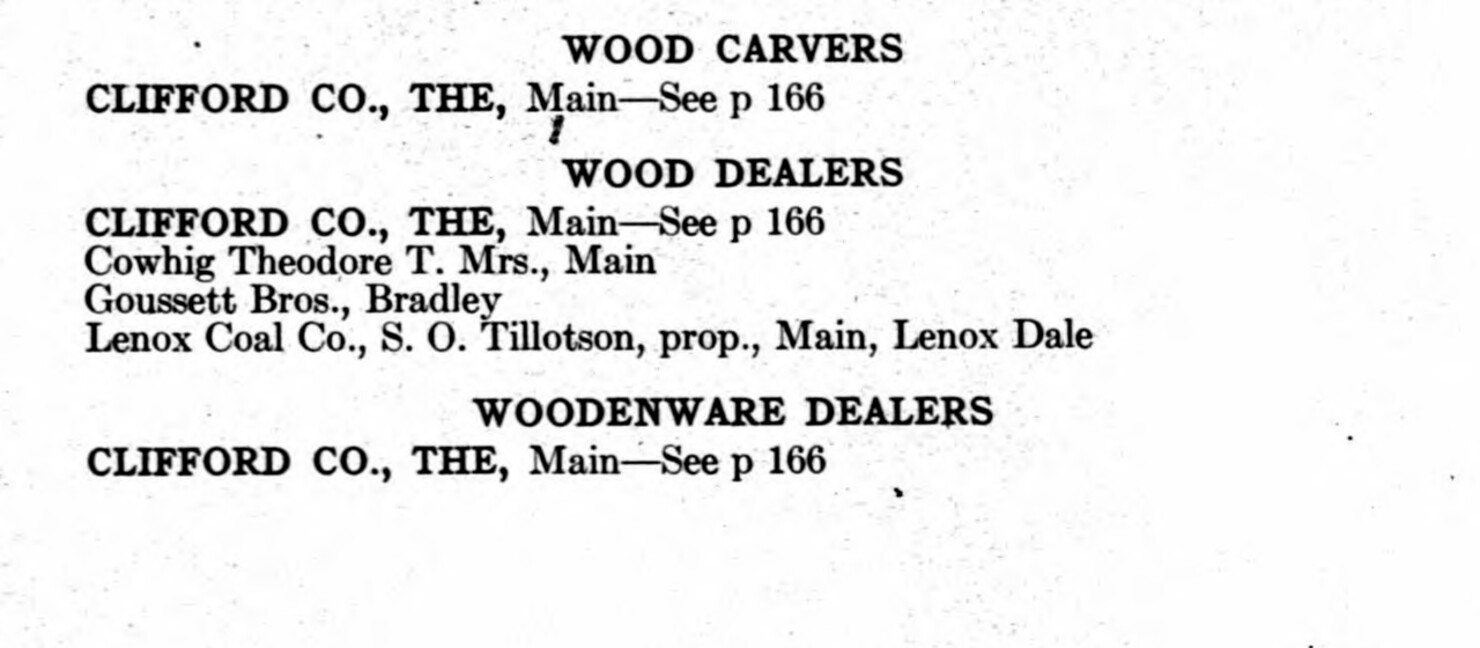
Among the Lenox headings, on the last page: WOOD CARVERS.
WOOD CARVERS
CLIFFORD CO., THE, Main—See p 166
One entry. In the town that had lately finished putting up some of the most elaborately carved interiors in the United States, the trade directory for wood carving has a single line in it, and the line is a cross-reference to an advertisement.
II. Page 166
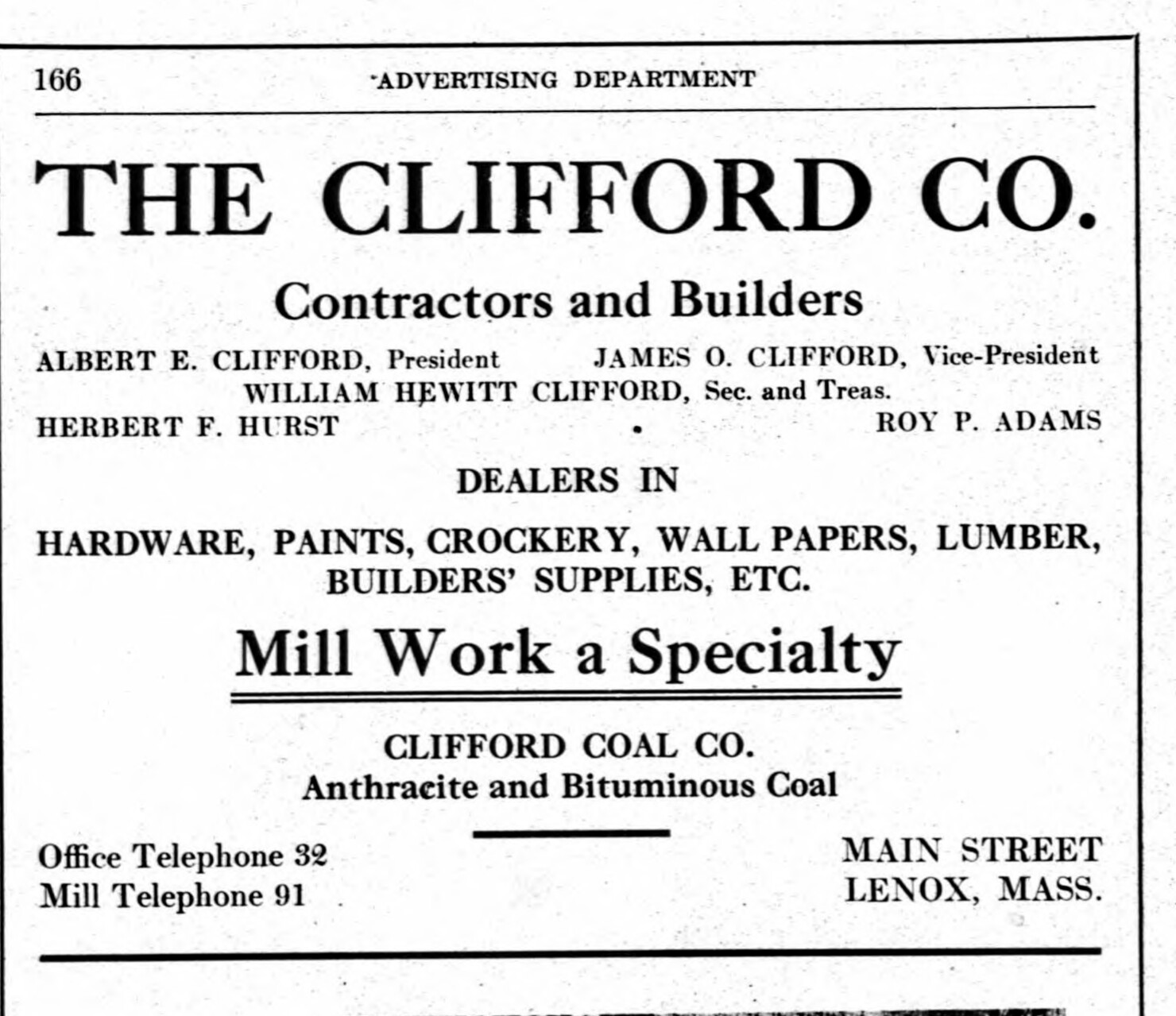
Turn to it and you get a full-page advertisement in the book’s advertising department, headed in three-quarter-inch capitals:
THE CLIFFORD CO. — Contractors and Builders
ALBERT E. CLIFFORD, President JAMES O. CLIFFORD, Vice-President
WILLIAM HEWITT CLIFFORD, Sec. and Treas.
HERBERT F. HURST ROY P. ADAMS
DEALERS IN HARDWARE, PAINTS, CROCKERY, WALL PAPERS, LUMBER, BUILDERS’ SUPPLIES, ETC.
Mill Work a Specialty
CLIFFORD COAL CO. — Anthracite and Bituminous Coal
Office Telephone 32 Mill Telephone 91 MAIN STREET, LENOX, MASS.
Hardware, paints, crockery, wall papers, lumber, builders’ supplies, and coal. Mill Work a Specialty is as close as it comes. The firm the directory files under wood carvers does not describe itself as carving anything.
III. Twenty headings
Read the classified section straight through and the Clifford Co. keeps appearing. It is under twenty of the Lenox headings:
Cabinet Makers · Carpenters and Builders · Carpets · Coal and Wood Dealers · Furniture Dealers and Repairers · Hardware and Cutlery Dealers · House Furnishings · Lumber · Masons, Builders and Materials · Painters · Paints, Oils and Glass · Paper Hangers · Pictures and Frames · Planing and Moulding · Sportsmen’s Goods · Stair Builders · Upholsterers · Wood Carvers · Wood Dealers · Woodenware Dealers
Under eight of those it is the only name in the town: Carpets, House Furnishings, Lumber, Pictures and Frames, Planing and Moulding, Stair Builders, Wood Carvers and Woodenware Dealers.
Stair Builders is the one to sit with. The carpenters story argues that stairbuilding was a specialism of its own, a piece of arithmetic and sculpture at once that took years to learn. The town of Lenox agreed with that enough to give it a heading. It could then name one firm that did it.
IV. The men in the shop
The firm is not just a name. It had a mill, a telephone of its own for the mill, and a works on Old Bourne Road that the book treats as a landmark — several people are located by boarding n Clifford Shop, near the Clifford shop, in the way other people are located by a church or a bridge.
And its men are in the alphabet, named, with trades:
Carty Michael J., (Ellen) carpenter, Clifford Co., h Mill, Lenox Dale
Prowse William H., (Hattie) plasterer, emp The Clifford Co., h West
Behind them, at least fifteen more men and one woman, listed as emp The Clifford Co. with nothing after it: Beecher Michael, Broderick John F., Cook Henry G., Darey Jaques, Dennis Frank, Dupont Peter, Lux Felix P., Martin Chester, Penfornis Joseph, Quinlan John, Toole Richard J., and Fielding Grace, stenographer.
Which is the point worth making. The same volume that prints carpenter and plasterer after the names of two men in a Main Street shop prints nothing at all after the names of seventeen people at Elm Court. A wage-earner in a business was a tradesman with a trade. A wage-earner in a house was emp and an address.
V. What the carving looked like
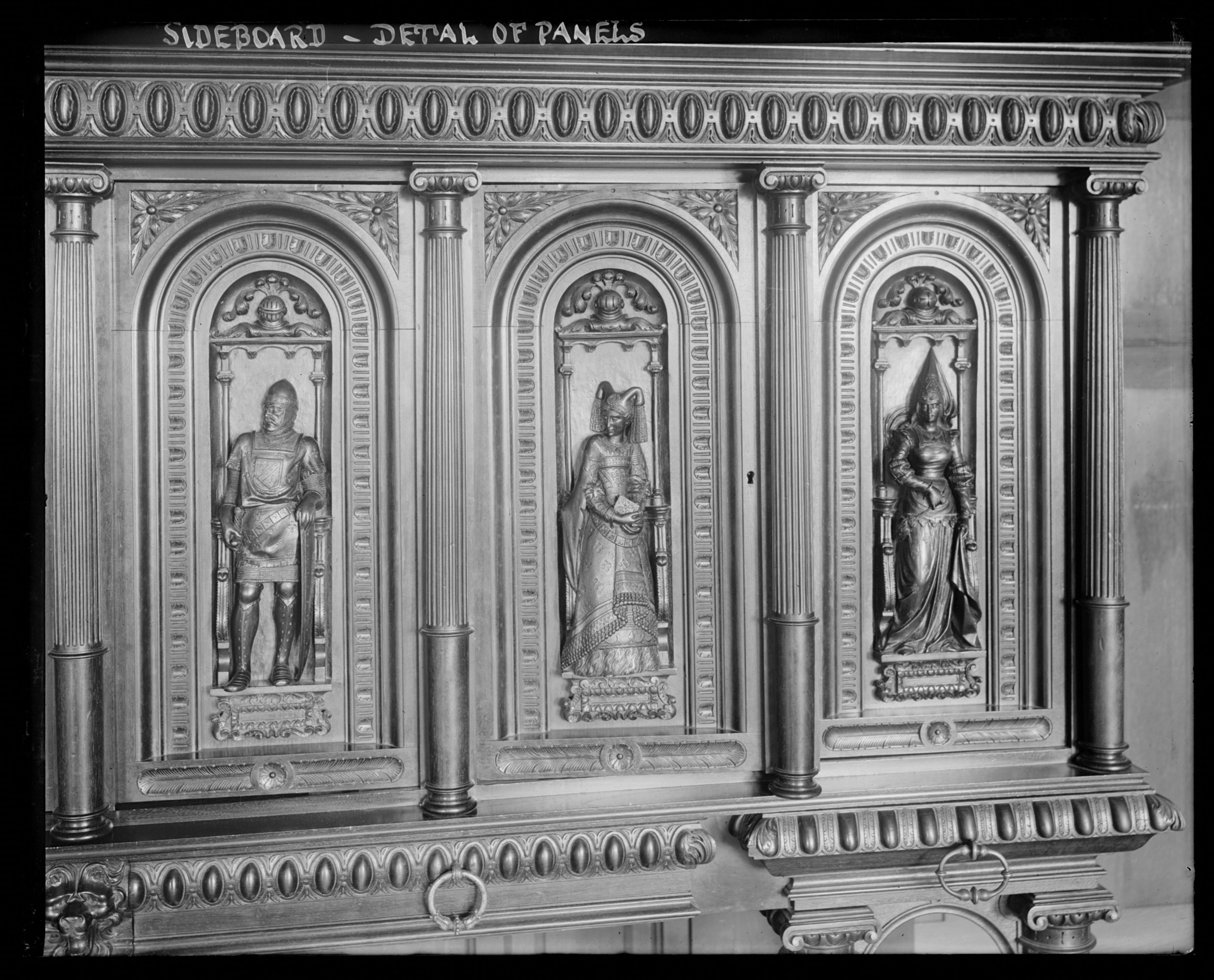
The one photograph in the Lenox collection that shows the work itself is catalogued Anson Phelps Stokes, NYC: sideboard panel detail — a piece from the New York house of the man who built Shadow Brook. Three figures stand in three arched panels under a cornice of egg and dart, flanked by turned columns, every element cut by hand out of solid oak by somebody who could carry a drawing in his head and take away wood he could never put back.
It is a photograph of work for a Berkshire client that was not made in the Berkshires. That is the general case: the carved interiors of these houses were ordered from the New York and Boston houses described in the decorating story, made in their own shops, and shipped up crated. The ornamental hand came into the county in a packing case.
VI. The other ornamental trade on the same page
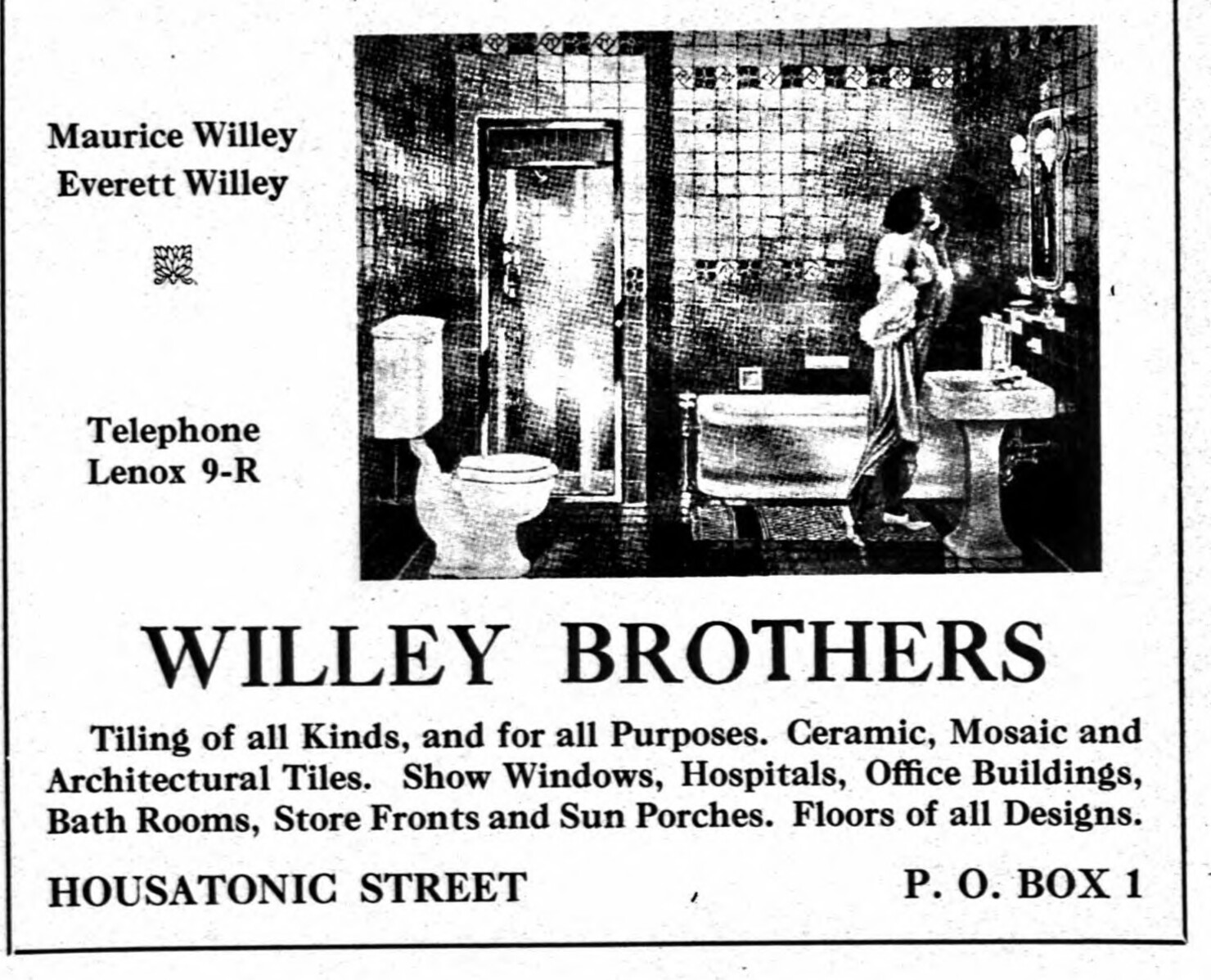
Below the Clifford advertisement on the same page sits the second of these one-name trades:
WILLEY BROTHERS
Tiling of all Kinds, and for all Purposes. Ceramic, Mosaic and Architectural Tiles. Show Windows, Hospitals, Office Buildings, Bath Rooms, Store Fronts and Sun Porches. Floors of all Designs.
HOUSATONIC STREET P. O. BOX 1 Telephone Lenox 9-R
Maurice Willey and Everett Willey, and a halftone of a tiled bathroom with a pedestal basin, a roll-top bath and a patterned dado. Under TILE WORK in the classified section, WILLEY BROS., Housatonic—See p 166, and nothing else.
Ceramic and mosaic work is the other trade where a hand is visible in the finished surface, and the town supported exactly one firm of it. The advertisement is also, as far as this survey has found, the only photograph of a completed Berkshire interior anywhere in the book — and it is a bathroom, in an advertisement, sold by the square foot.
VII. The two men who were called sculptors
There is a word in these volumes for a person who cuts a figure out of solid material, and it is not carver. Two men in the county have it after their names.

Lukeman Henry Augustus, sculptor, h W. Stockbridge rd (Stockbridge, p. 288)
Kilson Henry Hudson, sculptor, bds “Santarella”, Lee rd, P. O. Lee (Tyringham)
Henry Augustus Lukeman (1871–1935) is listed on West Stockbridge Road in both the 1923–’25 and the 1926 books. In exactly those years he was at work on the Stone Mountain memorial in Georgia, which he took over in 1925 and carried to 1928 — the largest relief carving then attempted anywhere. The directory gives him a road and a trade word and moves on to the next name.
The second entry is printed Kilson. The sculptor who lived and worked at Santarella in Tyringham in these years is recorded everywhere else as Henry Hudson Kitson (1863–1947), who modeled the Lexington Minute Man, the Roger Conant at Salem and the Pilgrim Maiden at Plymouth, and who rebuilt the old mill at Santarella into the studio that is still there. The book has his given names exactly right and his surname wrong. It is printed here as printed.
Set the two of them beside the wood carvers heading and the arrangement is clear enough. The county recorded the ornamental hand when it belonged to a man with a national reputation who happened to live here, and did not record it when it belonged to a man in a shop.
VIII. What the single entry means
It is tempting to read WOOD CARVERS — one firm as a decline story, and it partly is. But the dates do not support the simple version.
By 1926 the carved interiors in these houses were thirty and forty years old. The work had been done, in the 1880s and 1890s, largely in city shops, and it had not been repeated: the building of the cottages had stopped, and the county’s own trade counts show the whole building economy contracting in the same years — the Pittsfield series has blacksmiths falling from fifty-four to nine over the same span.
So the single entry is not evidence that nobody in Lenox could carve. It is evidence that by 1926 carving was not something a person could make a living at in Lenox, and that the directory’s taxonomy — Cabinet Makers, Planing and Moulding, Stair Builders, Wood Carvers, four headings for what had become one shop on Main Street — had outlasted the work it was built to describe.
The headings are a fossil of a trade structure. The Clifford Co. is what was left standing in it.
Classified entries, headings and advertisements from the Lenox section of the Central Berkshire County Directory, 1926, pages 166 and 219–225, reproduced page by page here; the twenty headings and the eight sole entries were counted from the page images, not from the machine-read text. Name entries for Clifford Co. employees from the Lenox alphabet, pages 182–216, and the Lukeman entry from the Stockbridge section, page 288; the Kitson entry is in the Tyringham section of the same volume. All entries quoted exactly as printed, including “Kilson” for Kitson. Lukeman’s dates and his work at Stone Mountain from 1925 to 1928, and Kitson’s dates, principal works and Santarella, from their Wikipedia entries. Sideboard panel photograph, Lenox Library Association, via Digital Commonwealth, title quoted as catalogued; it is a New York piece and stands for the trade rather than the place. No carved interior in a Berkshire house is attributed to a named hand here, because no source consulted attributes one.