I. The book’s only past tense
A directory is written entirely in the present. It tells you who is here, what they do, whom they do it for, and where they sleep. It has no room for history and no interest in it.
Except for two words. Rem to — removed to — followed by a place.
That is the canvasser reporting a negative. He knocked, and somebody said: they have gone, and they have gone to Torrington. And rather than strike the name out, the book prints it, with the destination, so that anyone looking for that person knows where to look next.
It was put in for a practical reason, and the practical reason has produced the only systematic record we have of what became of the working people of these towns.
II. Two hundred and eighteen
A parse of the ten town sections in the 1923–’25 volume yields 2,329 people with a trade attached. Of those, 218 — nine and a half per cent — carry a rem to.
Who goes? Overwhelmingly, the people with the least holding them. One hundred and two of the two hundred and eighteen are in farming — farmers and farmhands. Twenty-seven are laborers. Fifteen are carpenters. Thirteen are household servants. Eleven are chauffeurs. Then, in ones and twos: painters, engineers, housekeepers, gardeners, masons, coachmen, teamsters, superintendents, blacksmiths.
Where do they go? Mostly not far. New York is the single commonest destination, at seventeen; then Pittsfield at fifteen; then Great Barrington, and Lee, and Egremont, and Sheffield, and West Stockbridge — the next town over, which is not emigration so much as a change of landlord.
But ninety-four of the two hundred and eighteen left Berkshire County altogether, and that list is a different kind of document.
III. The far column
Hartford. Bridgeport. Waterbury. Torrington. Winsted. Danbury. Salisbury. Rockville. Oakville. That is the Connecticut mill belt, an hour or two south, and it is where a man who could no longer make a living on a Berkshire farm went to work indoors for wages.
Then: Troy. Rochester. Ithaca. Ossining. Brooklyn. Millerton. Chatham. Hillsdale. Spencertown. Austerlitz. Stephentown. Green River. The Hudson Valley and the state beyond it.
Then Boston, Worcester, Springfield, Fitchburg.
Then: Chicago. Cleveland. Ravenna, Ohio. California. DeLand, Florida. Jacksonville, Florida.
And then, at the end of the list, the four entries that stop you:
Lynch George P (Mary J) gardener rem to Ireland
Sermini Andrew mason rem to Italy
Zucco Angelo laborer rem to Italy
McCabe Susie Miss nurse rem to Scotland
A gardener, two Italian building men and a nurse, going home, recorded in six-point type in a book paid for by advertisements for shoes and funeral livery.
IV. Andrew Sermini
Look up the Sermini entry in the Great Barrington section, though, and the story changes shape entirely.
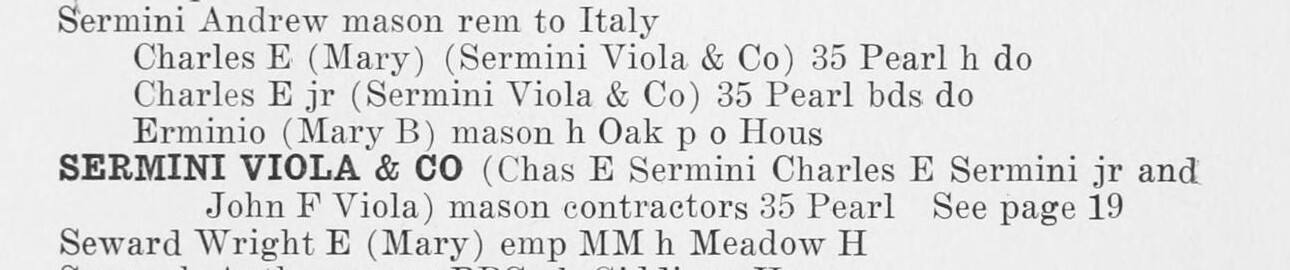
Andrew Sermini, mason, removed to Italy. Indented beneath him, in the way the book sets out a household: Charles E (Mary), of Sermini Viola & Co, at 35 Pearl, house his own. Charles E junior, of Sermini Viola & Co, same address, boarding. Erminio (Mary B), mason, with a house on Oak Street.
And then, set in bold across the column:
SERMINI VIOLA & CO (Chas E Sermini Charles E Sermini jr and John F Viola) mason contractors 35 Pearl See page 19
This is not a family being driven out. This is a family that had arrived, gone into the stone trades, and built a mason contracting business with its own advertisement on page nineteen — and one of whose members, having done his working life here, went home.
The same page holds four more departures — a Mrs Seeley removed to New York, a Miss Shaker to Bridgeport, a waitress to Lee, a farm superintendent to Hillsdale — and, two lines further down, Daniel F Shea, electrical contractor, of 4 Avery Place, with his own advertisement on page twenty-seven.
Departures and arrivals, in the same alphabet, on the same page, in the same type. The book makes no distinction whatever, and that is the most useful thing about it.
V. The Farrells
Go back to that column at the top of this page, because it is the clearest thing in the book.
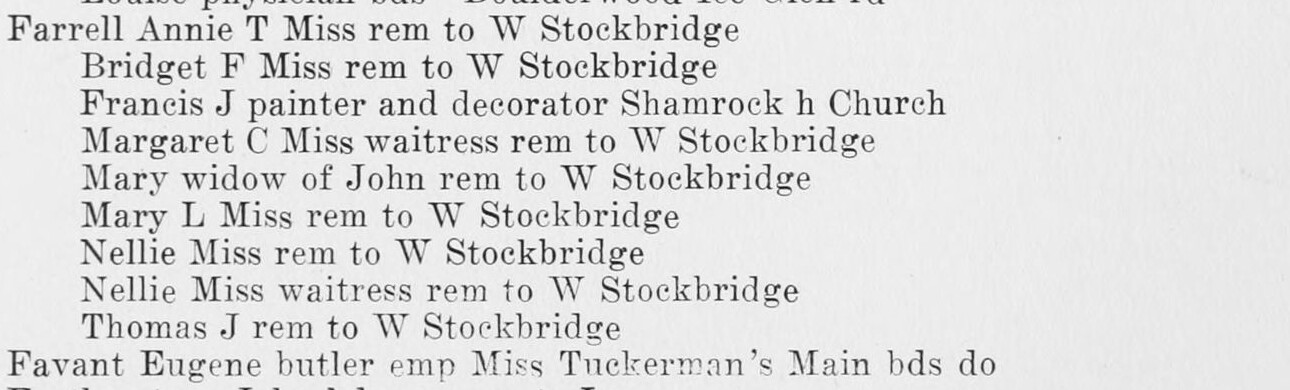
Nine Farrells are listed together under one surname, in the way the directory sets out a household: the head first, then everybody else indented beneath. Annie T. Bridget F. Francis J. Margaret C. Mary, widow of John. Mary L. Nellie. Nellie again, a different one. Thomas J.
Eight of the nine read rem to W Stockbridge. Only Francis J — painter and decorator, with the trade name Shamrock and a house of his own on Church Street — is still there.
Two of the women who left are waitresses. The widow of John kept the household together. And the one member of the family who had a trade and a house stayed put, while everyone else moved eight miles.
Nobody wrote that down as a story. It is simply what the alphabet produced when a canvasser worked down the F’s.
VI. What was actually happening
Set the two directories on this site side by side and the pressure is obvious.
In 1874, Briggs canvassed a county of farmers, lime burners, sawyers and carpenters, and Lenox had no coachman, no gardener, no butler and no laundress in it. By 1923 those occupations exist in quantity — and the older ones are going. The 1923 book still counts seven hundred and fifty-six farmers and three hundred farmhands in ten towns, and they are the largest group in it by a very long way, and they are also the group most heavily represented in the rem to column.
The hill farms were being given up. The fields behind these houses were closing over into the second-growth woods that cover them now. And the estate work that had absorbed some of that labor for a generation — the eight coachmen, the thirty-four gardeners, the fifteen firemen, the seventy superintendents — was itself about to contract, as the houses were sold, given away, converted and pulled down through the 1930s and 1940s.
The people in the rem to column are the front edge of that. They left first because they had least to leave.
VII. The ones who did not appear at all
One caution, and it is a real one.
A directory records the people a canvasser found at an address he could get to, in towns his employer sold advertising in. It does not cover Lenox at all — for Lenox you need the 1926 Central Berkshire directory, three years later. It under-records anybody transient — the gangs who came in for a season of excavation, the Italian stone crews, the men living four to a room over a store. And by construction it cannot record anyone who had already gone before the canvasser arrived, unless a neighbor volunteered where.
So two hundred and eighteen is not a count of departures. It is a count of departures that somebody happened to know about, in a two-year window, thirty years after these houses were built. The real number is larger and there is no way to recover it.
VIII. What it is worth
Every other trade in this section is anonymous. A hundred and more masons on the steps at Shadow Brook and not a name among them. Fifty or sixty men on a Berkshire site in 1893 and no payroll, no photograph with the backs of the prints written on, nothing.
And then a commercial directory, produced to sell advertising to clothiers and undertakers, printed two hundred and eighteen names with the places those people went. It did it by accident, for a practical reason, and it is the closest thing to a record of outcome that any of these people got.
Lynch George P (Mary J) gardener rem to Ireland. He kept somebody’s garden here, his wife was called Mary, and he went home. That is the whole of what is known, and it is four lines more than we have about the man who laid the terrace he kept.
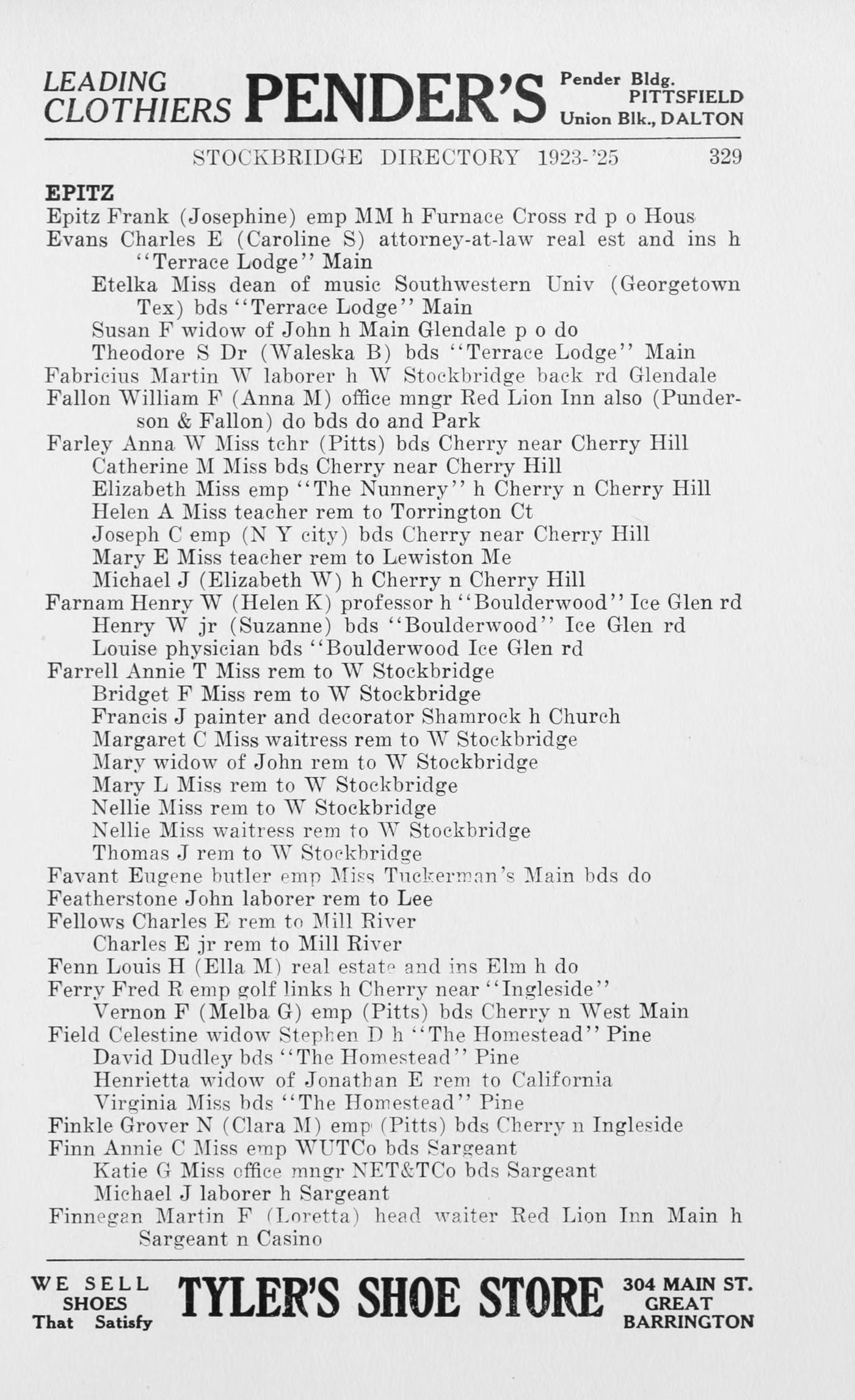
Counts and quoted lines from a parse of the ten town sections of Crowley & Lunt, South Berkshire Directory, 1923–’25, producing 2,329 records with an occupation; the whole volume is reproduced here, and page 329 of the Stockbridge section, shown above, is leaf 317 in it. The volume covers Alford, Egremont, Great Barrington, Monterey, Mount Washington, New Marlboro, North Canaan, Sheffield, Stockbridge and West Stockbridge, and does not cover Lenox; the 1926 Central Berkshire directory does. Directory lines are quoted as printed. The 1874 comparison is from Briggs & Co., Berkshire County Directory for 1874, reproduced here. Forest-cover figures behind the “second growth” sentence are set out on this site’s Shadow Brook page.