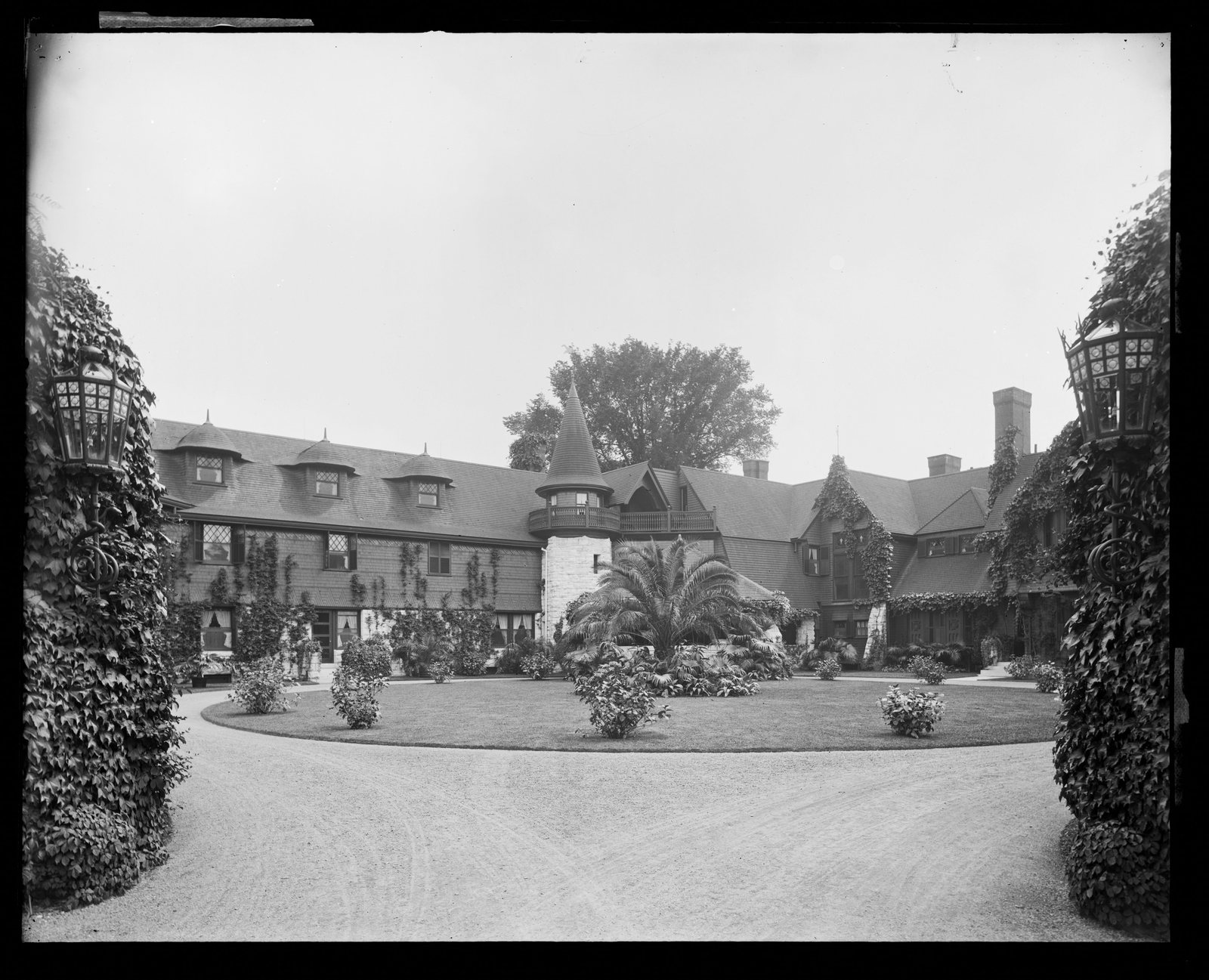
I. The book that names them
Everything else in this section has had to work from counts. So many gardeners, so many coachmen, a hundred anonymous men on a pile of rubble.
The 1926 Central Berkshire directory does something the other volumes do not. It covers Lenox, and it treats the great houses as street addresses — printed in quotation marks, in the ordinary alphabet, with people listed at them the way people are listed at 14 Church Street.
Which means that for the first time on this site a staff can simply be read off the page.
II. The house is in two towns
Elm Court straddles the Lenox–Stockbridge line. The drive comes up from Lenox; a good deal of the land, the farm and most of the cottages are in Stockbridge. The directory handles this the only way it can, which is to list the place twice.
There is a Lenox section and a Stockbridge section, they were canvassed separately, and they do not agree. Seventeen staff appear under Lenox and twelve under Stockbridge, and exactly one man is in both. The Stockbridge canvasser wrote down trades the Lenox canvasser did not.
The clearest case is William L. Weston. Under Lenox he is emp “Elm Court,” Stockbridge, h do — no occupation. Eighty-two pages later, under Stockbridge, he is a gardener.

III. Twenty-eight people
Searching both sections for the words Elm Court returns thirty-six lines. Stripping out the two street-directory entries, the two lines for the owners and two more for daughters who board near the house rather than work in it leaves twenty-nine staff lines and twenty-eight people. Transcribed from the page images, spellings and all:
Lenox section
Chague Alphonse, Jr., (Mary) emp W. D. Sloan, Elm Court, h do
Chague Eugene, emp Elm Court, bds East bey Four Corners, Lenox Dale
DeCico Antonio, emp Elm Court, h Golden Hill rd
Fraval Francois, (Louise) emp Elm Court, h Hiland, Lenox Dale
Fraval Jerome, (Mary) emp “Elm Court”, h Walker bey Lee rd
Heeremans Frederick, supt “Elm Court”, h do, Stockbridge, P. O. Lenox
Huber Charles, (Julia) gardener, emp Elm Court, h High
Kerveran John, emp “Elm Court”, bds East n Four Corners, Lenox Dale
Lagarce Emil, (Eloise) emp Elm Court, h Walker n Four Corners
Lebeux Yves, emp “Elm Court”, bds East n Four Corners, Lenox Dale
Loubard Hervey, (Rena) emp Elm Court, h Main, Lenox Dale
McKegg Edward C., (Mary) chauffeur, emp Elm Court, h Stockbridge
Meuret Jules P., (Mary B.) emp Elm Court, h East bey Four Corners, Lenox Dale
Rondot Joseph, (Betty) blacksmith, Elm Court, h Stockbridge
Vuillemenot Henry, (Helene) emp Elm Court, h Housatonic bey Hynes av
Weiss Edmund F., emp Elm Court, bds Housatonic bey Hynes av
Weston William L., (Mary) emp “Elm Court,” Stockbridge, h do
Stockbridge section
Colorec Henry, (Mary) emp “Elm Court”, Lenox East rd, h do
Fraval James, emp “Elm Court”, bds do
Kervron Ambrose, laborer, emp Elm Court, bds Lenox East rd
Ladour John, laborer, emp Elm Court, bds Lee East rd
Lagoffe Louis, emp Elm Court, bds do
Mahan William F., (Anna) emp Elm Court Farm, bds Lenox East rd, P. O. Lenox
McDonnell William P., (Julia) emp “Elm Court”, farm, h Lenox East rd, P. O. Lenox
Pensivy John, emp Elm Court, bds Lenox East rd, P. O. Lenox
Stride Herbert E., (Daisy) butler, emp Elm Court, h Lenox East rd, P. O. Lenox
Weed Eugene B., emp Elm Court Farm, bds Lenox East rd, P. O. Lenox
Weed Wallace, (Elizabeth) emp Elm Court, h Lenox East rd, P. O. Lenox
Weston William L., (Mary) gardener, emp Elm Court, h n do, Lenox East rd, P. O. Lenox
And the owners, in both towns:
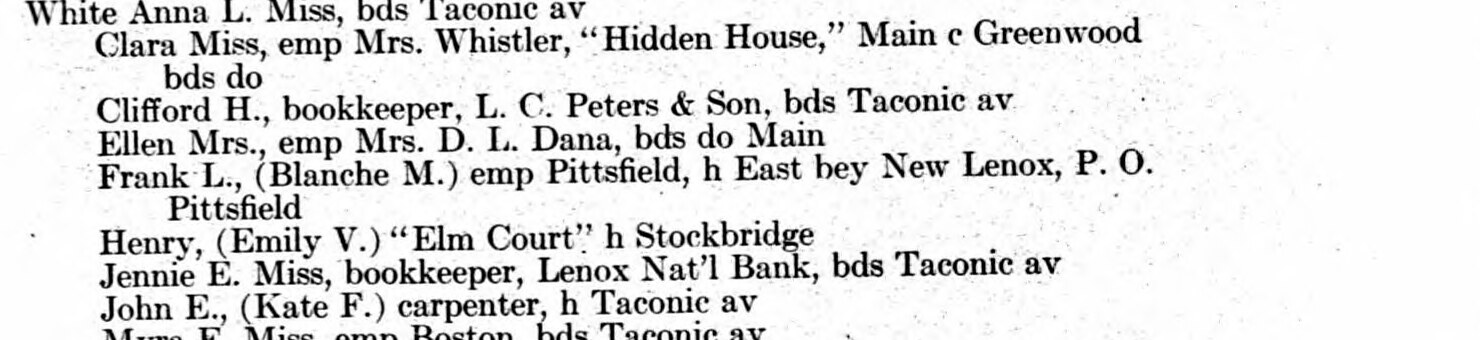
White Henry, (Emily V.) “Elm Court” h Stockbridge (Lenox, p. 217)
White Henry, (Emily V.) emp “Elm Court”, h Stockbridge n town line (Stockbridge, p. 299)
Henry White, and Emily Vanderbilt Sloane White — who had built the place as Mrs W. D. Sloane forty years earlier — set in the same six-point type as the men who worked for her, between a bookkeeper at the Lenox National Bank and a carpenter on Taconic Avenue. And in the Stockbridge section the compiler has given the owner of the house the same emp he gave the laundry staff, which is worth remembering before treating that abbreviation as evidence of anything.
IV. Eight trades and seventeen silences
Count the occupations across both lists. Superintendent, two gardeners, a chauffeur, a blacksmith, a butler, two laborers. Eight.
Three more men are put at the farm without a job title: Mahan and Weed emp Elm Court Farm, McDonnell emp “Elm Court”, farm.
The other seventeen read emp Elm Court and stop.
They were not doing nothing. A place of this size — a hundred and six rooms, forty acres of lawn and formal garden, two acres of glass — ran on grooms, farmhands, laundresses, housemaids, footmen, kitchen staff, stablemen, glasshouse men. The canvasser met these people, took their names, took their addresses, wrote down where they worked, and did not write down what they did.
That is the same silence documented in the Pittsfield series, where a woman in service appears for sixty years as emp plus a street number while the man three lines away gets coachman. Here it has swallowed most of a workforce.
It is worth noticing what the eight trades are. Superintendent, gardener, chauffeur, blacksmith, butler, laborer — six of the eight are outdoor or male indoor senior positions. Not one woman in the twenty-eight has an occupation printed, and only three women appear at all. A house of this size did not run on twenty-five men and three women. It ran on a kitchen and a laundry and a linen room that the book did not canvass, or canvassed and did not describe.
V. The road
The alphabet is not the only way into this book. Each town also gets a street directory, which walks every road in order and names who is in each house.
Lenox East Road runs northeast off East Street and ends at the town line. Here is the last third of it.
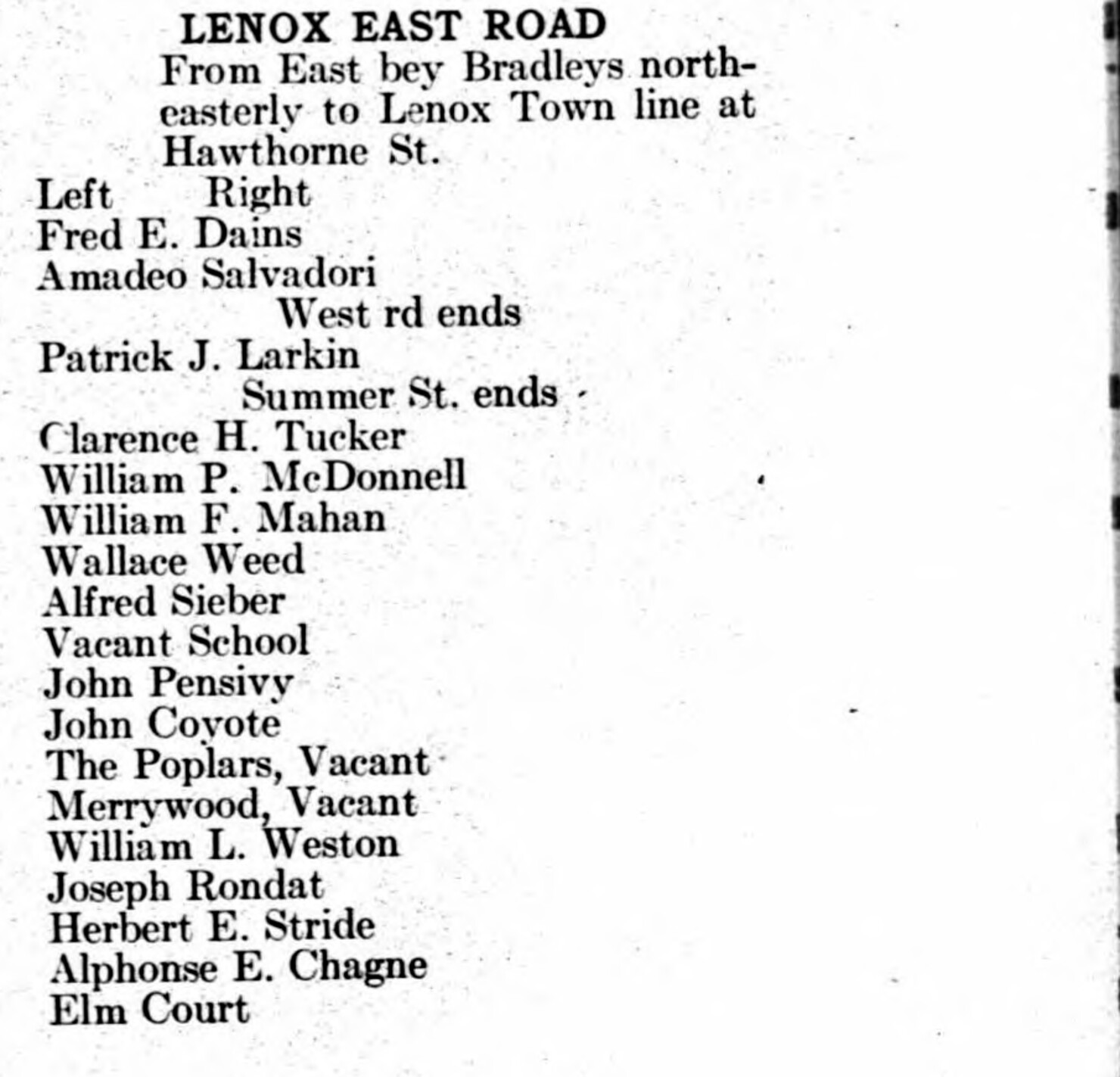
That is the approach to the house, in order, as a person walking it would have met it. The farm men first. Then two cottages standing empty, The Poplars and Merrywood, named like small estates because on this road they were. Then, in the last four houses before the gates, the gardener, the blacksmith, the butler, and Alphonse Chague.
The street directory also catches someone the alphabet missed. John Coyote is on the road between Pensivy and the empty cottages, and his own entry in the name section says nothing about Elm Court. Three years later the 1929 volume prints Coyote John, emp “Elm Court”, bds Stockbridge. Whether he was already working there in 1926 the book does not say; what it shows is that the roll call in section III is a floor and not a ceiling.
The Lenox street directory reaches the same house from the other side. On Stockbridge Street, past Charles Lanier at Allen Winden and Cortland Bishop, the sequence runs Michael J. Mitchell — Henry White “Elm Court” — Frederick Heeremans — Cross road begins. The superintendent is the next house along from his employer, which is exactly the arrangement the housing story describes, here visible as a position in a list.
VI. The French names
Read the surnames again.
Chague. Fraval. Kerveran. Kervron. Lagarce. Lagoffe. Lebeux. Loubard. Meuret. Rondot. Vuillemenot. At least fourteen of the twenty-eight are French, and several are specifically Breton — the Ker- prefix of Kerveran and Kervron, and Lagoffe, which the same book elsewhere prints as La Goffe and Le Goff. The given names run with them: Yves, Emil, Jules, Hervey, Francois, Jerome, Ambrose.
And several of them board at the same place. East near Four Corners, Lenox Dale, and East beyond Four Corners — Kerveran, Lebeux, Chague Eugene, Meuret. The Lebeux and Meuret households are there too, keeping houses with grown children in them.

Turn a few pages in the same section and the pattern holds: Le Breck, Ledeur, LeFoll, Lefebvre, Besanson, Favreaut, Prosper Pratt. And one line that finishes the thought the way the departures story does:
Legalle Frank, rem to France
This site is not going to claim a colony from a page of surnames. What the record supports is narrower and still remarkable: a French-speaking crew worked at Elm Court in 1926, a number of them lodged together at one end of Lenox Dale, and at least one of them went home.
VII. Alphonse Chague, 1926 to 1948
The directories were published every few years for another thirty. Running the 1926 names forward through them turns a list into careers.
Take the man at the end of the road. In 1926 he is Chague Alphonse, Jr., (Mary) emp W. D. Sloan, Elm Court, h do — no trade, and an employer who had been dead for eleven years. In the 1929 Stockbridge section he is gardener, emp Elm Court, and his wife Mary I. is a registered nurse on the same road. By 1935 he is Supt. By 1938 the entry reads in full:
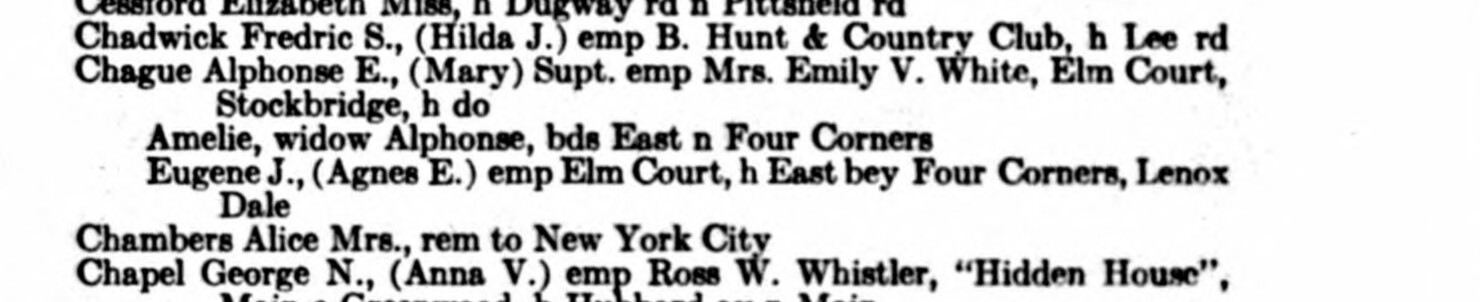
The 1942 volume repeats it. The 1948 volume, by which time the book had stopped printing much of anything, still has Chague Alphonse E supt Elm Court.
No trade in 1926; gardener in 1929; superintendent from 1935 to at least 1948. Twenty-two years at one house, thirteen of them running it. That is one of the seventeen blanks in the list above, filled in by the next volume on the shelf.
Others hold on longer than they have any business doing. Francois Fraval, emp Elm Court in 1926, is still emp Elm Court Estate in the 1952 book — twenty-six years. Edmund F. Weiss is there in 1926, 1929, 1938 and 1942. John Kerveran spans 1926 to 1942; Henry Vuillemenot the same. Edward C. McKegg is the chauffeur for sixteen years at least, and Herbert E. Stride the butler for the same span.
The Weiss entries settle something else. The 1926 scan is poor at that line, and the machine-read text renders it Teiss. The 1938 and 1942 volumes, set fresh from new copy, both print Weiss. An earlier version of this page had the man down as Teiss; he was Weiss.
A note on what has not been done here. Running the whole staff forward volume by volume would make a table of about two hundred entries, and the later scans are poor enough that it would need the same page-by-page checking as the 1926 list. The names above are the ones that have had it. The rest of the trail is in the same book, waiting.
VIII. The Daleys of Overlee
The other way a house gets staffed is visible two hundred pages earlier, under D.
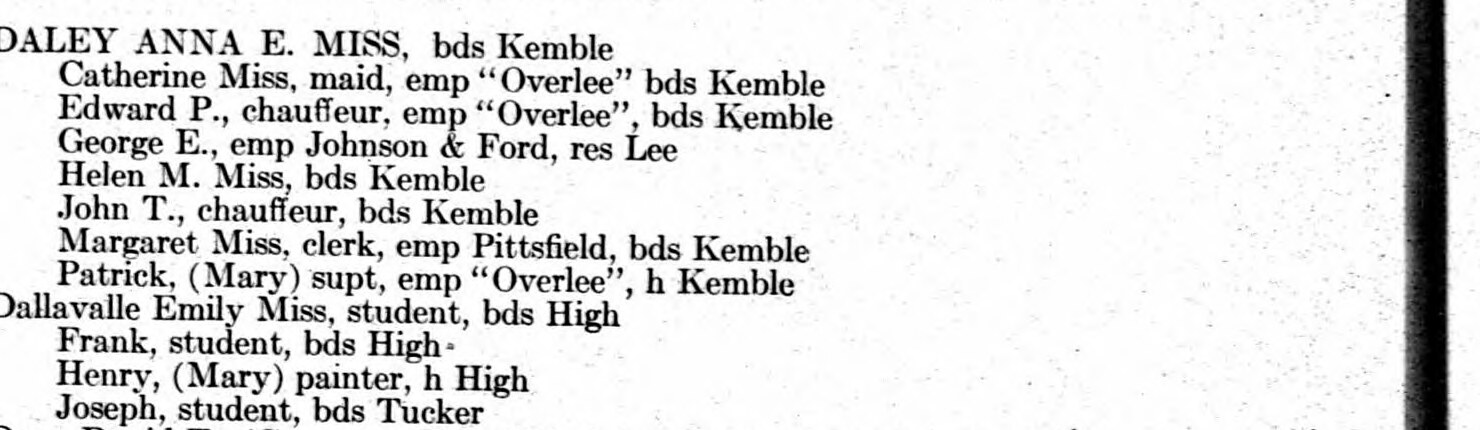
Patrick Daley, (Mary), supt, emp “Overlee”, h Kemble. He owns the house on Kemble Street. Indented beneath him, the household: Anna, Catherine, Edward, George, Helen, John, Margaret.
Catherine Miss, maid, emp “Overlee”. Edward P., chauffeur, emp “Overlee”. John T., chauffeur. Margaret Miss, clerk, emp Pittsfield. George E., emp Johnson & Ford, res Lee.
Three of one family working at one estate, a fourth driving somewhere else, a fifth clerking in Pittsfield. The father runs the place and holds the deed to a house in the village — and here you can see what that meant in practice, which is that the estate employed your children.
On the same page, at the same house: Merrick William J., (Mary) chauffeur coachman, emp “Overlee”, Stockbridge, h do.
Chauffeur coachman. Both words, one man, one job, in 1926 — fifteen years after the two trades crossed in the Pittsfield book and two years after the word coachman disappeared from it entirely. The transition did not end on a date. It ended in a hyphenless compound in a directory entry.
IX. And the rest of them
The same reading works on every house in the book, and the two-town problem applies to several of them. It does not work equally well everywhere: some houses give up a dozen names and some give up one.
Bellefontaine, Giraud Foster’s: Edwin Jenkins, superintendent, living on the place with Anna. Wilfred G. Lewis, gardener, boarding there. George Quinn Reves, butler, boarding there. Edward G. Conklin, watchman, on Maple Avenue with Elizabeth. James Moran and Charles Spaulding, emp Bellefontaine, no trade given. Foster himself at the top, with Jean V.
Groton Place, Grenville Winthrop’s: Walter G. Henry, superintendent. Roger Connors, houseman, with Emma, on Hawthorne Street. Joseph Kotaski with Mary on Fairview. Richard Beecher and Bernard Leary, boarding. Winthrop last, alphabetically.
Stonover: John J. McGee, (Alice), coachman, emp Stonover Farm, h Taconic av — a working Berkshire coachman with a name, a wife, an employer and a street, in 1926. Peter Nausick, laborer. George E. Page, teamster, with Nina. Michael Leahy. Antonio Smith, with Josephine.
Shadow Brook: John Curran, (Margaret), emp Shadowbrook — and his address is given as the Gate House.
Naumkeag, Joseph Choate’s house on Prospect Hill, nine years after his death: Crighton Robert R., (Alice A.) supt. emp “Naumkeag”, Prospect Hill, h do. Caroline Choate, his widow, is listed at the house with Mabel. And three men are attached to the family rather than to the place — Ellery James A., (Kathryn M.) emp Choate Place, h Church, Laird Frank H., (Frances) emp Choate Place, h Church, Snow Charles A., (Katherine) emp Mrs. Choate, h Church — all three living on Church Street in the village rather than on the hill, and all three with no trade printed. One superintendent on the place, three men in the village, and a garden that is now a National Historic Landmark.
Blantyre is the house this section keeps coming back to for its forty-two painters on a brass plaque, and it is the one the 1926 book will not name anybody at. The word appears once in the whole volume, in the Lenox street directory, as a house on East Street. Twelve years later, with new owners, the 1938 volume finally prints one: Girton Herbert L., (Amanda) Supt. emp “Blantyre”, Lee rd, h do, three lines above a man who worked for an insurance company in Pittsfield.
White Lodge, the Sloane house next door to Elm Court, gets its own crew in the Stockbridge section: Lagoffe Vincent, laborer, emp White Lodge, h Lee East rd, on the same road as the Elm Court men. And on the page above, in capitals, LABEILE JOSEPH, chef, W. D. Sloane, bds Lenox East rd — a chef, named, eleven years after the death of the man he is still listed as working for.
X. The staff of the staff
One last line, because it is the one that shows how far down the arrangement went.
McLeod Jessie Miss, housekeeper, emp F. Heeremans, Stockbridge, bds do
Frederick Heeremans was the superintendent of Elm Court and lived on the place. He had a housekeeper of his own, and she boarded with him.
XI. What this changes
Nothing in this story is a discovery in the archival sense. The book has been on a shelf for a century and online for a couple of years. Nobody had read it against the houses.
What it changes is the register. Up to now this section could tell you that South Berkshire held eight coachmen and thirty-four gardeners, and that a hundred and more men sat on the rubble at Shadow Brook. It could not tell you who was at a particular house on a particular morning.
Now it can, for 1926, for any house in nine towns — provided you remember to look in every town the house touches, and to walk the road as well as the alphabet. Heeremans and Huber and Weston and McKegg and Rondot and Stride at Elm Court; the Daleys at Overlee; Jenkins and Lewis and Reves at Bellefontaine; McGee with his horses at Stonover while everyone else was learning to drive.
And seventeen people at Elm Court whose work nobody wrote down — one of whom, followed three volumes on, turns out to have run the place for thirteen years.
All entries transcribed from the Lenox and Stockbridge sections of the Central Berkshire County Directory, 1926, reproduced page by page here; the Lenox section begins at page 190 of that reproduction and the Stockbridge section at page 288. Page numbers cited above are the book’s own. Every name printed on this page was checked against the page image rather than taken from the machine-read text, and is given exactly as printed, including “W. D. Sloan” for Sloane, “Rondat” in the street directory against “Rondot” in the alphabet, “Chagne” against “Chague”, and the book’s own inconsistent quotation marks. Surnames for indented entries were resolved from the flush entry above them on the page. The later entries in section VII are from the Central Berkshire County volumes for 1929, 1935, 1938, 1942, 1948 and 1952 in the same collection; the 1929, 1938, 1942 and 1952 lines quoted were image-checked, the 1935 and 1948 lines were not. Staff living outside Lenox and Stockbridge would not appear in either section. Elm Court photograph, Lenox Library Association, via Digital Commonwealth. The house’s own history, and the Olmsted job file behind it, are on the Elm Court page.