I. Forty-two painters on a lower rail
The Lenox Library holds a set of photographs made at Blantyre in October 1912, when the pictures were taken down one at a time, stood against a dark cloth and copied. The catalogue titles them plainly and names no artist, because no artist is named on the negatives.
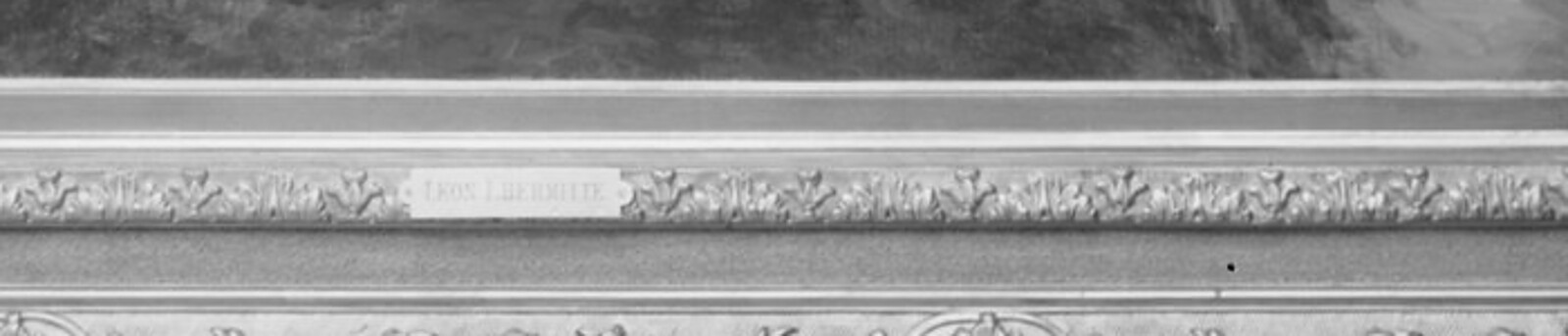
But the camera was close and the plates were fine, and on the lower rail of nearly every frame there is an engraved brass plaque. At full resolution the plaques read.
Forty-two painters came out of that: Corot twice, Millet, Rousseau, Daubigny twice, Díaz twice, Dupré, Jacque, Decamps, Harpignies — and a wall of English portraits plaqued as Gainsborough, Reynolds, Raeburn, Romney and Morland. One plaque even carries provenance, because provenance was part of what had been bought: from the Fop Smit Collection, a Rotterdam shipping family whose pictures were dispersed in the 1890s.
Nobody had read them. Not because they were hidden — because nobody had enlarged the corner of the picture that was not the picture.
That is the method of this entire section, and it is worth setting out properly, because the same trick works on almost everything here.
II. The rule
The mark is almost never on the part of the object you are looking at. It is on the edge, the back, the underside, the corner, the rail, the selvage, the title block — the part that was finished last, by the person who made it, for the person who would take it apart.
And it survives for exactly that reason. Nobody polishes a mark off a place nobody looks.
III. A working list
Here is where names have actually turned up on this site, with what was found.
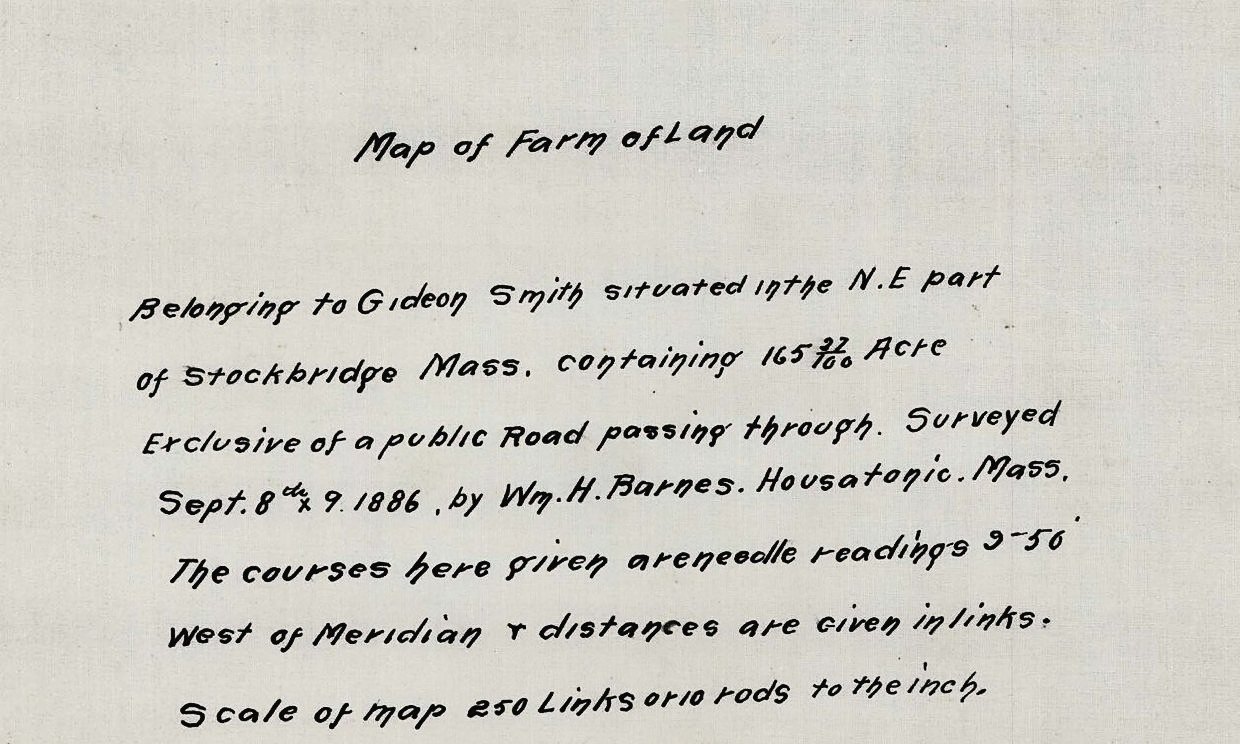
The corner of a drawing. The Olmsted office let its draftsmen sign. J.E.TITUS Del. on the Wyndhurst general plan of 24 August 1894. W.H.M. on a grading plan. J.C.O. — John Charles Olmsted — initialling the Wheatleigh species key. Alex Sholtes on a garden perspective at Elm Court in 1924. And in the title blocks, the surveyors: W. H. Barnes, G. A. Murdock Surveyor, Pittsfield Mass.
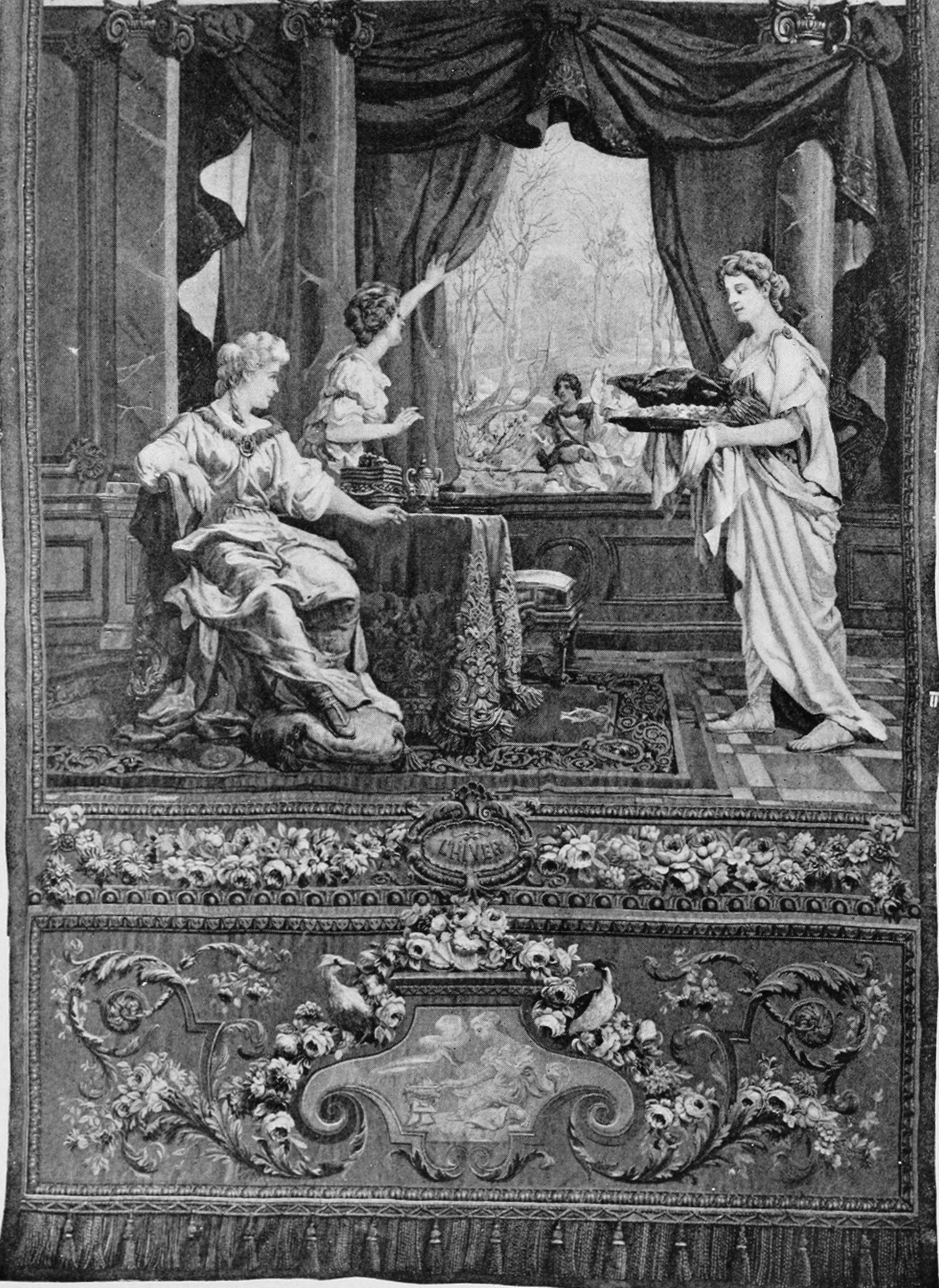
The selvage of a tapestry. The Williamsbridge works signed its portières with a B and a shield, set into the right-hand edge where the weaving runs out. A weaver’s mark is put in with the same bobbin as the picture, at the same moment, and cannot be removed without unpicking the cloth.
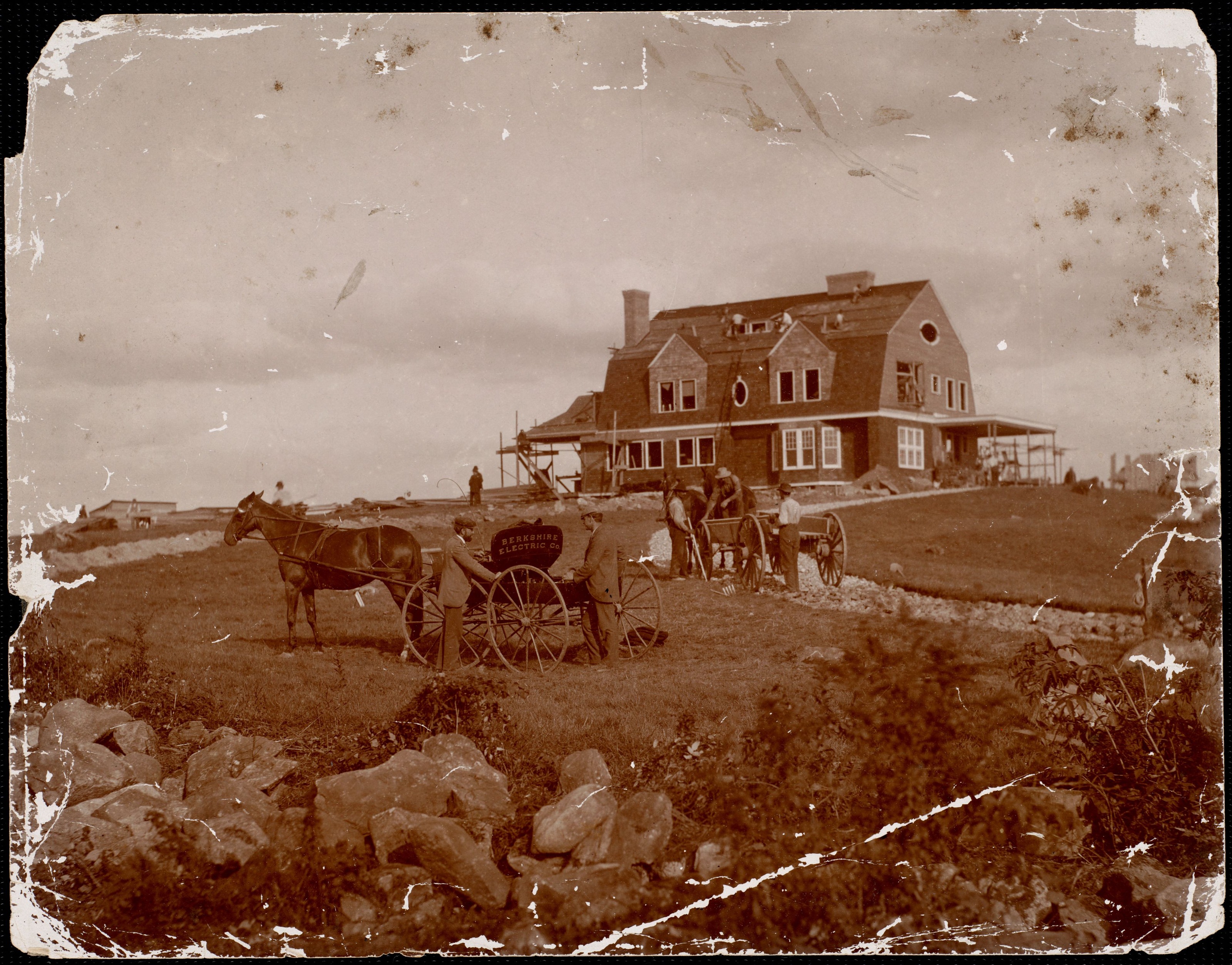
The back of a photographic print. This is the richest seam in the Berkshire collections and the least used, because it requires someone to have turned the print over and written on it. When they did, the cataloguers recorded it. “At left by carriage is Benjamin Rogers, right: Edward B. Rogers” — handwritten on the back of a photograph of a house going up on October Mountain in 1896, and the only reason two electrical contractors have names. “Ventfort Hall; G. Morgan estate” — on the back of a print of three men working on a bed. “Item G-4, superintendents house” — on the front of a mount at Brookhurst.
The lettering on a vehicle. A contractor who paints his name on a buggy and then parks it where the camera can see it has signed the job as surely as a mason cutting initials into a step, and rather more legibly.
The title block of anything commercial. When an estate was appraised to be broken up, the appraiser signed the sheet: J. R. Hampson, Inc., Appraisal Engineers, Pittsfield, Mass. That is a firm, a town and a date, attached to a measured drawing of a staff house that would otherwise be nothing at all.
The advertising in a directory. The running heads and end papers of the 1923–’25 volume are solid with local businesses — Pender’s the leading clothiers, Tyler’s Shoe Store at 304 Main Street, Henry A. Stevens, funeral director and auto livery — and those are trade names with addresses, printed by the businesses themselves, on the same page as the people who worked for them.
A trade catalogue. Tiffany Studios published its own account of how its glass was made, with plates. That is a maker describing its method in its own words, in a book anybody can still read, and it does more work than any amount of stylistic attribution.
IV. Where nobody has looked yet
The list above is what has been read. The list below is what is almost certainly sitting in these buildings right now, unread.
The underside of a stone step, where a quarry stamps its blocks so the yard knows what came off which face. The back of a plaster boss, where a modeler presses initials into the wet cast before it is set. The head of a radiator, where the founder casts its name and city into the iron because it is also an advertisement. The back of a slate, where a Vermont or Pennsylvania quarry marks size and grade. The back face of a stair riser, where a carpenter writes the tread number in pencil so the pieces go up in order — pencil on bare pine, in a dry stairwell, lasts indefinitely. A brass tag wired to a valve. A name scratched into the back of a bell-board with a bradawl.
These are not romantic possibilities. They are ordinary trade practice, and they are ordinary trade practice because the work was made in pieces by different hands and had to be sorted. Every one of them is a name or a firm or a town, and most of them are within reach of anybody with a torch, a stepladder and permission.
V. Three rules that make it work
Photograph past what you need. The Blantyre plaques are legible because a photographer in 1912 used a plate that recorded more than the eye needed, on a job that was only meant to be an inventory. Every archive holds images whose resolution exceeds the use they were catalogued for.
Do not trust the catalogue to have read the object. A cataloguer titles what the image is of. Nobody is paid to enlarge the frame and transcribe the brass. The Lenox catalogue is excellent and it says nothing about forty-two painters, because that was never its job.
Say where you read it. Every attribution on this site that came off a mark is given with the mark quoted as engraved, printed or lettered — including the errors. A plaque that gives Díaz’s birth as 1808 when the usual year is 1807 is quoted as 1808, and the difference is stated. A draftsman who lettered PREIMMINARY across the top of a sheet gets his spelling kept. The mark is evidence; correcting it silently destroys the evidence.
VI. Why this is the point
Go back through this section and count who is named.
James Renfrew, coachman. Thomas Proctor, gardener. Alfred Richards, butler, with an address in Lenox and another off Fifth Avenue. John Valinaggi, plasterer. Benjamin and Edward B. Rogers, electrical contractors. Eugene Dellea and Felix Delmolini, quarrymen. J. E. Titus, draftsman. M. Foussadier, weaver and dyer. George P. Lynch, gardener, removed to Ireland.
Not one of them is in a history book. Every one of them is on a mark — a line in a directory, a caption, the back of a print, a corner of a drawing.
The people who built and ran these houses were not forgotten because nobody wrote them down. They were written down constantly, in small letters, on the parts of things that nobody photographs. All that has happened is that nobody went and looked.
Blantyre frame plaques transcribed from the Lenox Library Association’s October 1912 picture inventory at full resolution; the complete table of forty-two attributions, with each plaque quoted as engraved, is on The paintings at Blantyre. Draftsmen’s initials and title blocks: Olmsted Archives, National Park Service, jobs 01295, 01027, 01346 and 01016. Photograph annotations quoted from the cataloguers’ notes recording what is written on the prints and mounts, Lenox Library Association, via Digital Commonwealth. Williamsbridge selvage mark from George Leland Hunter, Tapestries: Their Origin, History and Renaissance (1912). Appraisal title block, J. R. Hampson, Inc., Pittsfield, February 1938. Directory advertising from Crowley & Lunt, South Berkshire Directory, 1923–’25, reproduced here. The practices listed in section IV are ordinary trade practice and are offered as places to look, not as findings.