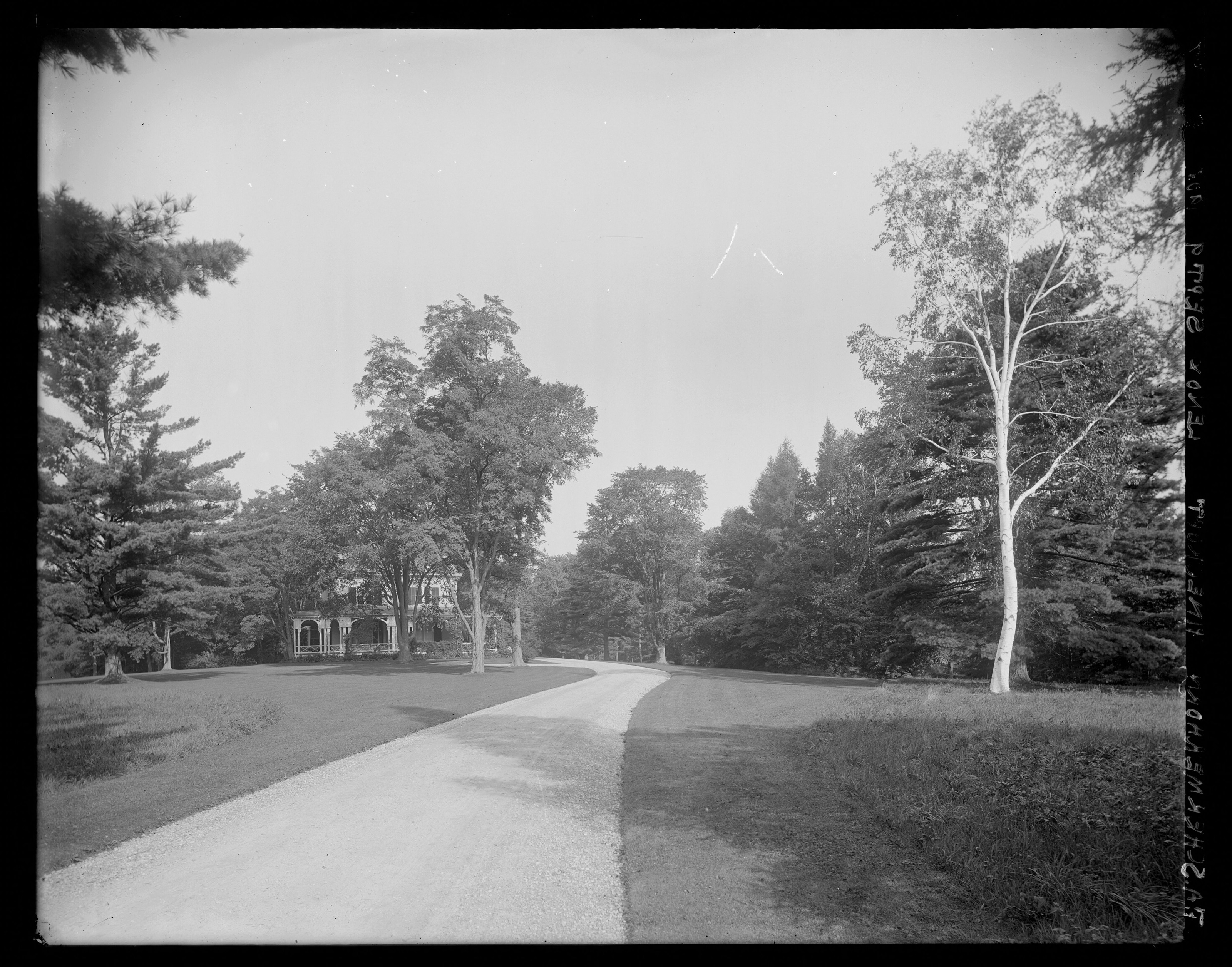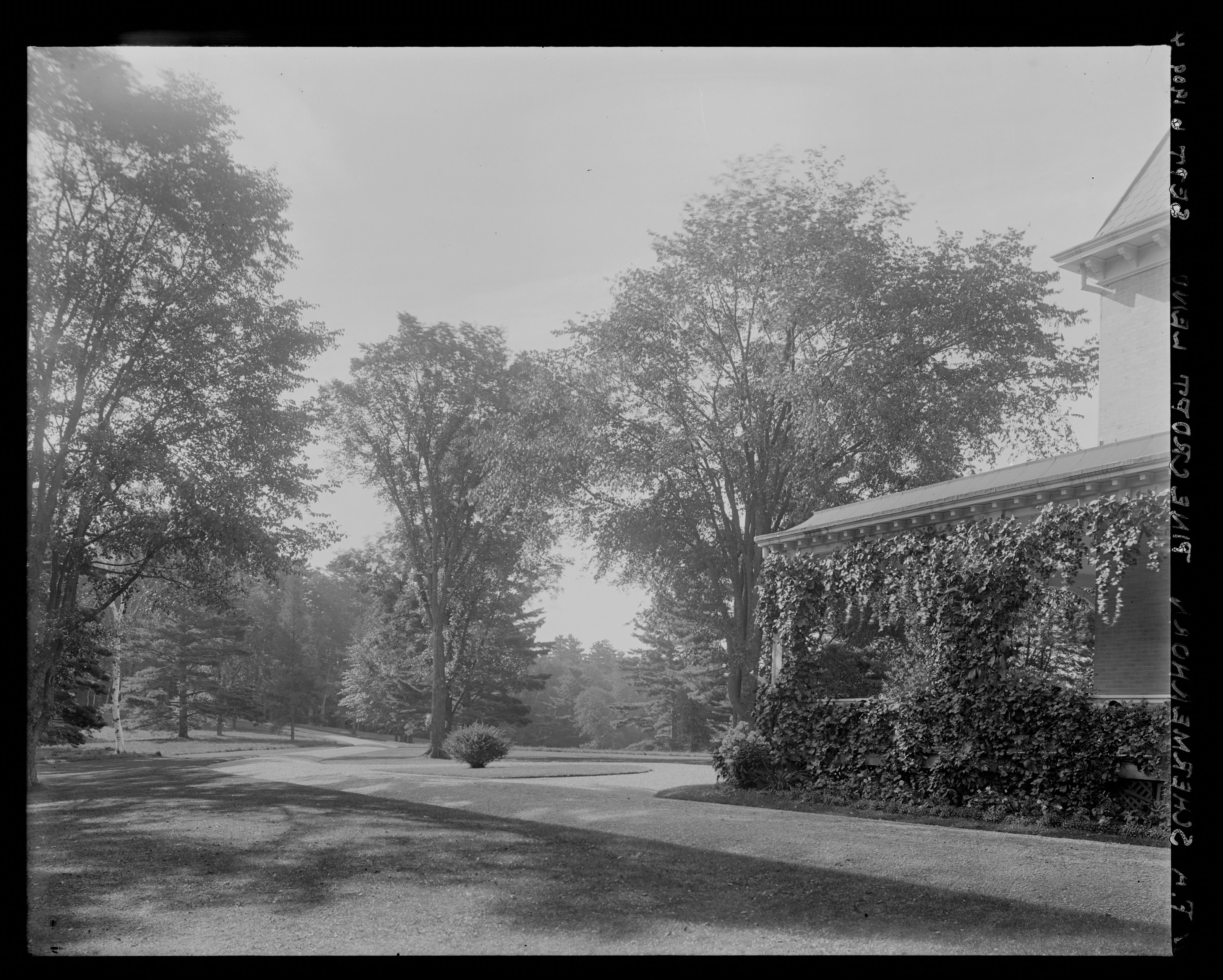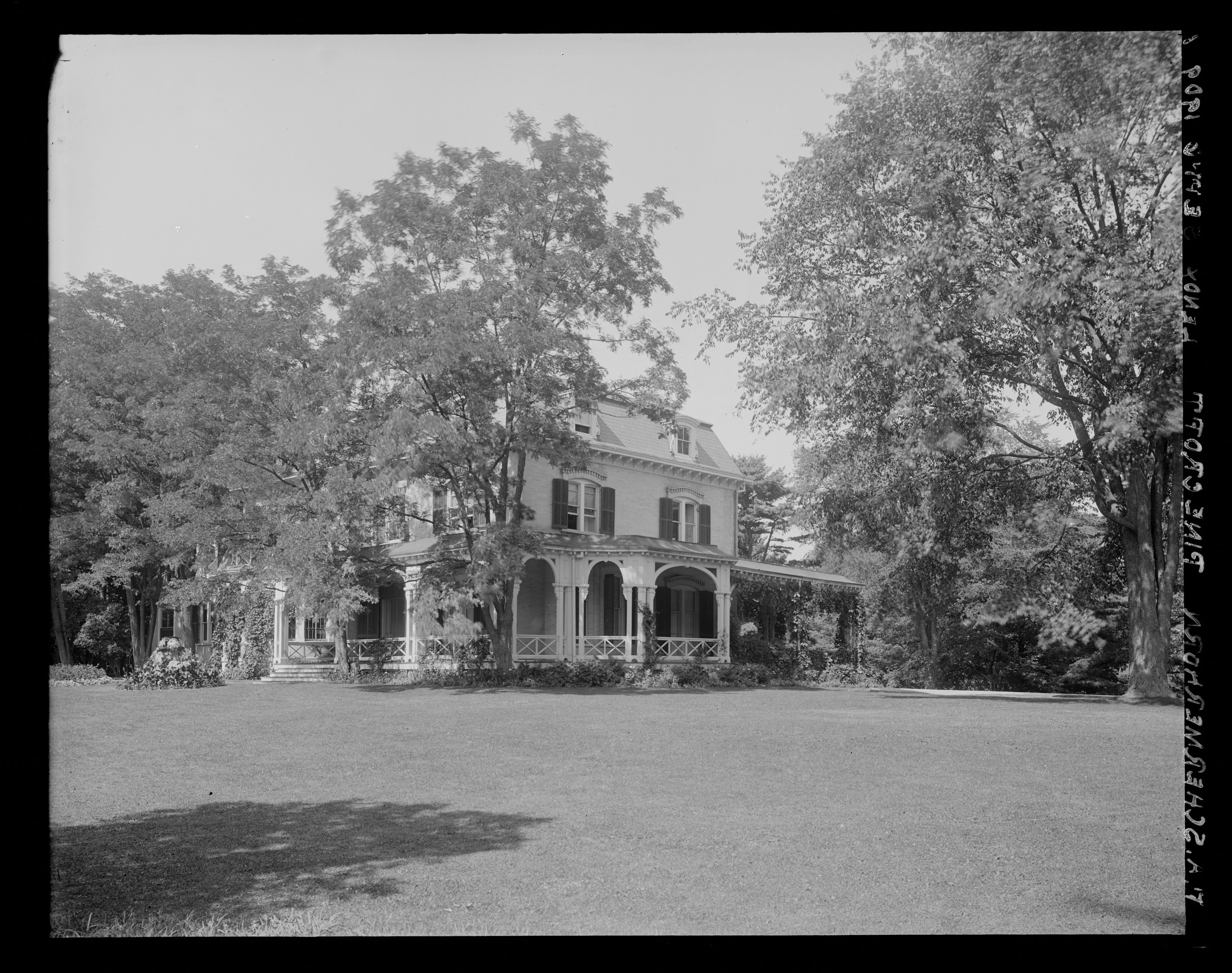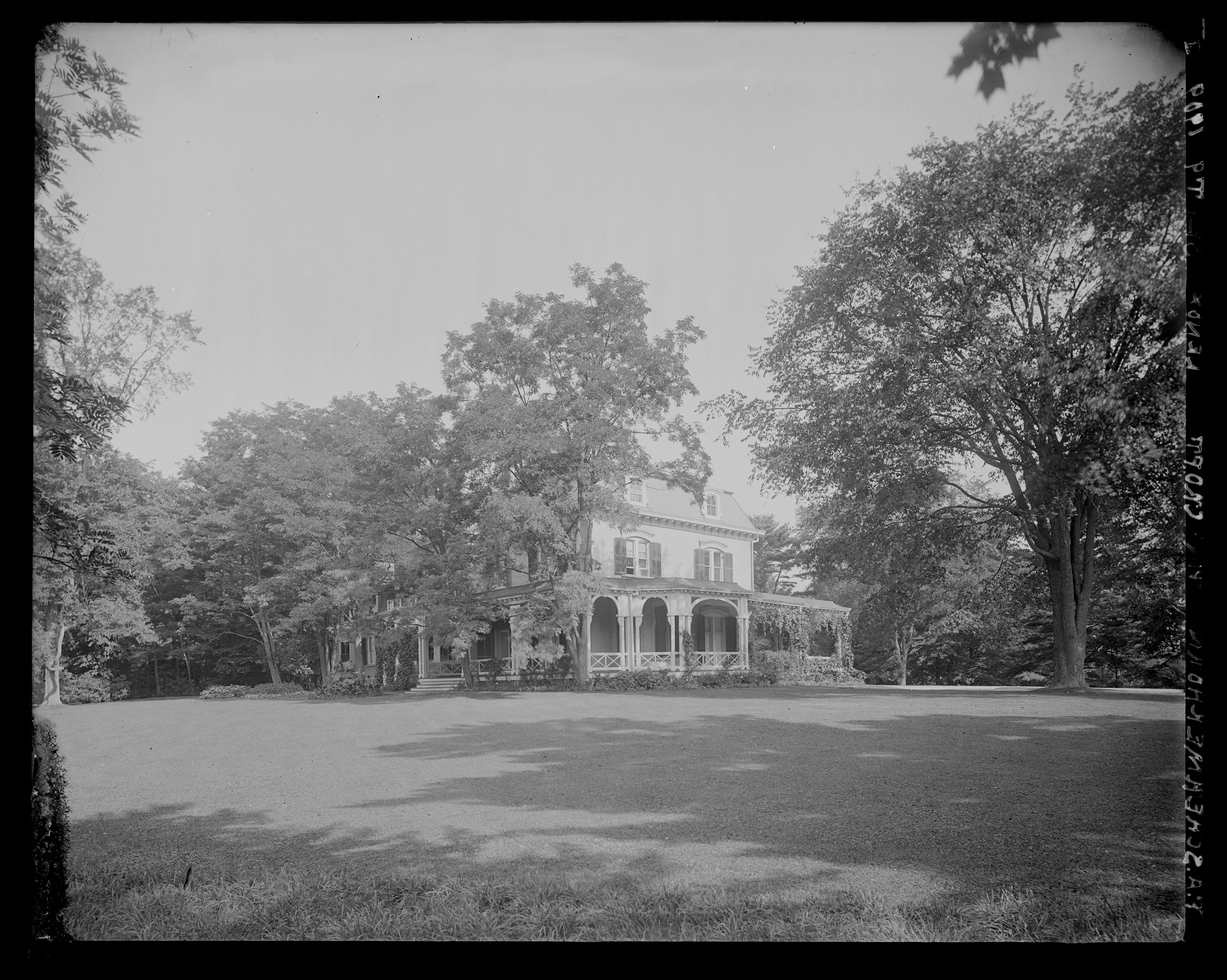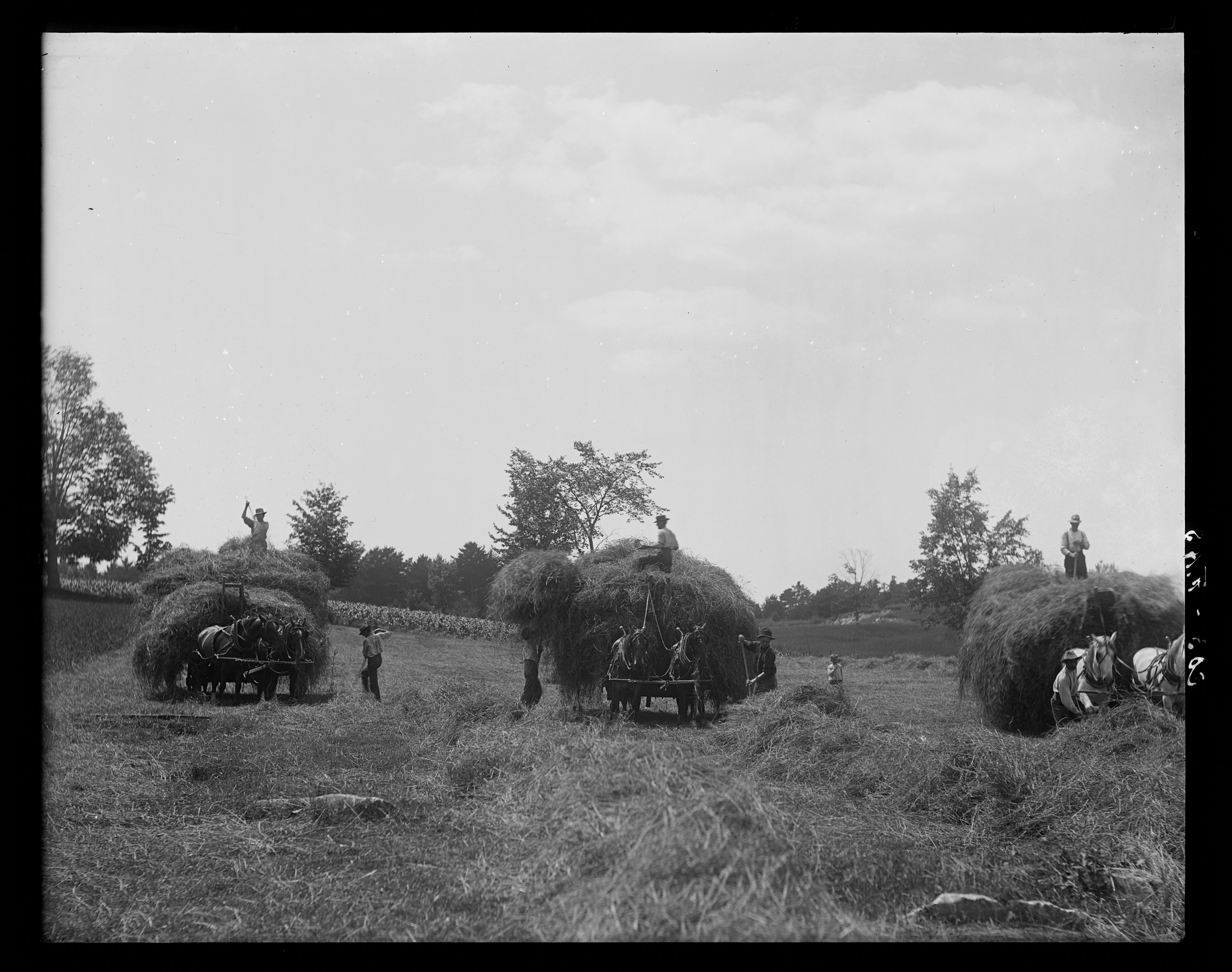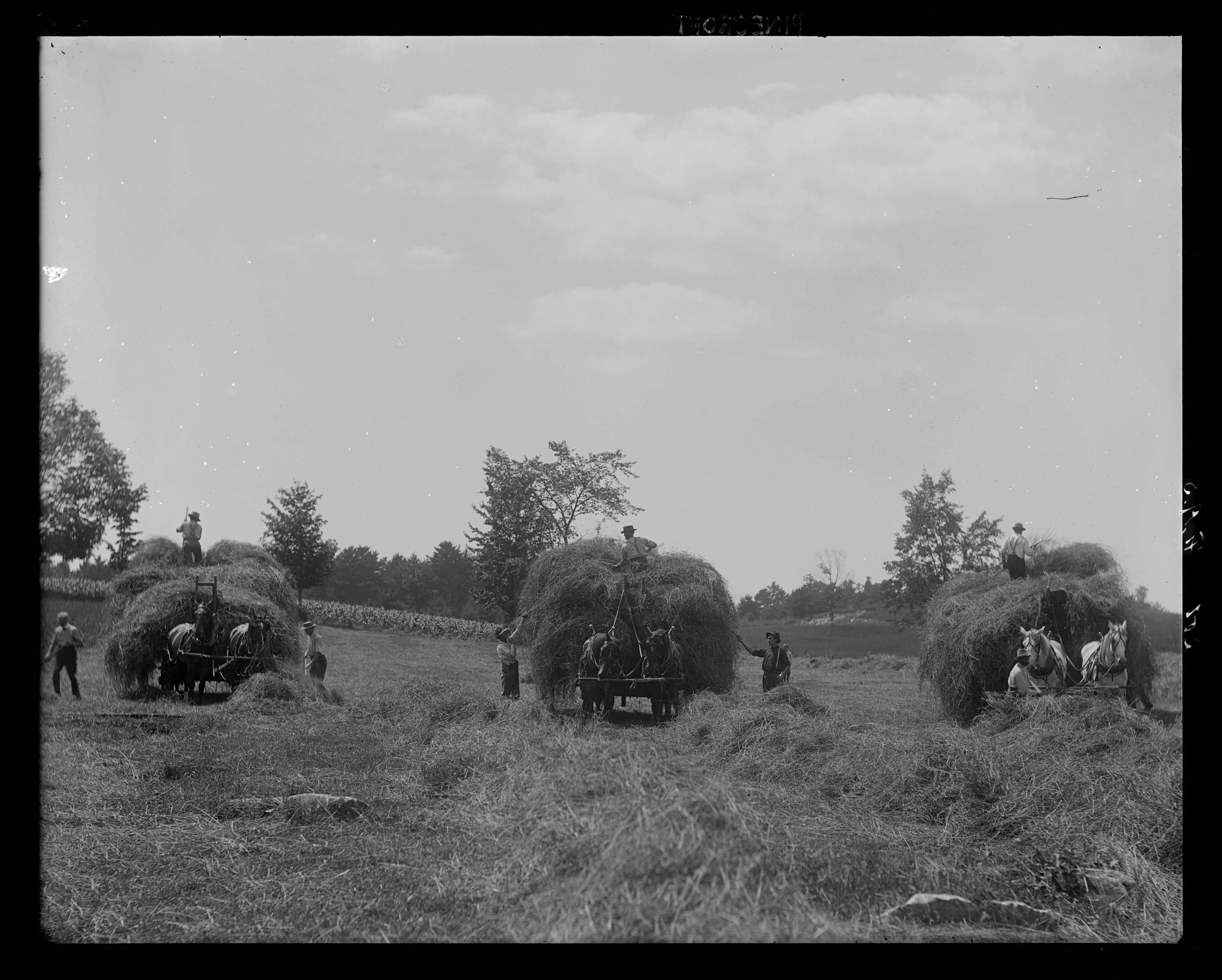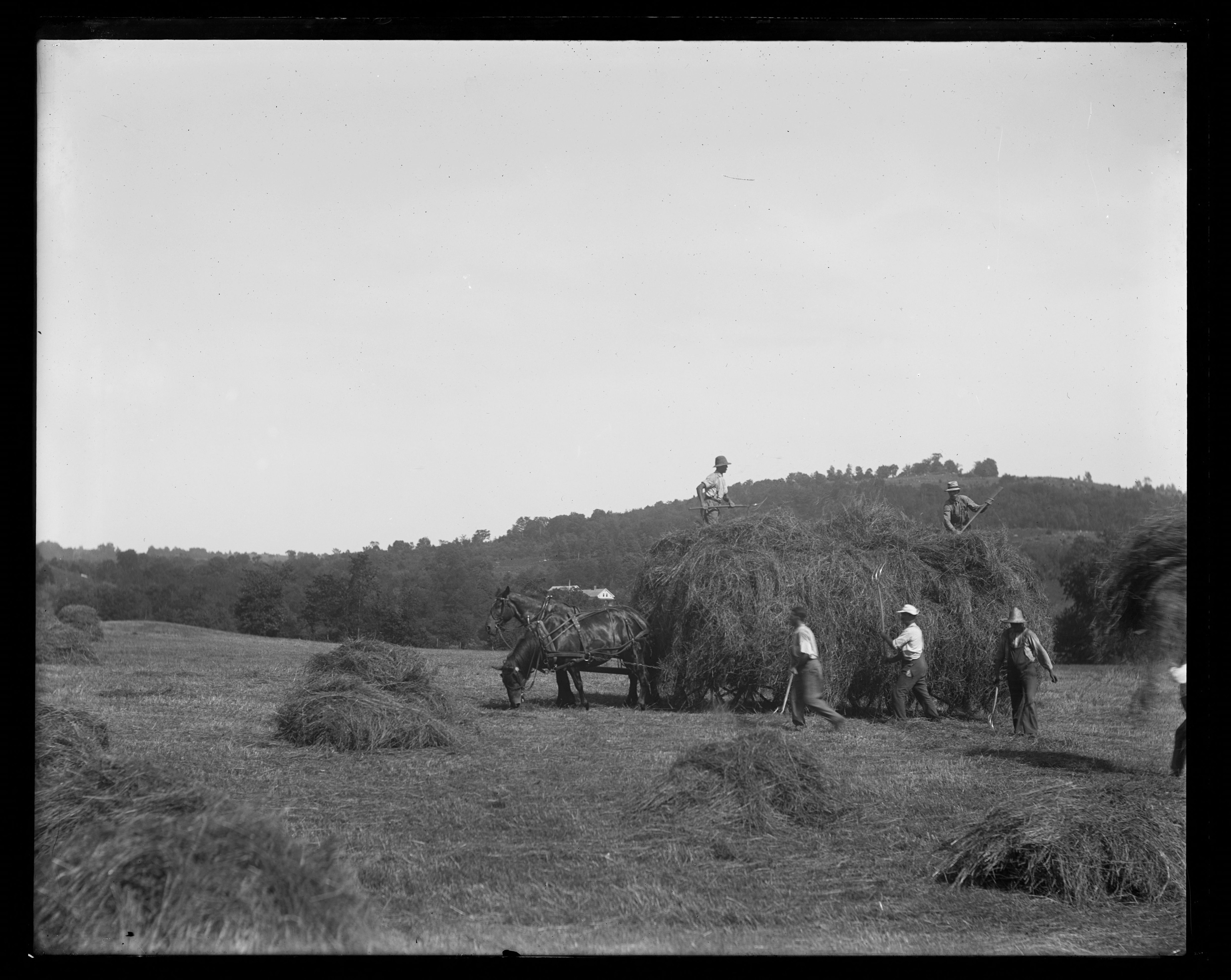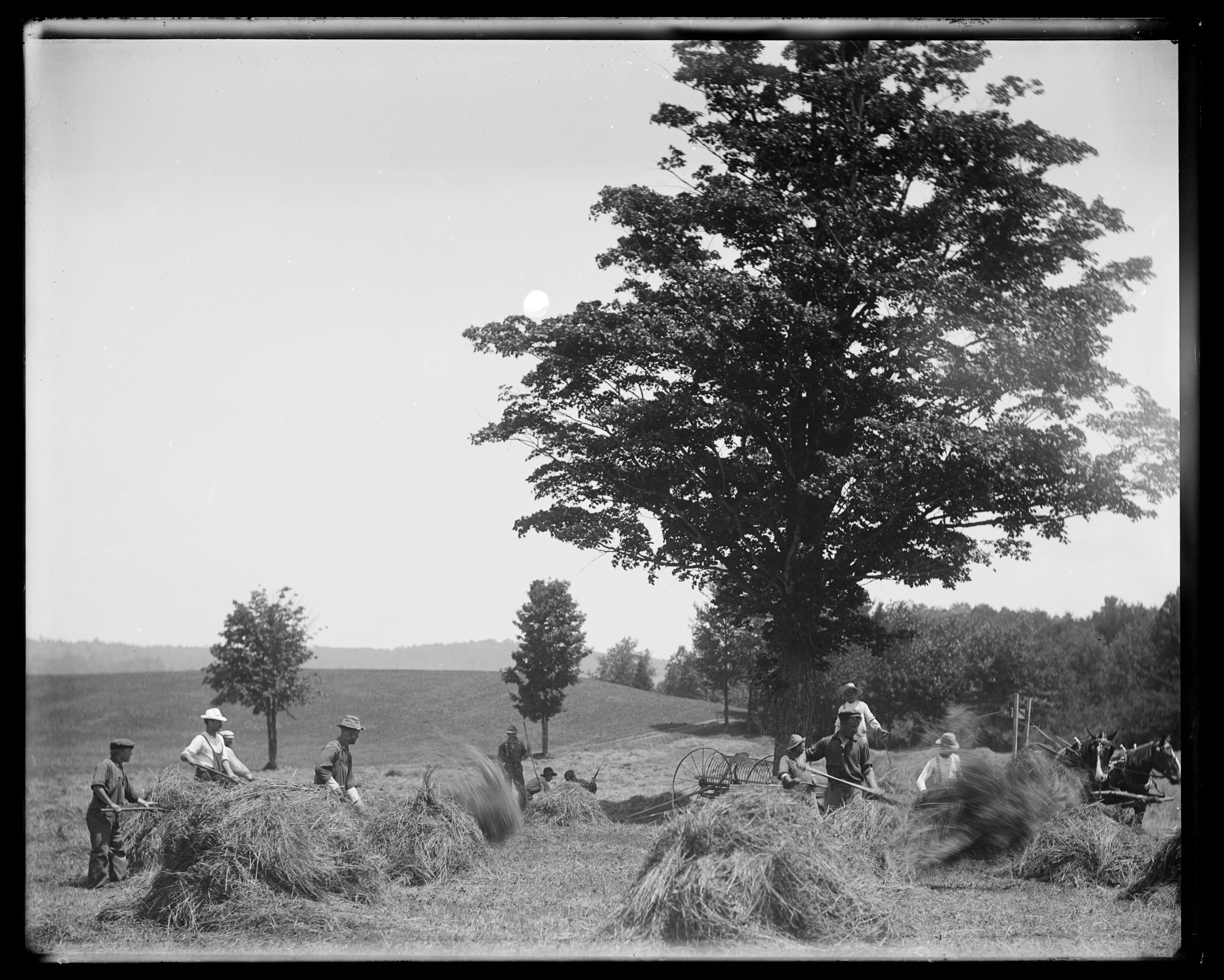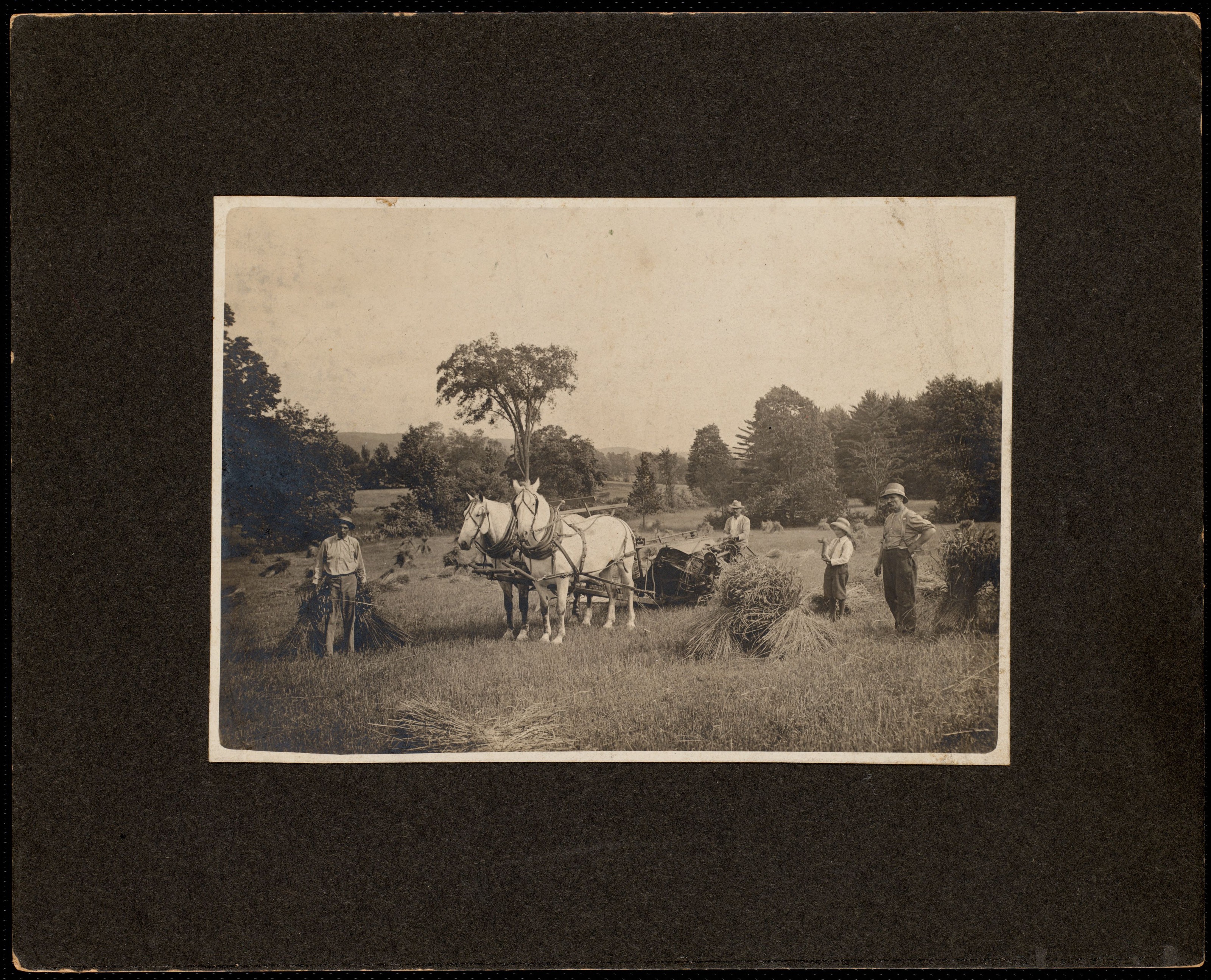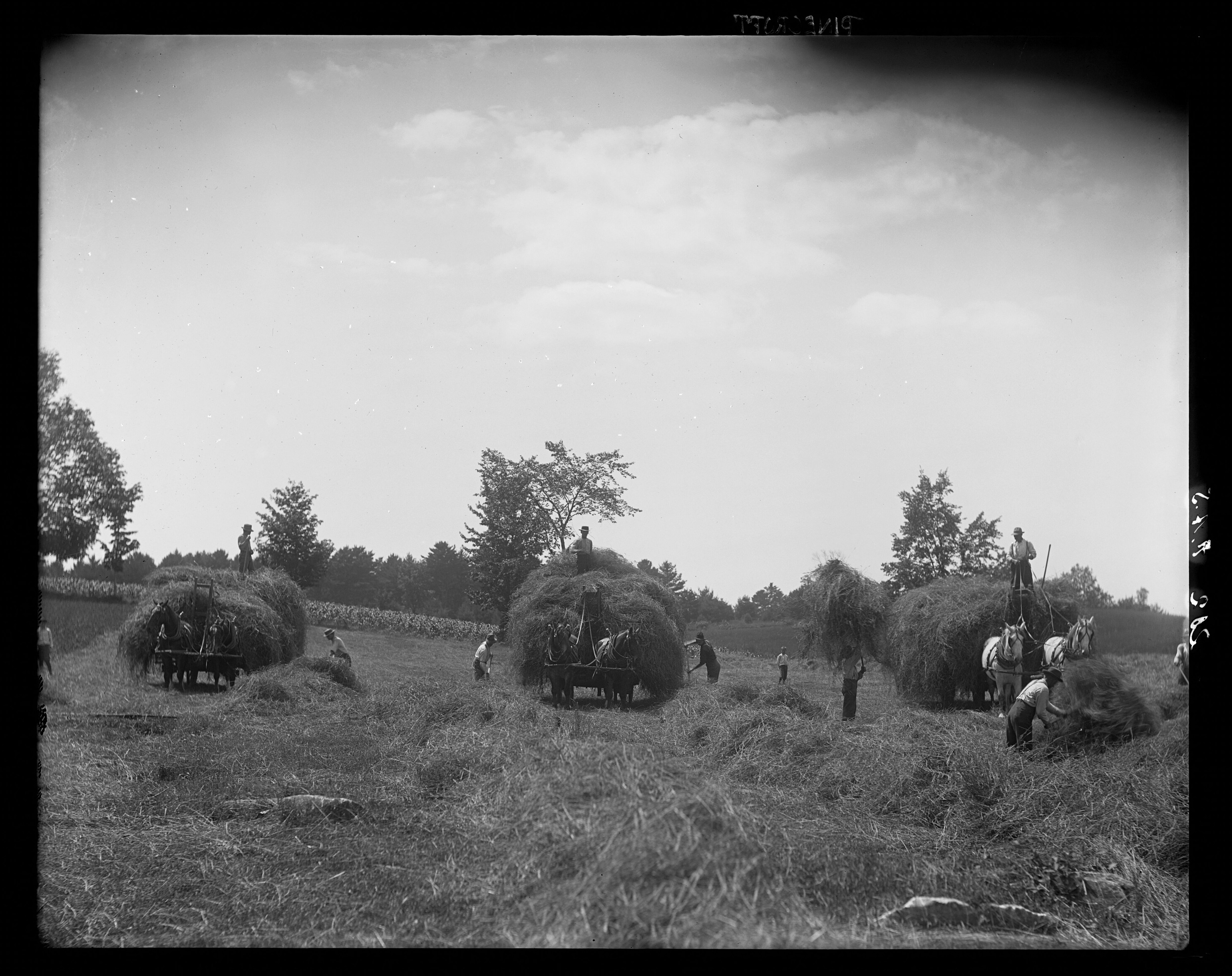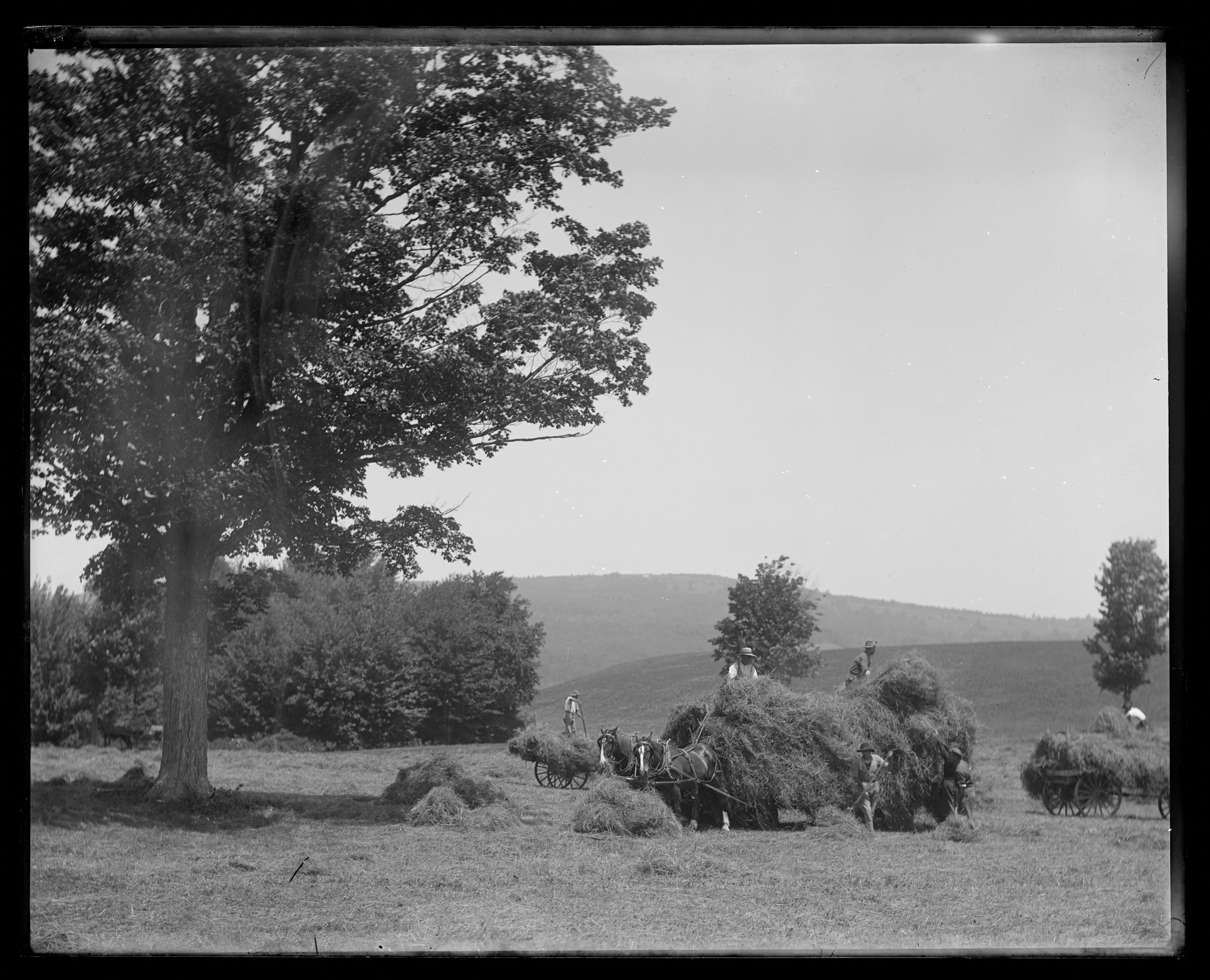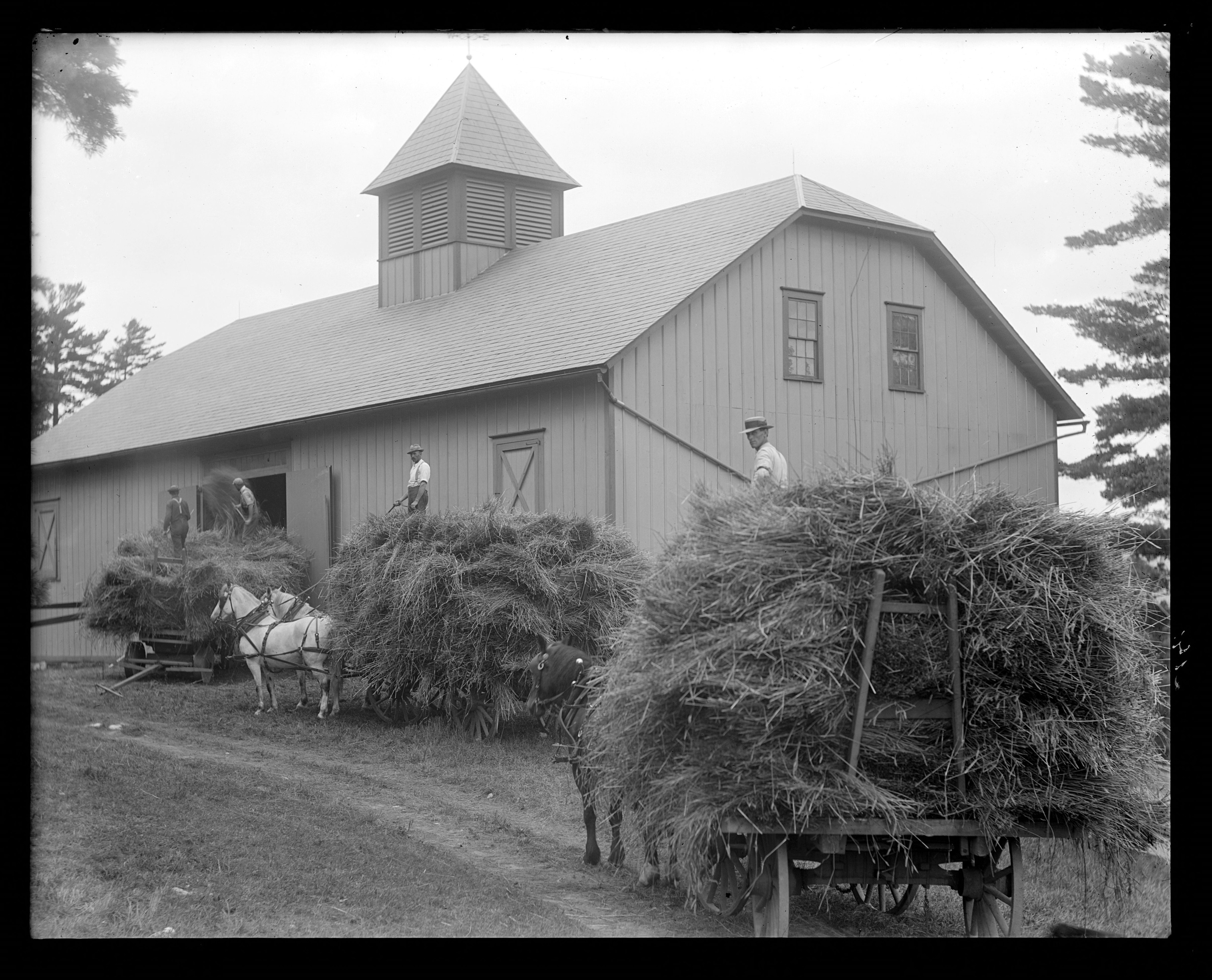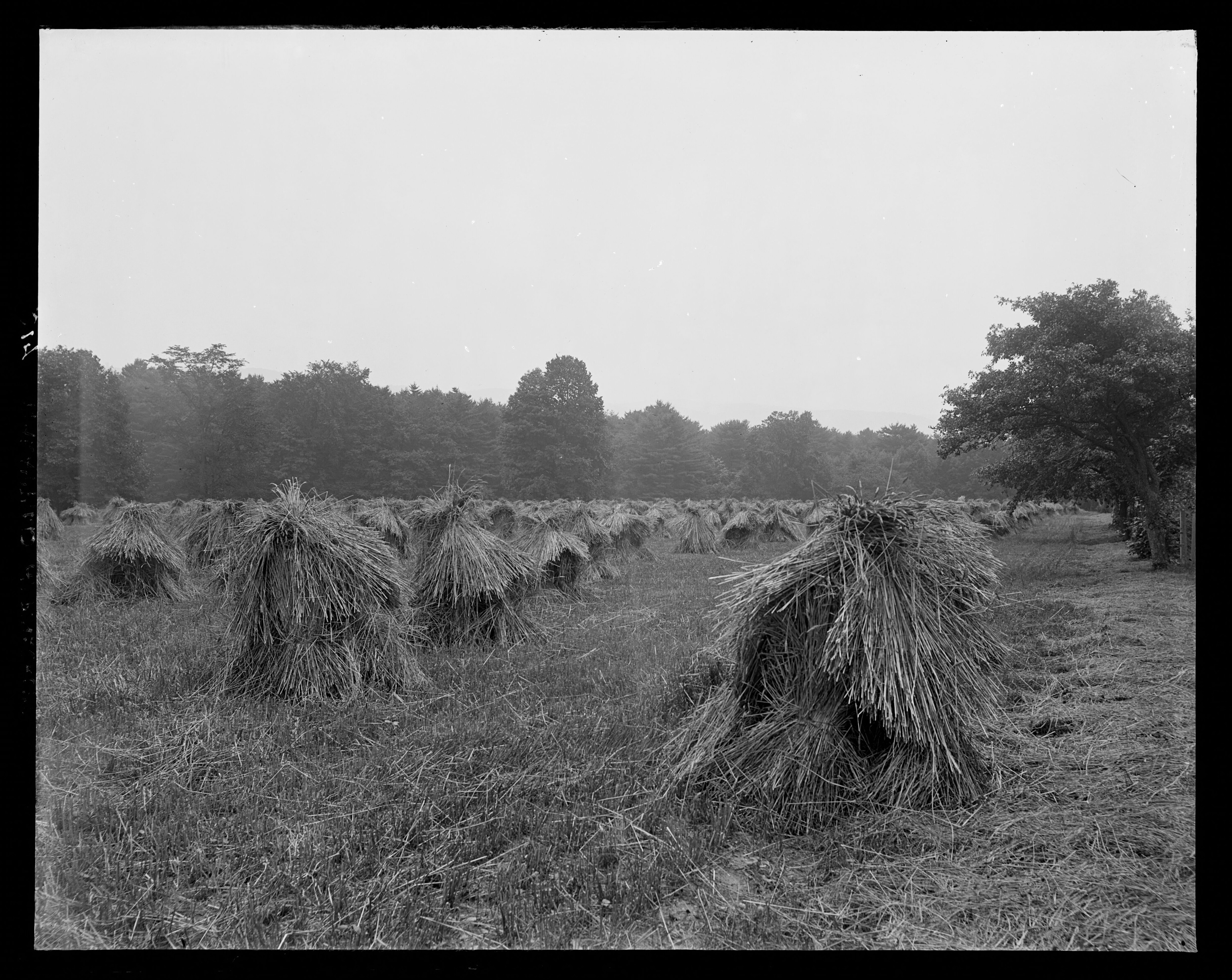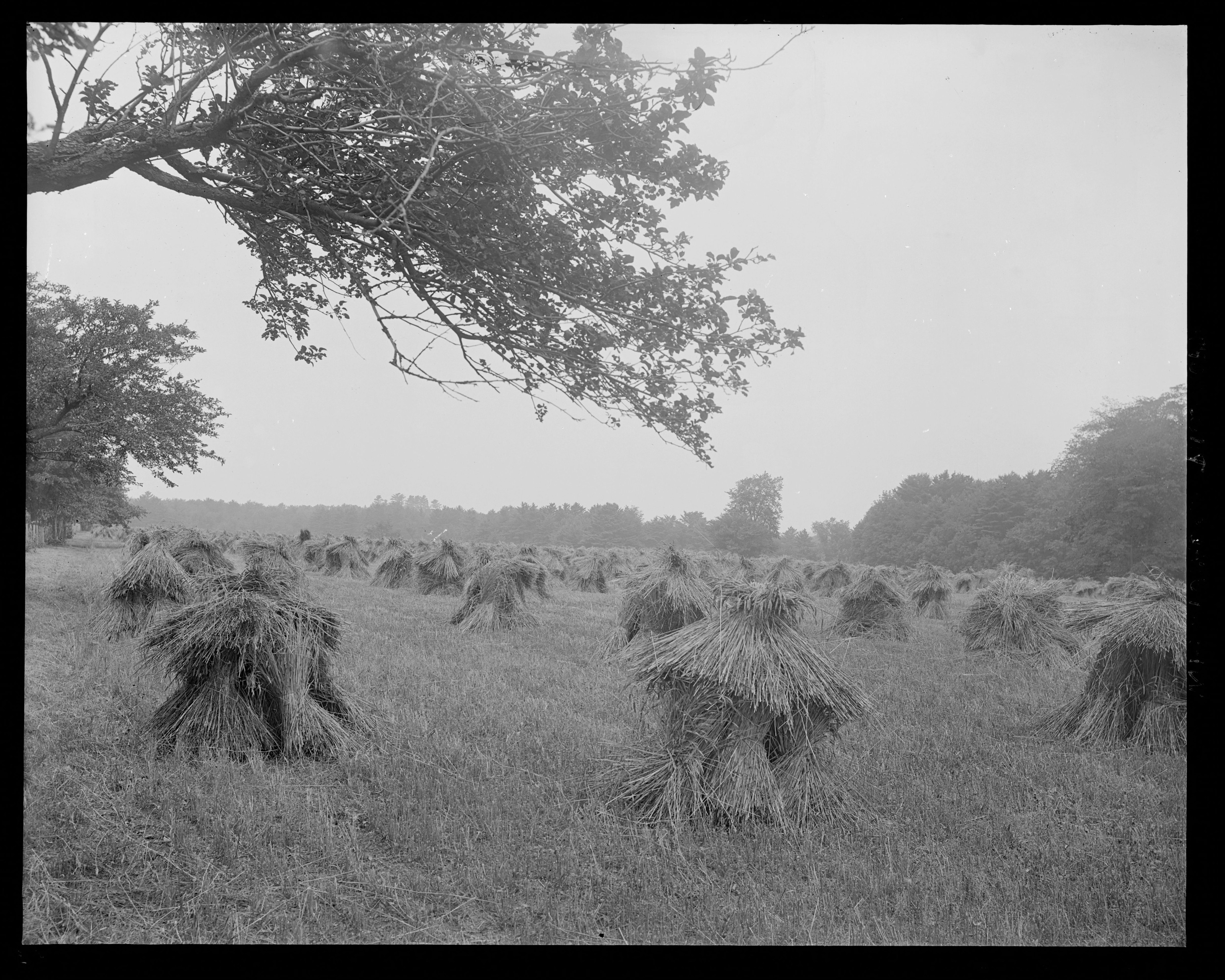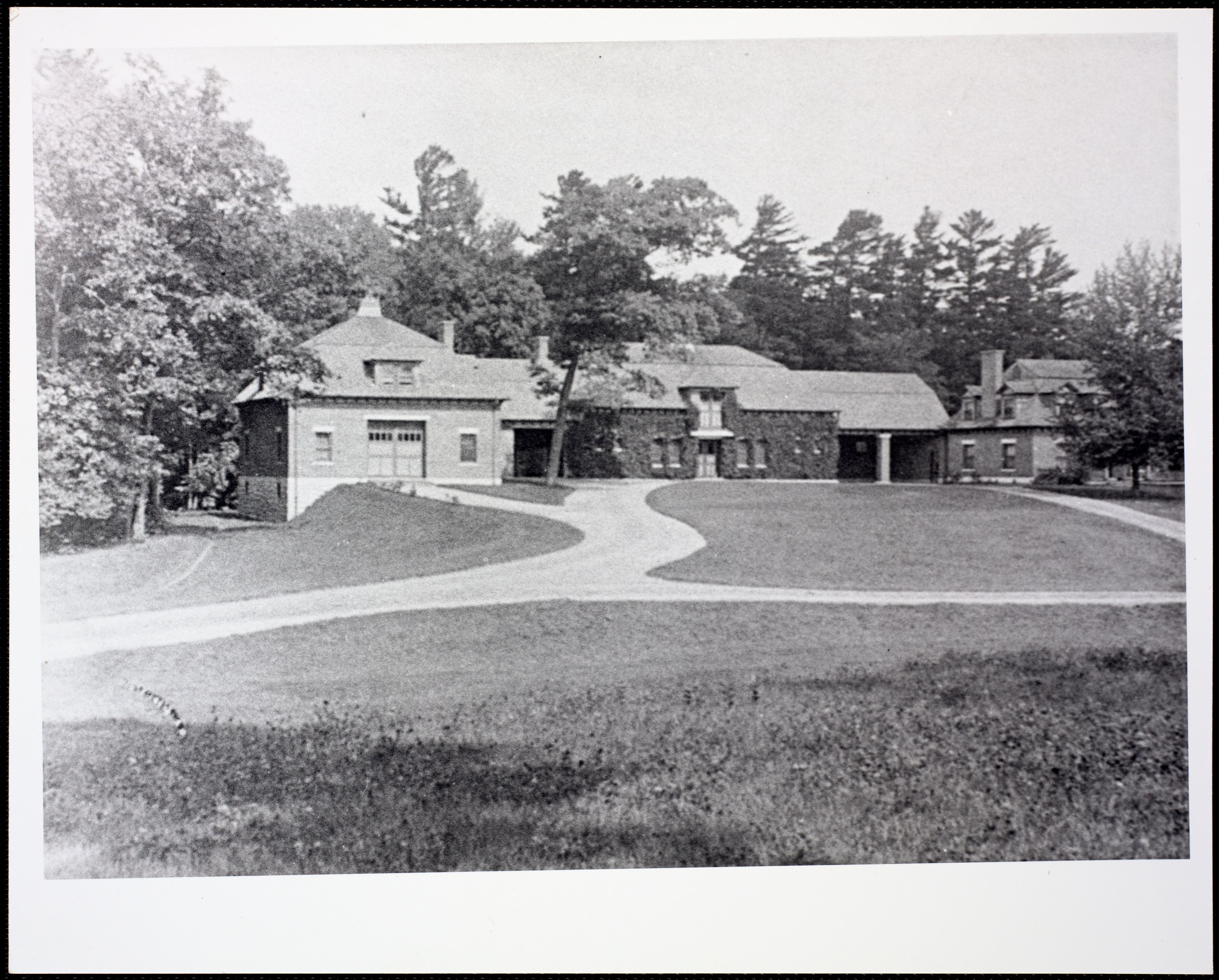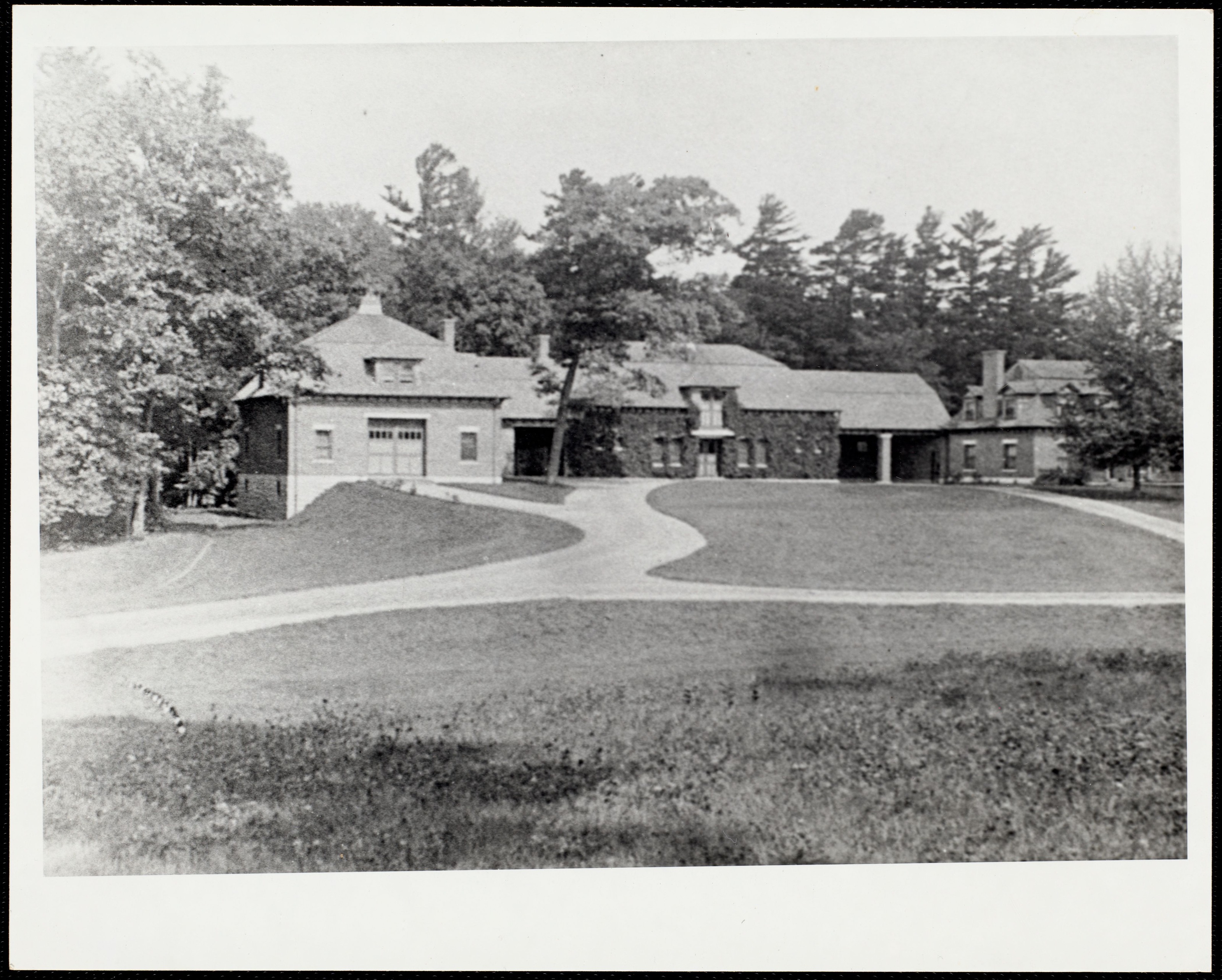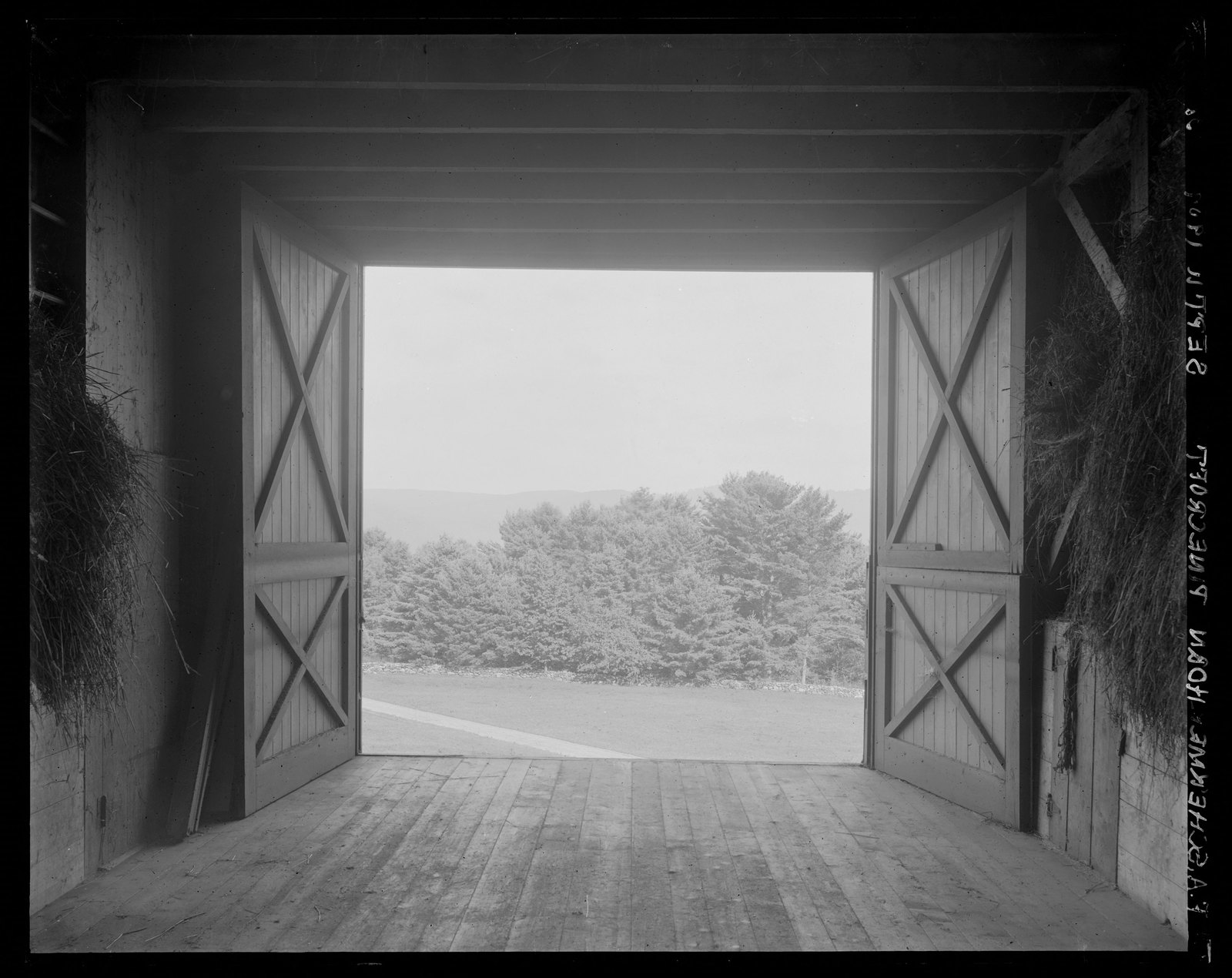
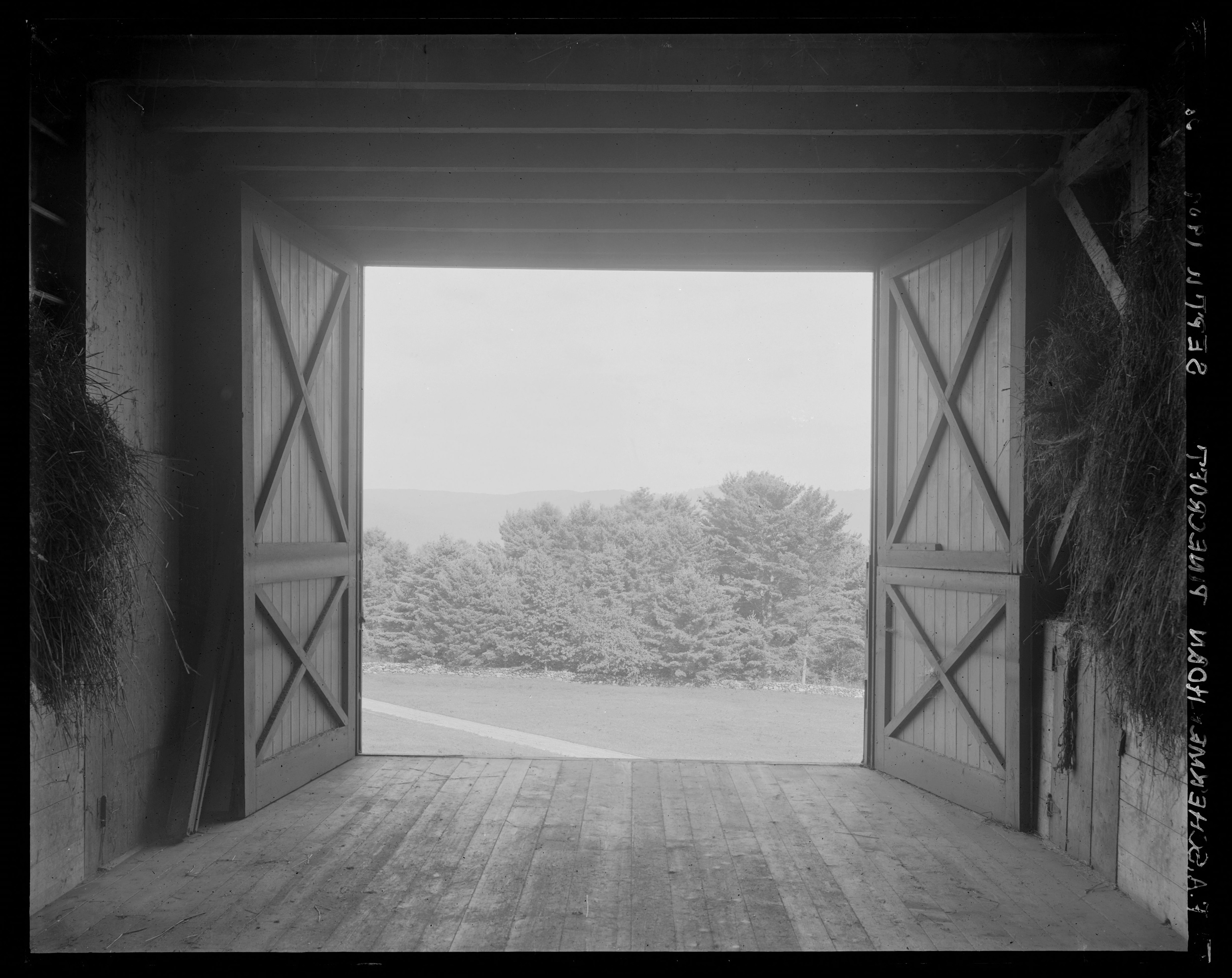
Eleven of these thirty-seven photographs are of hay and wheat. Men pitching loads onto horse-drawn wagons, a wagon backed into a gambrel barn with a cupola on it, stooks standing in rows across a field, and one picture taken from inside the barn looking out through the open doors at the hayfield beyond. This is a Lenox cottage estate, and most of what survives of it is the harvest.
I. The name on the negatives
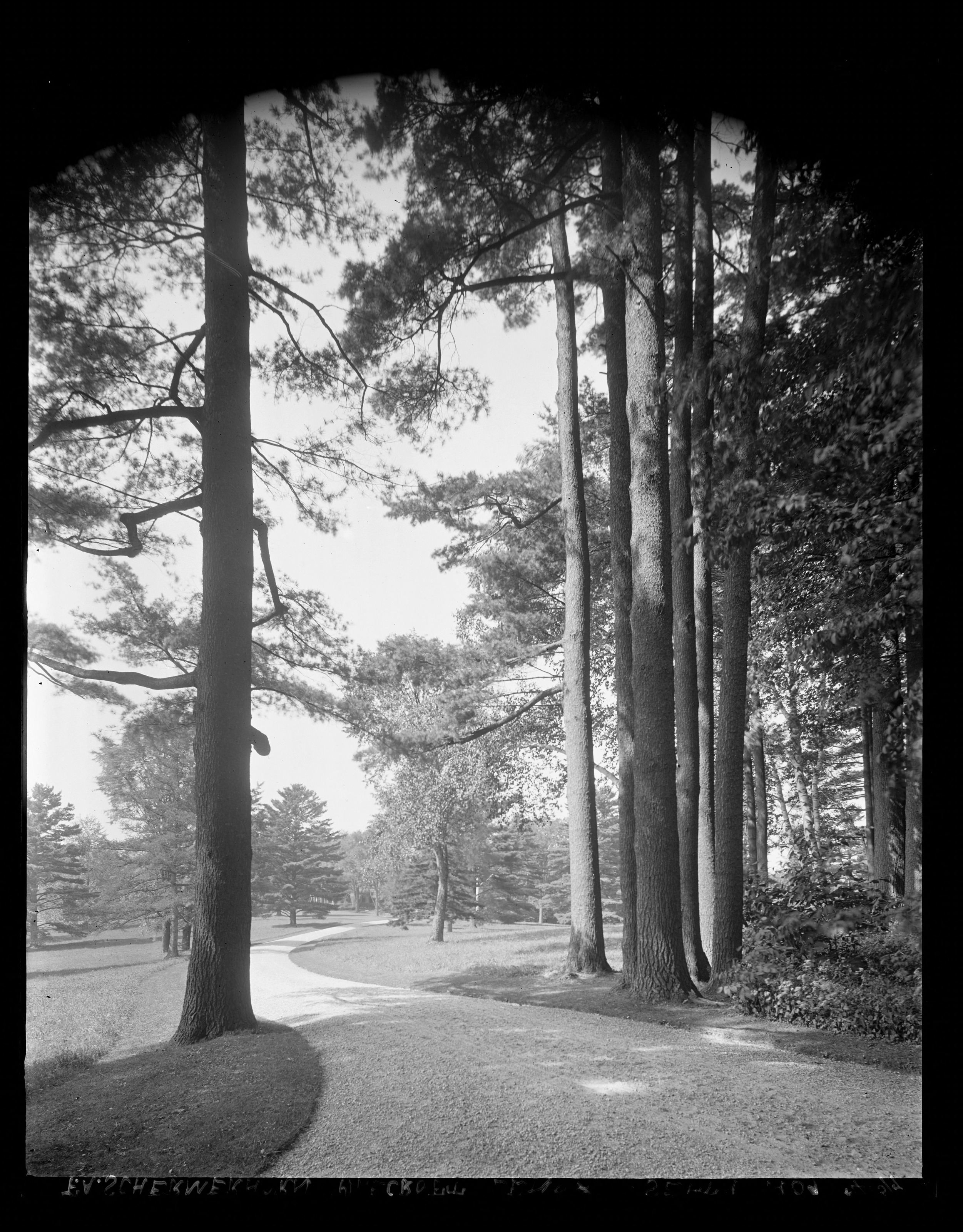
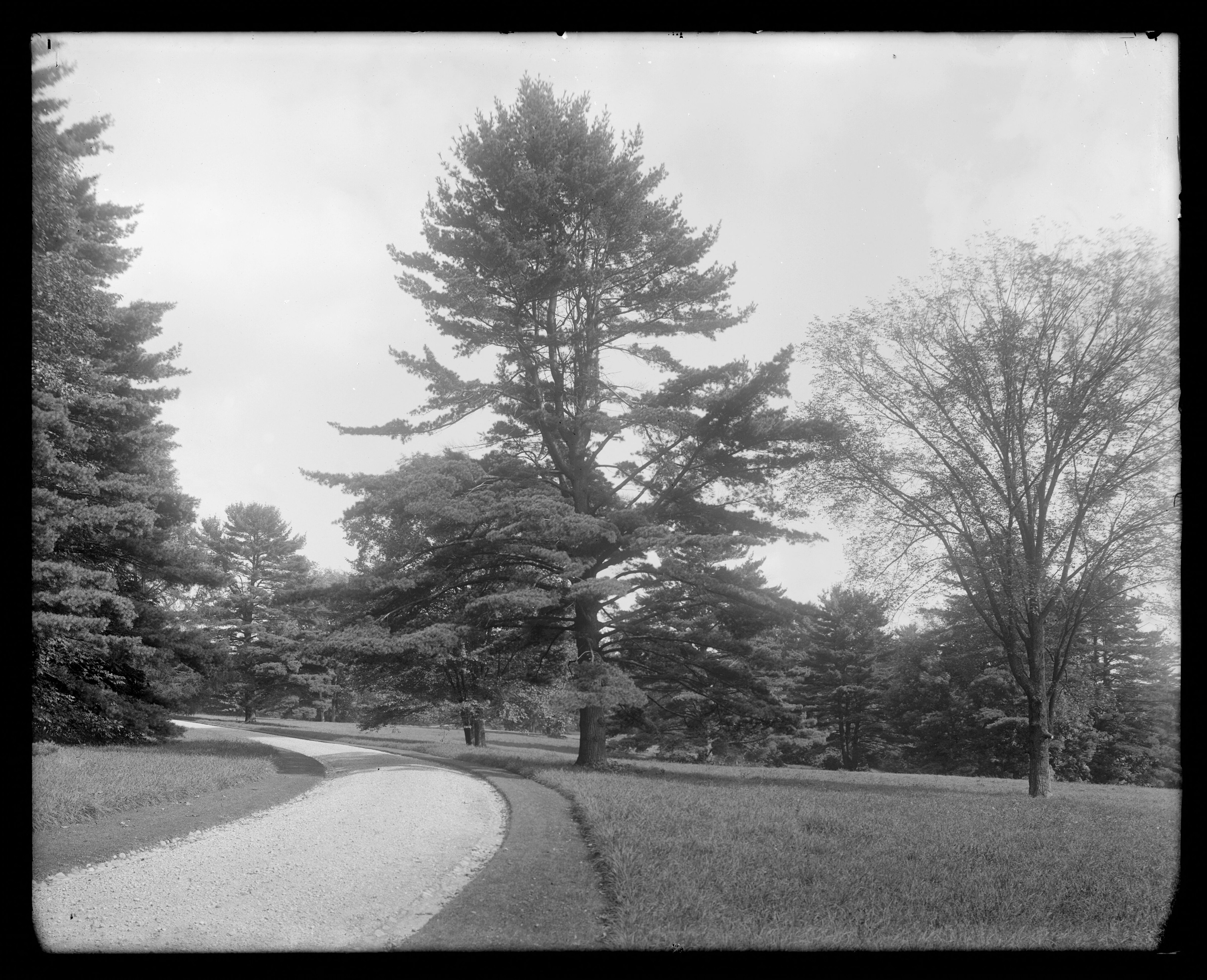
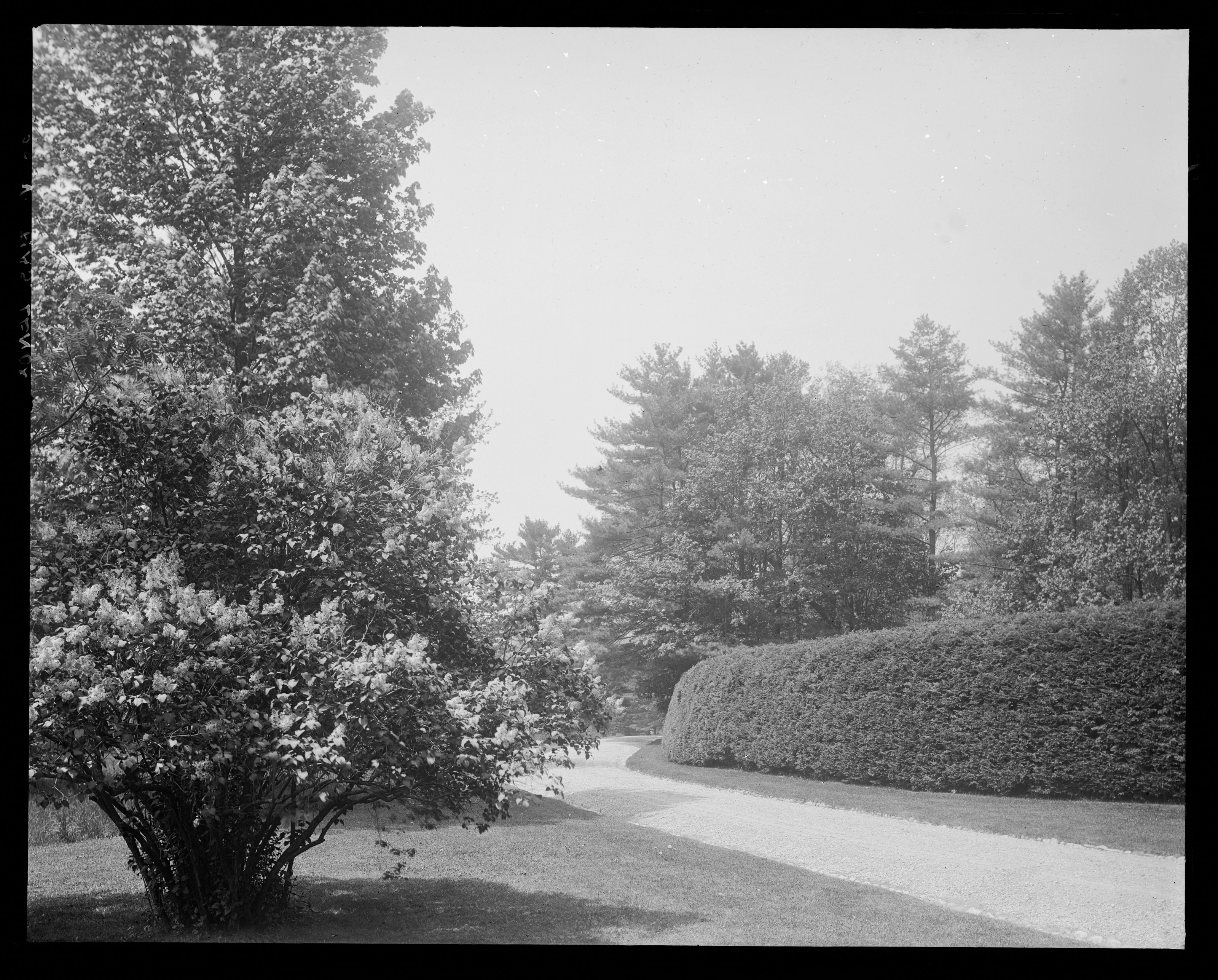
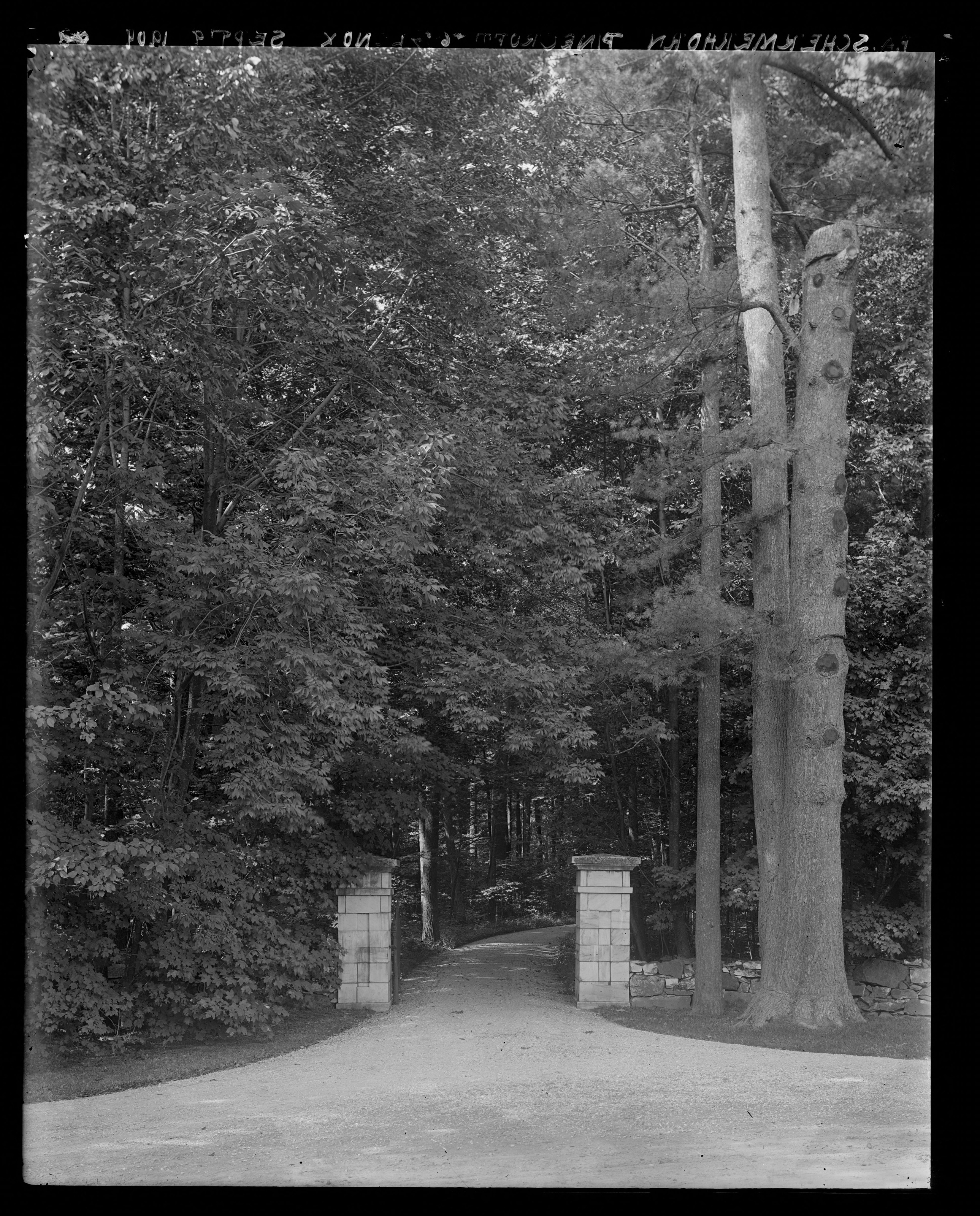
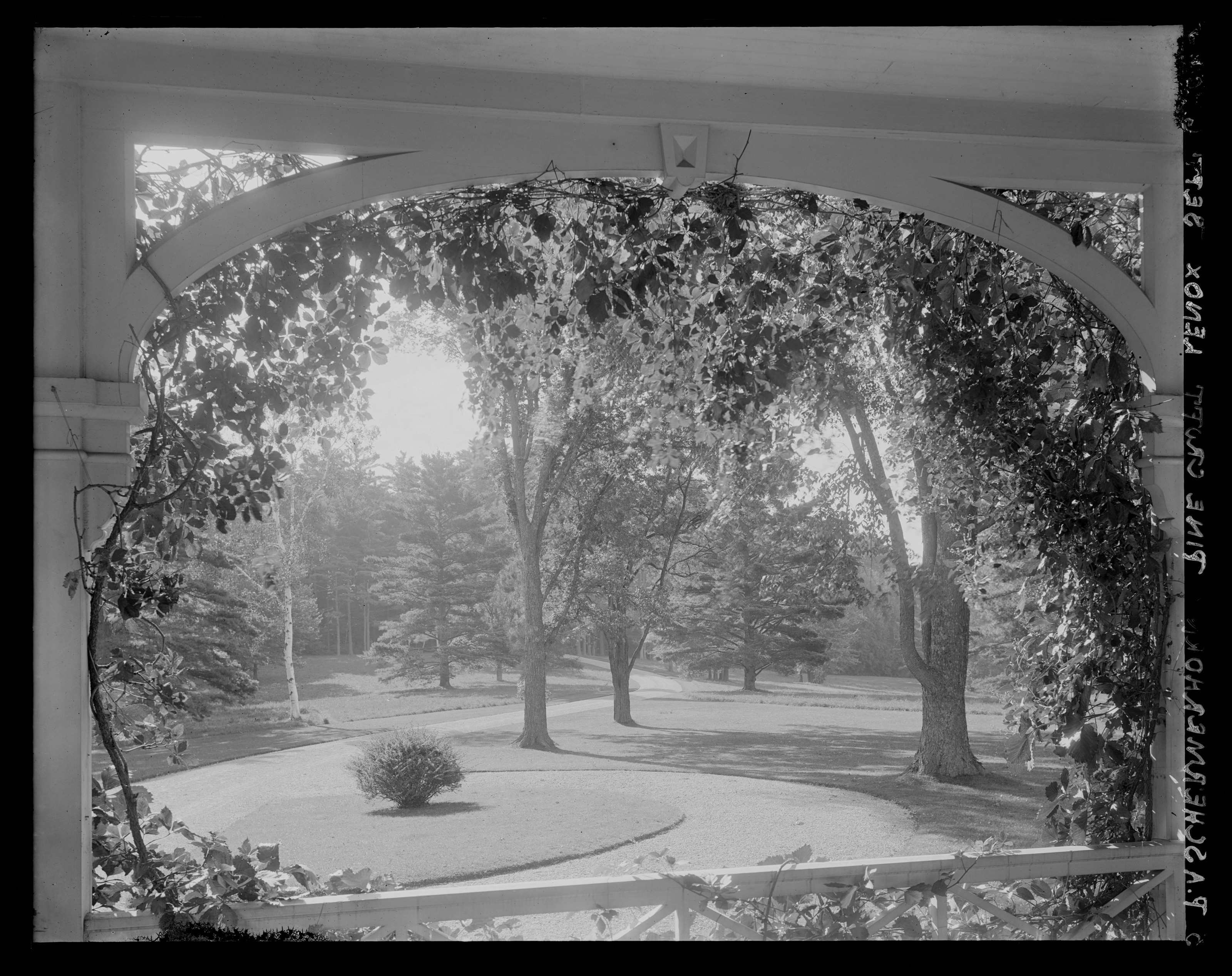
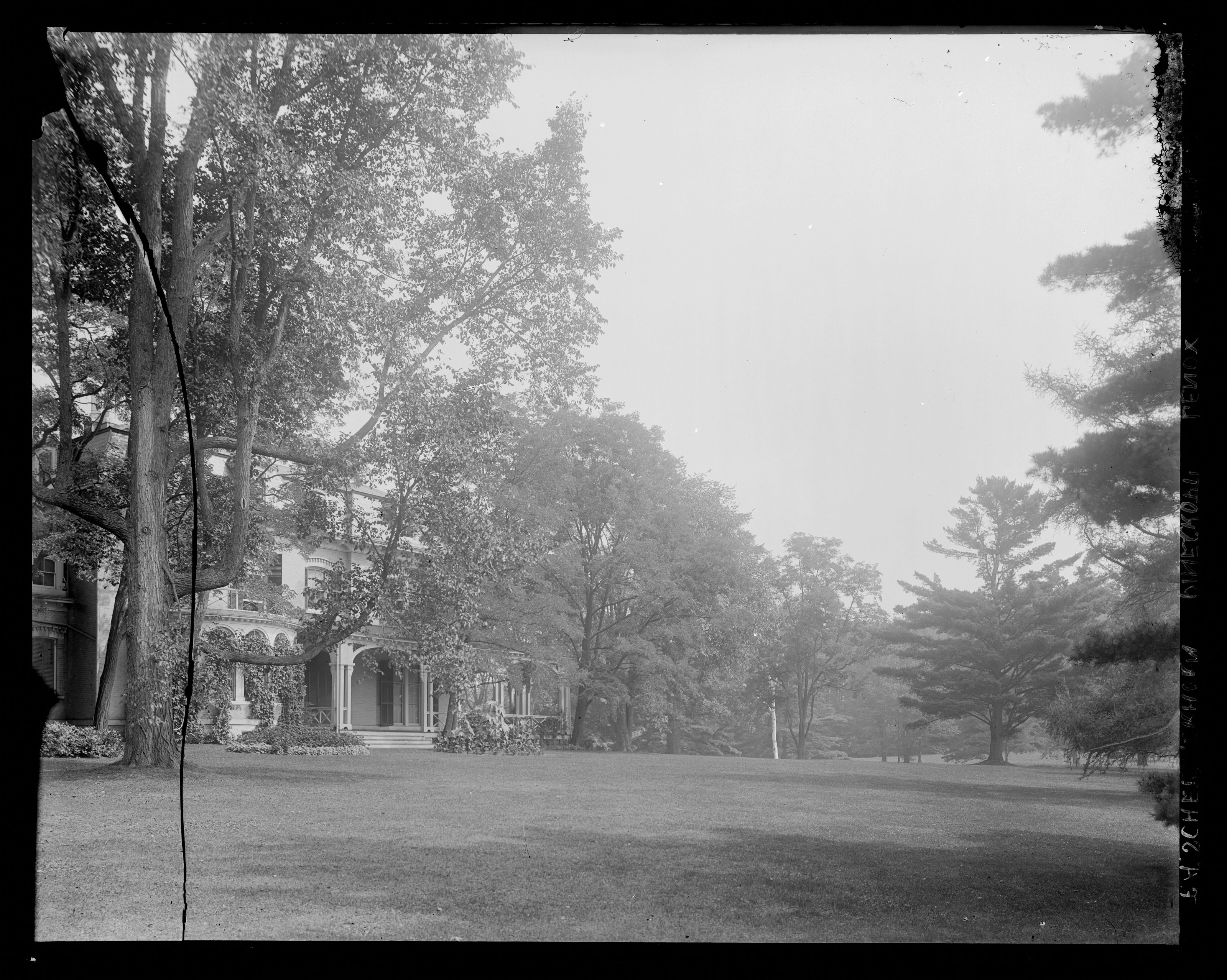
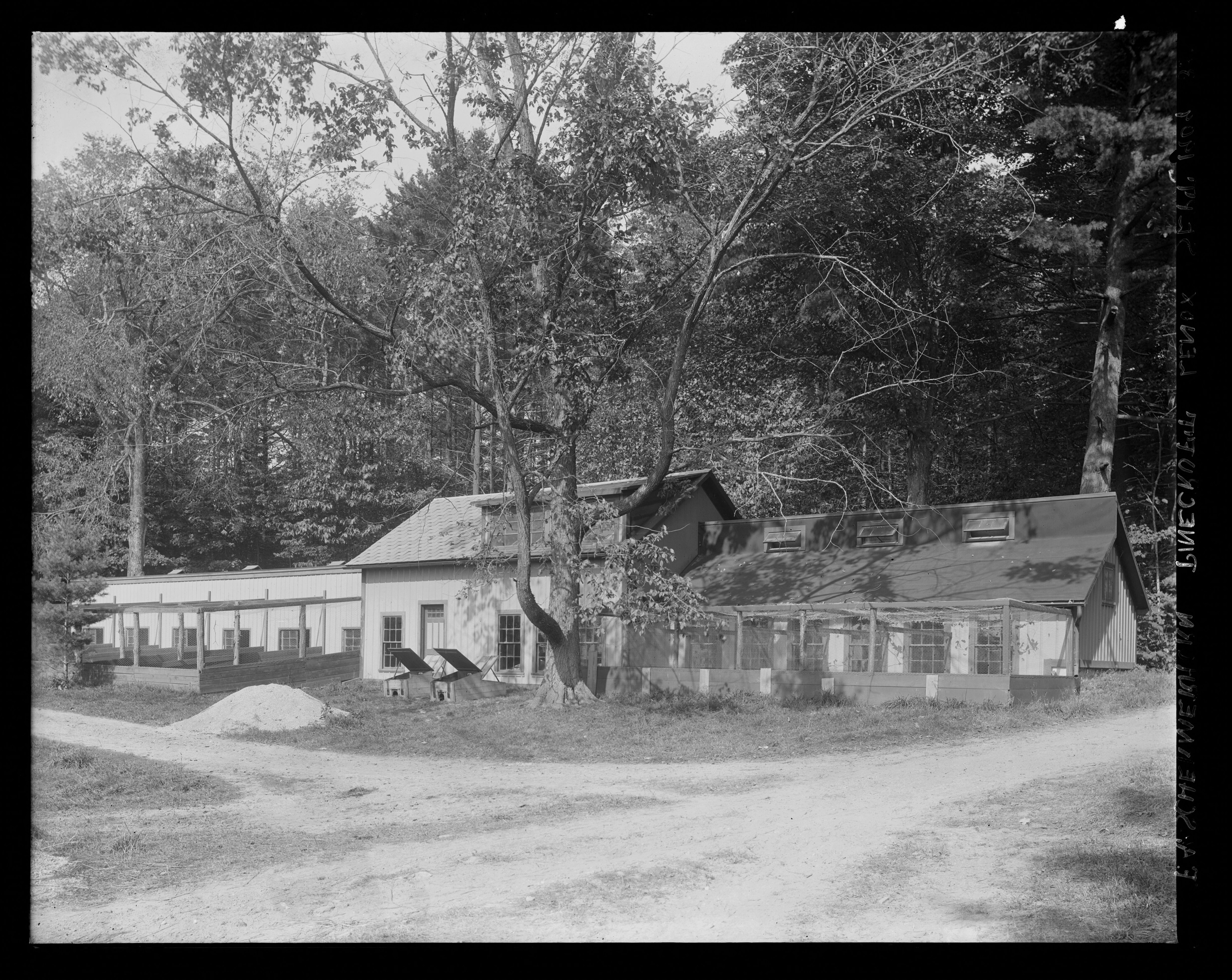
The Lenox Library’s titles are all “supplied by cataloger,” but the negative sleeves carry more. Again and again the accompanying note reads “F.A. Schermerhorn. Pinecroft Lenox” with a date — 6 September 1909, 9 September 1909, 25 September 1909, 9 July 1910 — and two negatives are marked simply F.A.S. in the photographer’s own shorthand.
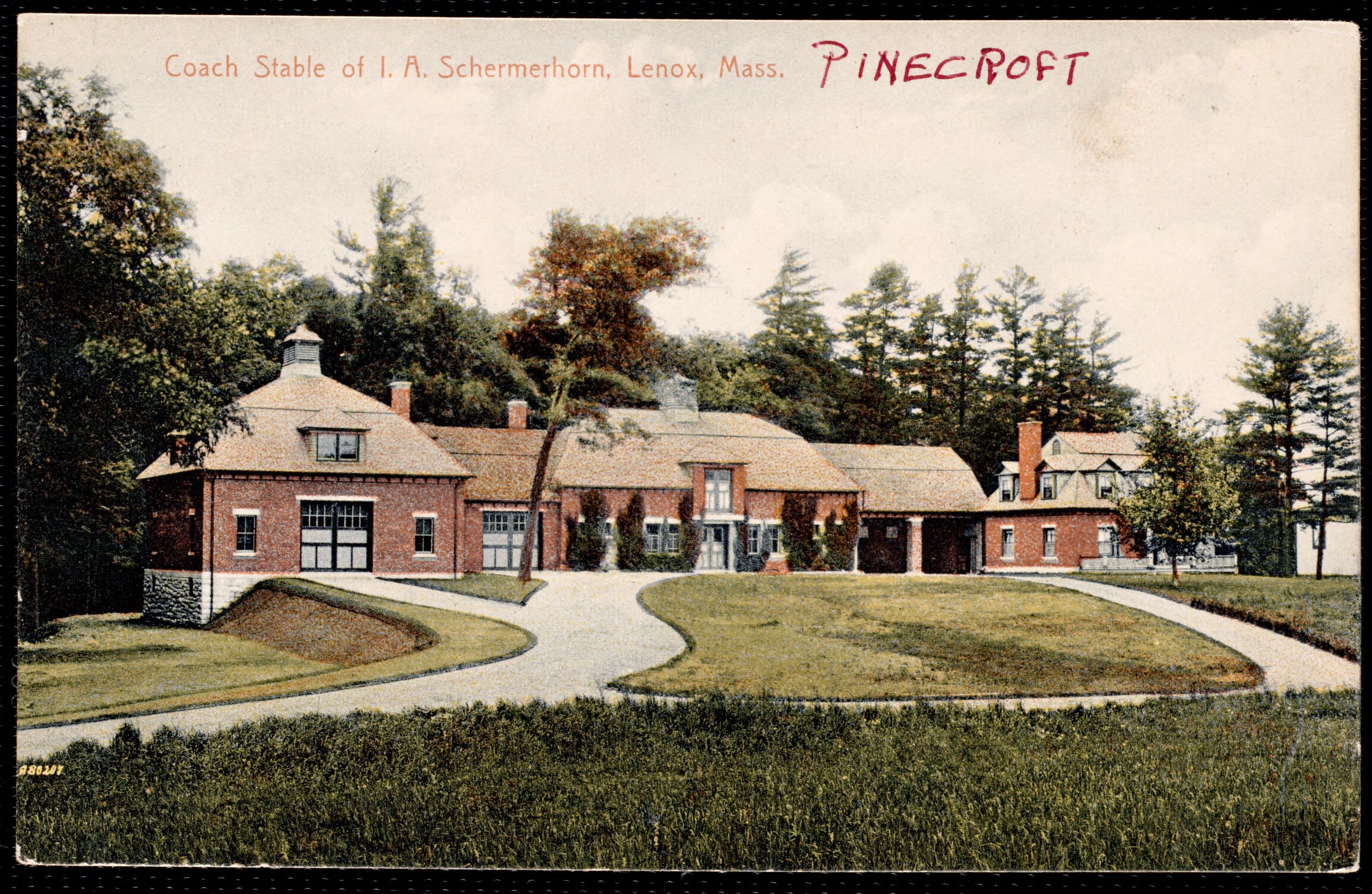
One item disagrees. A hand-colored postcard is captioned in red type “Coach Stable of I.A. Schermerhorn, Lenox, Mass.” — an I where the negatives have an F. It is quoted here as it stands, and it stands alone.
The F is right, and the man has a full name. The Lenox Library’s own catalogue holds one item under Schermerhorn, Frederick Augustus 1844–1919: a typescript of four leaves, “[Letter] to the editor of the ‘Valley Gleaner’, March 22d, 1900”, described in the record as “written in opposition to a proposed trolley line in Lenox, MA on behalf of ‘the many summer residents’.” Its call number is Ref Office Nonfiction File Pinecroft. So the library that holds the negatives reading F.A. Schermerhorn. Pinecroft Lenox also files Frederick Augustus Schermerhorn’s own letter under Pinecroft — two independent records in one building, agreeing. The postcard’s I is a misreading of the printer’s or the publisher’s, and is left uncorrected above.
What the Schermerhorn genealogy gives of him: born 1 November 1844, son of Peter Schermerhorn and Sarah Jones; educated at private schools in New York and entered Columbia with the class of ’65; enlisted in 1864 and was mustered in as 1st Lieutenant of Co. C, 185th New York Volunteer Infantry, served as aide-de-camp to Major General Charles Griffin, and was breveted Captain for “bravery and efficiency at Quaker Road” in 1865; entered the School of Mines at Columbia in 1865 and took the degree of Mining Engineer in 1868; trustee of Columbia from 1877 to 1908; manager of the New York Institution for the Blind for over forty years. He died in 1919.
The letter is the one thing here in his own voice, and it is about the village rather than the place: in March 1900 he wrote to the Lee paper against a trolley line through Lenox, speaking for the summer people. The Berkshire Street Railway was incorporated the following year and began running in Pittsfield in the summer of 1902.
The name runs through this survey. The Dormers was the home of Ellen Schermerhorn Auchmuty, whose family gave Lenox the building that became the Library holding these plates; Brookhurst was built for Newbold and Helen Schermerhorn Kingsland Morris. The same family gave the town the building the Library is in.
II. September 1909
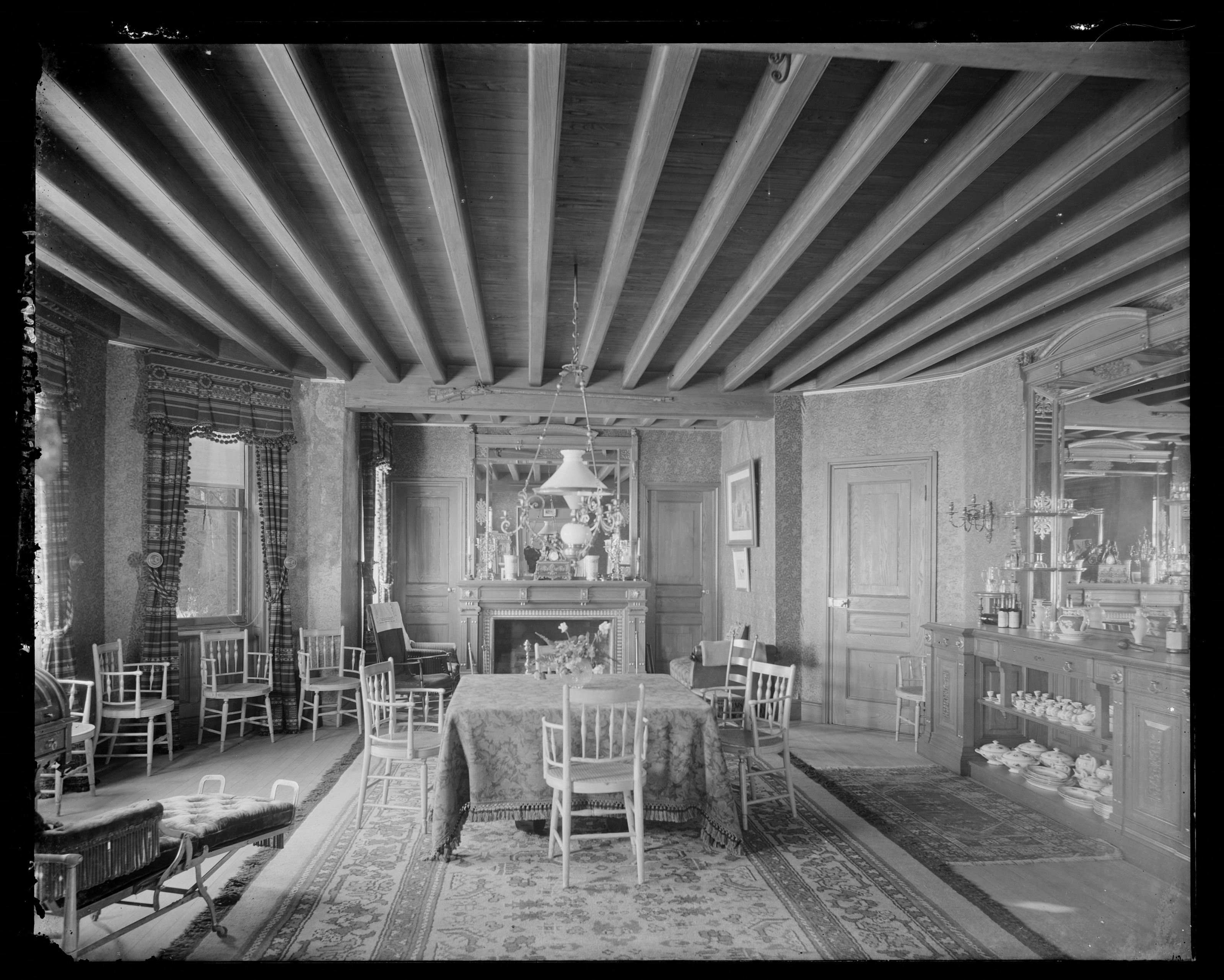
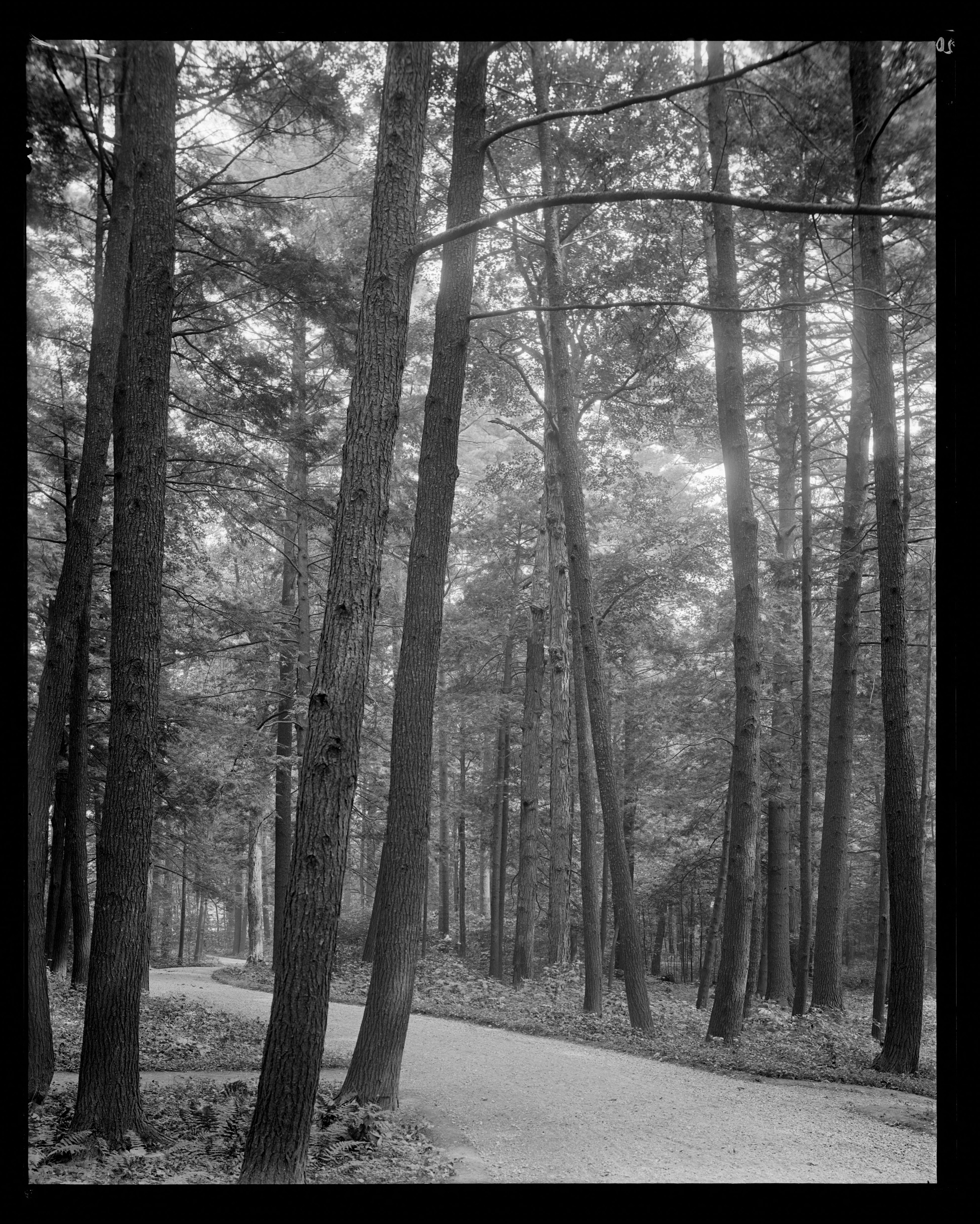
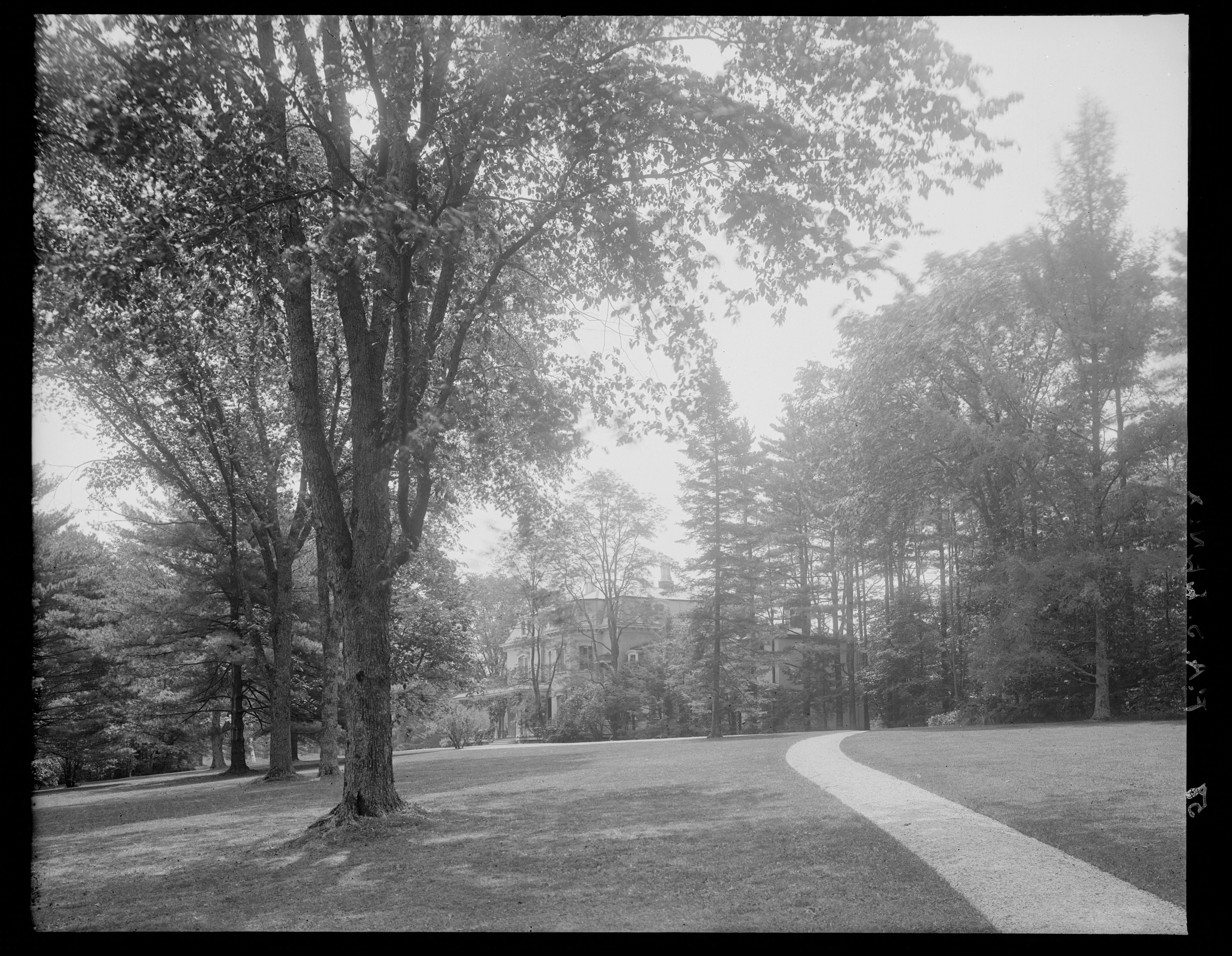
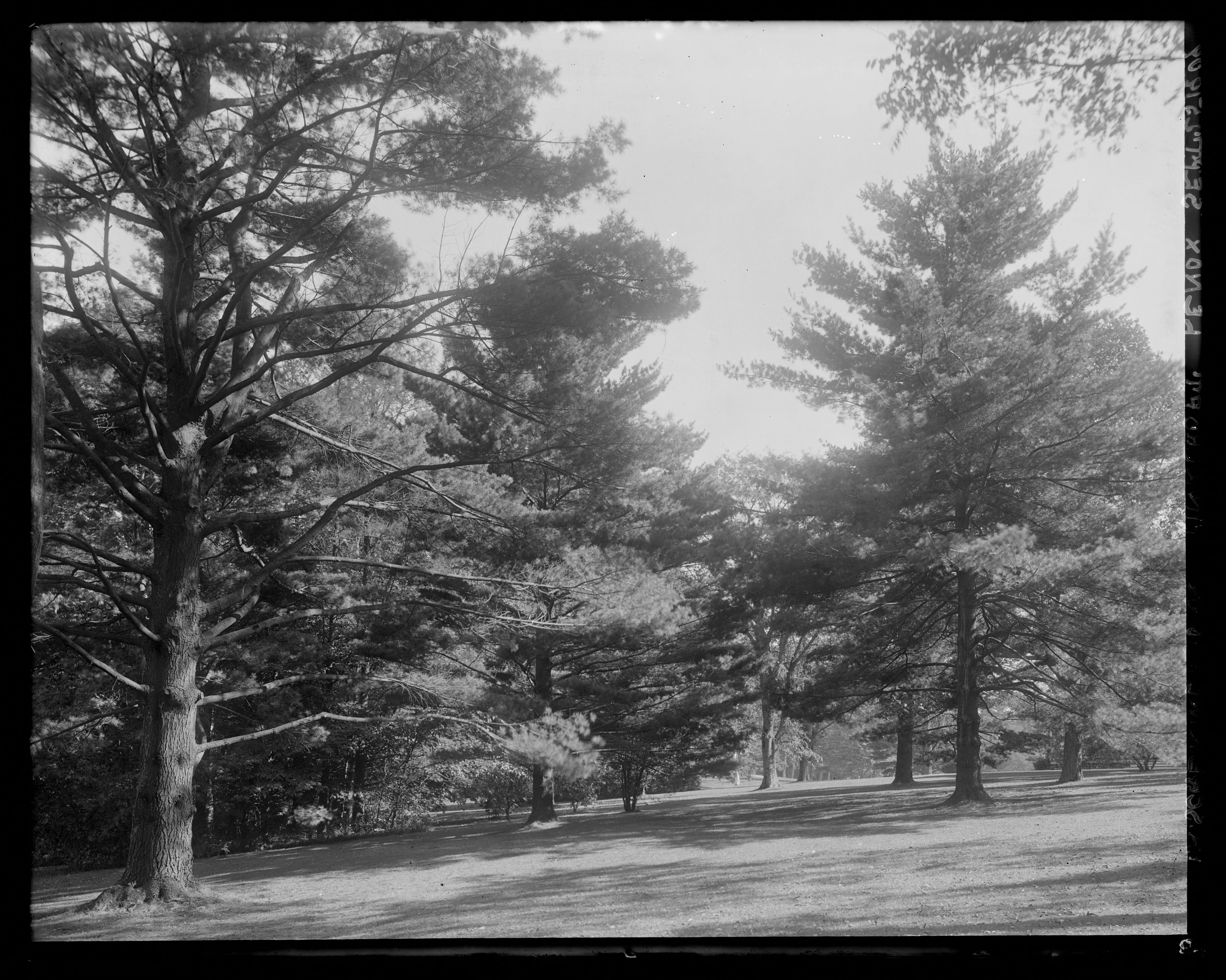
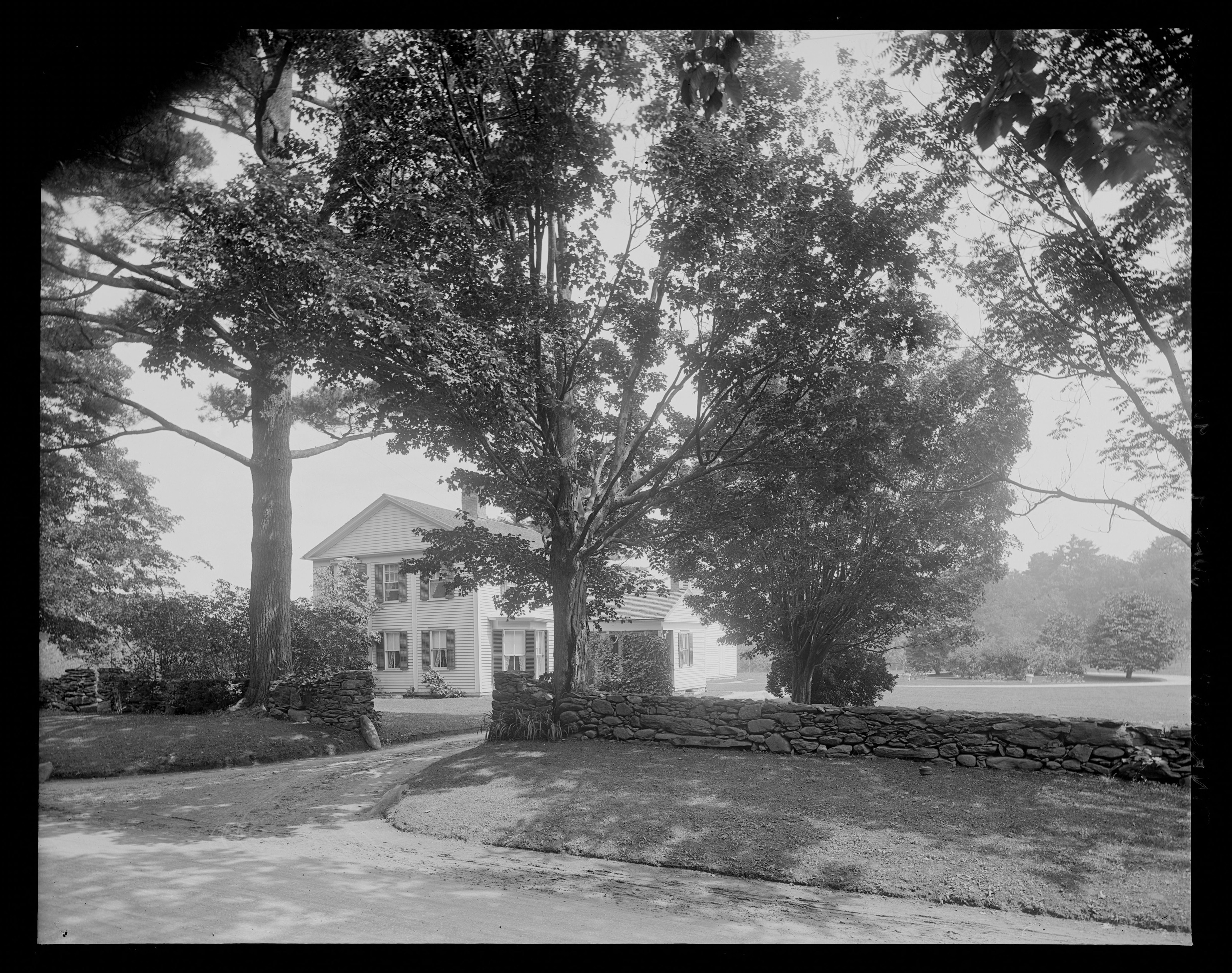
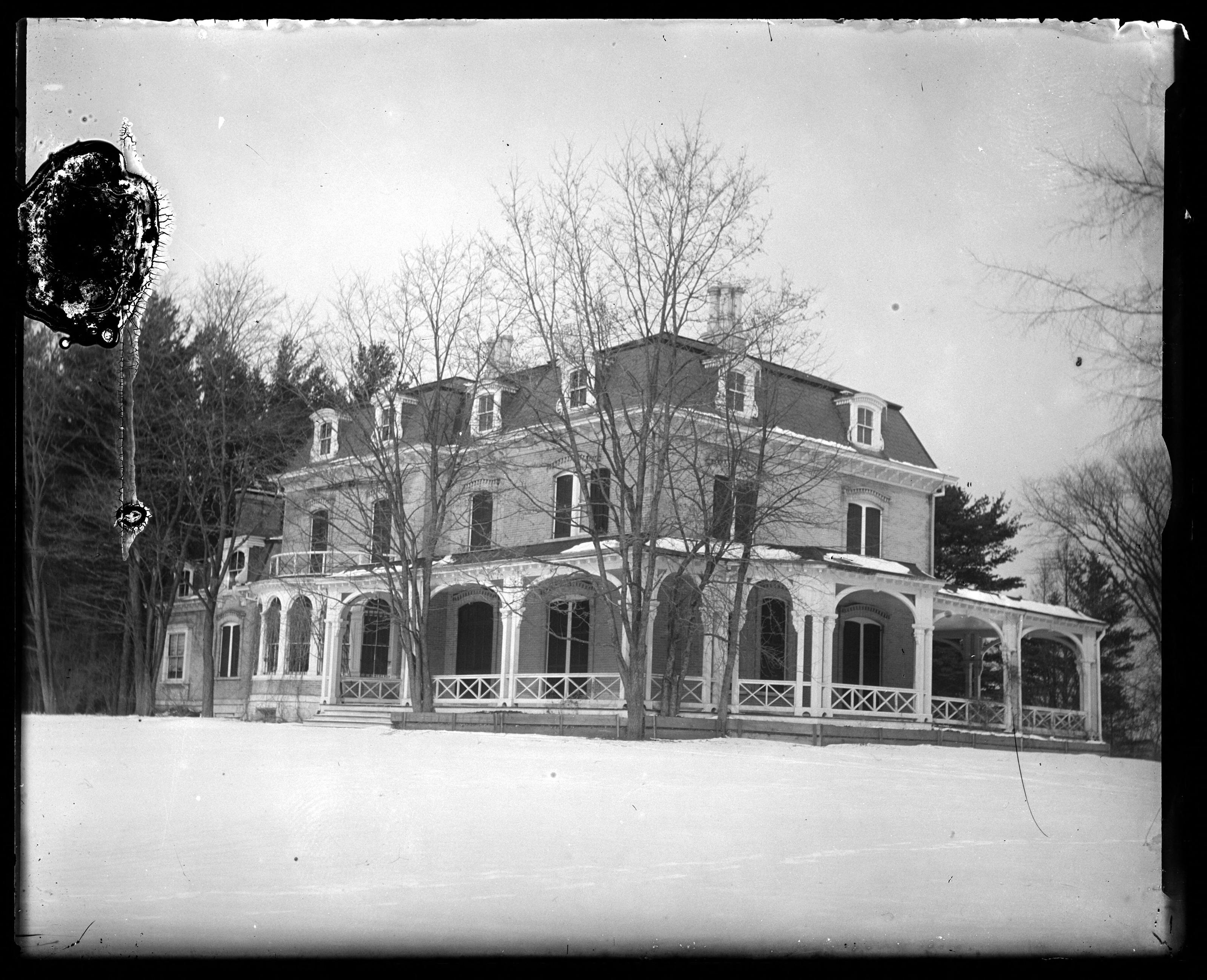
Most of the plates are by Edwin Hale Lincoln, and a run of them is dated to particular days in the autumn of 1909: the grounds and the house on the sixth, the gate, the drive and the trees on the ninth, a view looking through the barn on the eleventh, the park on the twenty-fifth. He came back on 9 July 1910 for a small house on the grounds, and on 10 June 1918 for the haying — three plates, the catalogue notes, “very much alike.”
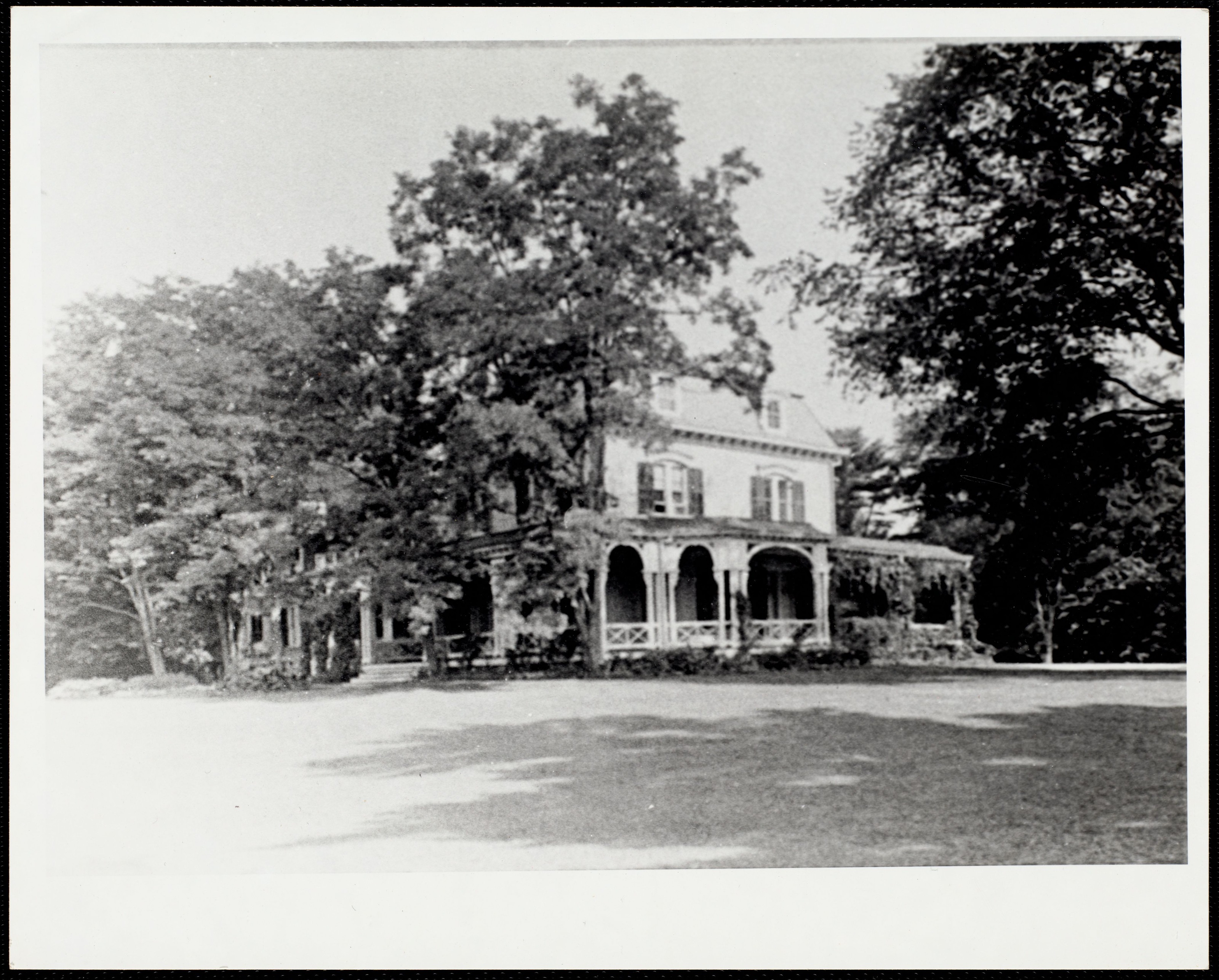
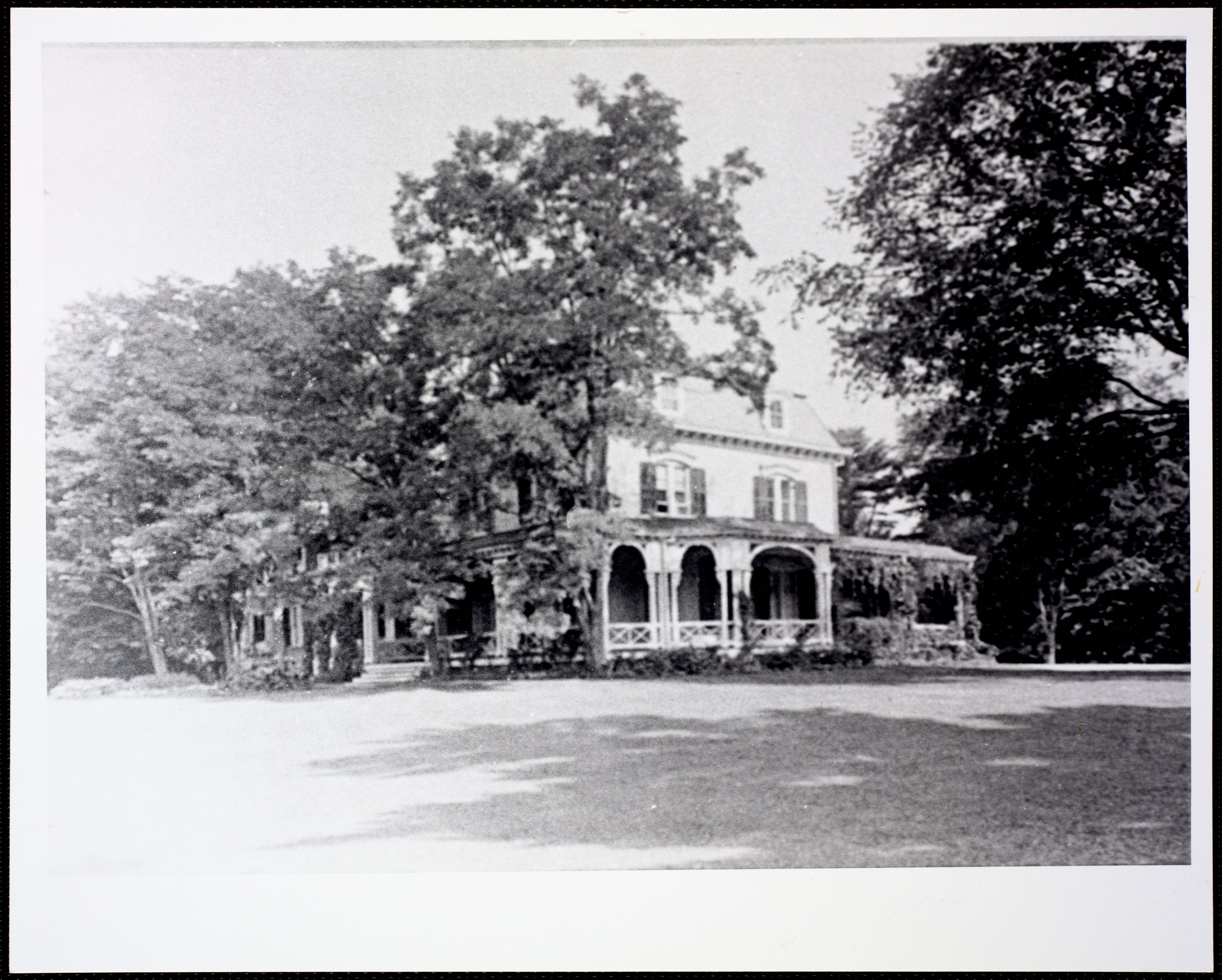
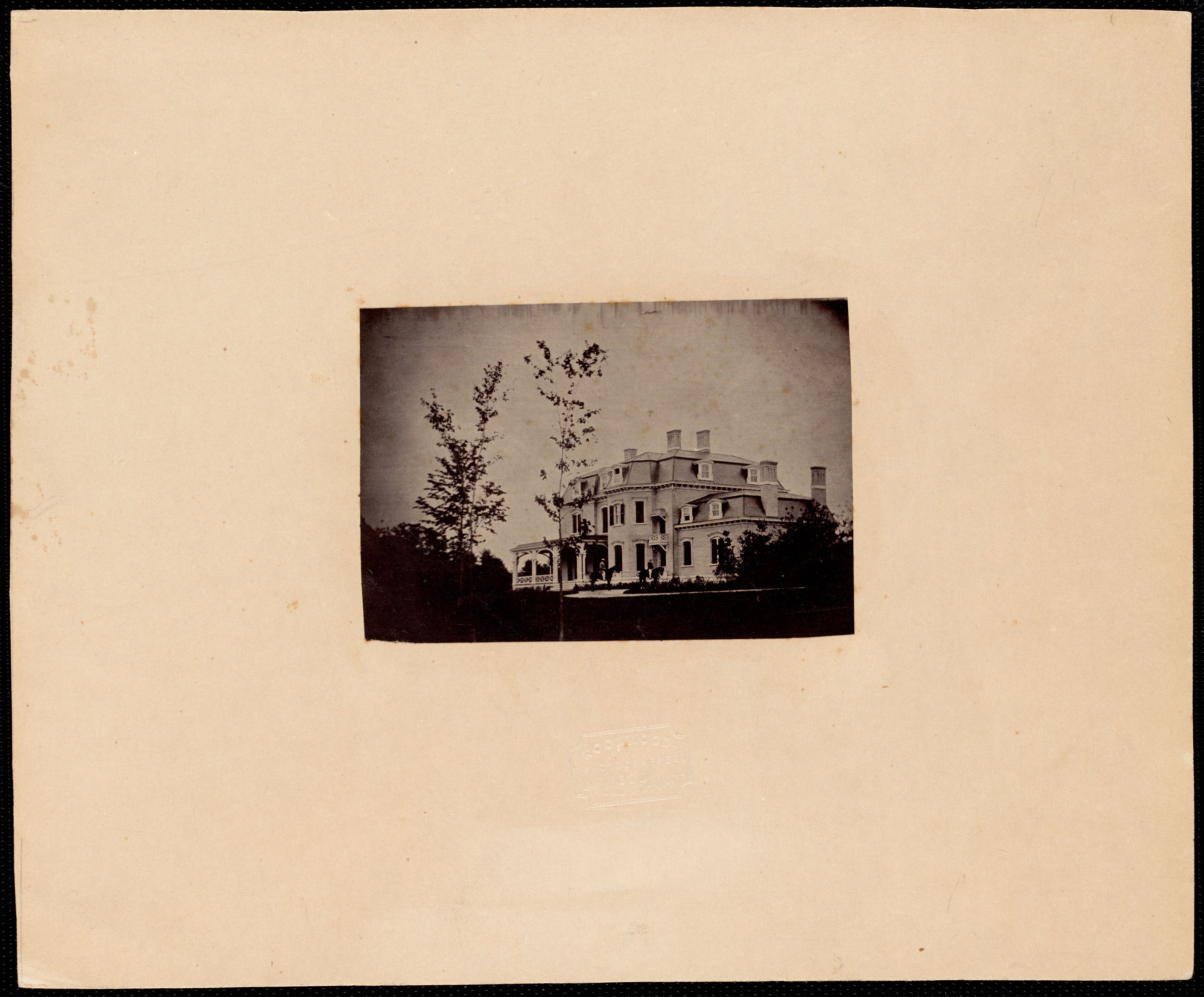
The house is a long Italianate block with a mansard roof and deep verandas running its length, standing above a mown slope with the drive sweeping up to it. It is an older house than most on this site; a print of about 1860–70 shows it already there.
III. The harvest
Six plates of hay loading, one of haying, two of wheatstacks, one of wheat going into the barn, one of the view through it. Men with pitchforks, a pair of horses to each wagon, the load built up above the rack. Wheat stooks in a field in Lenox, Massachusetts, in about 1910.
This is the counterweight to nearly every other page in this survey. The published picture of the Berkshire cottages is a picture of drawing rooms, terraces and formal gardens. The photographic record of Pinecroft is mostly a farm at work — and it was made not by an outsider but on commission, by the county’s best photographer, for the owner. Somebody wanted the hay recorded.
IV. Two named men
Very few of the people who worked on these estates are named anywhere. Two are named here, both in ink on the backs of prints.
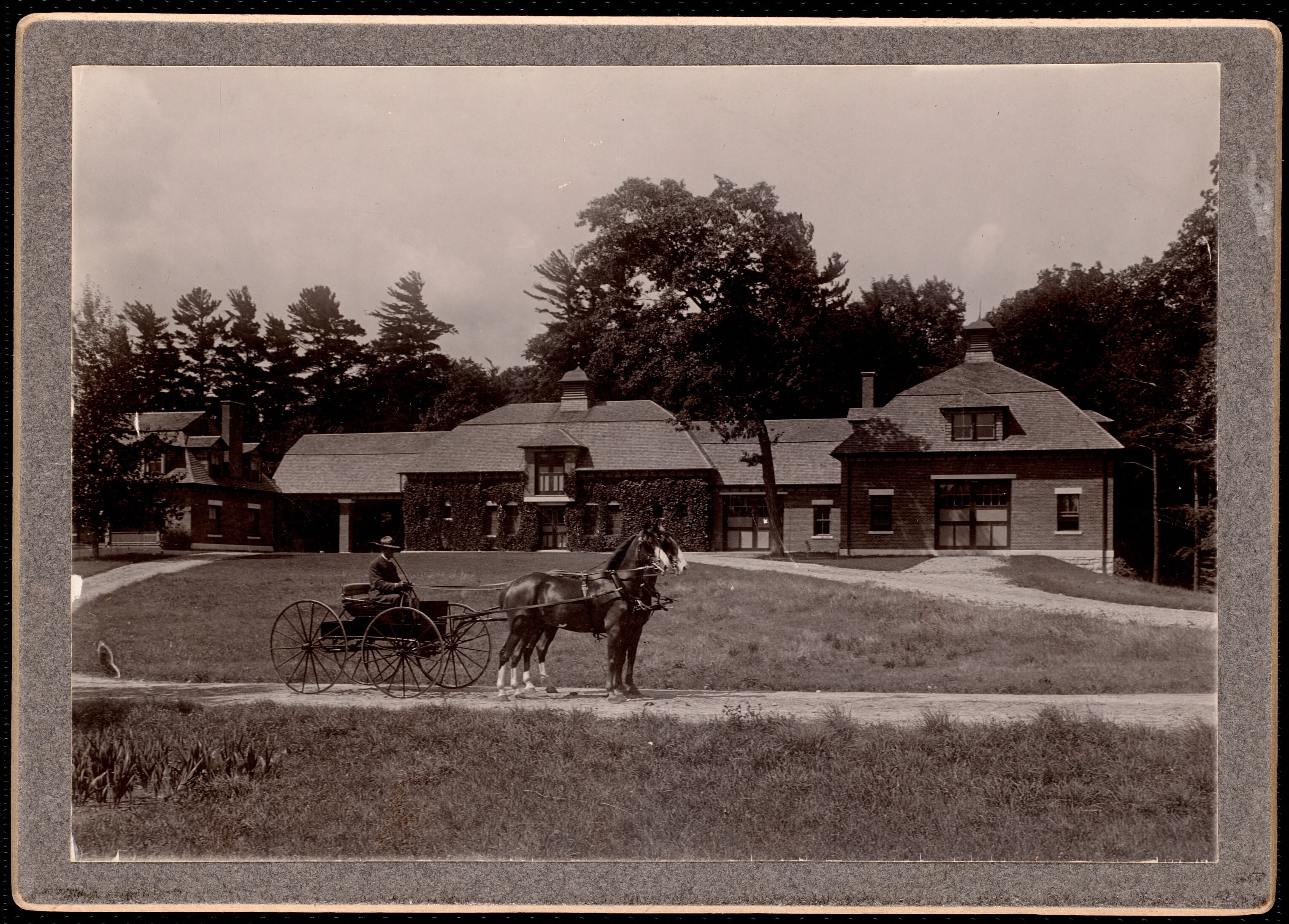
The first: “Mr. James Renfrew, coachman at Pinecroft” — a portrait, given to the Library by Miss Marion Prout in April 1962.
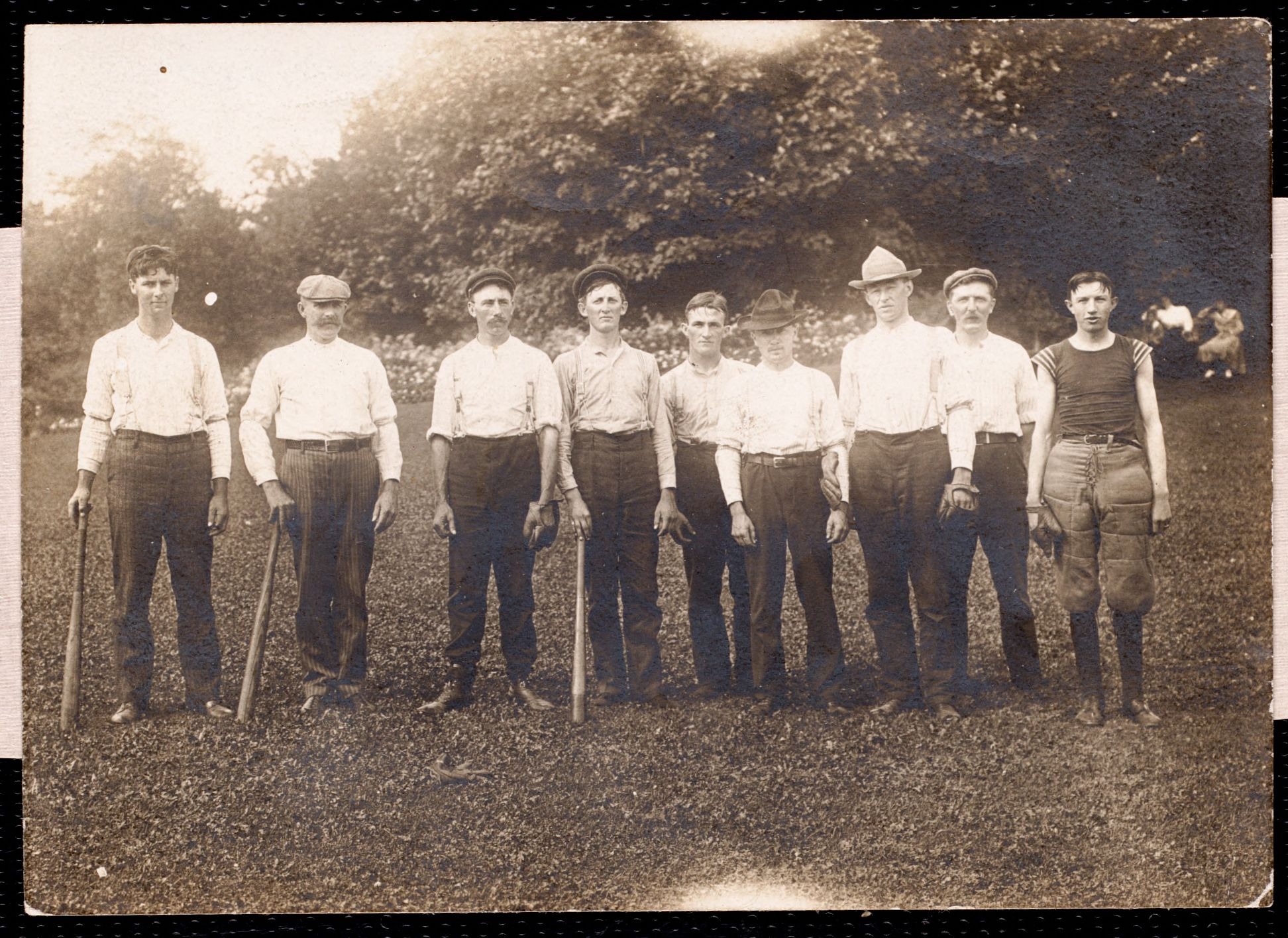
The second is a photograph of nine men standing in a line in their shirtsleeves, several holding bats. The note on the back reads: “William Gregory. The Pinecroft invincible nine. George W. Ferguson Captain.” An estate baseball team, with its captain’s name and, presumably, the name of the man in the picture who kept the print.
The same donor, Marion Prout, gave the Library the haying photograph — her name appears on that one as Praut. Both spellings are the catalogue’s.
V. The oldest plate
One print stands apart: two horsemen in front of the house, embossed “Rockwood, Photographer, 839 Broadway, N.Y.” and dated by the Library to about 1860–1870. It is among the earliest photographs in this survey.
On its back, in pencil, somebody wrote on 11 January 1938: “Miss Hall’s School. (Pinecroft)? Schermerhorn Home.” Miss Hall’s School is in Pittsfield and has an Olmsted job of its own. The note is a guess made seventy years after the picture, complete with its own question mark, and it is reproduced here rather than resolved.
Sources
Lenox Library Association, via Digital Commonwealth: thirty-seven items. Twenty-three are from the Edwin Hale Lincoln Photographs collection, whose rights the Library gives as “No known copyright restrictions,” asking that it be contacted about reuse; thirteen are from the Local History Photograph Collection, licensed CC BY-NC-ND 4.0, and one CC BY 4.0. All titles are “supplied by cataloger”; the quoted matter — “F.A. Schermerhorn. Pinecroft Lenox,” the F.A.S. markings, “Coach Stable of I.A. Schermerhorn,” “Looking thro barn,” “Mr. James Renfrew, coachman at Pinecroft,” “William Gregory. The Pinecroft invincible nine. George W. Ferguson Captain,” the Rockwood imprint and the pencil note of 11 January 1938 — is transcribed from the Library’s own notes on the negatives and prints. Lenox Library Association catalogue (C/W MARS), record for “[Letter] to the editor of the ‘Valley Gleaner’, March 22d, 1900,” by Schermerhorn, Frederick Augustus 1844–1919, [New York : 1900], 4 leaves, 33 cm, call number Ref Office Nonfiction File Pinecroft: the general note and the call number are quoted from that record. Schermerhorn Genealogy and Family Chronicles, chapter III, via schenectadyhistory.org, for his birth on 1 November 1844, his parents, Columbia and the class of ’65, the 185th New York Volunteer Infantry and Co. C, the service with Major General Charles Griffin, the brevet for Quaker Road, the School of Mines and the 1868 degree, the Columbia trusteeship of 1877–1908 and the New York Institution for the Blind. Wikipedia, “Berkshire Street Railway,” for the 1901 incorporation and local Pittsfield service beginning in the summer of 1902. No Olmsted job under this name appears on the firm’s Berkshire list.