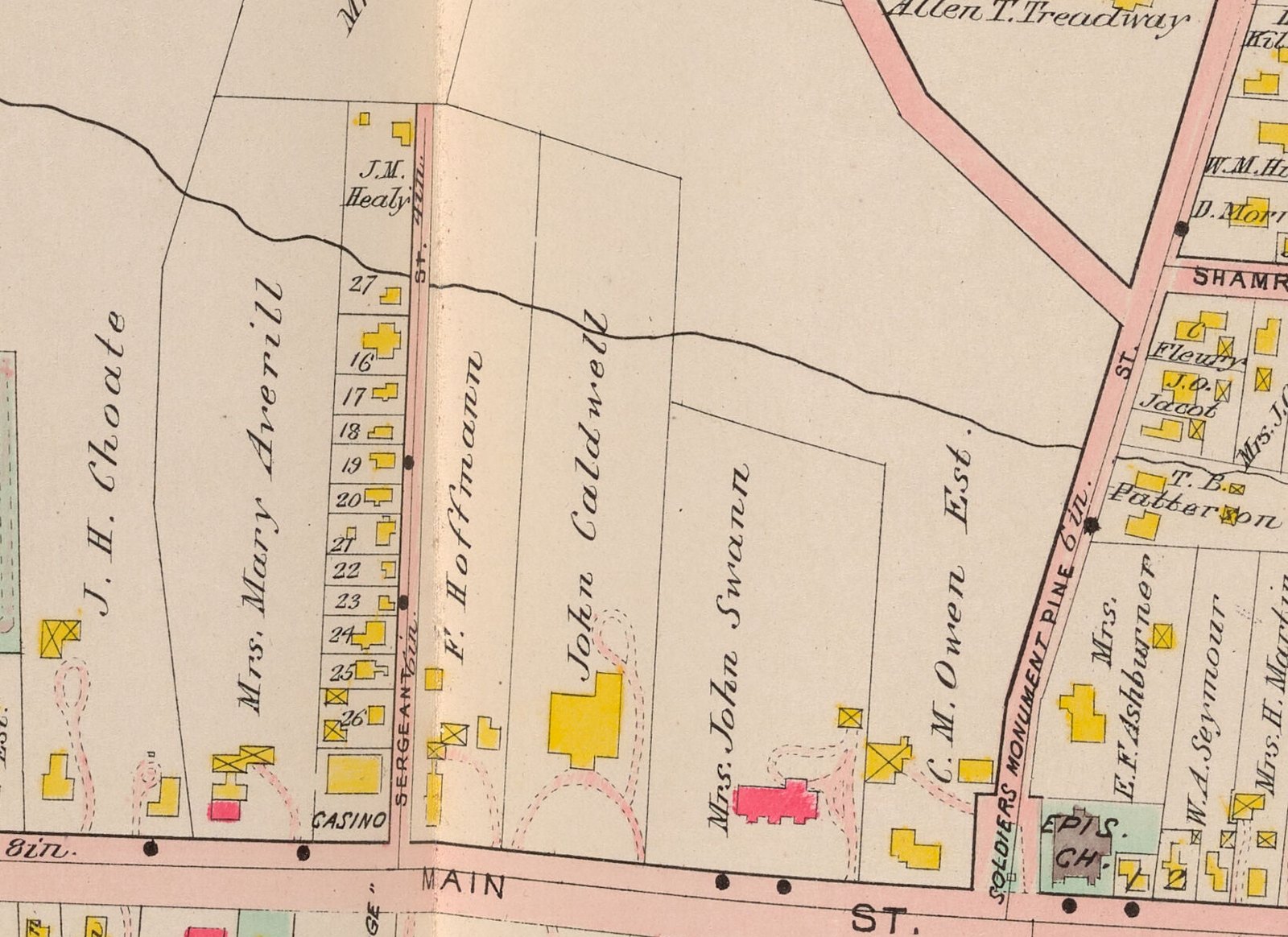
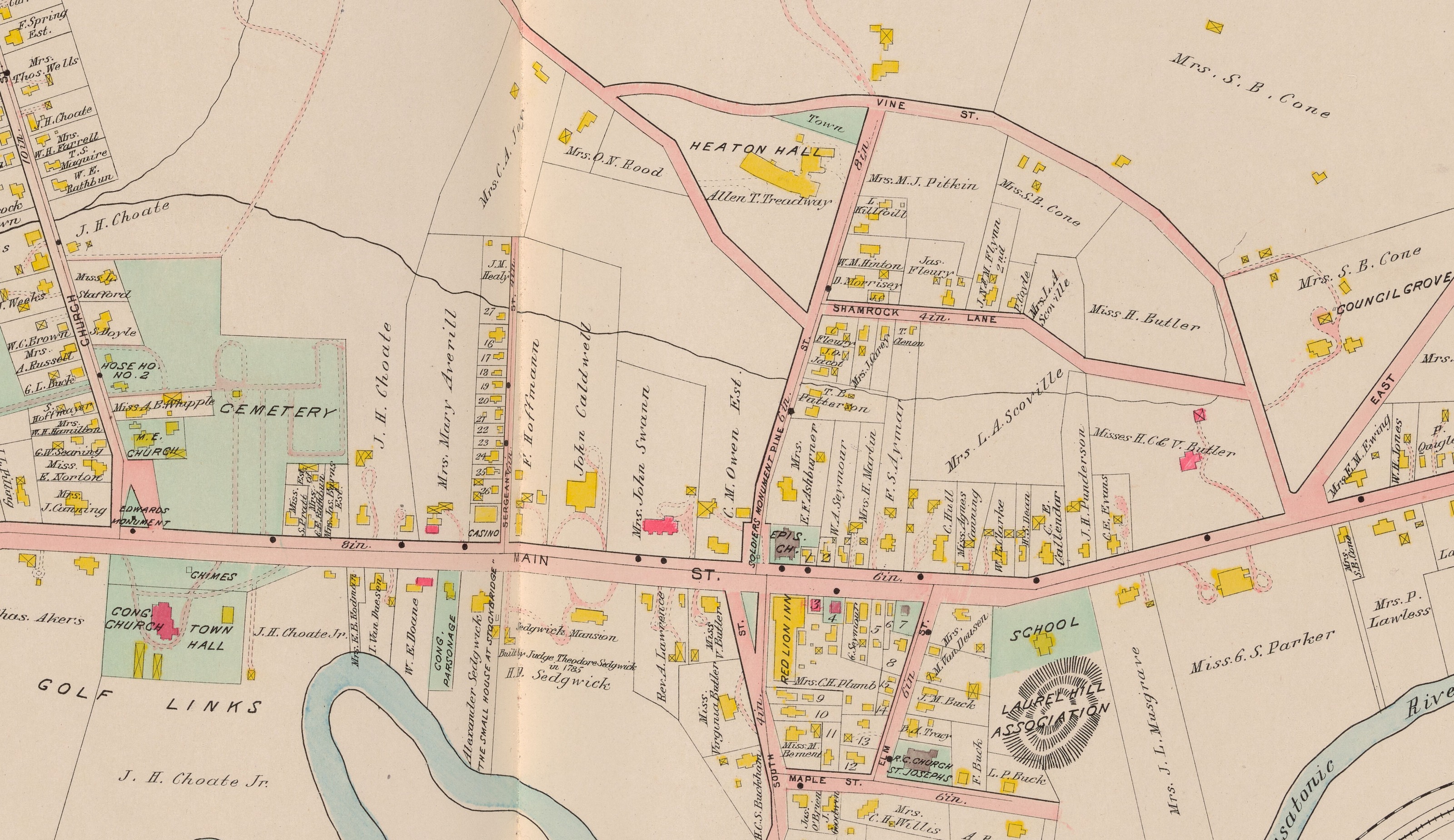
The 1904 county atlas colors its buildings by what they are made of: yellow for wood, gray for stone, pink for brick. On Stockbridge’s Main Street, between Sergeant Street and Pine, every house is yellow but one. That one is pink. The name across its lot is Mrs. John Swann. Today the house is painted white and belongs to the Austen Riggs Center. No photograph of it from before Riggs has been found.
I. What the survey says
The one published account of the house is a short post of 2013 in Historic Buildings of Massachusetts: “At 25 Main Street in Stockbridge is a mansion built in 1894 for Charles E. Butler (1818-1897).” It gives the design to Robert S. Stephenson and Stanford White. After 1904, it says, the house was known as Swann Cottage and was the home of Mrs. John Butler Swann. It was later an inn, and the Austen Riggs Center acquired it in the 1950s. “The wings were added for medical offices and the building was painted white in 1957.”
Two things in that account do not sit easily with the record. Stephenson had worked for McKim, Mead & White, but, on Wikipedia’s account of him, “He left this firm in 1882”; a joint design with Stanford White twelve years later is not explained by anything found. And Rick Wilcox, writing in the Berkshire Edge in 2018, puts a different house on the lot: “Dwight owned a house at what is now 25 Main St., the site of the Austen Riggs Center medical building,” and Grace Stanley Parker “moved the house around 1896” to what is now 52 Main Street. A house built in 1894 on a lot another house left about 1896. Both are recorded here.
II. Charles E. Butler
He died in New York on 1 May 1897, at seventy-nine. The New York Times called him “the distinguished lawyer and the founder of the law firm of Evarts, Choate & Beaman.” He was born in Virginia in 1818. In 1842 he and William M. Evarts set up in practice together, “and the house established by these young men became the most famous in the country.” Charles F. Southmayd came in as a partner in 1852, and Joseph H. Choate in 1859. Butler retired for good on 1 January 1879. “His first wife was Miss Clinch, a sister of Mrs. A. T. Stewart. His second wife was Miss Sedgewick. His six children are by his first wife.” And: “The family has a country residence at Stockbridge, Mass.”
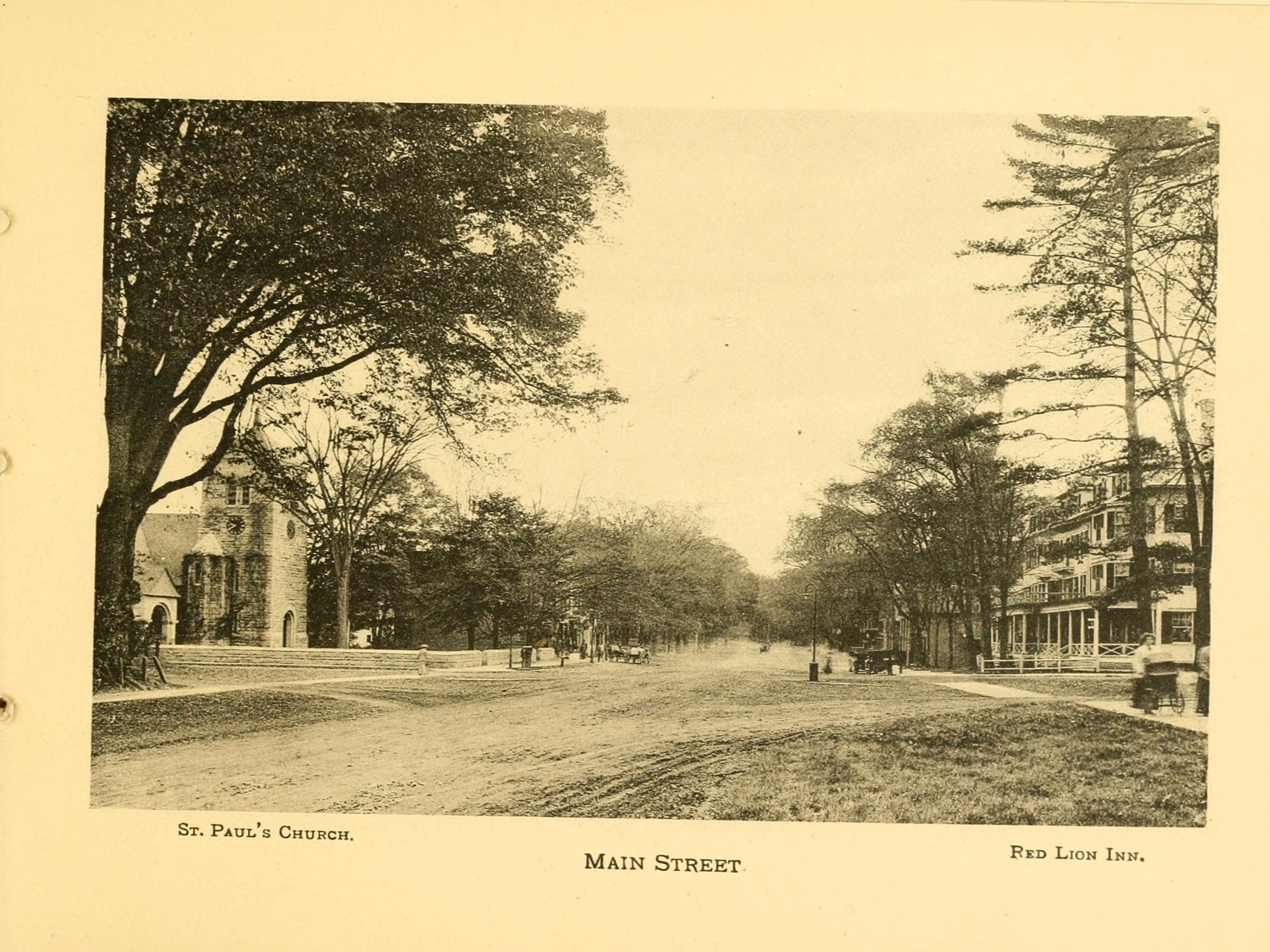
Three partners of that firm ended up summering in the same village. Choate built Naumkeag. Southmayd was Butler’s neighbor; Stockbridge 1739–1939 has the two of them paying for “two iron bridges at the west end of the town.” Butler’s own country house was not this one. “In 1859 he built Linwood,” the same history says, on “a lovely site overlooking a loop of the river as it winds to Glendale.” His second wife was Susan, “sister of Henry Dwight Sedgwick.” In 1883 he gave St. Paul’s Church “in memory of his second wife,” with Charles McKim as architect, “but Mr. Butler stood at his elbow while he drew the plans.” The authors call him “Arrogant, stern, and just,” and the family “the plutocrats of the village.” He was, they add, a Unitarian.
Why a man in his mid-seventies with a house at Linwood would build a second one in the village is not recorded. What the record does show is whose house it became.
III. Mrs. Swann
Stockbridge 1739–1939 identifies her once, in a story from the summer of 1893, when a burglar the village took for a gentleman worked the bedrooms of the summer houses at night. “Mrs. Swann, a daughter of Mr. Butler,” was so touched when he gave back a ring she prized, and took a cheaper one at her suggestion, that she tried to reason with him over the foot of the bed. “Don’t you think you might choose some other employment?” He was caught through his taste in cigars and turned out to be a laborer who had worked on Mr. Choate’s house. The book does not say in which house Mrs. Swann was robbed.
By 1904 the lot on Main Street is hers on the atlas. Her sisters are on the same plate: Misses H. C. & V. Butler, with another house drawn in brick, and a Miss Virginia Butler on the south side of Main. In 1926 the directory has Butler Virginia Miss, h “The Nunnery”, South (image 291).
The 1923–25 directory has Swann Lillian L widow of John h Main (image 337), with a chauffeur and a second employee listed as working at “Mrs Swann’s” (image 330, image 323).
IV. The Martin
In April 1924 the New York Times’s Berkshire column reported a sale: “The deed transferring for $45,000 from Mrs. John Swann to the Martin, Inc., of which Martin F. Finnegan is President and Treasurer, was also recorded. It is to be made into a hotel.”
By 1926 the street list for Main Street runs “‘The Martin’, Martin F. Flannegan,” then Brown Caldwell, then the Casino at Sargent Street (image 284). The alphabetical section has him right: FINNEGAN MARTIN F (Loretta) The Martin, Main (image 295), and an advertisement-line for THE MARTIN, “open the year around” (image 310). The same volume still lists Swann Lillian L., widow John, h Main (image 310), two years after the sale. Whether she had moved along the street or the canvasser repeated an old line, the book does not say.
Stockbridge 1739–1939, in 1939, closes its chapter on the resort years with the village’s ghosts, and the burglar is among them: he “just escapes detection as one turns on an electric light in a dark passage in the Martin Inn, once Mrs. Swann’s house.”
V. Riggs
“In 1907, Dr. Austen Fox Riggs came to live in Stockbridge,” Stockbridge 1739–1939 says, ill and forced out of a New York practice. Patients came to him, “driving up from the station in a horse-and-buggy and boarding around in houses in the village.” In 1919 a fund given by grateful patients made it “possible to remodel a house on Main Street into an inn, and build a ‘shop’ for occupational therapy.”
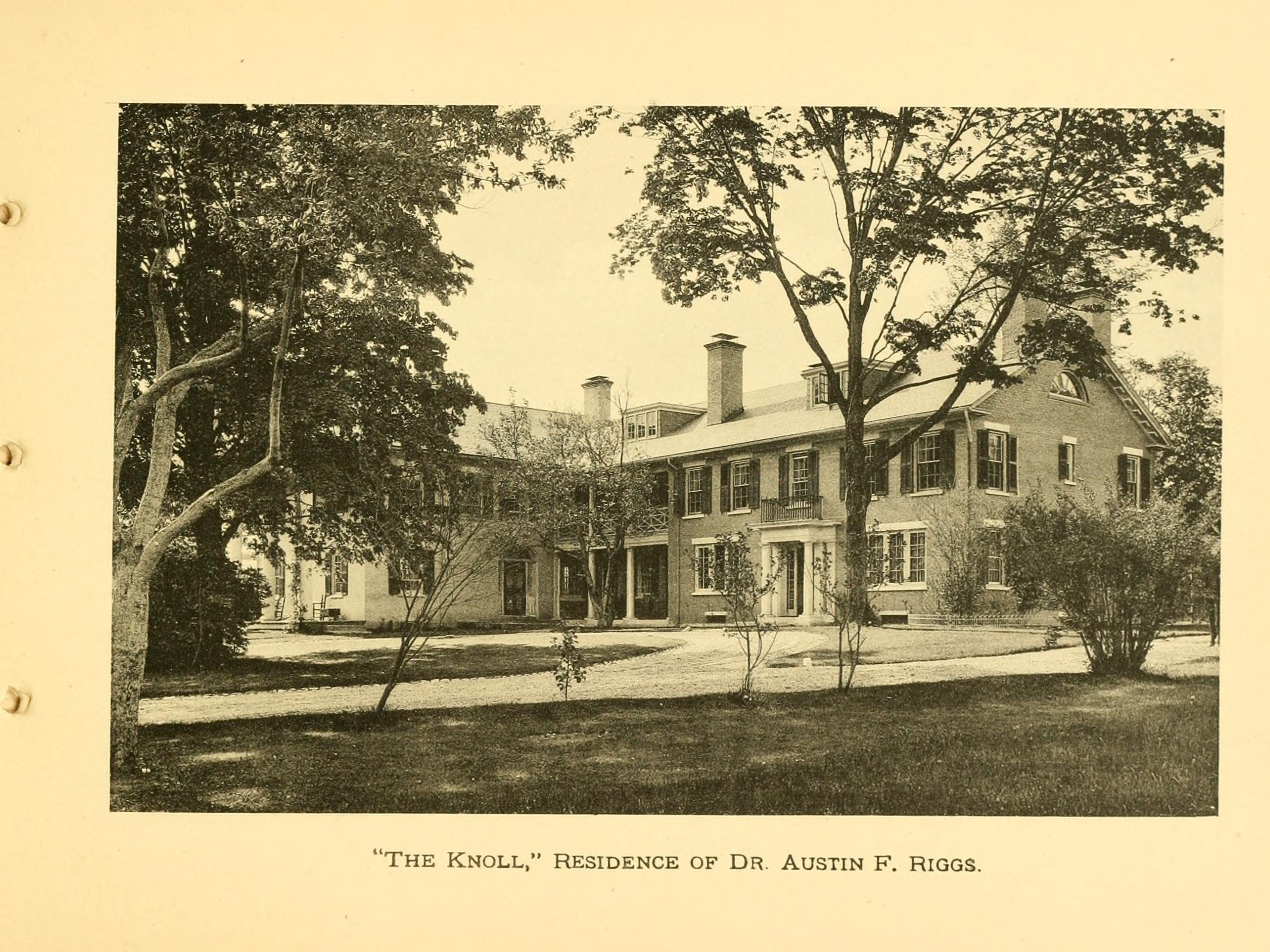
That first Foundation Inn is in the directories. In 1923–25: Foundation Inn (Dr Austen F Riggs pres E E Purrinton mngr) Main (image 318). In the 1926 street list it stands at the other end of the village from the Swann house, near Elm Street and the library: “Charles E. Hull | Austen Riggs Foundation Vocational Shop Bldg. | Foundation Inn | Braman Store” (image 283). Riggs himself lived at “The Knoll” Main (image 334; 1926, image 307).
Then the center moved west along Main Street, house by house. Stockbridge 1739–1939: “In 1929, the work had outgrown the existing inn, and the property on the corner of Main and Sergeant (formerly known as Casino) Streets was acquired.” The Casino itself had gone, given by Mabel Choate to Walter Clark and moved to become the Berkshire Playhouse, which opened in 1928; Riggs was one of the founders of the Three Arts Society that ran it. the same survey has the house next door, the John Caldwell house of the atlas — Caldwell Brown (Blanche F) h “Edwards Arms” Main in both directories (image 312) — sold to Riggs in 1930 and remodeled, its pedimented portico taken off, as the Foundation Inn. The survey gives that house to Delano & Aldrich about 1890, a firm founded in 1903; the date or the attribution is wrong, and nothing found settles which. Riggs’s purchase of the Swann house, the survey says, came in the 1950s.
VI. The Riggs houses now
The town’s assessor names the center’s buildings on its own list. Along Main Street: 13 Main, “Lavan Hall–Purinton House”; 23 Main, “The Inn” — the Caldwell house; 25 Main, “Research Bldg” — the Butler house; 27 Main, “The Elms”; 37 Main, a workshop; and 48 Main. Behind them, a tennis court at 1 Pine Street, a medical director’s house at 3 Prospect Hill Road and a lot on Prospect Hill Road. The 2013 survey called 25 Main the center’s Medical Office Building.
Purinton House carries the name of Elmer E. Purinton, who managed the first Foundation Inn and who in 1926 kept a fashionable boarding house, Main (image 306). That the building is named for him is this page’s inference.
The Elms, on the corner of Pine Street, is the oldest of the group. Wilcox has Barnabas Bidwell buying it in 1792 from Timothy Edwards, son of the Reverend Jonathan Edwards. Glimpses of Stockbridge names its tree: “the elm standing in front of Edward B. Owen’s home opposite the church, having been set out by a grandson of President Edwards in 1786.” The atlas letters the lot C. M. Owen Est. By 1939, Stockbridge 1739–1939 says, the house behind the elm was “the house of Mr. Allen T. Treadway,” the Congressman who owned the Red Lion Inn across the street. The same book puts “Jonathan Edwards Field’s law office, the little white building next to Mr. Treadway’s present house,” at the end of the telegraph line strung from Pittsfield in 1858 to carry the news of the Atlantic cable.
Sources
The house, its design attribution, the 1950s purchase and the 1957 wings: Historic Buildings of Massachusetts, “Butler House/Swann Cottage (1894)” and “Brown Caldwell House (1890),” both posted 4 April 2013. The Dwight house on the lot: Rick Wilcox, “The Stockbridge Civil War park and monument at the Red Lion Inn intersection,” The Berkshire Edge, 7 April 2018. Stephenson’s career: Wikipedia, “Robert Storer Stephenson.” Charles E. Butler: New York Times, 2 May 1897, “Death List of a Day,” in the Internet Archive’s scanned run. The sale to the Martin, Inc.: New York Times, Berkshire society column, April 1924 (the Internet Archive item is dated 3 April; the page itself is a Sunday issue, and the exact date has not been fixed). Linwood, St. Paul’s, the burglar, Riggs, the Foundation Inns, the Casino and the Treadway house: Sarah Cabot Sedgwick and Christina Sedgwick Marquand, Stockbridge 1739–1939: A Chronicle (1939), pages 156 (note), 239–241, 260–261, 270–271, 274–275 and 277. Directory lines are quoted as printed from the 1923–25 and 1926 volumes on this site. Atlas of Berkshire County, Massachusetts, Barnes & Farnham, 1904. Boston Public Library copy, via Digital Commonwealth. No known copyright restrictions. The transcription of plate 28 on this site gave the Butler sisters’ parcel as “Misses H. G. & T. Butler”; re-read at magnification for this page, it is Misses H. C. & V. Butler, and the transcription has been corrected. Glimpses of Stockbridge and Vicinity, photogravures, E. A. Benjamin, Stockbridge. University of Massachusetts Amherst copy, via the Internet Archive. Not in copyright. Building names and addresses today are the Town of Stockbridge assessor’s, fiscal year 2026. Disagreements left standing: whether Stanford White had a hand in the design; whether the house of 1894 stood on a lot another house left about 1896; when the Swanns took the house (the survey says after 1904; Mrs. Swann was Butler’s daughter and married by 1893); Mrs. Swann still listed on Main Street in 1926, two years after the sale; the year Riggs bought the Caldwell house (1929 in Sedgwick and Marquand, 1930 in the survey); and the Caldwell house’s architect. No photograph of the Butler house before Riggs has been found in the Lenox Library, Digital Commonwealth or the Internet Archive. No Olmsted job is recorded for it.