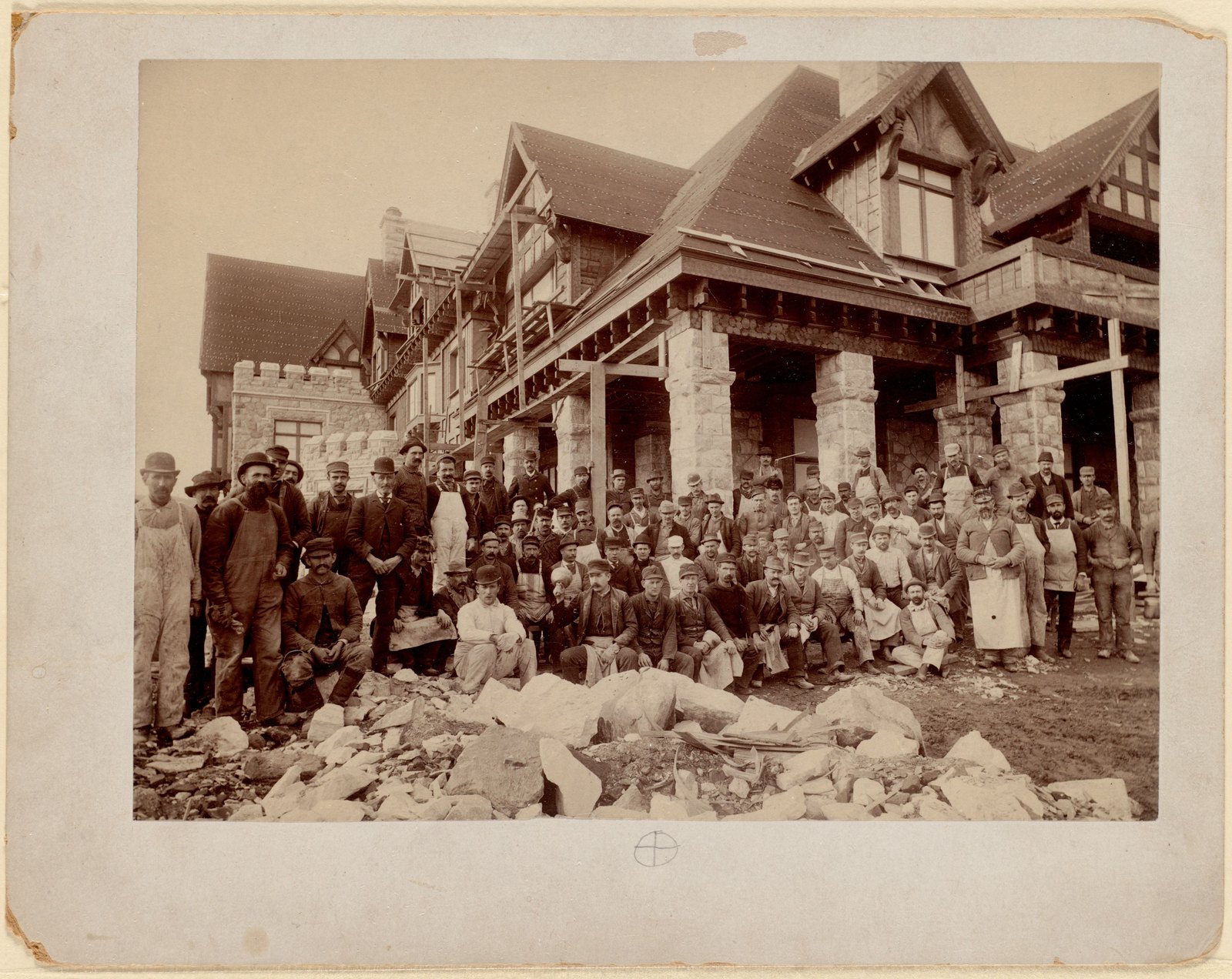
Somebody at Shadow Brook decided the crew was worth a plate. There are two of these photographs in the Lenox Library. In one, the men are ranked across the front of the unfinished house, in overalls and shirtsleeves and waistcoats and every kind of hat, standing on and among the cut stone that has not gone into the wall yet. In the other they are massed on the steps between the stone piers, packed shoulder to shoulder, a hundred or more faces turned to the camera.
Count them and you understand what one of these houses actually was. Not a commission. A works.
The catalogue entries read Shadow Brook: workmen and Shadow Brook: Shadow Brook construction workmen, about 1893–94, and that is the entirety of what is recorded about any of them.
I. Where the stone came from
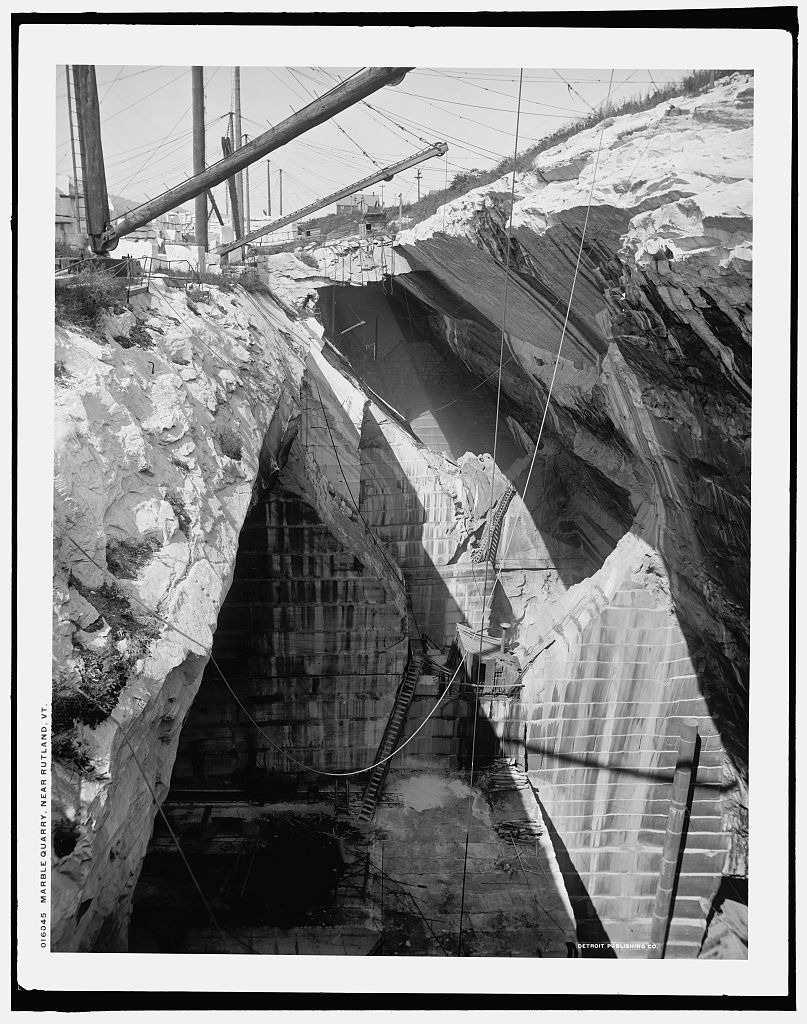
Very little of it came from far. The Berkshires and the valleys either side were a stone district — marble out of West Stockbridge and Lee and, over the line, the great white beds around Rutland; granite out of New Hampshire and the Cape Ann coast; limestone burned for mortar at kilns within a waggon ride. The quarrying was industrial, and it was photographed, because quarries were a sight worth selling a view of.
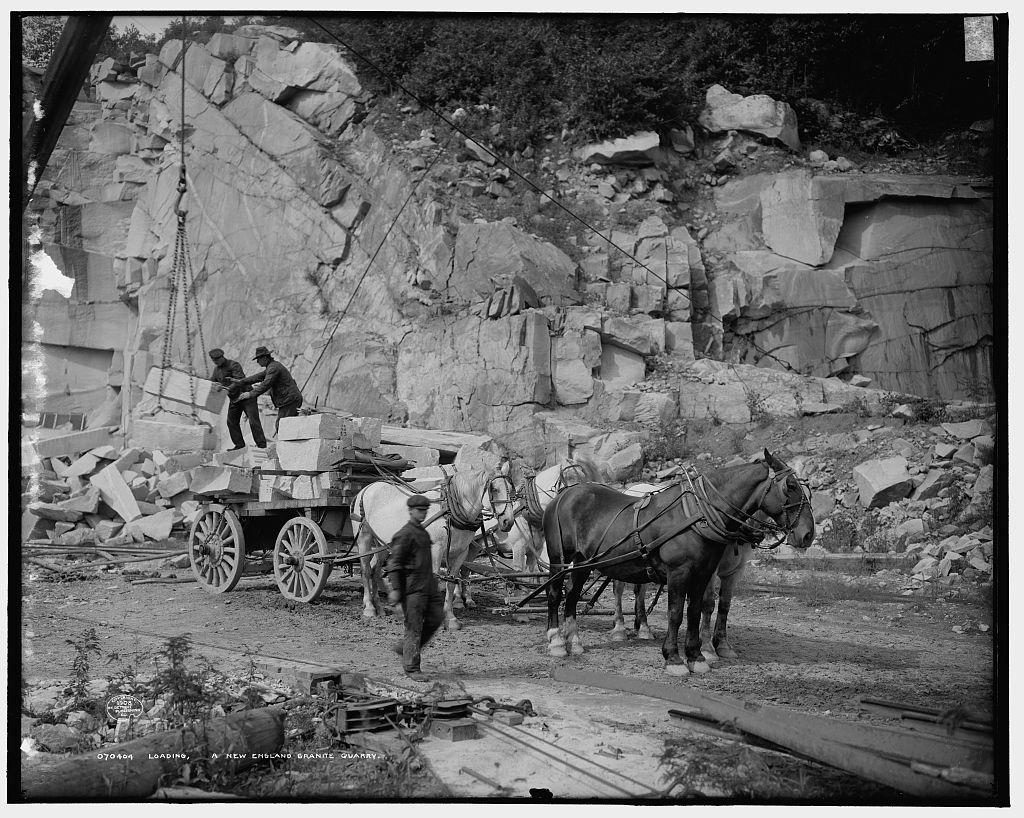
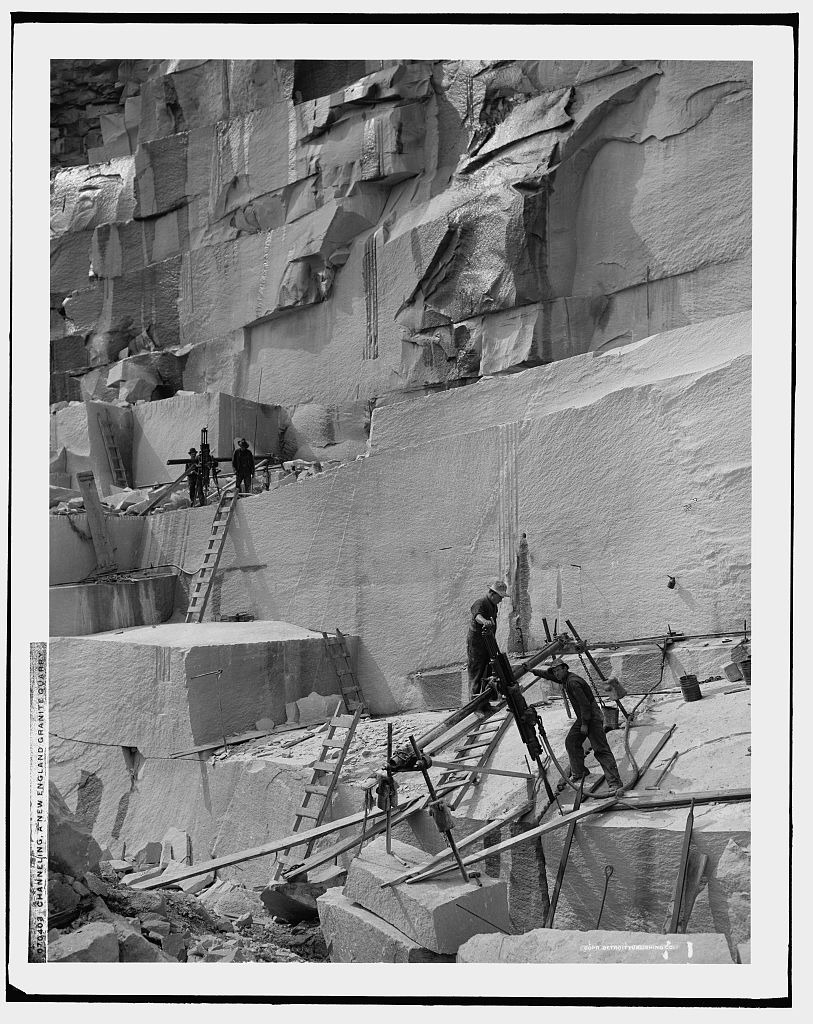
Look at what the plates actually show. In the marble quarry the men are working at the bottom of a slot cut down into the hill, derrick cables crossing overhead, the faces squared off like masonry already. In Channeling a man rides a channelling machine along the top of a bench, cutting the groove that will free the next block; the figures standing on the step above give the scale, and it is not a human scale. In Loading, a block swings on a chain onto a waggon while a teamster holds the heads of four horses, and the whole weight of the thing is about to come down onto one axle.
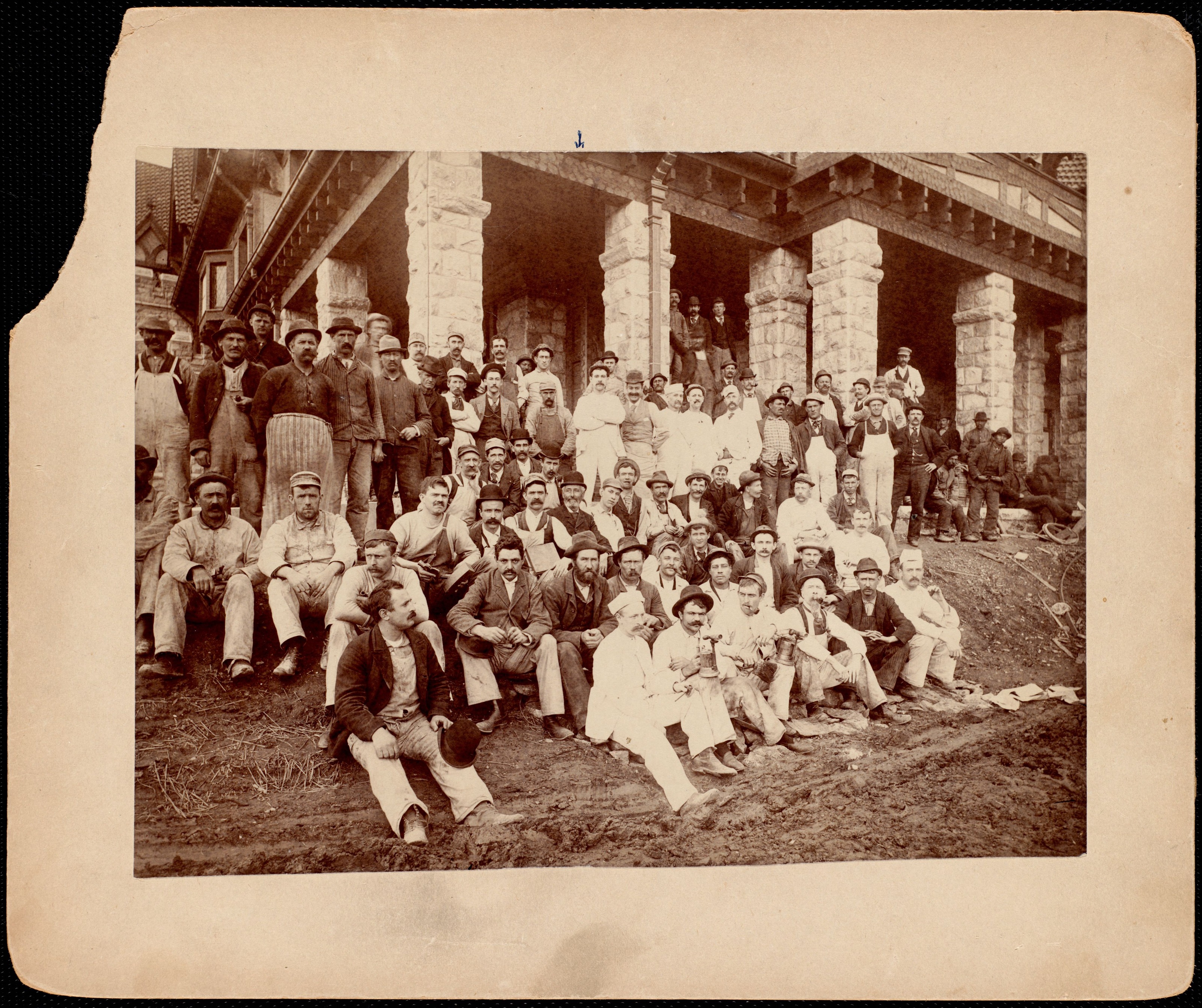
Every dressed stone in a Berkshire wall began in a hole like that.
II. The trades that stone needed
Stone is not one job. The quarryman freed the block. The sawyer and the channeller reduced it. The stonecutter worked it to the architect’s full-size profile — and the profiles were drawn full size, because a molding cannot be scaled by eye. The carver took whatever was to be enriched. The setter and his mason put it up, bedded it and got it plumb; the pointer finished the joint. Around them the teamsters moved everything, and the laborers — the largest group in any of these photographs — carried, mixed, dug and hauled.
The 1923–’25 directory, thirty years after Shadow Brook went up, still lists fifty-seven masons, eight quarrymen, eighty-two teamsters and two hundred and ninety-six laborers across the southern towns. And it puts names to some of the stone trade: Dellea Eugene (Louisa) quarryman h Albany rd. Delmolini Felix (Teresa) emp GLCo quarry h Lenox rd. Rice Louis supt Allyndale quarry.
III. What the walls are holding up
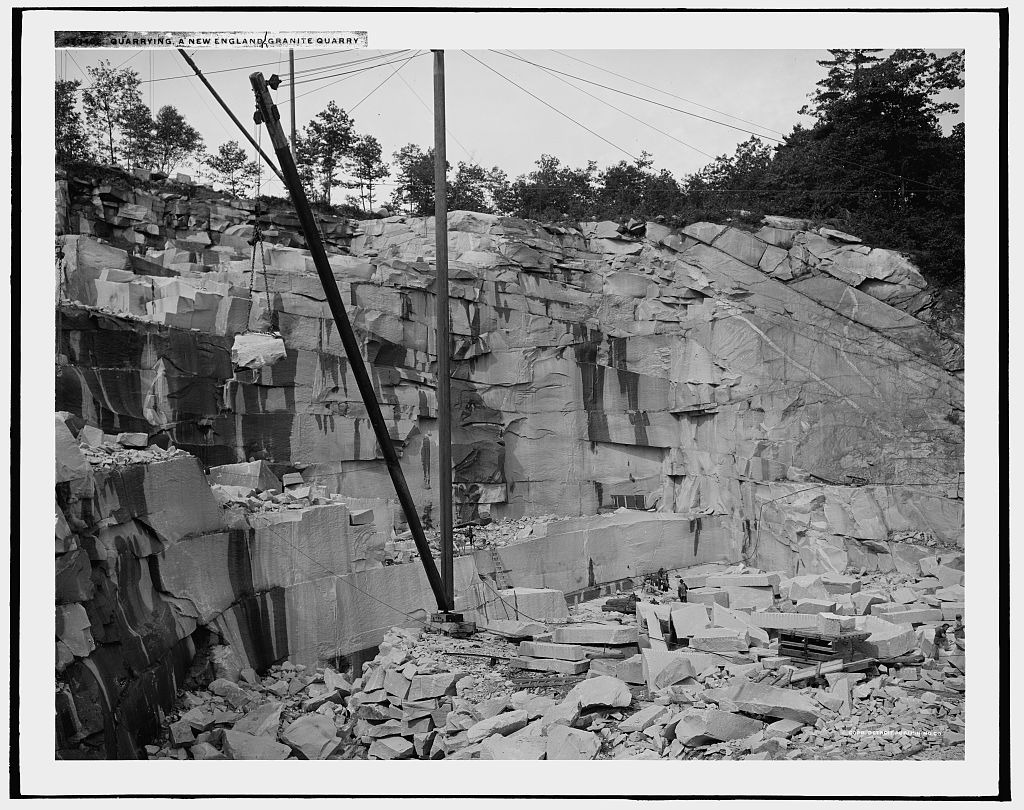
The retaining courses are the part nobody looks at. These houses sit on terraces cut into hillsides, and the terraces are held by stone — courses running back into the slope, drained behind, laid to take a pressure that never stops pushing. A terrace wall is a piece of engineering that has to work in February, in a freeze, in a county where water gets into everything and then expands.
Most of them are still standing. That is the measurement: a hundred and thirty Berkshire winters against work done by hand, by men paid by the day and photographed once.
IV. The photograph again
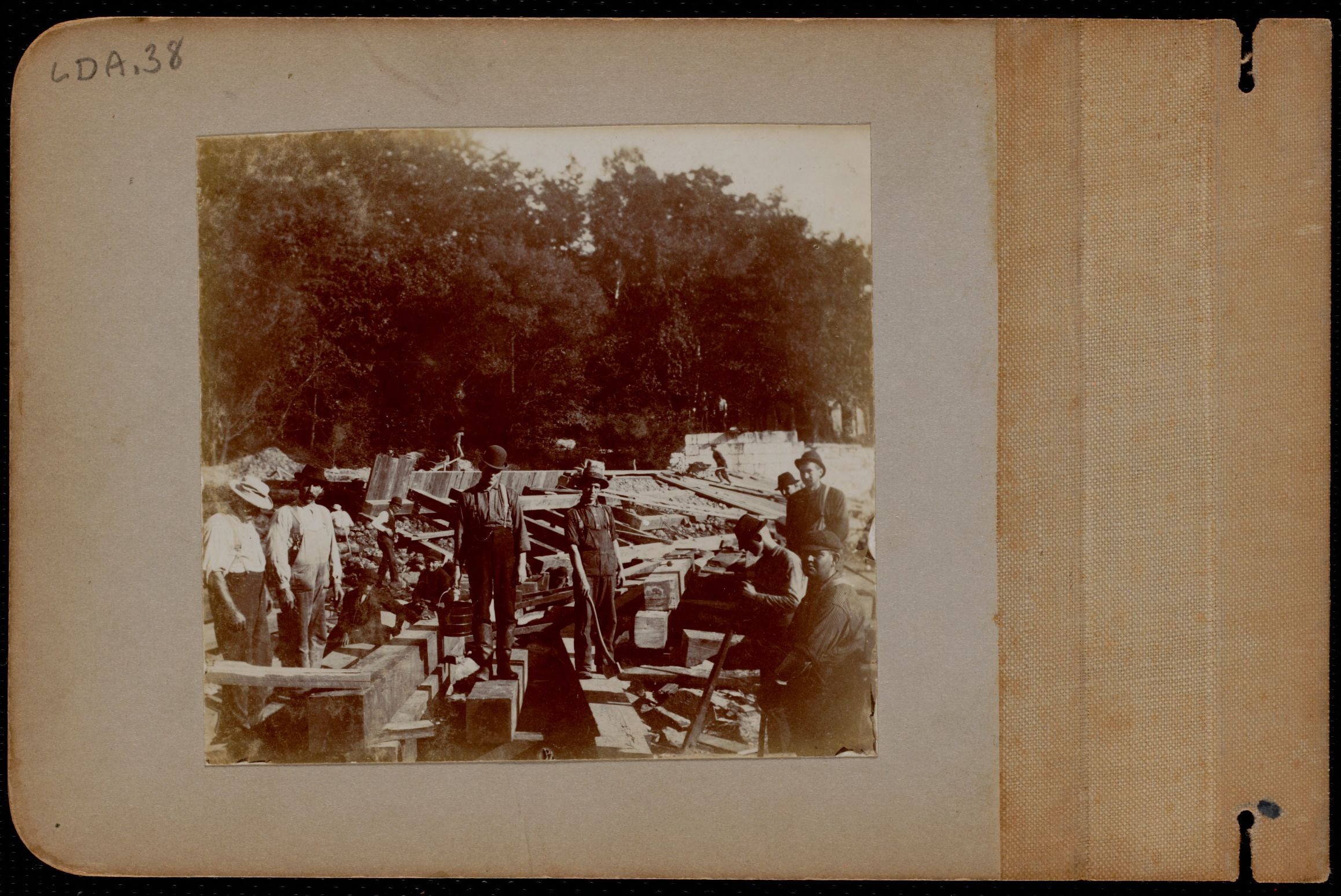
Go back to the steps. The men are sitting where the owners would later stand. Several are grinning. One near the front has his arms folded in the manner of a man who has been told to hold still and has decided to enjoy it. They had built the thing, and for the length of one exposure it was theirs, and somebody thought to point a camera at them before the scaffolding came down and the family arrived.
It is the only group portrait of a Berkshire estate workforce this site has found. Shadow Brook itself burned in 1956. The photograph outlasted the house.
V. The firms did have names
The men on those steps are anonymous. The firms that employed them are not — they are in the advertising, where they paid to be.
Turn to page 19 of the 1923–’25 directory, headed Builders, and there they are, three to a page with their telephone numbers.
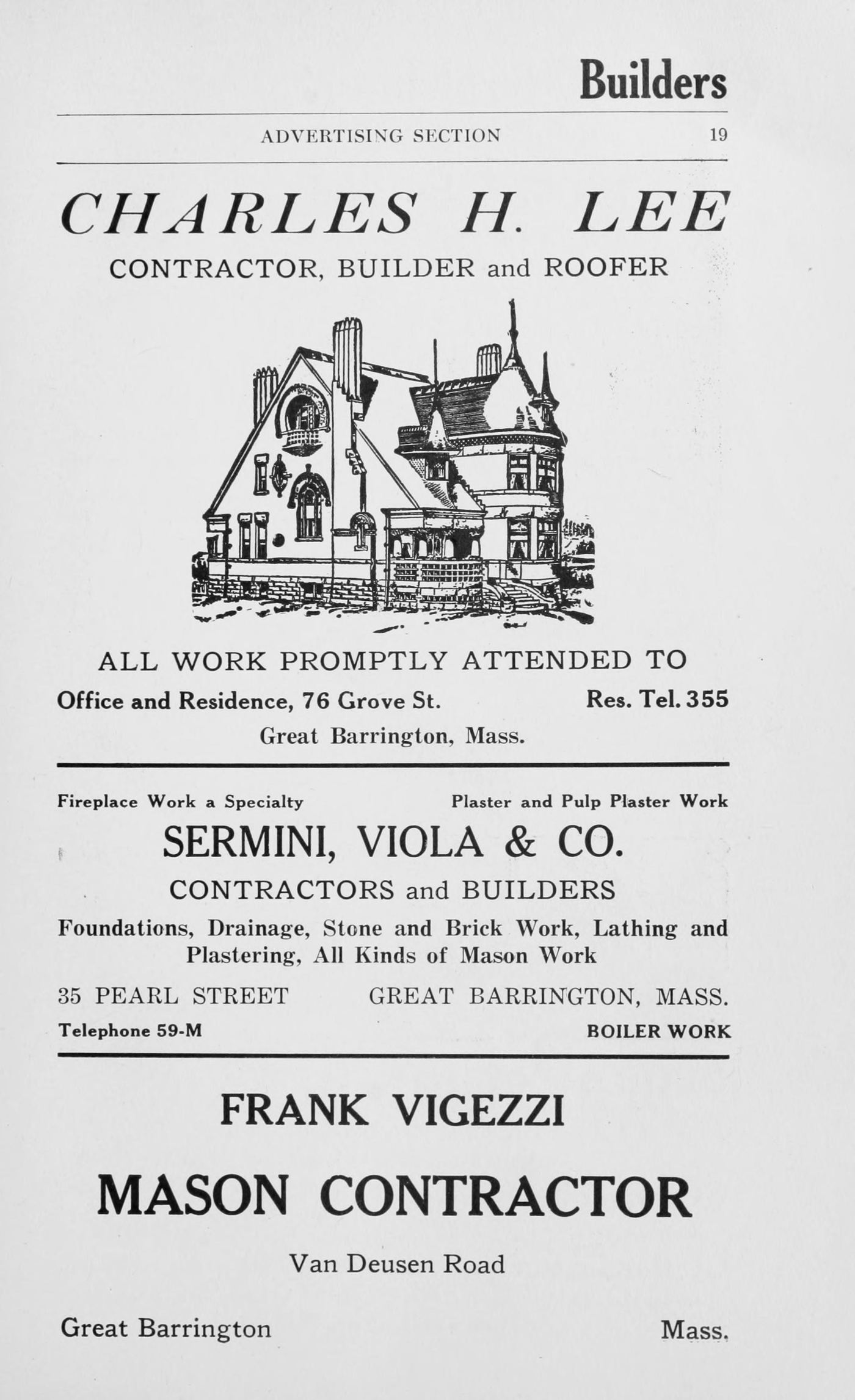
SERMINI, VIOLA & CO. — Contractors and Builders — Foundations, Drainage, Stone and Brick Work, Lathing and Plastering, All Kinds of Mason Work — 35 Pearl Street, Great Barrington, Mass. — Telephone 59-M
Chas E Sermini, Charles E Sermini jr and John F Viola. A family firm at a house address on Pearl Street, and a scope of work that runs from the hole in the ground to the finish coat on the wall. Below them on the same page, Frank Vigezzi, Mason Contractor, Van Deusen Road. Above them, Charles H. Lee, Contractor, Builder and Roofer, of 76 Grove Street — “all work promptly attended to” — who had gone to the expense of a line engraving of a turreted Queen Anne house with a stone foundation, because that was the job he was advertising for.
Two of the three are Italian names, in a county whose 1874 directory has almost none. The stone trades are how a generation of Italian families came into these towns and stayed, and by 1923 they owned the contracting.
Note also what Sermini’s advertisement includes: lathing and plastering. The same volume lists exactly one man in the whole of South County under the occupation “plasterer” — which, set against this, is plainly a fact about how directories classify people and not a fact about how many men were plastering. The trade is in here. It is filed under masonry.
Shadow Brook and construction-site photographs, Lenox Library Association, through Digital Commonwealth; titles quoted as catalogued. Quarry photographs, Detroit Publishing Company, Library of Congress, which records no known restrictions on publication. The New England granite quarry views are dated 1908 and the Rutland marble view about 1900; neither is a Berkshire quarry, and they stand here for the process rather than the place. Trade counts, named quarrymen and the builders’ advertisements from Crowley & Lunt’s South Berkshire Directory, 1923–’25, reproduced in full here; the Sermini Viola & Co, Frank Vigezzi and Charles H. Lee advertisements are on page 19 of the advertising section and are quoted as printed. That volume does not cover Lenox, which is in the 1926 Central Berkshire directory instead.