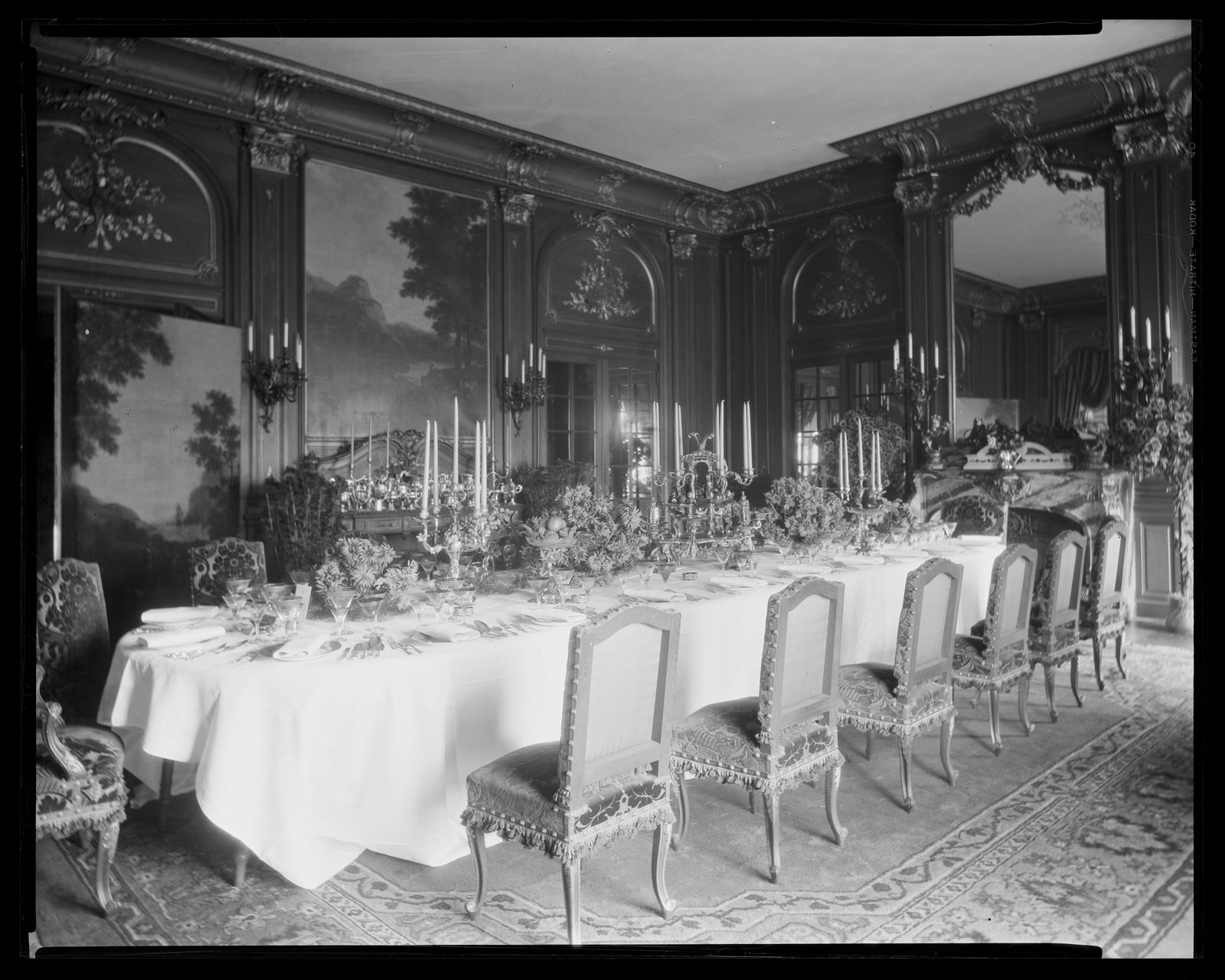
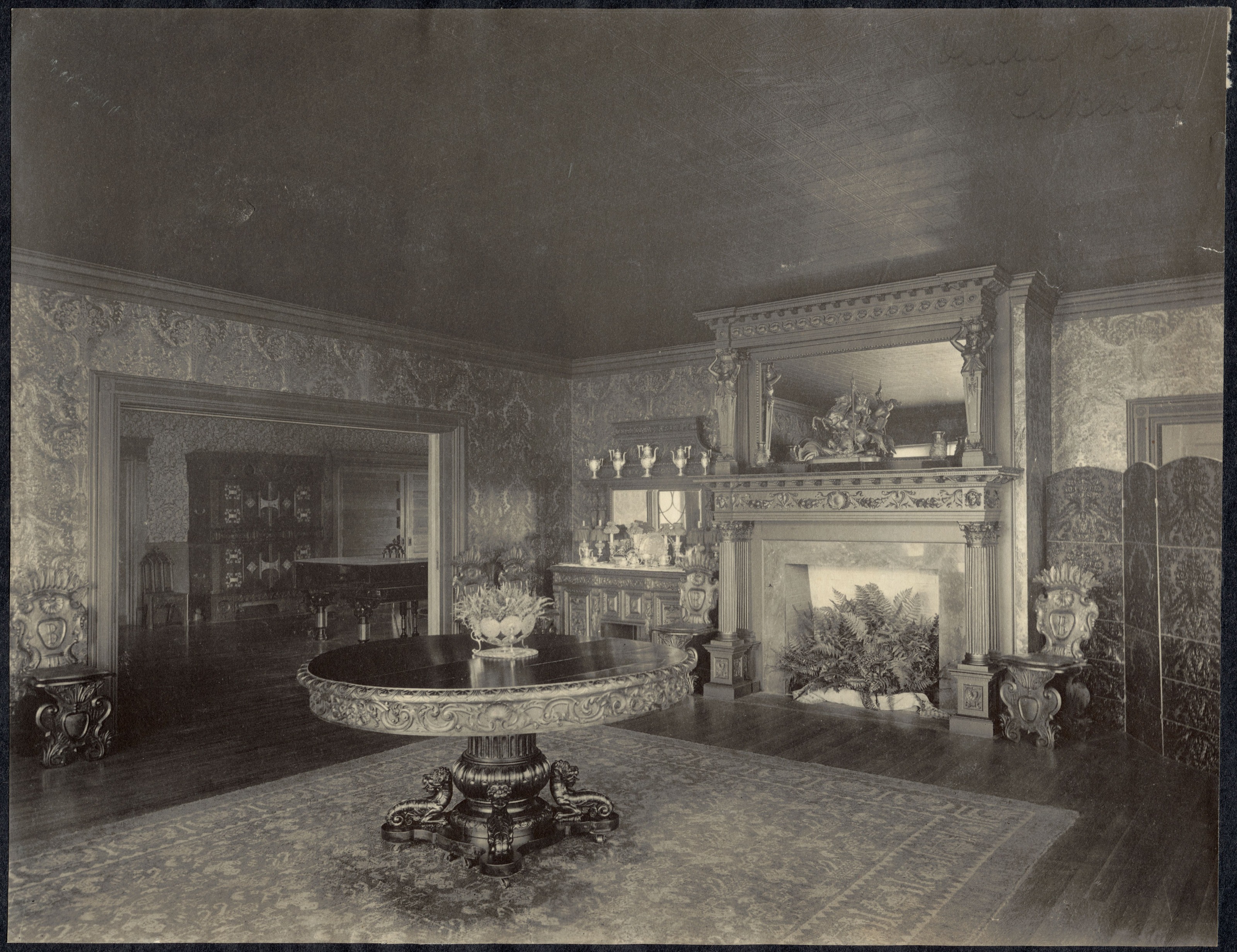
Search the Lenox Library’s photographs for a dining room and they arrive by the dozen — Bellefontaine’s laid for dinner with flowers down the middle and the candles lit, Lakeside’s under a carved chimneypiece, Blantyre’s, Oakswood’s, the Dormers’, Hagyard’s.
Search the same collection for a kitchen and you get an old woman at a hearth in a farmhouse and a pancake breakfast at the town bicentennial. Search for a scullery, a servants’ hall, a still room, a pantry, a laundry, and you get nothing at all.
These houses had every one of those rooms, at scale. Somebody boiled and pressed the linen on that table. Somebody polished the silver, trimmed the wicks, carried the courses up from a kitchen deliberately placed far enough away that the smell of cooking never reached the room. None of it was photographed, because photography was expensive and you photographed what you were proud of.
I. What was actually down there
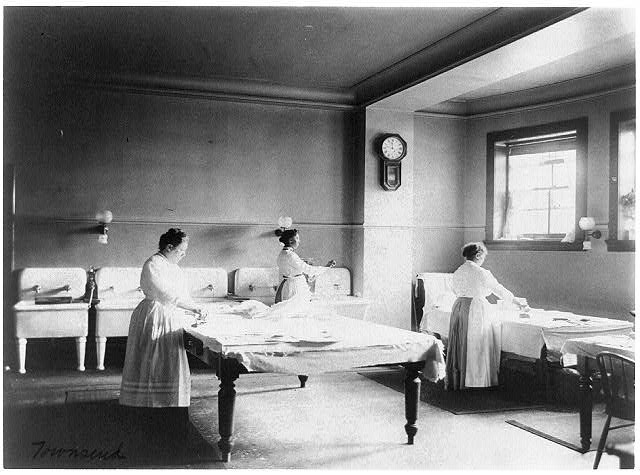
For the rooms themselves we have to go outside the county. Frances Benjamin Johnston photographed the service floor of the Mary Scott Townsend house in Washington around 1910, and it is the most useful picture in this story: a laundry with three women at long tables, sleeves pushed back, a wall clock above them, daylight from a single high window. Nothing decorative. A workroom, in a mansion.
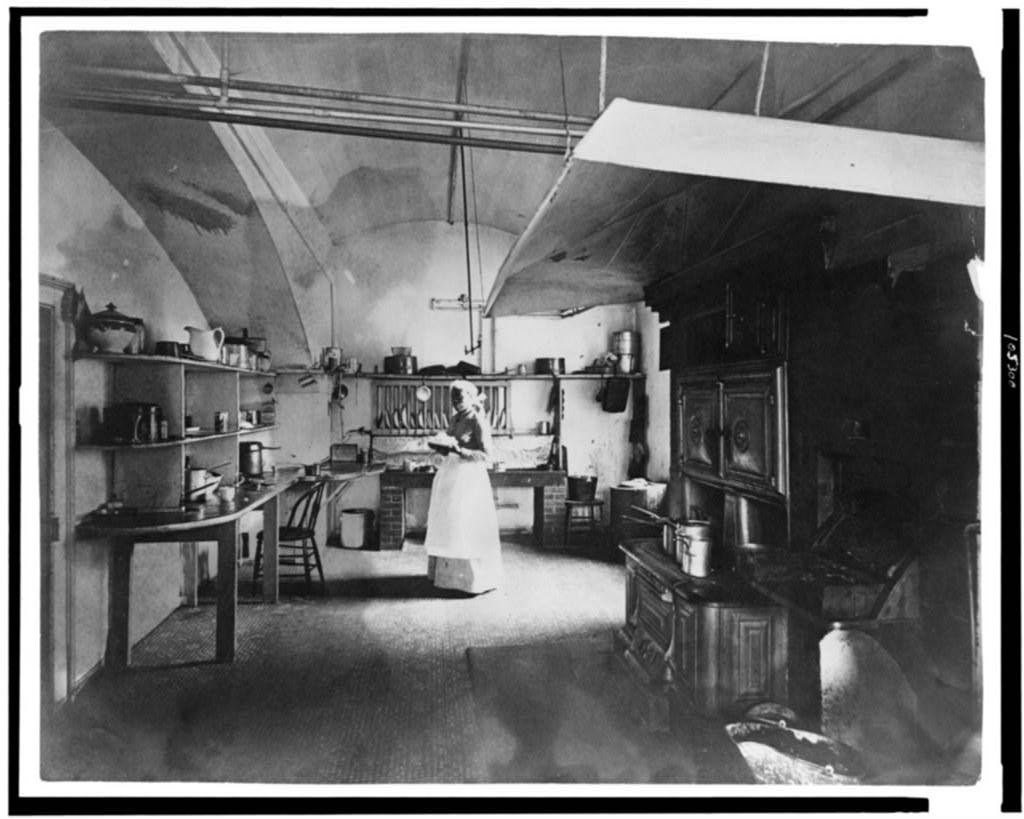
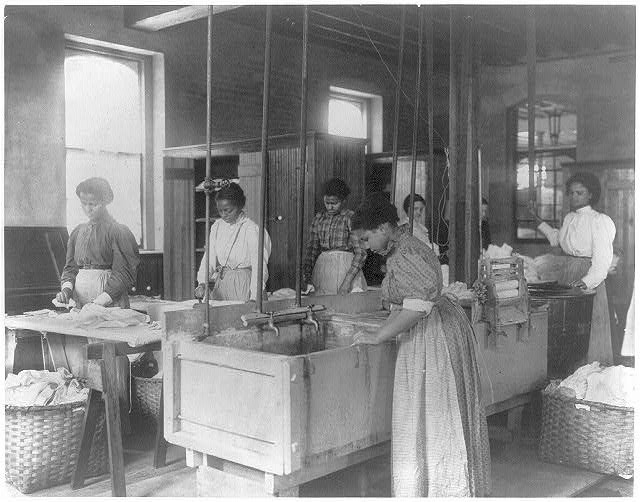
The White House kitchen of the same period is a brick-vaulted basement with one cook in it and the batterie hung on the wall behind her. The Hampton Institute laundry shop of 1899 shows the mangle and the wringer that a great house would also have had, and the women trained to use them.
II. The order of it
A full Berkshire household ran on a hierarchy that everyone in it could recite. The butler had the dining room, the wine, the plate and the male staff. The housekeeper had the linen, the stores, the china and the women. Below them: cook and kitchen maid and scullery maid; footmen; parlormaids and chambermaids; laundress; lady’s maid and valet, who belonged to a person rather than to the house; and, in families with children, a nurse and a governess, who belonged to neither world and generally ate alone.
The two at the top were not servants in the way the word is now used. They hired, dismissed, ordered goods, kept accounts and settled precedence, and a good pair of them were worth more to a family than most of the family’s advisers.
III. The names that survive
The 1923–’25 directory lists, across the southern towns, seventeen butlers, twenty-seven housekeepers, thirty-six cooks, twenty-nine maids, eleven waitresses and four laundresses. Nowhere near the whole of it — live-in staff were frequently recorded under the employer, and the volume misses Lenox entirely — but it puts names to some of them, with the employer attached and bds do, boards at the same address, meaning they lived in the house:
Bassey Joseph butler emp Tanglewood West bds do p o Lenox.
Favant Eugene butler emp Miss Tuckerman’s Main bds do.
Bottum Clara M Miss housekeeper N S Stevens’ Main.
Zell Louise housekeeper W S Smart’s.
Broome George butler rem to New York City.
IV. Two addresses
And then there is this one, which is worth the price of the whole book:
Richards Alfred butler Brookside rd bds do and at 23 West 54th N Y.
A butler with two addresses. He is recorded in the Berkshires and simultaneously at a townhouse off Fifth Avenue, because the household moved and he moved with it — up in June with the trunks and the plate, down in October, the same man running the same dining room in two states.
That is the shape of the whole Berkshire season in one line of six-point type. The families came for the summer; a proportion of the staff came with them, and the rest — the ones with houses on VanDeusen Road and Yale Hill — were local people hired for the months the house was open, and unhired when it shut.
V. What the absence tells you
An archive is not a neutral thing. It is the sum of what somebody paid to have made and somebody else thought worth keeping. The Lenox collection is rich in these houses because the houses were photographed for their owners — the terrace, the gardens under glass, the hall with the new tapestries. The service floor was photographed far more rarely, and in this county not at all, because nobody was proud of it in the same way and because the people in it were not the client. Where such rooms were photographed — and Johnston photographed several — it was usually as a record of a building, not of a household.
Which leaves the dining room at Bellefontaine standing in for both. Look at it again knowing that every object on that table passed through a set of hands that morning, and that the hands are not in the picture, and were never going to be.
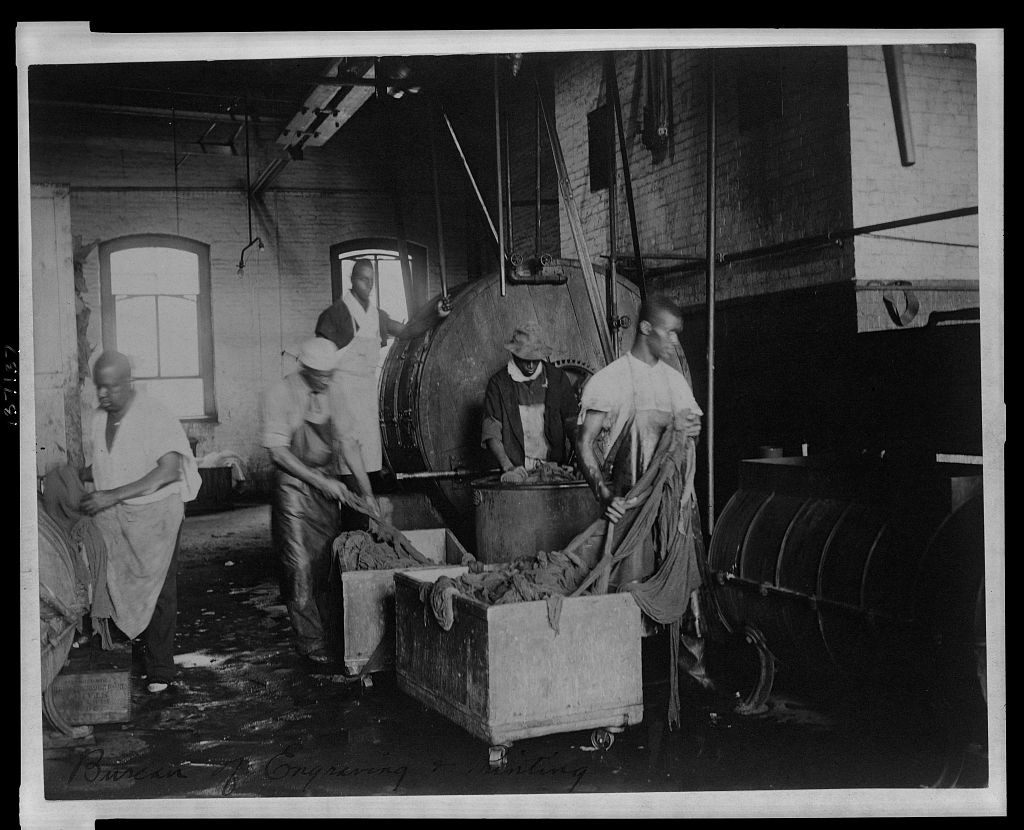
Dining rooms, Lenox Library Association, through Digital Commonwealth; titles quoted as catalogued. Service-room photographs from the Library of Congress: the Mary Scott Townsend house laundry and the Hampton Institute laundry shop are by Frances Benjamin Johnston; the White House kitchen and the Bureau of Engraving and Printing laundry are also Library of Congress. None of these is a Berkshire room, and they stand here for the kind of room, not the place — because no photograph of a Berkshire service floor has been found in this collection. Staff counts and quoted entries from Crowley & Lunt’s South Berkshire Directory, 1923–’25, reproduced in full here; that volume does not cover Lenox, so these counts understate the household trades considerably. The 1926 Central Berkshire directory does cover Lenox: across its nine towns it names forty-six butlers, thirty housekeepers and twenty-five cooks.