I. Finding the village
Lenox in 1910 is two enumeration districts. District 42 runs west and north — Leason Road, West, Housatonic, Franklin, Church, Fairview, Cliffwood, Hubbard, Christian Hill, Main. District 43 begins again at the Curtis Hotel and works out through Depot, School, Meaneys Lane, Kemball, Hawthorn, Stockbridge Road. On sheet 8B it turns down East Street toward the Lenox Dale road, and from sheet 9B to sheet 15B — ninety-four households, families 163 to 256 — it is in the village.
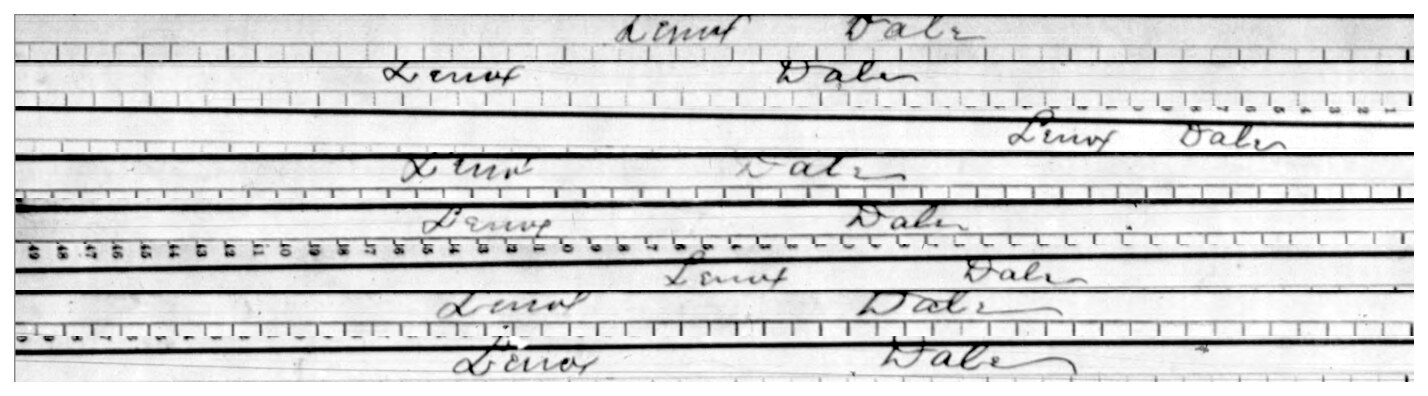
The first column of the schedule asks for the street, avenue, road, etc. For most of the town the enumerator wrote a street. For these sheets he wrote Lenox Dale, eight times running, and left it at that. The village was small enough to be an address.
II. The words the directory would not print
The companion story on the 1926 book makes a count out of an absence: across two hundred and twenty-nine directory entries naming the county’s paper mills as employer, thirty-eight carry a trade, and almost none of those is a papermaking trade. Rag sorter, calender man, back tender do not appear in the volume at all.
Here is a single household on sheet 11A.
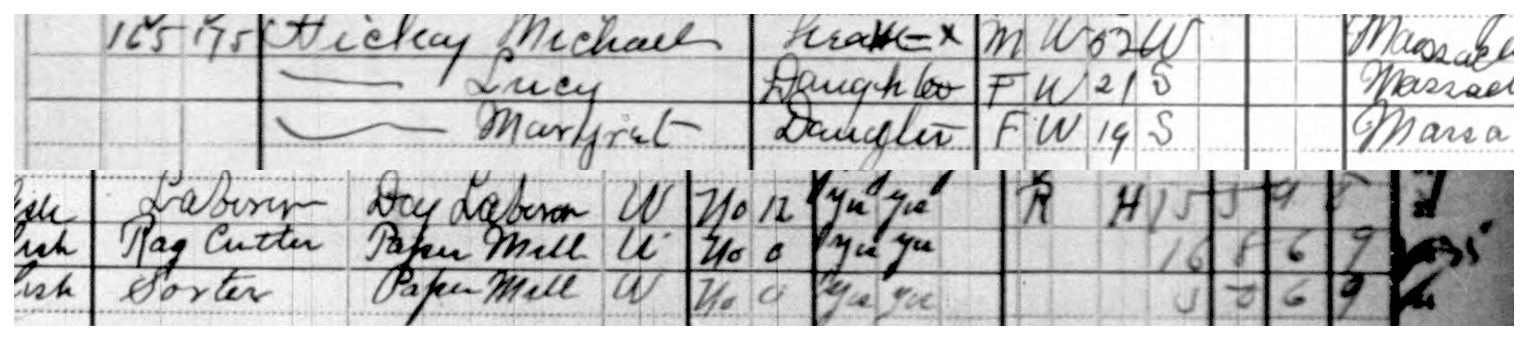
165/175 Hickey Michael, head, 52, widower — Laborer — Day Laborer — 12 weeks out of work
Lucy, daughter, 21 — Rag Cutter — Paper Mill
Margret, daughter, 19 — Sorter — Paper Mill
Rag cutter. Sorter. Those are the jobs at the wet end of a rag mill, and they are printed here in a clerk’s hand on a government form, because the form asked.
Across the thirteen sheets the mill occupations come steadily: Mahoney William, 58, Engineer — Paper Mill, and his son John, 22, Paper Maker — Paper Mill. Pizer Peter J., 46, Foreman — Paper Mill; Noble Thomas, 37, foreman; Perry, 46, foreman. Ward Martin, 32, Finisher — Paper Mill. And then the word that does most of the work: Operator.
| Operator, paper mill | Age |
|---|---|
| Mary Chardin | 15 |
| Jennie Peltier (arrived from France 1907) | 16 |
| Margaret McCabe | 17 |
| Flora Soule | 17 |
| Mary Rollett | 18 |
| Fred Houghtaling | 19 |
| Rosa Bonethel | 20 |
| Charles Washburn | 20 |
| Louis Martin | 21 |
| Eliza Houghtaling | 26 |
| Charles Martin | 27 |
| Catharine Costello | 28 |
| Alfred Corveley | 30 |
| John Bradshaw | 30 |
Fourteen operators; eight of them are twenty or under. Bertha Chardin, twenty, is an operator at the box shop; Gregor and Arthur St. Peter, seventeen and sixteen, are operators at the electric works. This is a village whose mill ran on its own teenagers, and the directory of 1926 — which lists three Lauber sisters boarding together on Elm Street, all three emp Valley Mill — gives you the sisters and withholds the job.
III. A French village inside a Massachusetts one
Read the birthplace columns and the character of the place changes again. Household after household on these sheets is France — Fr. French — Fr. French: Rondot, Tessaix, Reyvou, Oliver, Bagard, Garnier, Belperin, Reisser, Narroy, Berry, Bouthill, Chardin, Favre, Nessaux, Corveley, Mangin, Glezze, Corbat, Toupence, Peltier, Merchand, Patard, Rollett, Barth, Gousset, Den Blauw, Tamagnes, Chague, Meurett. A Belgian widow, Jennie Renaud, with her son. Two Italians and a Turk, all three arrived in 1904.
The arrival years in column 15 run from 1863 — August Garnier, fifty-two, day laborer — to 1909. Kate Narroy, seventy-eight, in the country since 1872, is entered in column 17 as speaking French, not English; so are the two men in the next section. Three French carpenters — Barton, Crowley and Exenel, arrived 1888 and 1891 — board together in one house on sheet 12A and all three are entered Carpenter — House.
IV. The Chagues and the men next door
The census story already sets out the Chague household: Alphonse, forty-nine, day laborer, and his sons of sixteen and fifteen, both at day labor, both twelve weeks out of work. It sits on sheet 10A, dwelling 154, family 164.
What was not clear until the sheets on either side were read is that the Chagues are not an isolated French family in an Irish and Yankee village. They are one house in a row of them — and two of the names in that row are names the 1926 Elm Court story found working at the house.
One household earlier, family 163: Meurett Jule, thirty-seven, born France, arrived 1893, naturalized — Laborer, Day Laborer, eight weeks out of work — with his wife Marie and two small daughters born in Massachusetts.
And on sheet 11B, boarding with the Bouthills:
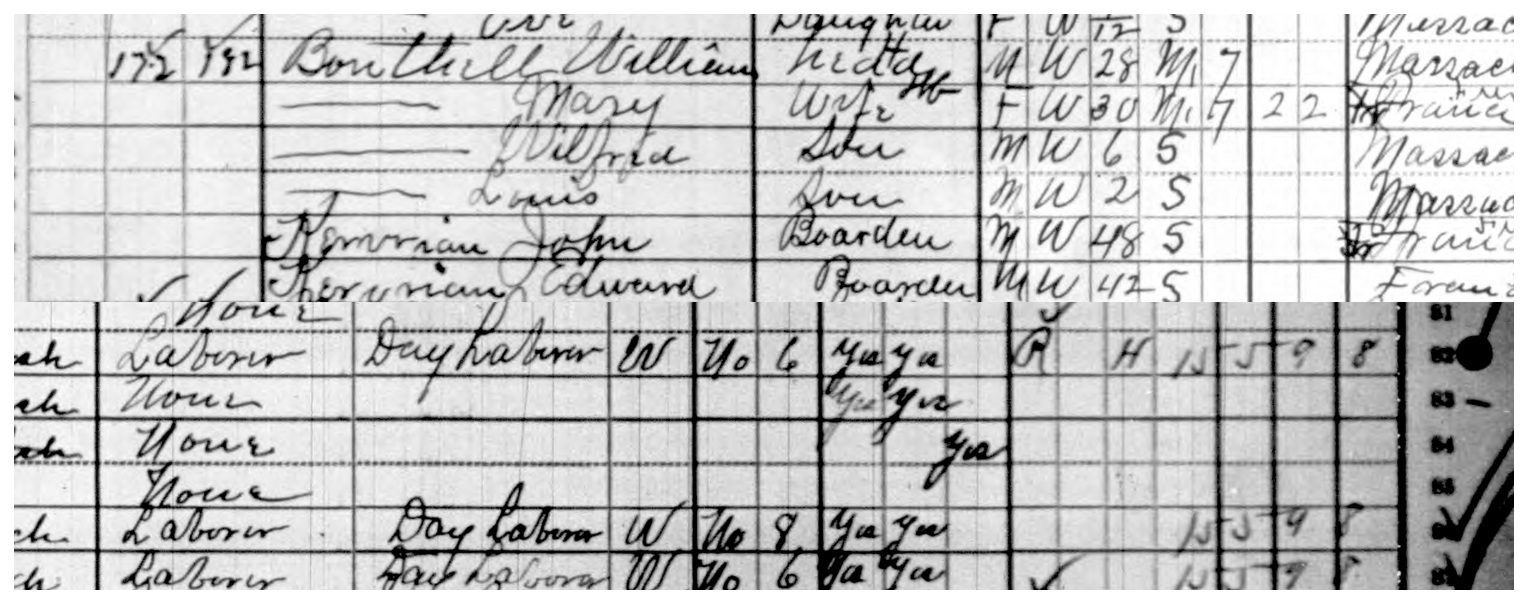
Kervorian John, boarder, 48, France, 1902 — Laborer — Day Laborer — 8 weeks out of work
Kervorian Edward, boarder, 42, France, 1902 — Laborer — Day Laborer — 6 weeks out of work
The enumerator wrote the surname twice and not quite the same way either time. In the 1926 directory it is Kerveran. This site has been here before, with a Lenox Dale man the 1926 book called Teiss and the 1938 and 1942 books called Weiss: a Breton name arriving in an English-speaking clerk’s ear comes out differently every time it is written down, and the way to follow a family through the record is to stop trusting the spelling.
Two more names carry straight across the sixteen years. Cullen Thomas, fifty-five in 1910, born Ireland, arrived 1860, day laborer, with his wife Mary A. — and in 1926, Cullen Thomas F., (Mary A.) emp Valley Mill, h E. Main, Lenox Dale. Shaw James W., with his wife Grace, day laborer in 1910 — and in 1926, Shaw James W., (Grace) emp Centennial Mill, h Lee rd, Lenox Dale. And on sheet 14A, boarding with the Roys on what is now Roy Avenue, Gousset Celestine, sixty-one, born France, arrived 1878, day laborer, twelve weeks out of work — while the 1926 book lists Goussett Bros. of Bradley Street under saw mills, and three Goussetts living on Roy av.
V. Weeks out of work
Column 22 of the 1910 schedule asks how many weeks the person was out of work during 1909. It is the plainest thing on the page and the directories have no equivalent for it.
The Chague boys, sixteen and fifteen, lose twelve weeks each. Amos Chardin, forty-seven, loses twelve. Celestine Gousset, sixty-one, loses twelve. Michael Hennessy, seventy-one, loses twenty. John Hackett, forty-two, loses twenty.
And three men lose the year entire. Bennett William, sixty-two — fifty-two weeks. Couverson Edmund jr., thirty-two — fifty-two weeks. Roy August sr., sixty-one, in the country since 1870, a widower with two grown sons in the house also at day labor — fifty-two weeks.
Jule Toupence is seventy-seven, born France, in the country since 1886, and is entered as a day laborer with ten weeks lost. George Jessup is seventy-seven, born England, arrived 1847, day laborer, fifty-two weeks lost. There is no retirement in this column. There is work, and there is the number of weeks there wasn’t any.
VI. And a few of them went up the hill
Lenox Dale in 1926 sends three people to Elm Court and keeps one gardener. In 1910 the proportion is much the same, and the census names the jobs.

Proctor Thomas, fifty-three, born Scotland, arrived 1884, naturalized, with his wife Catharine — Superintendent — Farm Superintendent. Back on sheet 9B, Bourke John P., thirty-five, boarding on a farm, Gardener — Private; and Heyn Charles, thirty-six, born Germany, arrived 1890, with four children, Florist — Private. On sheet 13A, Merchand Armand, forty-four, born France, arrived 1887, with five children — Laborer — Private. On sheet 11A, Blanche Stringer, eighteen, eldest of seven — Waitress — Private. On sheet 10A, Alice Herrick, fifty-seven, in her brother-in-law’s farmhouse — Nurse — Private.
Private. Column 19 asks for the general nature of the industry, and for anyone working in somebody else’s house the answer is that word and no other. It is the census’s own version of the silence this section keeps finding: the directories name the employer and hide the trade; the census names the trade and hides the employer. Neither book will give you both, and the only way to get both is to read them against each other, which is what these two stories have been doing.
Ninety-four households, and six people working for a private family. The rest are in the mill, on the road, at the quarry, in the lumber yard, or out of work.
All of it read off the Thirteenth Census of the United States, 1910: Population, Massachusetts, Berkshire County, town of Lenox, enumeration district 43, sheets 8B to 15B, National Archives microfilm publication T624, reel 572, digitized by the Internet Archive and free to read. The sheets carry no machine-readable text and were read by eye; names are given as the enumerator wrote them, including Kervorian, Meurett, Bonethel and Margret, and where a hand is ambiguous the entry has been checked at full resolution before being quoted. Ages, birthplaces, years of immigration and weeks out of work are from columns 7, 12–14, 15 and 22; occupations from columns 18 and 19, matched to names by the printed line numbers in the right margin. The 1926 comparisons are from the Lenox section of the Central Berkshire County Directory, 1926, which can be read here. No claim of descent is made where two books give the same surname sixteen years apart; where a first name, a wife’s name and a street also agree, that is said and the reader can weigh it.