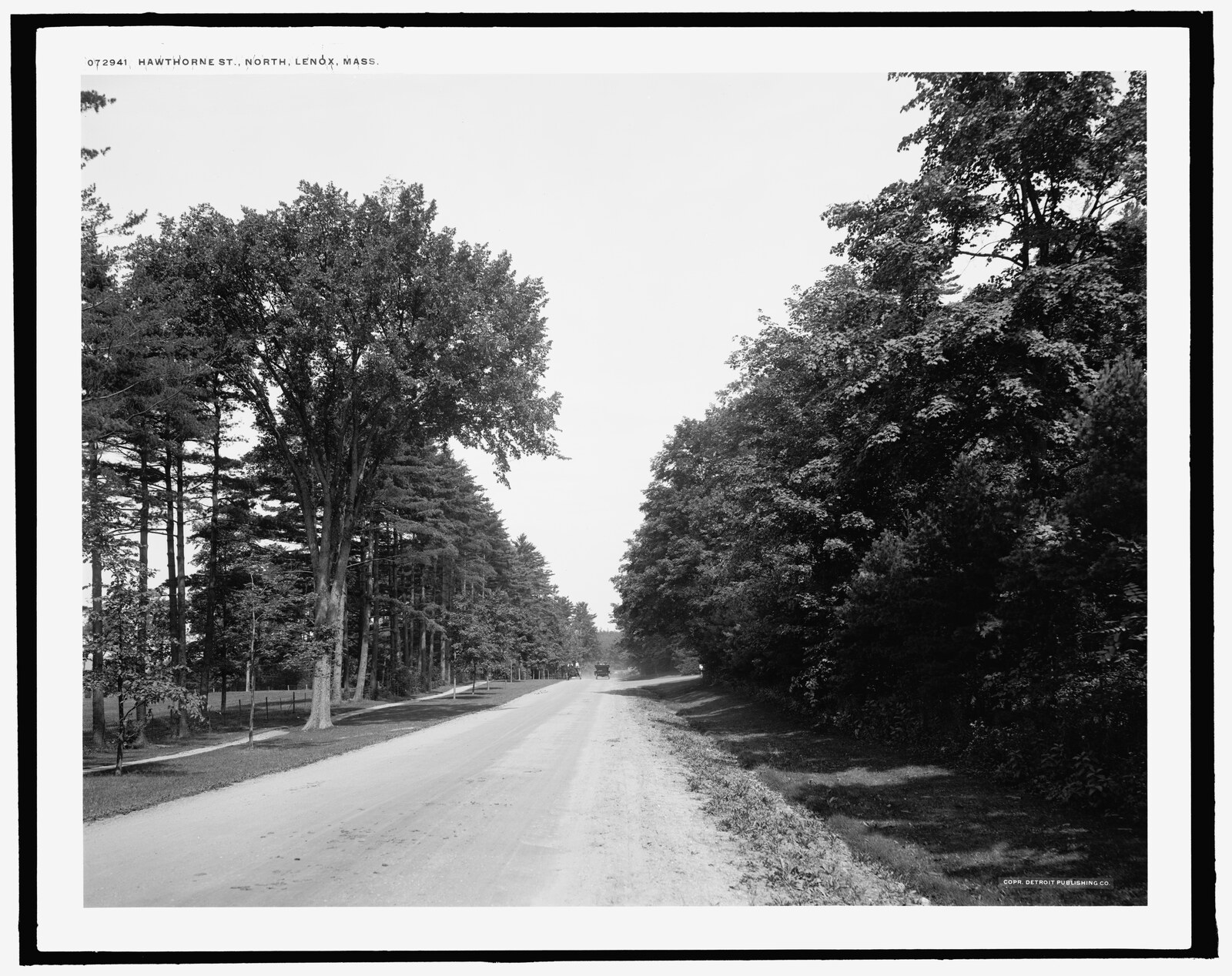
The Elm Court story exists because a house turned out to straddle a town line and half its staff had been missed. The High Lawn story did the same thing with three towns. This one is what happens when you stop chasing houses and follow the road.
I. Three headings, no map
Before it prints the names, the 1926 volume prints a street list for each town: every road walked in order, with the householders in the order you would pass them, the side roads marked as they open and close, and two columns of indent under the heading Left Right for the two sides of the carriageway. Lenox has one. Stockbridge has one. Between them, three headings bear on the ground this page is about.

HAWTHORNE STREET · Lenox, page 170
From Stockbridge southwest to Stockbridge Line
HAWTHORNE STREET · Stockbridge, page 268
From Lenox line near Court House Hill, south west and northwest to Lenox line at Shadow Brook
WEST STREET · Lenox, page 177
From junction of Main Stockbridge and Walker, westerly to Stockbridge Line
Two of the three are called Hawthorne Street, one in each town. Nothing in any of the three headings mentions either of the others. The book gives no map, prints no key, and never once says that a road it has just walked to a town line carries on past it.
So this page does not argue from those descriptions. It argues from the households, which are the only thing the book actually proves.
A note on the names, because they have moved. Every street name on this page is the 1926 book’s, and the 1926 book’s names are not today’s. The run of houses in section IV — Highwood, Tanglewood, Wheatleigh and the stretch of West Street that meets them — is Hawthorne Road today, not Hawthorne Street. Today’s Hawthorne Street is a different road, running parallel to West Street, and it does not meet it. Anyone taking this page to the ground should go by the houses and not by the street names, which is the point of the page.
II. The doctor, entered twice
Highwood stands on it — the 1845 house above the Stockbridge Bowl that the Boston Symphony Orchestra bought in 1986, whose history is on the Tanglewood page. In 1926 it belonged to a Boston neurologist, and the directory enters him in both towns.

Bullard William Dr., h “Highwood”, West — Lenox, 184
Bullard William N. Dr., (Mary) h “Highwood”, Hawthorne — Stockbridge, 278
Two entries, and they are not the same entry. Stockbridge gives him a middle initial and a wife; Lenox gives him neither. Lenox puts him on West; Stockbridge puts him on Hawthorne. Working in one town’s section you have no way of knowing the other exists.
The street lists, which is where a named house usually announces itself, make it worse rather than better. Stockbridge’s walk names the place outright: Dr. William N. Bullard “Highwood.” Lenox’s Hawthorne Street names nobody’s house at all — seven households, no cottages. Lenox’s walk of West Street names Fairlawn, Beaupre, Groton Place, Brookhurst, The Orchard, Bonny Brae, Shadowbrook and Tanglewood — eight cottages in a row — and does not name Highwood at all.
III. One house, three employers
Now try to find the people who worked there. The directory prints an employer after a worker’s name, and the employer is whatever the canvasser was told at the door. At this house he was told three different things.
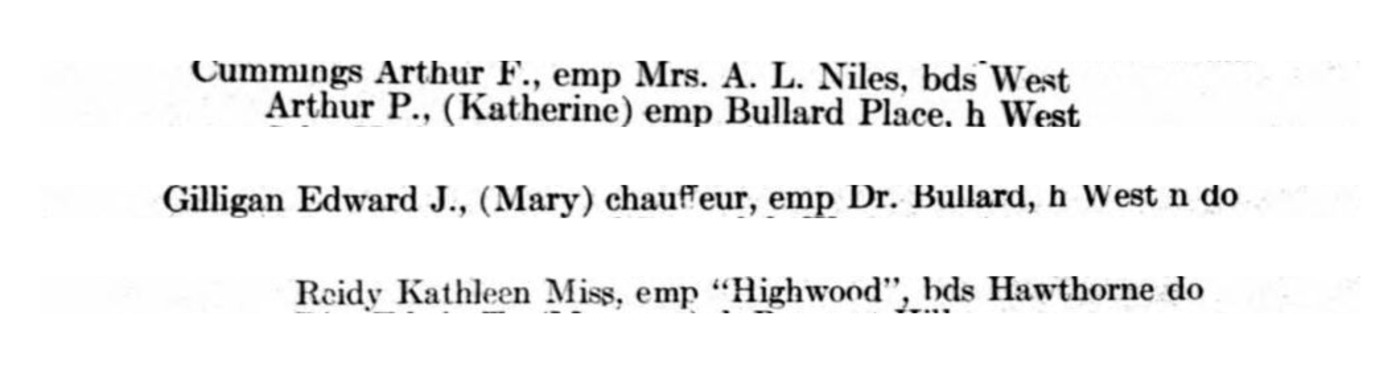
Cummings Arthur P., (Katherine) emp Bullard Place, h West
Gilligan Edward J., (Mary) chauffeur, emp Dr. Bullard, h West n do
Kirby Edward J., emp “Highwood”, bds West
Eisele Louis, (Louisa), emp Bullard Place, h Hawthorne, P. O. Lenox
Reidy Kathleen Miss, emp “Highwood”, bds Hawthorne do
Sawyer Herbert L., (Marion M.), gardener, emp “Highwood”, h Hawthorne n do
Six people. Three in the Lenox section and three in the Stockbridge section; three indexed under the name of the house, two under the name of the place, one under the name of the man. Searching this book for the word “Highwood” finds half of them. Searching one town’s section finds half of them. Doing both wrong finds two.
Only one of the six is given a trade — Sawyer, the gardener. Gilligan’s chauffeur is attached to the man, not the house. The other four are the blank the rest of this section keeps running into: a name, an employer, a street, and nothing about what they did all day.
There is a smaller warning in the first line. Cummings Arthur P. sits directly beneath Cummings Arthur F., emp Mrs. A. L. Niles, bds West — two men, same surname, same first name, one letter apart, same street, different houses. Continuation lines in this book drop the surname; read one carelessly and the two are a single person.
IV. Walked from both ends
Put the Lenox and Stockbridge lists side by side at the point where they meet and the overlap is on the page.
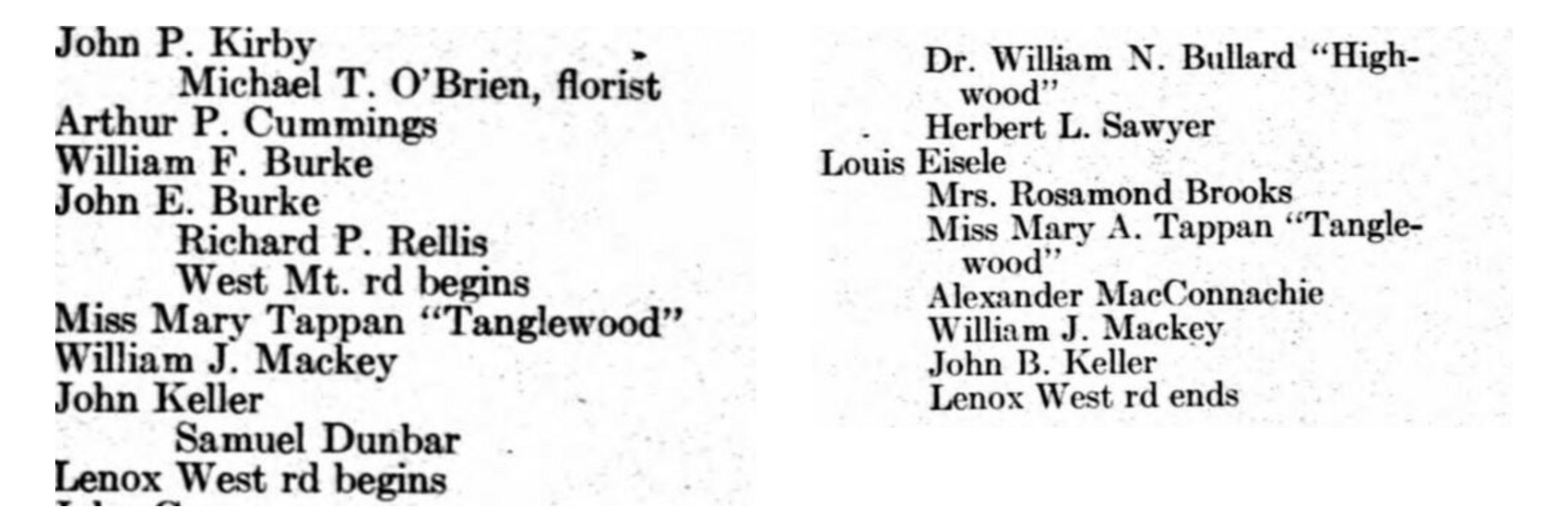
Mary Tappan, William J. Mackey and John Keller are in both. That is the proof, and it is the book’s own: two canvassers walked past the same three doors, going opposite ways, and each wrote them into his own town under a different street name. And because the book sets the left-hand side of the road flush and the right-hand side indented, the three of them change columns between the two lists: flush left in Lenox’s walk, indented in Stockbridge’s. That is not an error. That is what happens when you walk a road from the other end.
Highwood, Herbert Sawyer, Louis Eisele, Mrs. Rosamond Brooks and Alexander MacConnachie are in one list only. By the same convention, Highwood and Tanglewood are on the right-hand side of the road going west and Louis Eisele is on the left — the man who worked at Bullard Place lived across the road from it.
The alphabetical sections know about the problem and do not fix it. Lenox’s own pages carry the flattest statement of it in the book:
Keller John, (Annie), h West in Stockbridge
A Lenox entry, on a Lenox street, telling you the house is in the other town. Four of the Stockbridge entries above end P. O. Lenox: these households are in Stockbridge and collect their mail in Lenox, which is very likely why both canvassers thought they were owed.
V. Supt. Mrs. R. C. Dixey
One name in the Stockbridge list is worth stopping at. It stands between Tanglewood and the Lenox line, and it is in no Lenox list at all.
MacConnachie Alexander, supt. Mrs. R. C. Dixey, Tanglewood, h Hawthorne, P. O. Lenox
The Tanglewood page reproduces a photograph of Hawthorne’s Little Red House taken somewhere between 1860 and 1890. Somebody wrote three things in pencil on the back of it. The third is:
McConnachie Supt. Of Tappan place
A job title on the back of a print — no first name, no date, and a spelling nobody can check. And here is a household of that name in a book: Alexander, a house on the book’s Hawthorne Street a few doors past the place he ran, an employer, and a spelling with an a in it.
Whether the man who wrote the pencil note and the man in the 1926 directory are the same person, or father and son, or unrelated, this site cannot say and does not claim. What the directory establishes is narrower and still worth having: a superintendent of that name, at that place, was a real household on that road, and the caption on the back of the photograph is not the only surviving trace of him.
His employer is a flag rather than a conclusion. The book makes him superintendent to Mrs. R. C. Dixey — Ellen Sturgis Tappan Dixey, the daughter of the house, who put the music room into it in 1896 — while the same volume has Brooks Rosamond Mrs., h “Tanglewood”, Hawthorne and Tappan Mary A. Miss, h “Tanglewood”, Hawthorne, P. O. Lenox living there. Directories carry information forward from year to year. An employer line is not evidence of who was alive; it is evidence of what the household still called itself.
Four doors along: Mackey William J., (Mary) chauffeur, emp Mrs. R. C. Dixey, h Hawthorne n do, P. O. Lenox — the same William J. Mackey that Lenox also claims, driving for the same employer.
VI. Eleven years early
The last thing the road gives up is a date. Mrs. Rosamond Brooks and Miss Mary A. Tappan are both at Tanglewood in this book, printed one after the other on Hawthorne Street, with a superintendent and a chauffeur between them and the Lenox line.
In 1935 the two of them put the place on the market at $45,000 and nobody bought it. In 1937 they gave it to Serge Koussevitzky and the Boston Symphony Orchestra. Eleven years after this canvass, the road stopped being a row of private houses: the estate at one end of it became the Berkshire Festival, and the house halfway along it — Highwood, entered twice and named once — went to the same orchestra forty-nine years after that.
None of which is in the directory. What is in the directory is six working people whose employer had three names, a doctor with two addresses, three households claimed by two towns, and a superintendent who until now had been a pencil note on the back of a photograph.
All entries, street lists and headings from the Central Berkshire County Directory, 1926, from the Pittsfield + Berkshire County MA Directory Collection at the Internet Archive. Lenox street list, printed pages 170 (Hawthorne Street) and 177–178 (West Street); Stockbridge street list, printed page 268; the Bullard entries at printed pages 184 (Lenox) and 278 (Stockbridge); the remaining entries from the Lenox alphabetical section (printed pages 183–246) and the Stockbridge alphabetical section (printed pages 277–316). Page numbers are the numbers printed on the pages, and the links open the volume at the corresponding image; the whole book can be read and searched here. Names, spellings, abbreviations and the book’s own punctuation are given as printed; where the original breaks an address across two lines it has been closed up, and nothing else has been altered. The four plates are unretouched crops from the Internet Archive scan of the volume, which is not in copyright, enlarged but not otherwise worked on; the plate in section IV sets two crops from two different pages side by side, and the plate in section I likewise, each labeled in its caption. The hero photograph is Detroit Publishing Company negative 072941, Hawthorne St., north, Lenox, Mass., in the Library of Congress, which records no known restrictions on publication; the title is the one lettered on the negative, and which of the two Hawthorne Streets it shows is not established here. The reading of flush-left and indented names as the two sides of the road follows the book’s own Left Right heading at the top of each street. Highwood’s building history, the pencilled inscription reading “McConnachie Supt. Of Tappan place,” Ellen Sturgis Tappan Dixey’s music room of 1896, the 1935 asking price of $45,000, the 1937 gift to the Boston Symphony Orchestra and the 1986 purchase of Highwood are set out with their sources on the Tanglewood page.