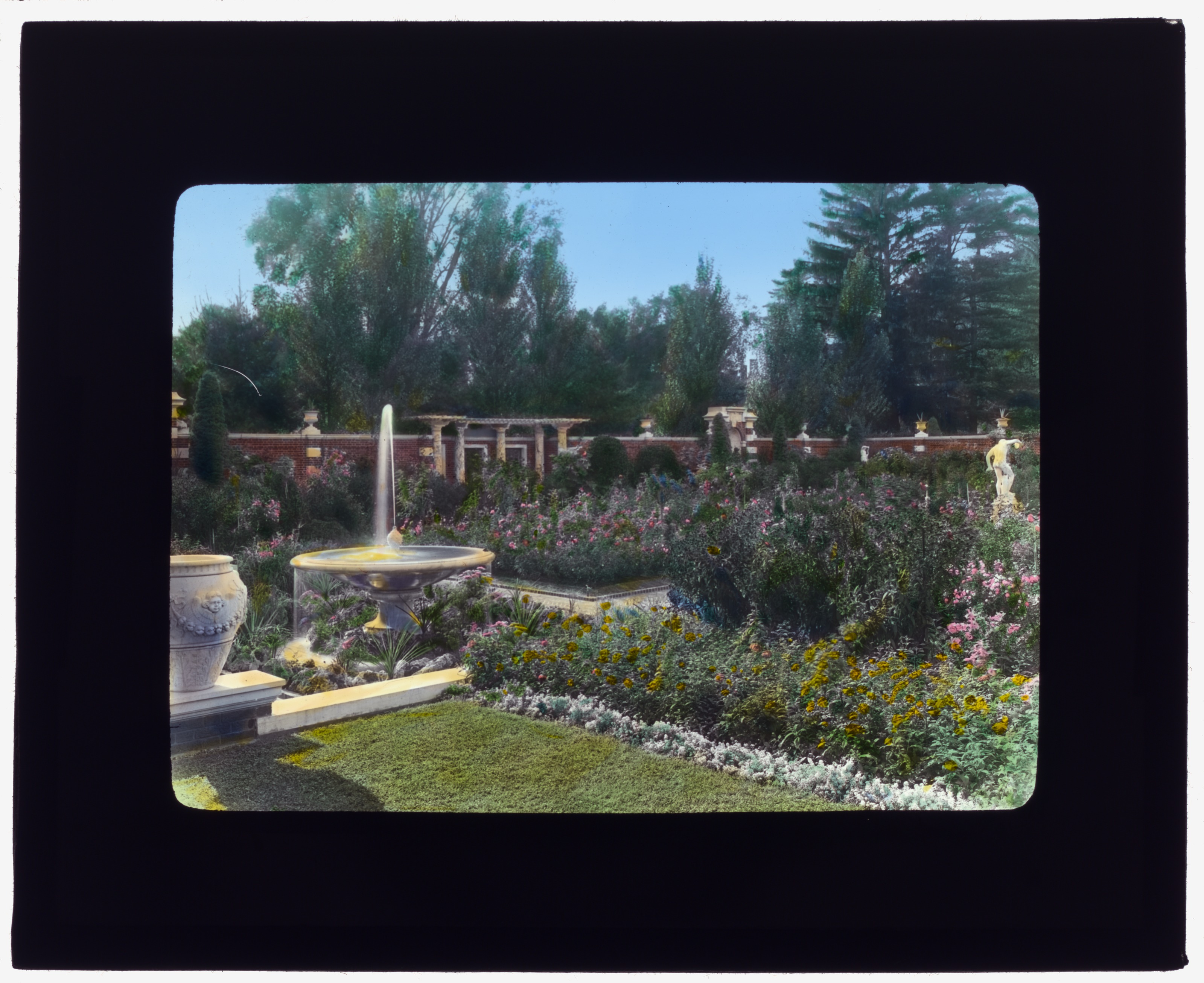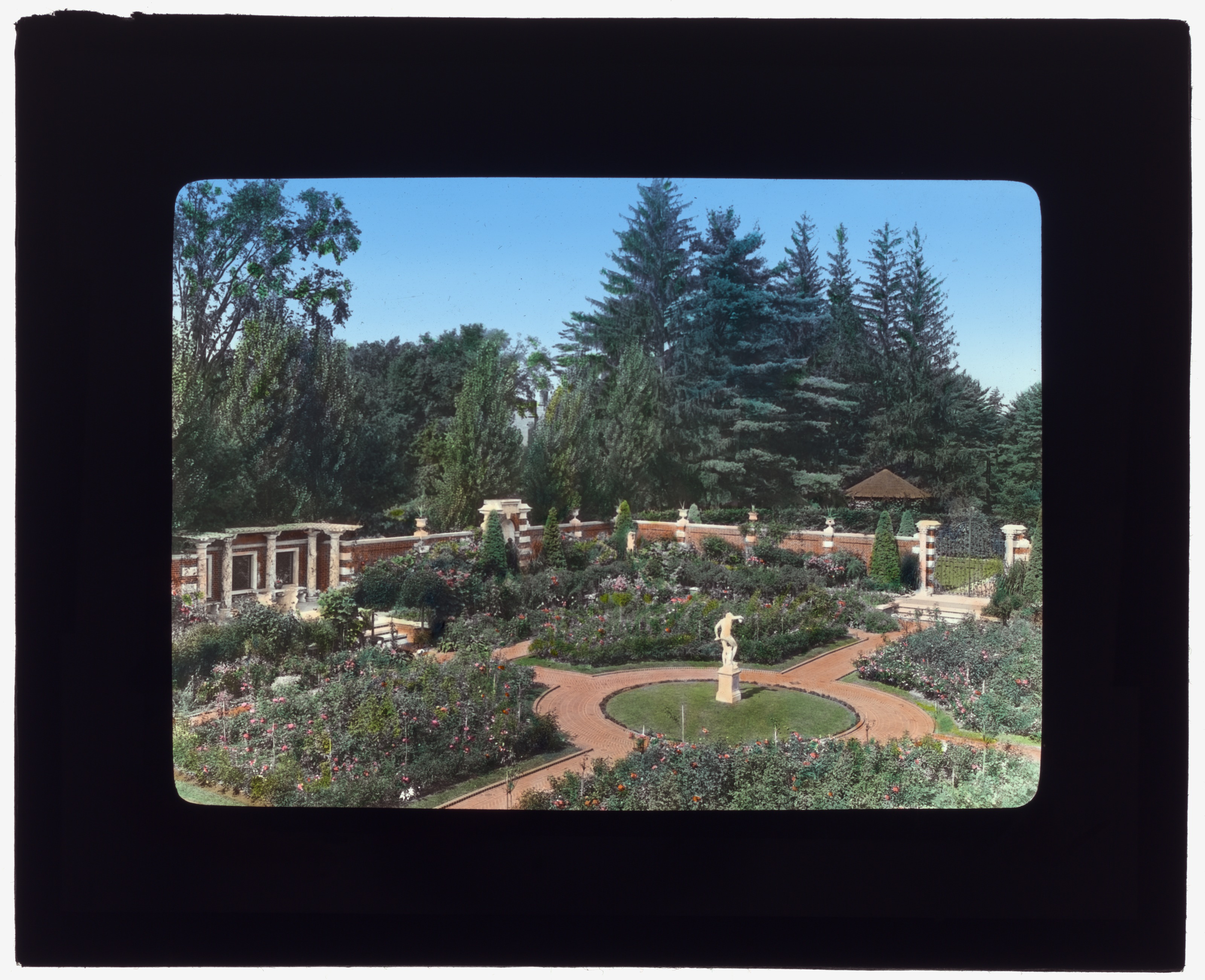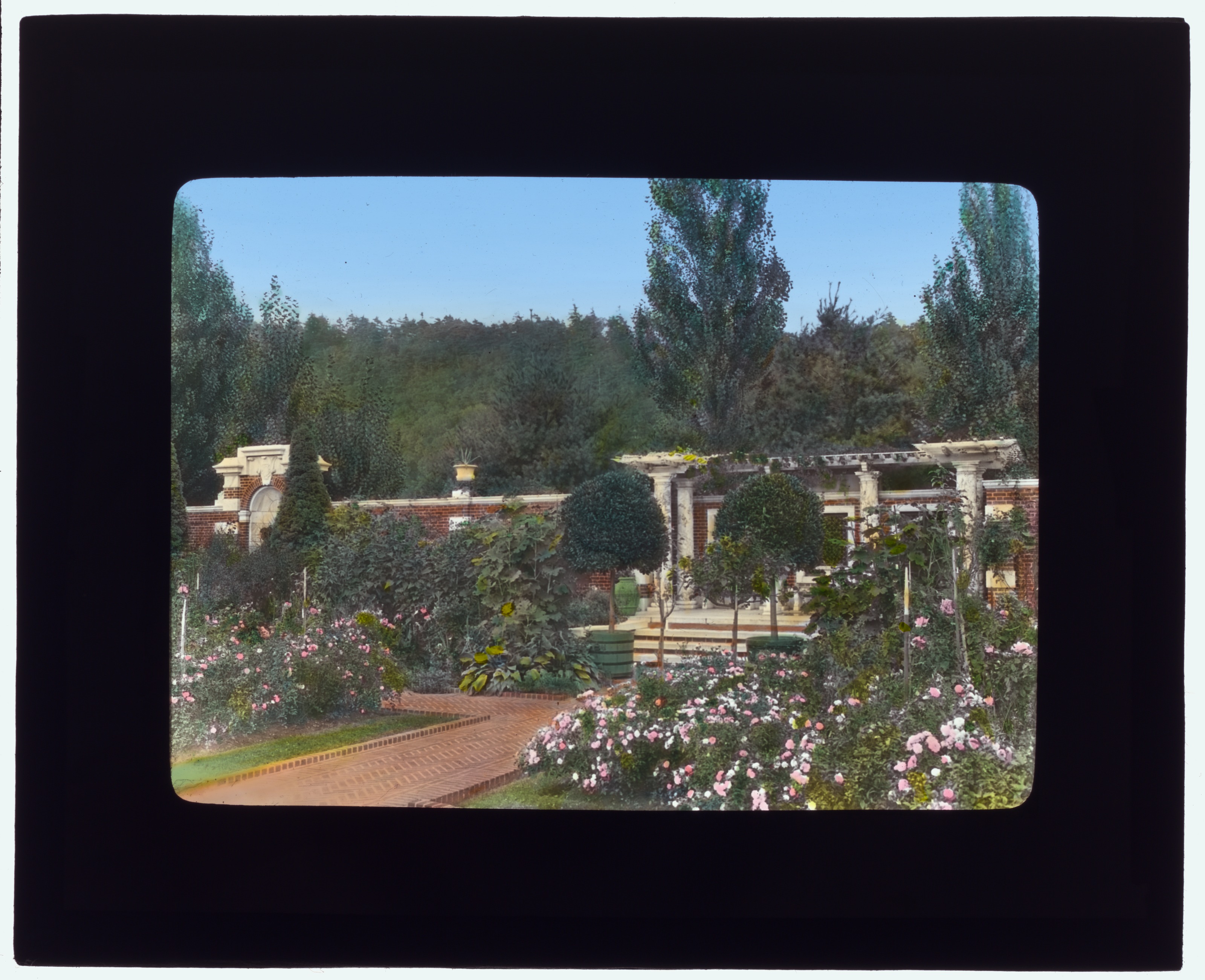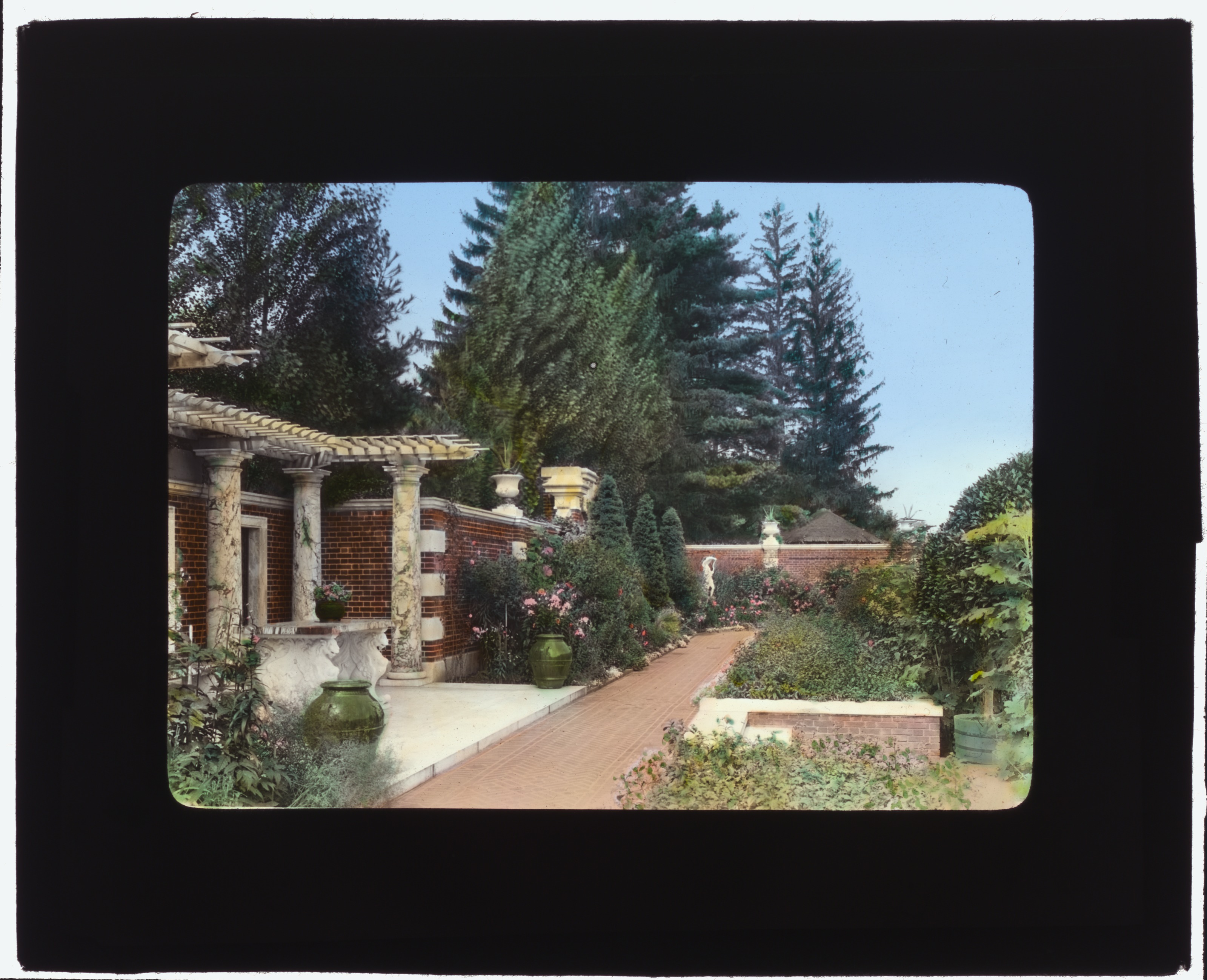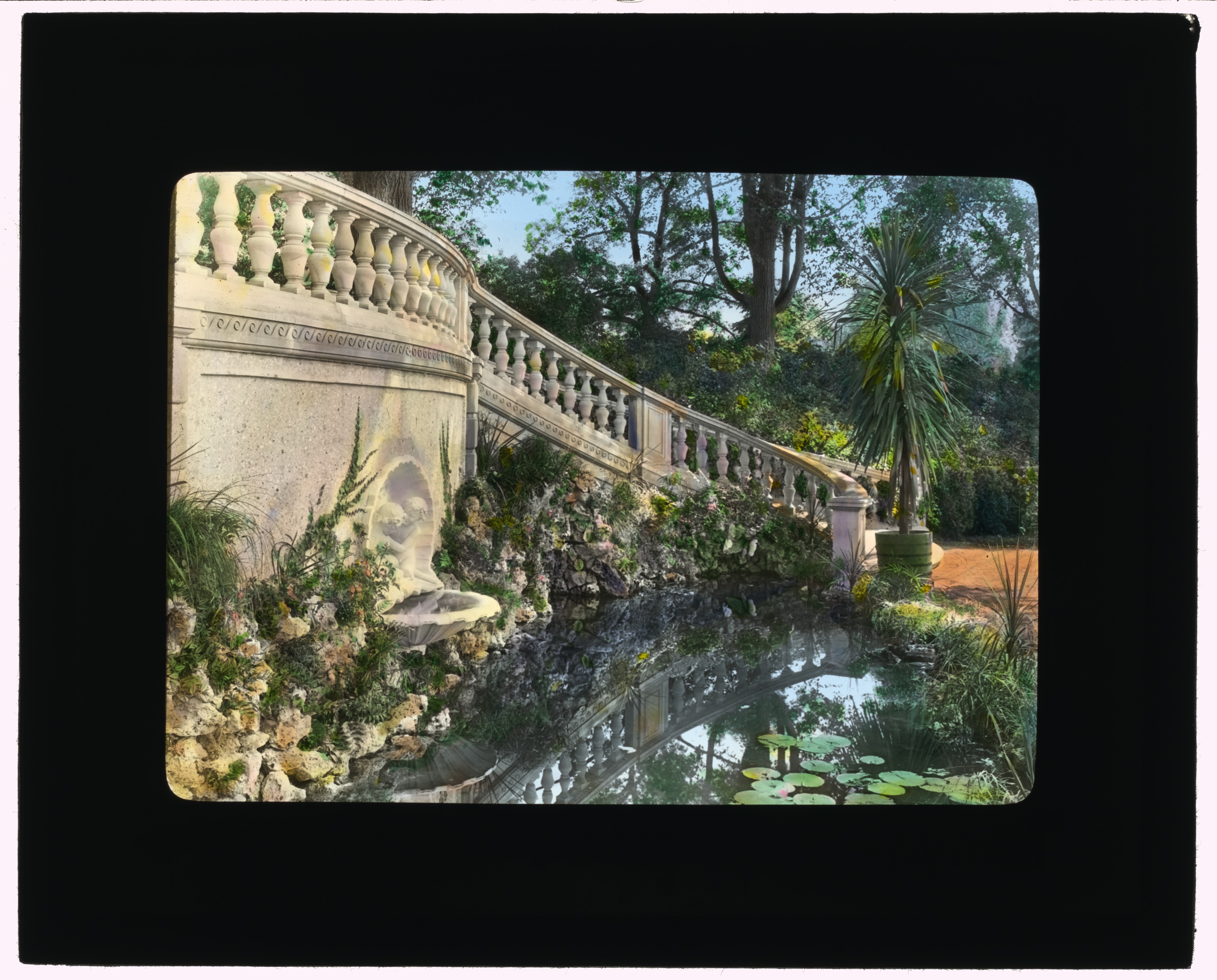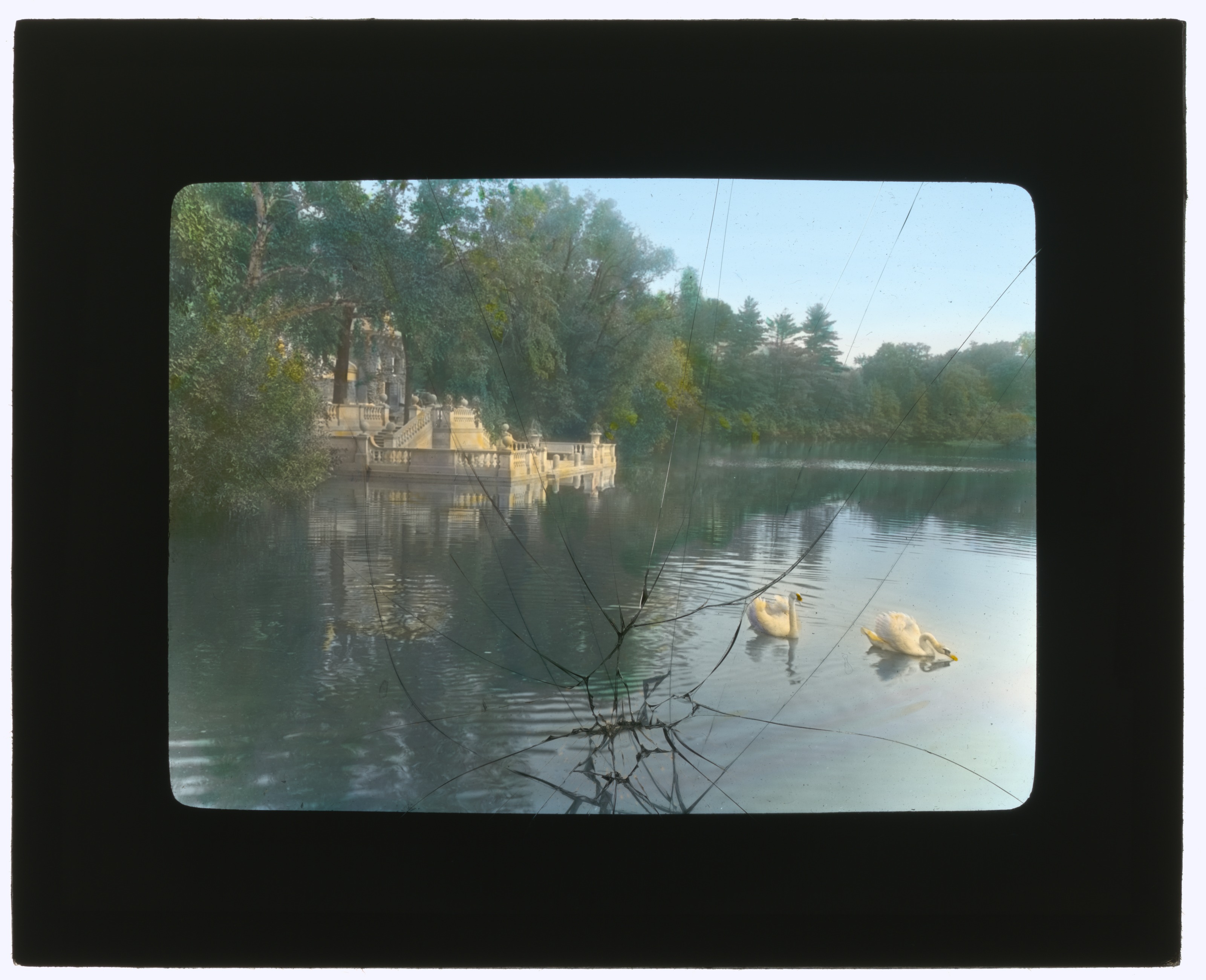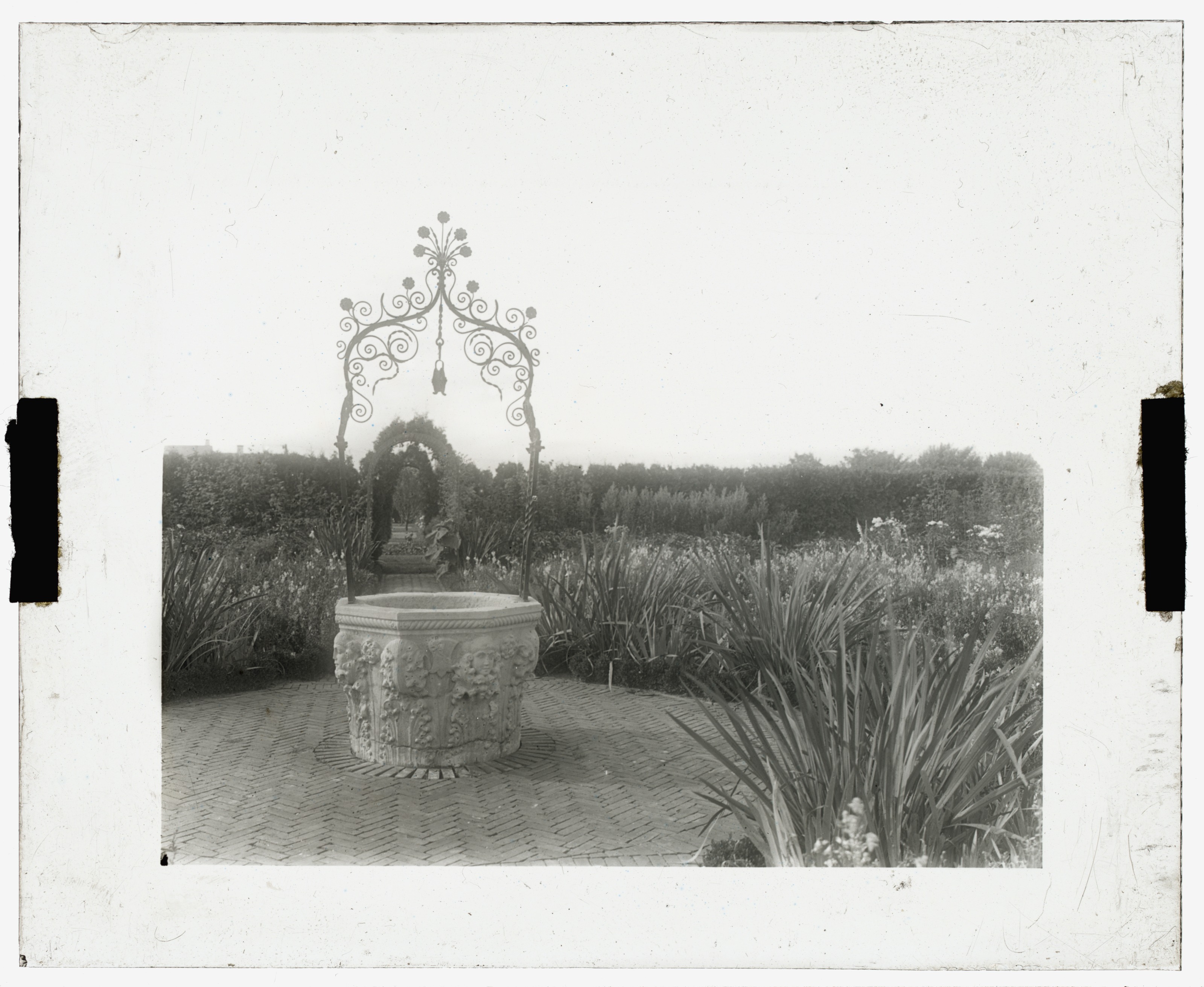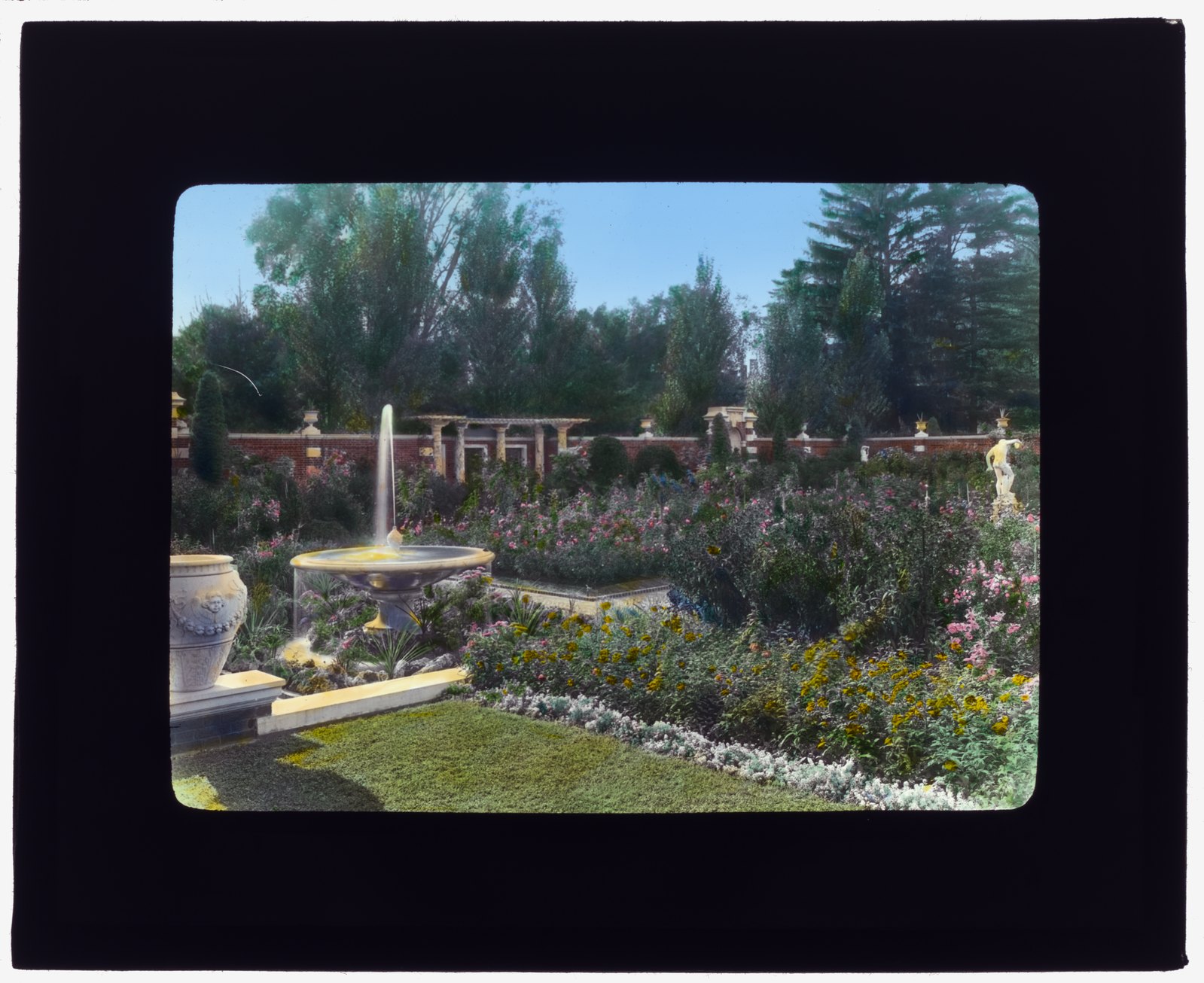
The man who lit Great Barrington’s Main Street with alternating current lost his house here to a fire in 1904, and rebuilt it out of concrete so it could not happen again. He never finished it: George Westinghouse took him to court over the patents and the money ran out. The next owner completed the house and paid a Florentine to lay out the gardens, and those gardens survive in eight hand-colored glass slides made by one of the great American photographers — which is the only reason anyone can now see what was there, because the whole thing was taken out in 1975.
I. Leavitt’s barn
The banker David Leavitt built the first Brookside in 1855, on three hundred acres bought from Daniel Wilcox. Its celebrated feature was not the house but the barn — a “cascading barn” built down through a ravine in stepped levels, an arrangement copied elsewhere in the country. Leavitt also kept a picture gallery, with works he had commissioned from Emanuel Leutze, who painted Washington Crossing the Delaware.
II. Stanley, and the fire
William Stanley bought the place in 1877 and enlarged it to six hundred acres. He was an electrical engineer, and he invented the transformer and the alternating-current circuit; his demonstration lit the main street of Great Barrington.
On 23 November 1904 the manor house burned. The report of the time says the fire “originated among bundles of kindling wood in the basement,” and that the family “had no time to dress” before getting out. Everyone got out.
Stanley’s answer was to build something that could not burn. He hired Carrère & Hastings — the firm already on this site at Bellefontaine and at Groton Place — for a fireproof Tudor house in concrete. Then the patent litigation with Westinghouse ran the money out. The house stood unfinished, and in 1908 Stanley sold.
III. Walker, and the Florentine
William H. Walker, a Kodak executive — The Berkshire Eagle credits him with inventing the pinhole camera — paid more than $250,000 for it and finished what Stanley had started: oak paneling with gilded highlights, and a two-story music room with a player pipe organ in it.
Then, in 1912, he brought in Ferruccio Vitale. Vitale was born in Florence on 5 February 1875, the son of an engineer and a countess, took an engineering degree at the Royal Military School in Modena at eighteen, and came to Washington in 1898 as military attaché to the Italian embassy. He stayed, moved to New York in 1902, went into landscape architecture, and by 1908 was a fellow of the American Society of Landscape Architects with his own partnership. Longwood, Meridian Hill Park, the Washington Monument grounds and Skylands are his. Wikipedia dates his Brookside work 1912 to 1918; and puts him back in Berkshire County in 1921 at Villa Virginia in Stockbridge — an attribution the Villa Virginia page does not accept, its own form naming a Vitalli it declines to identify with him.
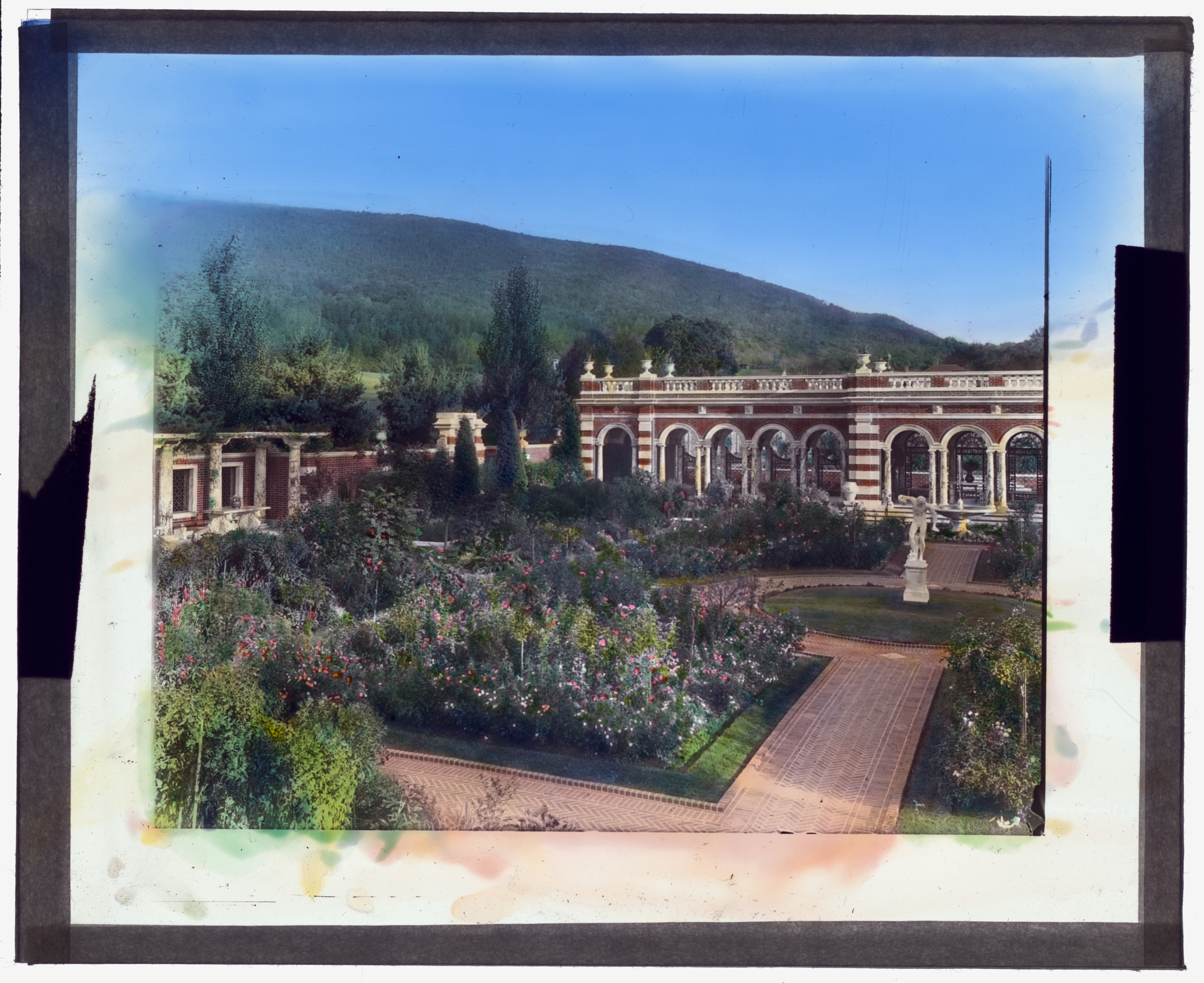
What he made here were Italian and French gardens with marble fountains and statuary. In 1915 Walker added French greenhouses at a cost of about $100,000.
IV. Eight pieces of glass
Frances Benjamin Johnston photographed Brookside about 1916, four years after Vitale began. Eight of her images of it survive at the Library of Congress as hand-colored lantern slides — glass transparencies three and a quarter by four inches, printed as positives, tinted by hand, covered with a second glass and bound at the edges with paper tape.
Johnston had 1,134 of her photographs made into slides, most of them tinted, and she lectured from them — “Our American Gardens,” “Old World Gardens” — to garden clubs, museums and horticultural societies from 1915 into the 1930s. The colorists were professionals she hired: Grace Adele Smith Anderson in Dayton, the Edward van Altena firm and T.H. McAllister-Keller in New York, William Oscar Hazard in Maryland.
So these are not documents in the sense the Olmsted drawings on this site are documents. They are a performance: color laid on by hand for projection onto a screen in a lecture hall, to show an audience what an American garden could look like. Seven of the eight are colored. The eighth, a wrought-iron well head, was left in black and white.
The gardens they show were removed in 1975.
V. After Walker
Walker died in 1917. His daughter Gertrude had the estate until 1943. In 1958 the Union for Reform Judaism bought it for $250,000 and opened Eisner Camp that summer with a hundred and seventy-three campers. The concrete house — the Manor House — is still in use for retreats, events and staff.
There is a second and larger photographic record of this place that is not shown here. The Lenox Library Association holds thirty-five glass negatives of Brookside by Edwin Hale Lincoln: twelve of the gardens in 1916, the same year as Johnston’s slides; three more from about 1925–33; and then, from about 1928–30, a family record — horses and riders, portraits of a woman and of a small boy, and a wedding, with the couple on the porch, the group, and the couple leaving by car. Digital Commonwealth gives their rights as “No known copyright restrictions” but their license as “contact host institution,” which is not the plain grant the Library attaches to its other photographs. They are not reproduced here pending that conversation.
Sources
Library of Congress, Prints and Photographs Division, Frances Benjamin Johnston Collection: items 2007685978, 2007685979, 2007685980, 2007685981, 2007685982, 2008676036, 2008676080 and 2008680107, all dated about 1916 and all carrying the rights advisory “No known restrictions on publication.” Slide titles are the Library’s. Library of Congress, “Lantern Slides for Garden and Historic House Lectures,” for the 1,134 slides, the named colorists, the lecture titles and circuit from 1915 into the 1930s, the 3¼-by-4-inch format and the method of manufacture. The Berkshire Eagle, “The Cottager: Brookside: Home of inventor rebuilt with concrete walls after 1904 fire,” for David Leavitt’s house of 1855 and the three hundred acres from Daniel Wilcox, the cascading barn, the Leutze commissions, William Stanley’s purchase in 1877 and the six hundred acres, the transformer and the alternating-current circuit and the lighting of Main Street, the fire of 23 November 1904 with the quoted account, Carrère & Hastings and the fireproof concrete house, the Westinghouse litigation and the sale of 1908, William H. Walker’s purchase at more than $250,000 and the interiors and the music room, Vitale’s gardens of 1912 and the greenhouses of 1915 at about $100,000, Walker’s death in 1917 and Gertrude Walker to 1943, the Union for Reform Judaism’s purchase in 1958 at $250,000 and the first 173 campers, and the removal of the gardens in 1975. Wikipedia, “Ferruccio Vitale,” for his birth at Florence on 5 February 1875 and death in 1933, his parents, the Modena engineering degree of 1893, the 1898 posting to Washington as military attaché, the move to New York in 1902 and Parsons & Pentecost, the partnership with Alfred Geiffert in 1908 and the ASLA fellowship, Longwood, Meridian Hill Park, the Washington Monument grounds, Red Maples and Skylands, and the dating of his Brookside work to 1912–1918 and Villa Virginia in Stockbridge to 1921. Lenox Library Association, Edwin Hale Lincoln Photographs, via Digital Commonwealth, for the thirty-five Brookside negatives described above. No Olmsted job for this estate appears on the firm’s Berkshire list.