I. The obvious source
Every story in this section has run into the same wall. The 1923–’25 directory gives a name, a street and an employer. The 1926 volume gives a name and a house. Neither gives the work, for most of the people doing it.
The United States census does. Every ten years an enumerator walked the same streets these directories were canvassed on and wrote down, for every person in every dwelling: name, relationship to the head of the household, sex, age, marital status, years married, number of children born and living, place of birth, both parents’ places of birth, year of immigration, whether naturalized, language spoken, occupation, the industry worked in, whether employer or employee, whether out of work on the day of the count, and how many weeks out of work in the previous year.
The population schedules from 1910 are public. The microfilm has been scanned and put online, and the Berkshire County reels can be read a page at a time without an account or a subscription. This story is the test.
II. Main Street, Lenox, April 1910
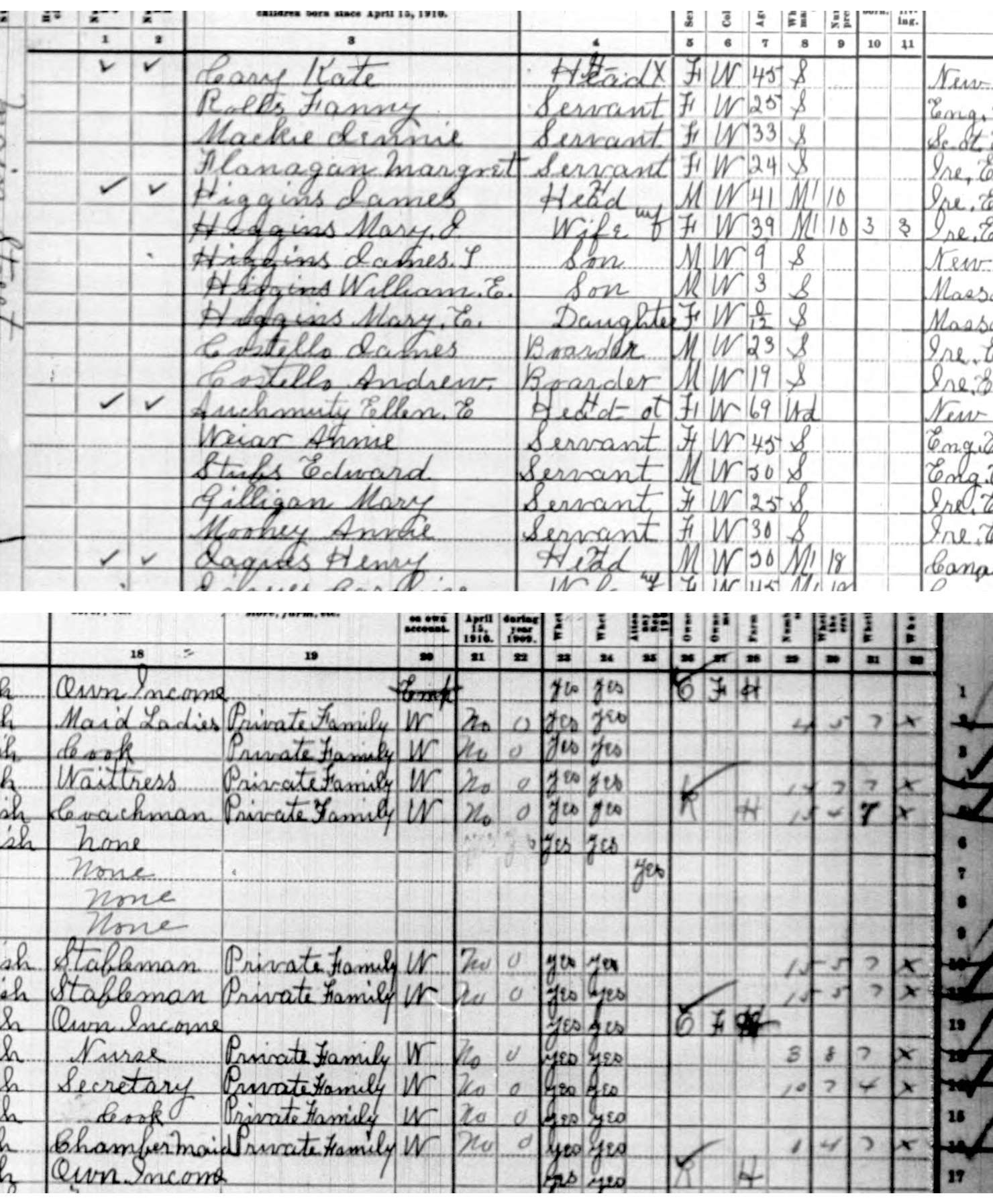
Fifteen consecutive lines from Main Street. Read them across:
1 Leary Kate, head, 45, single, New York — Own Income
2 Rolls Fanny, servant, 25, England — Maid, Ladies — Private Family
3 Mackie Jennie, servant, 33, Scotland — Cook — Private Family
4 Flanagan Margret, servant, 24, Ireland — Waitress — Private Family
5 Higgins James, head, 41, Ireland, married ten years — Coachman — Private Family
10 Costello James, boarder, 23, Ireland — Stableman — Private Family
11 Costello Andrew, boarder, 19, Ireland — Stableman — Private Family
12 Auchmuty Ellen E., head, 69, widowed, New York — Own Income
13 Weiar Annie, servant, 45, England — Nurse — Private Family
14 Stubs Edward, servant, 50, England — Secretary — Private Family
15 Gilligan Mary, servant, 25, Ireland — Cook — Private Family
16 Mooney Annie, servant, 30, Ireland — Chambermaid — Private Family
Maid, cook, waitress, chambermaid, nurse, secretary, stableman, coachman. Eight indoor and stable occupations on one page — and the household story exists because none of those words appear beside a Lenox name anywhere in the directories.
Mrs Auchmuty is the test case that closes the argument. She appears in the 1926 directory as an employer three times over — Francois LeGoff, gardener, emp Mrs. R. T. Auchmuty; John Quiniou, emp Mrs. Auchmuty; Francis R. Gorman, emp Mrs. Auchmuty — three men, outdoors, two of them with no trade printed. The census gives her four indoor servants, named, and what each of them did.
The two sources do not overlap. They are the two halves of one staff. The directory sees the men who came in from the village. The census sees the people who slept in the house.
And line 5 deserves its own sentence. Higgins James, coachman, private family, 41, born Ireland, with a wife, three children and two stablemen boarding with him. In 1910. The Pittsfield series puts the crossover from coachman to chauffeur in 1911. This is a working Berkshire coachman, named, in the last year before the line crosses.
III. The Chagues, sixteen years early
The Elm Court story follows Alphonse Chague from a trade-less line in 1926 to gardener in 1929 to superintendent of the place from 1935 to at least 1948. The census supplies the part that came before.
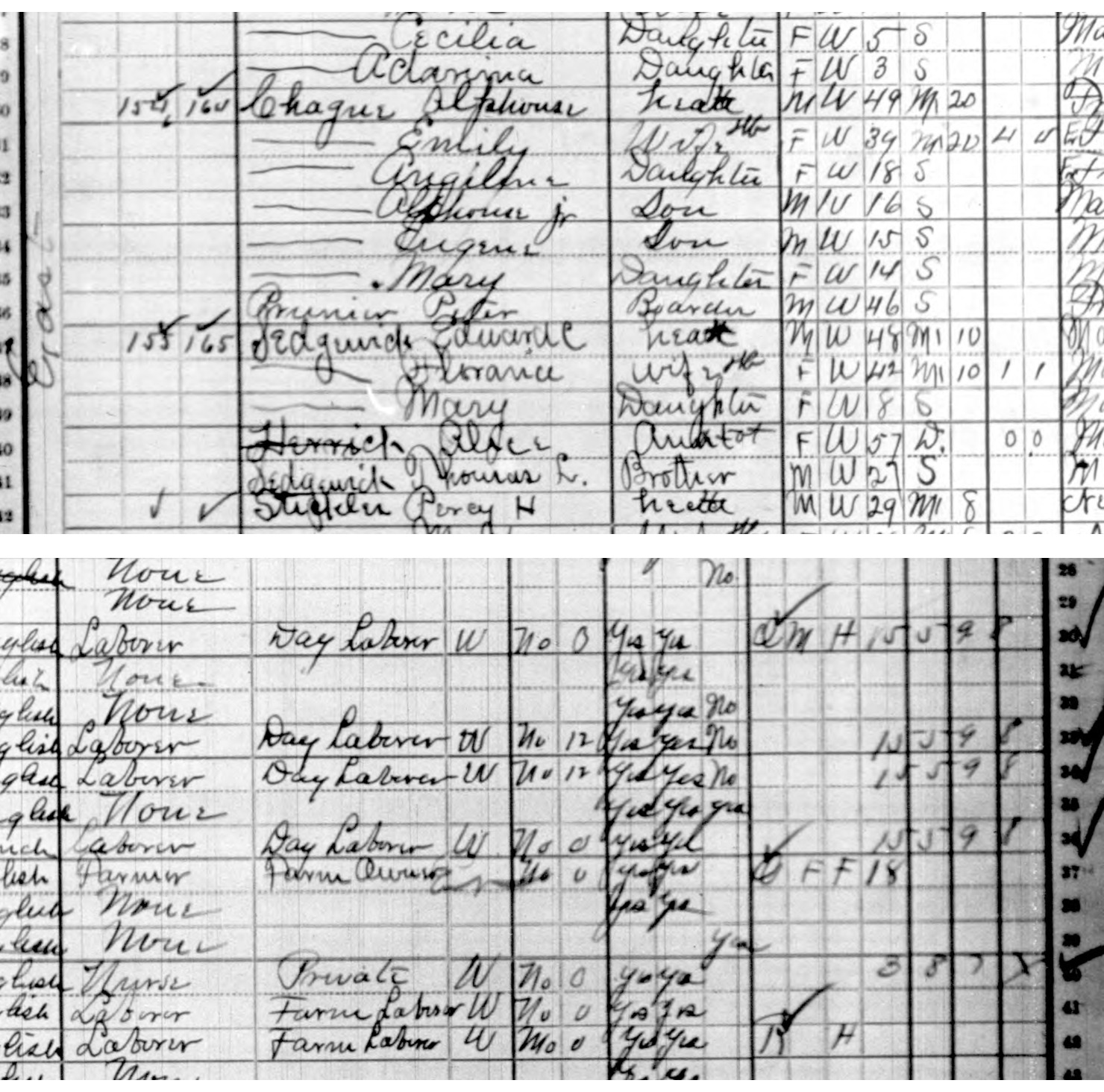
30 Chague Alphonse, head, 49, France, married 20 years — Laborer — Day Laborer
31 Emily, wife, 39, France
32 Angelina, daughter, 18, born France
33 Alphonse jr., son, 16, born Massachusetts — Laborer — Day Laborer — 12 weeks out of work
34 Eugene, son, 15, born Massachusetts — Laborer — Day Laborer — 12 weeks out of work
35 Mary, daughter, 14
36 Prunier Peter, boarder, 46, France — Laborer — Day Laborer
Four things fall out of seven lines.
The eldest daughter was born in France and the eldest son in Massachusetts, which puts the family’s arrival between her birth and his — a window of about two years in the early 1890s, fixed without a ship’s manifest.
And then column 15 settles it outright. Year of immigration to the United States: 1892, written against the father, the mother and the daughter alike. The birthplaces bracket the year; the column states it.
Alphonse junior is sixteen. Eugene is fifteen. Both of them are already out at day labor, and both are recorded as having had no work for twelve weeks of 1909. That is a quarter of a year, for two boys, in the same house.
There is a French boarder in the house, at day labor too — the same arrangement the 1926 book shows at Four Corners in Lenox Dale, sixteen years earlier and under one roof.
And the man who would run Elm Court was a casual laborer at sixteen. Nothing in any directory would ever have told us that.
IV. April, not August
The form says it at the top of every sheet: each person whose place of abode on April 15, 1910. Hold that against what these houses were.
The Berkshire cottages were summer houses. On the fifteenth of April the season had not begun — the owners were in New York, the houses were shut or held by a caretaking staff, and the servants who came up with the family in June were not in Lenox at all. So the schedule does not contain what you would expect it to contain. Reading the relation column of eighty-three consecutive sheets, looking for runs of the word Servant, the longest run in the town is not a house.
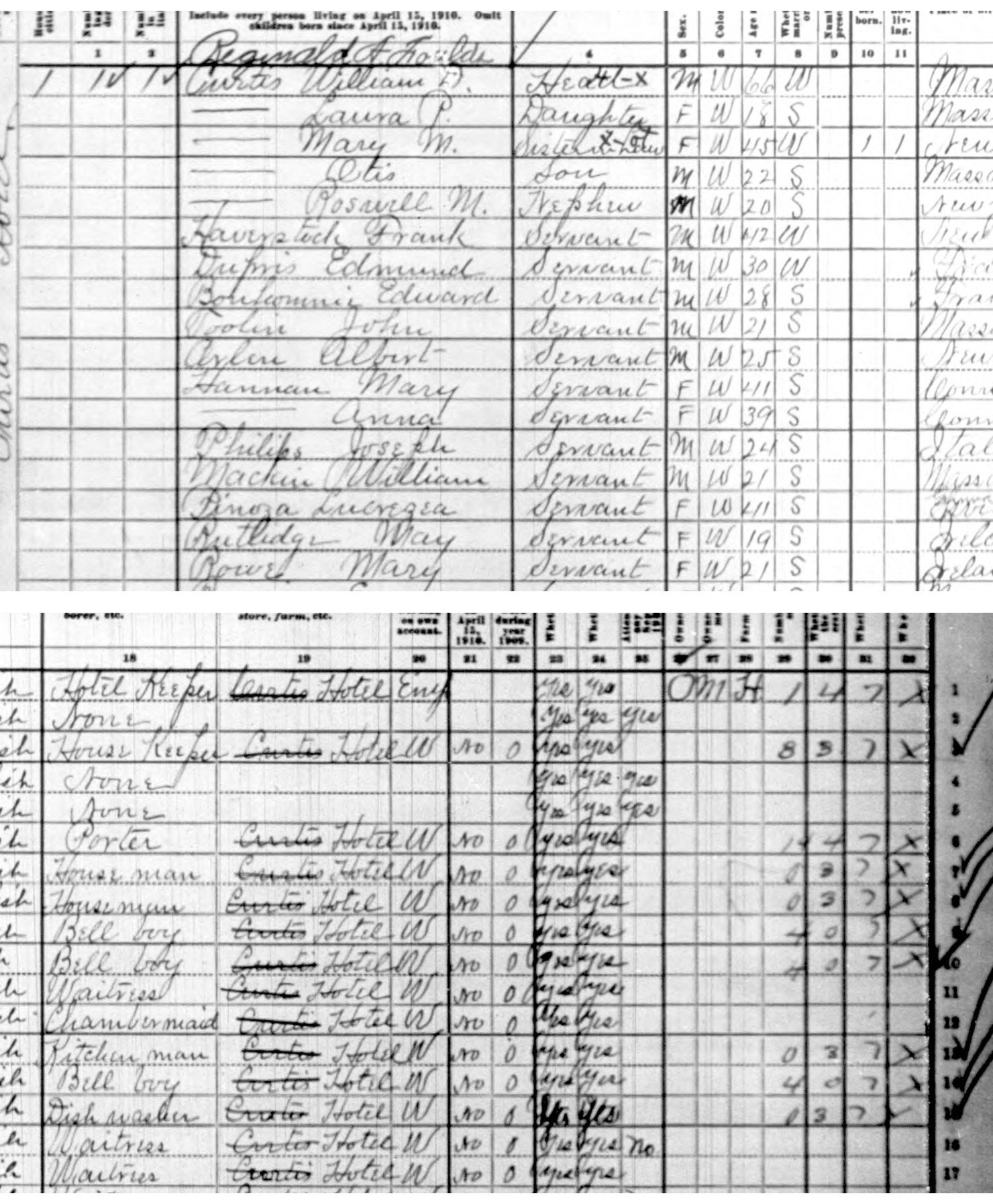
It is the Curtis Hotel. Curtis William D., head, 66, hotel keeper, Curtis Hotel, Employer, with his daughter Laura, his sister-in-law Mary as housekeeper, his son Otis and his nephew Rosswell — and then about thirty people entered as servants and given, one by one, the job they did: porter, two housemen, three bell boys, six waitresses, four chambermaids, a kitchen man, two kitchen girls, two pastry cooks, a dish washer, a laundress, a cook, a chauffeur.
After the staff come the guests. The Lindseys of Virginia, five of them down to a four-year-old; Anna Bradford of New York, seventy-six; Robert Rockwell, sixty-one, a retired journalist. And two women entered in the relation column as Guest whose occupation is given as:
Ladies Maid — With Family
Anna Hignet, fifty-three, born England, and Jessie Mitchell, thirty-one, born Scotland. Traveling servants, staying in a hotel with the family they work for, recorded as guests and caught only because the form asks a second question. No directory would ever have found them: they were not residents of anywhere in Berkshire County.
Two households further on there is something else the directories never record. Bourne George F., head, 51 — Post Master, with his wife Grace, and with them Vosburg Minnie, servant, 31, cook, private family, born Massachusetts, entered in the color column as B. She is the only Black worker this survey has so far found named anywhere in Lenox, and the column that names her does not exist in any directory on this site.
So the date cuts both ways. The 1910 census gives Lenox’s winter establishment — the people who were there in April, which is to say the year-round staff, the hotel, the village. The summer house at its full complement is not in it. The directories, canvassed for a book sold by the year, catch some of what the census misses, and the census catches what no directory asked.
V. What the census will and will not do
It is worth being exact about this, because the temptation is to treat the census as a better directory. It is not; it is a different instrument.
It does not name the employer. Column 19 asks for the nature of the industry, and for domestic service the answer is always Private Family. A servant is tied to a particular house only by the household she is enumerated in — so you get the employer when the staff lived in, and you get nothing when they lived out.
It is organized by dwelling, not by name. There is no alphabet. To find a person you find the street, and to find the street you read the schedule. The handwriting is legible and the sheets are not indexed by any means this site has used.
It catches everybody. Women, children, boarders, the unemployed, the people with no trade and no property — all the categories the directories thin out or drop. Six of the twelve people quoted in section II are women in service, and every one of them has an occupation printed.
It is ten years apart. 1900, 1910, 1920 — and then a gap, because the 1930 and 1940 schedules are a separate matter and the 1950 release is later still. Against a directory published every three or four years, the census is a set of deep soundings rather than a continuous line.
VI. What this opens
Everything this section has said about the record being silent needs qualifying, and the qualification is large.
The record is silent in the directories. In the census it is not silent at all: for 1900, 1910 and 1920, every indoor servant in Lenox and Stockbridge is named, aged, placed and given an occupation, inside the household that employed her. The great houses can be read staff by staff. The coachman-to-chauffeur transition can be watched household by household instead of as a county total. The French and Breton crews around Lenox Dale can be dated to their arrival. And the people the directories reduce to emp and a street get a trade at last.
Three soundings, ten years apart, of a workforce this site has so far only been able to count.
It is a large job and it has not been done here. What has been done is the test, on two pages, and the test passed.
Both plates from the Thirteenth Census of the United States, 1910: Population, Massachusetts, Berkshire County, town of Lenox, National Archives microfilm publication T624, reel 572, digitised by the Internet Archive and free to read. Section II is sheet 20A, the supplementary schedule of enumeration district 42, Main Street; section III is dwelling 154, family 164, on sheet 10A of enumeration district 43. Occupations are read from columns 18 and 19 and matched to names by the printed line numbers in the right margin, which appear in both halves of each plate. Entries are given as written, including “Rolls,” “Weiar,” “Stubs” and “Margret.” The Auchmuty employees of 1926 are from the Lenox section of the Central Berkshire County Directory, 1926. Section IV is sheet 1A of enumeration district 43, the first household of that district, read from the same reel; the relation column of eighty-three consecutive sheets was scanned to establish that it holds the town’s longest run of servants. No attempt has been made here to transcribe a whole enumeration district; the pages shown are a test of the source, not a survey of it.