I. Page 590
Start with a sheet of paper. The 1790 federal census of Stockbridge, page 590, in the enumerator’s own hand, with a pencil arrow somebody added much later pointing at one line.
The line says Samuel Jerome. Two free white males sixteen and over, three free white females. Directly above him, another Jerome household. Directly below, joined to Samuel’s entry by a hand-drawn brace, Lois Callender — his daughter, who married Ezekiel Callender of Sheffield. The brace is the marriage, drawn by a census taker who knew the household well enough not to need to explain it.
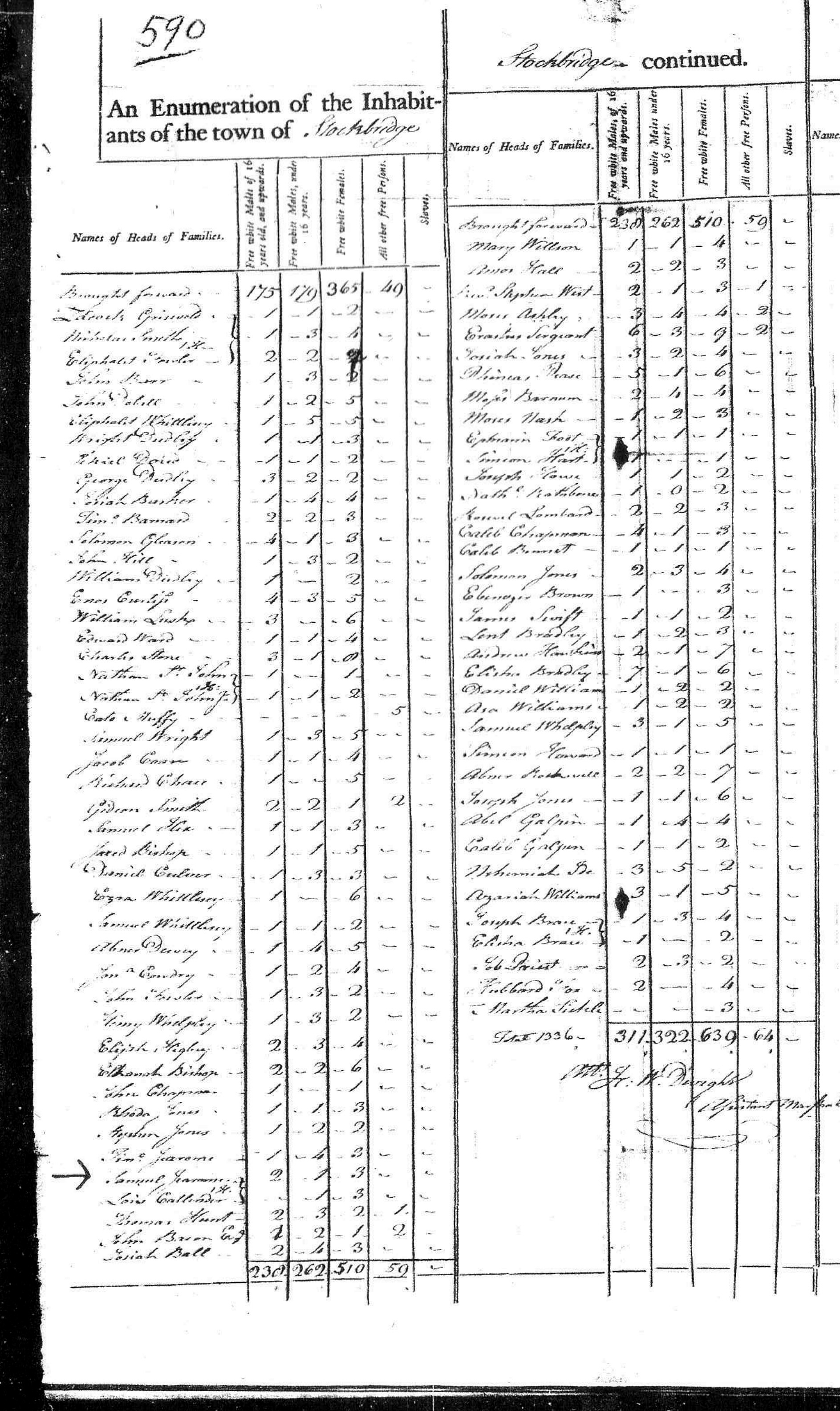
Read down the column and you are reading the neighbors. Henry Woolsey. Ithamar Bishop. Thomas Chapman. Rhoda Jones. Freedom Jones. Thomas Hunt. John Brown, Esq. Josiah Ball. In the facing column, Rev’d Stephen West, who held the Stockbridge pulpit after Jonathan Edwards, and Erastus Sergeant, the town’s physician and a son of the missionary John Sergeant.
The foot of the sheet carries the town total, 1,336 people: 311 free white males of sixteen and upward, 322 under sixteen, 639 free white females, and 64 under the heading all other free Persons. There is a sixth column, headed Slaves, and the enumerator has drawn a dash in it on every line of the sheet — not left it blank, marked it, household after household, in the only way the form gave him to write none.
He was filling in a federal form. Congress fixed the six questions in March 1790 and Massachusetts, alone among the states, used uniform printed schedules — paid for by its own marshal, whatever that state’s law was. Massachusetts had settled it in the early 1780s, when a Great Barrington jury heard Brom and Bett v. Ashley and freed Elizabeth Freeman — who had asked a Sheffield lawyer named Theodore Sedgwick to bring the case. She is buried about a mile from where this page was written, inside the family circle the town calls the Sedgwick Pie.
These, then, are the Jeromes’ contemporaries: the minister, the doctor, free Black households, a hillside of farmers, and a town that had just finished arguing the thing out in court. The names above are read off a photocopy and several are uncertain; and this is one sheet of Stockbridge, not the whole town, so Sedgwick himself, Freeman and Agrippa Hull would be on the pages either side of it.
II. The Jeromes, and the man who brought racing to America
Samuel Jerome came from Wallingford, Connecticut, and moved his family to Stockbridge in the early 1770s. He had fourteen children. He and his sons enlisted into the Revolution from here, and two of the youngest, Chauncey and Amasa, were baptized in this town in 1774 and 1775. The main house on Prospect Hill goes up somewhere in the 1760s or 1770s — the family’s papers and the family’s memory give different years and no deed has been pulled — and Aaron Jerome (1764–1802) had it on his father’s death.
Follow Aaron forward through his son Isaac and you arrive at Leonard Walter Jerome, born at Pompey, New York in 1817, died at Brighton, England in 1891: the Wall Street speculator who built Jerome Park, founded the American Jockey Club, and is a large part of the reason thoroughbred racing in America looks the way it does. His daughter Jennie, born in Brooklyn in 1854, married in Paris in 1874, died in Paddington in 1921, was Lady Randolph Churchill. Winston was her son.
So the horses are there at the beginning, in the blood of the family that built the house, two generations before anyone raced one on this hill.
III. Edge-Hill Farm, and a stallion named after a publisher
In the autumn of 1873 a notice ran over the name HENRY W. T. MALI, EDGE-HILL FARM, Near Stockbridge, Berkshire County, Mass. Applications to himself or to his superintendent, William J. Mallory. The subject was a horse.
The remarkable time of 2.30¼, made by Robert Bonner, at the close of his summer season, while taking his exercise on my half mile track, in the presence of over 200 people, six watches being held over him, makes him THE BEST STALLION IN Western Massachusetts, and one of the best in the country.
Robert Bonner was a bright golden bay with black points, 15.3 hands, 1,150 pounds, foaled in 1860, by Rysdyk’s Hambletonian out of a Long Island Black Hawk mare, grand-dam by old Abdallah. He stood at $100 the season and $200 to insure. Mali opened his book for twenty mares in 1873 and fifty in 1874, and advertised a second stallion, Americus, sixteen hands, at fifty dollars. The 1874 notice claims him as the only direct son of Rysdyk’s Hambletonian standing in the southern half of Berkshire County — which is to say the best trotting blood in America, standing on Prospect Hill.
Two hundred people came up this hill on an afternoon in 1873 to watch a horse go a half mile, and six of them held watches on him. That is the farm at its loudest.
The horse was named for Robert Bonner of the New York Ledger, the publisher who bought the fastest trotters in the country and refused on principle to race them for money. His name went onto a Berkshire stallion and has stayed in this house for a hundred and fifty years.
Mali built a breeding barn, which burned, and a small track across the road — in the field by the Bonnie Brier house, as the family places it. He held Edge-Hill through the middle 1870s. Babcock followed, and held it to the turn of the century; the 1904 atlas still letters Mrs. J. A. Babcock on two parcels on the road to Lenox, three years after she had sold, because county atlases run behind.
IV. 1901: the man who left Williamstown over a road
The first question about the Procters is why a Cincinnati soap family was in Massachusetts at all. The answer is that they were not, really. They were in New York, where the money went in the second half of the nineteenth century — and New York in July was unendurable.
New York was horrible in the summertime. And when you think about the manure, et cetera, that landed on the streets every day — no air conditioning, no electric, no nothing. And they decided that there should be a better place, as their socially acceptable friends had, and bought land in the Berkshires so they could come out for the fresh air.
That is the Berkshire cottage era in one sentence, and it is not often put that plainly. The usual account is mountain air, Italian gardens, the season, the architects. The engine underneath it was the stench. The streets of Manhattan carried the traffic of a city that ran on horses, what the horses left could not be carted off fast enough, and in August it was in every room with a window open. People who could leave, left. The Stokeses went to Shadow Brook, the Sloanes to Elm Court, the Westinghouses to Erskine Park. The Procters came out for the air like everyone else — and landed first in Williamstown, where Harley Thomas Procter kept horses and did not care for the roads.
Harley Thomas Procter was born in Cincinnati on 1 December 1847 and joined his father’s firm in 1868. Sitting in church one Sunday he heard the forty-fifth Psalm — all thy garments smell of myrrh, and aloes, and cassia, out of the ivory palaces — and came away with the name of a soap. He took the chemists’ purity reports, averaged them, and printed the result on the wrapper: 99 and 44/100 percent pure. Inside twenty years he had made Ivory the best-known brand in America, and he retired from business at forty-five.
Then he lived in Paris, London and Egypt — and in Williamstown.
He liked speed. I think after church he and his friends would race home, telling people that they were in a hurry because they had guests and the sermon had gone too long. So he offered Williamstown money to macadamize the roads, and they said, no thank you, Mr. Procter. We really don’t want to be beholden to you. So he got in a huff and he moved to Lenox.
There is a document under that story. The 1904 atlas letters ORLETON FIELDS — H. T. Proctor across an estate in Williamstown, with further Proctor parcels on four separate plates of that town. He was there, at scale, and he called the place Orleton. (Procter has been written with an o for the better part of two hundred years — by this atlas, by both Berkshire directories, and by most people since. The search on this site treats the two spellings as one word: type either and you get everything.)
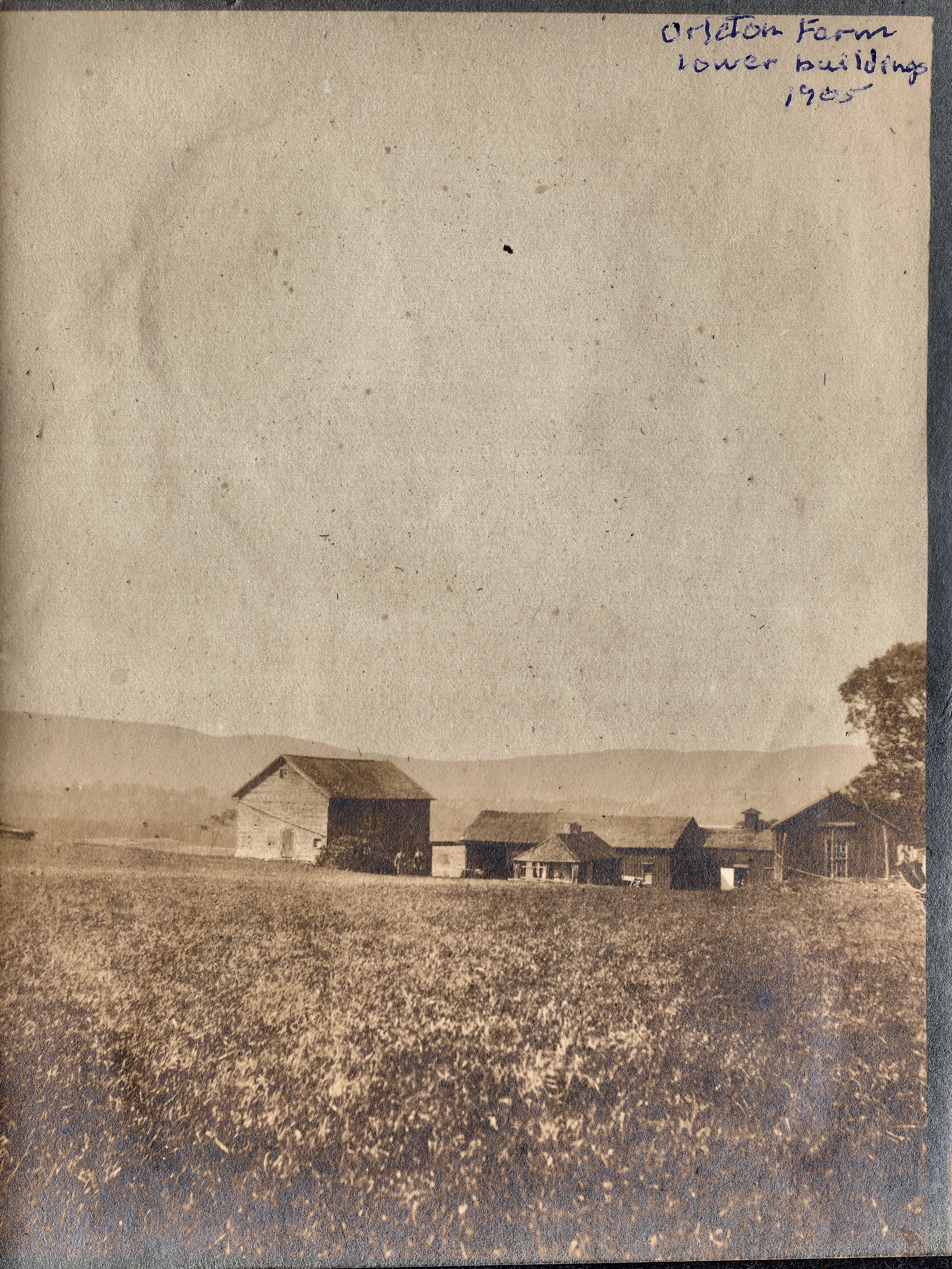
He called the next one Orleton too. A print in his album is captioned, in ink, Orleton Farm, lower buildings, 1905. And in 1912 he built a house on Walker Street in Lenox and named that Orleton as well; it has been an inn since 1937, under the name The Gateways. Orleton is a village in Herefordshire, which is where the family came from. He did not name a house after it. He named every house after it.
The three places worked as one establishment. The Lenox house was where you lived; the Stockbridge farm is what fed it.
This was the farm that produced all of the produce for that … They farmed it with horses. They moved to Florida for the winters. They all got on the train. They spent the summers here.
V. The names repeat
Three generations of this family reuse the same four or five names, and so do the families they marry into, so it is worth setting them out once.
The Procters. The firm was founded in Cincinnati in 1837 by William Procter, an English candlemaker, and James Gamble, an Irish soapmaker, who had married two of Alexander Norris’s daughters — Olivia and Ann — and were pushed into partnership by their father-in-law. The family tells it with more mischief: two young men who had watched their mothers work, making soap and candles for a landlady who was bad at both, and selling them round town out of a little red wagon.
- William Procter (1801–1884), the founder.
- Harley Thomas Procter (1847–1920), the founder’s son. Named Ivory; bought this farm.
- Harley Sanford Procter (1871–1872), Harley Thomas’s first child, who lived a year.
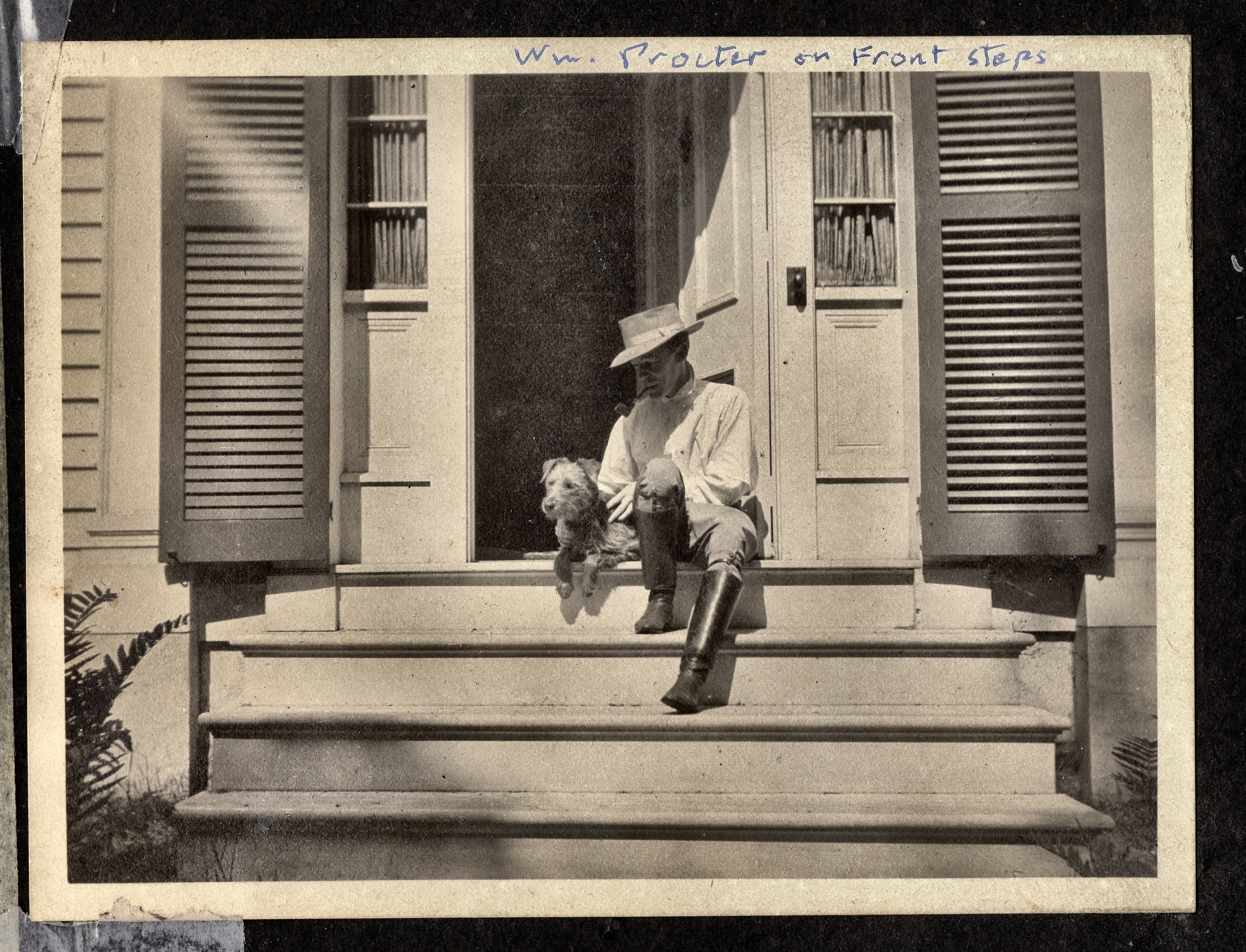
- William Procter (1872–1951), his son, listed with his wife Emily at Orleton Farm in the 1923–’25 and 1926 directories, and the man captioned Wm. Procter on front steps in the album.
- Lillian Sanford Procter (1875–1967), his daughter, of Williamstown. The family holds that she was the first woman in the United States to cast a vote.
- Rodney Procter (1878–1957), his son. The man raking hay in July 1906.
- William Cooper Procter (1862–1934), the founder’s grandson, who ran the company in Cincinnati. A cousin, not of this house.
There was also a brother who settled in Maine and spent his life on birds and insects.
The Stokeses. Anson Phelps Stokes (1838–1913), the Phelps Dodge banker, built Shadow Brook on the far side of Stockbridge Bowl in 1893: a hundred rooms, a four-hundred-and-ten-foot front, briefly the largest private house in the United States. His son, Anson Phelps Stokes Jr., was secretary of Yale. His grandson, Anson Phelps Stokes III (1905–1986), became the eleventh Bishop of the Episcopal Diocese of Massachusetts — and married Hope Procter of this farm.
The Frelinghuysens. Hope’s sister, Beatrice Sterling Procter (1919–1996), married Peter Hood Ballantine Frelinghuysen II (1916–2011) in 1940. The middle names are the money. Peter Ballantine’s brewery in Newark, P. Ballantine & Sons, was at its peak the fourth largest in the United States; a Frelinghuysen married a Ballantine granddaughter in 1881, went to work there as a patent lawyer and ended up running it. Behind that sits a second fortune, George Griswold’s, made in New York in the China clipper trade. The name itself carried something else again — a New Jersey political line reaching back to the Continental Congress, to which Beatrice’s husband added a seat in Congress and his son added another. They hold the land beside the farm and the land across the road, inherited from these same grandparents, and the Frelinghuysen Morris House in Lenox is a first cousin’s.
VI. Rodney wanted to run the farm
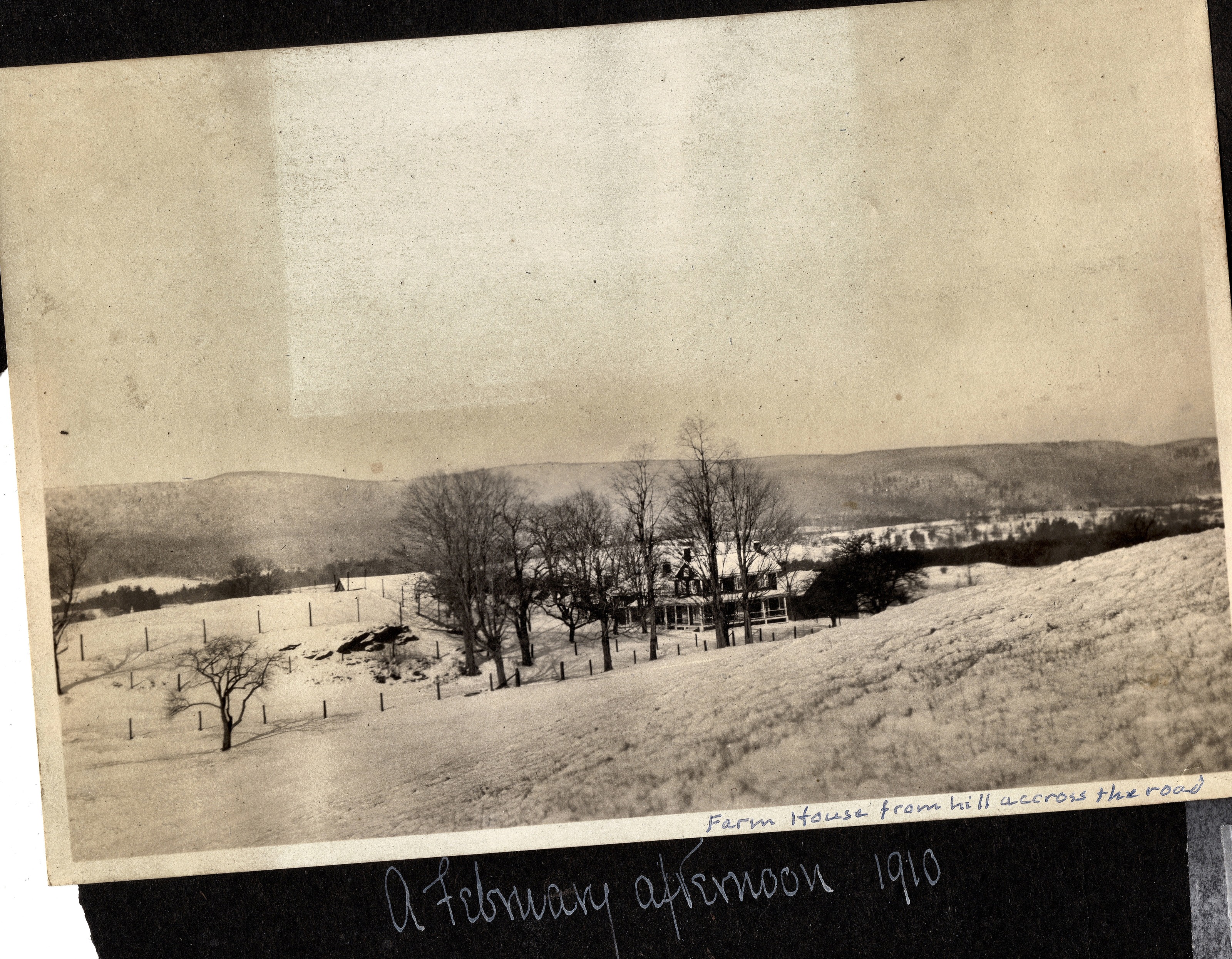
Harley Thomas Procter bought the place in 1901 and found it in poor condition — an awful sort of green-gray, as his great-granddaughter describes the paint, the barns no better. She has since found pieces of the original color in the fabric of the house.
He had the money of a man who retired at forty-five from the most profitable soap company in the world. What happened next is the whole point of this story.
Rodney wanted to run the farm, and he took it over.
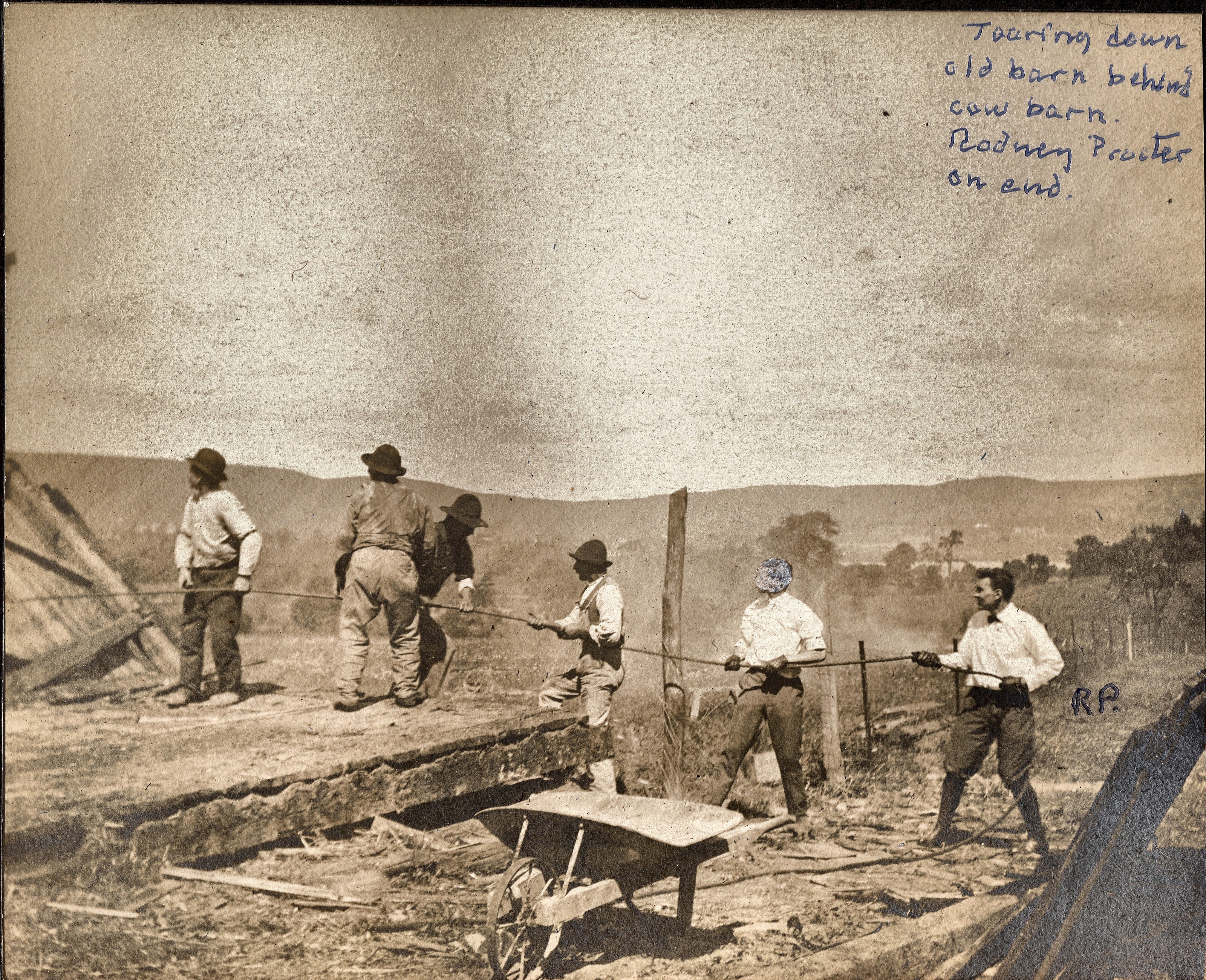
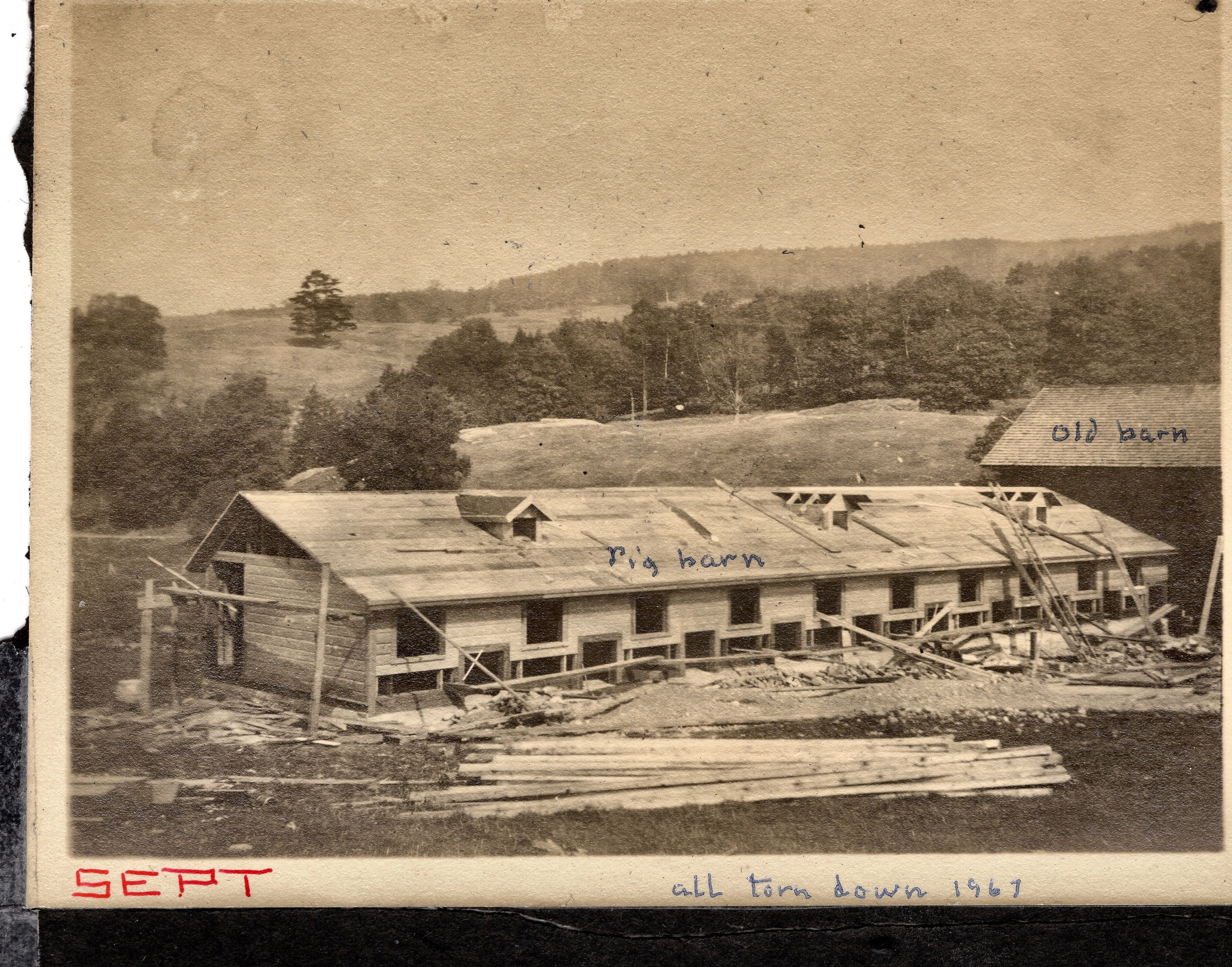
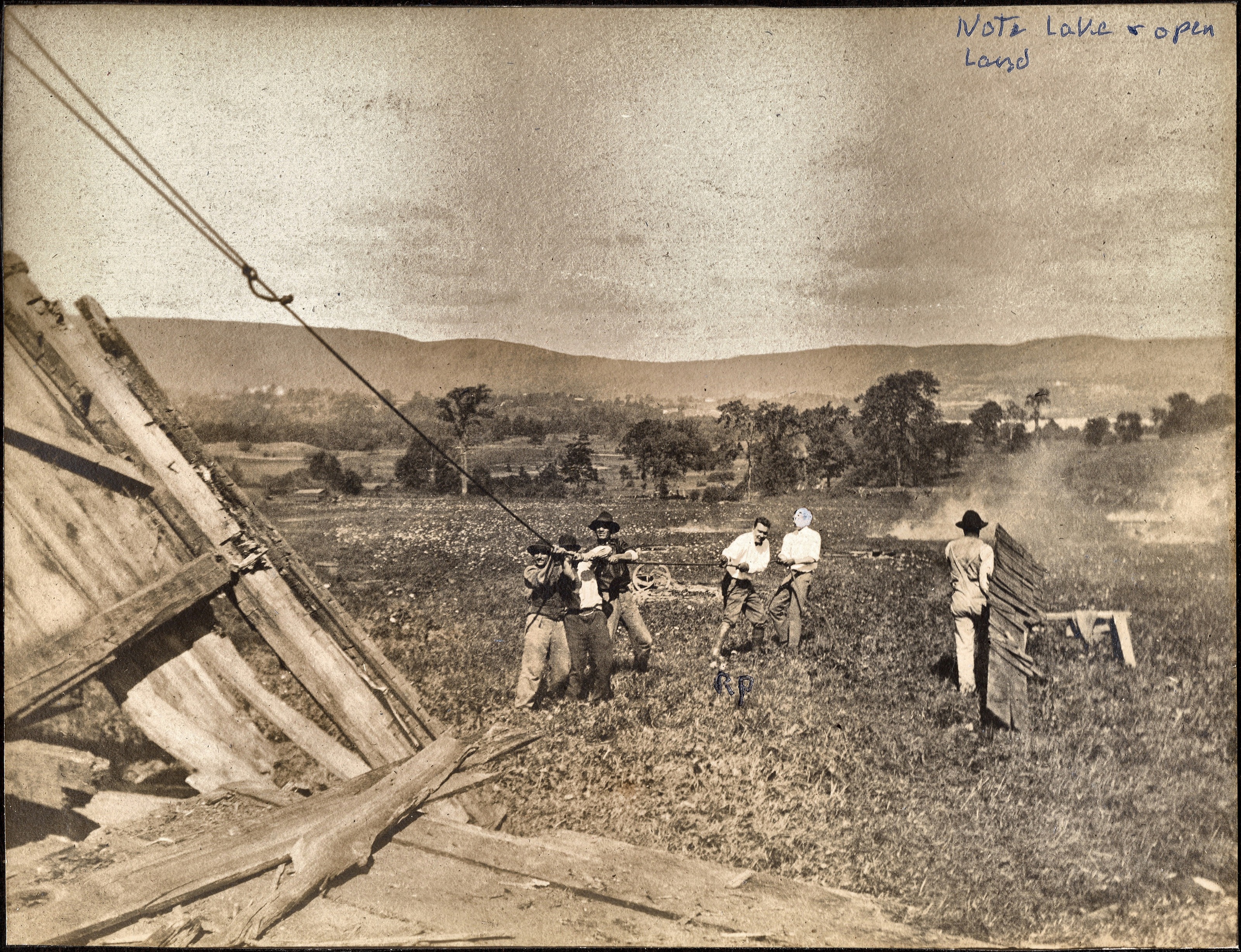
The album is the record of a man doing exactly that, and it is dated to the month. Oct. 1905. Labor Day. 1908. Nov. ’08 and Sept. ’08, on red rubber stamps on the mounts. End of box stall barn with outhouse. First birch tree of row north of barn. 1905. Tearing down old barn behind cow barn. Rodney Procter on end — and in the photograph one of the men standing on the wreck is initialed RP. Pig barn being built. Behind cow barn. Breaking the road in front of house, two oxen leading and two horses at the roller.
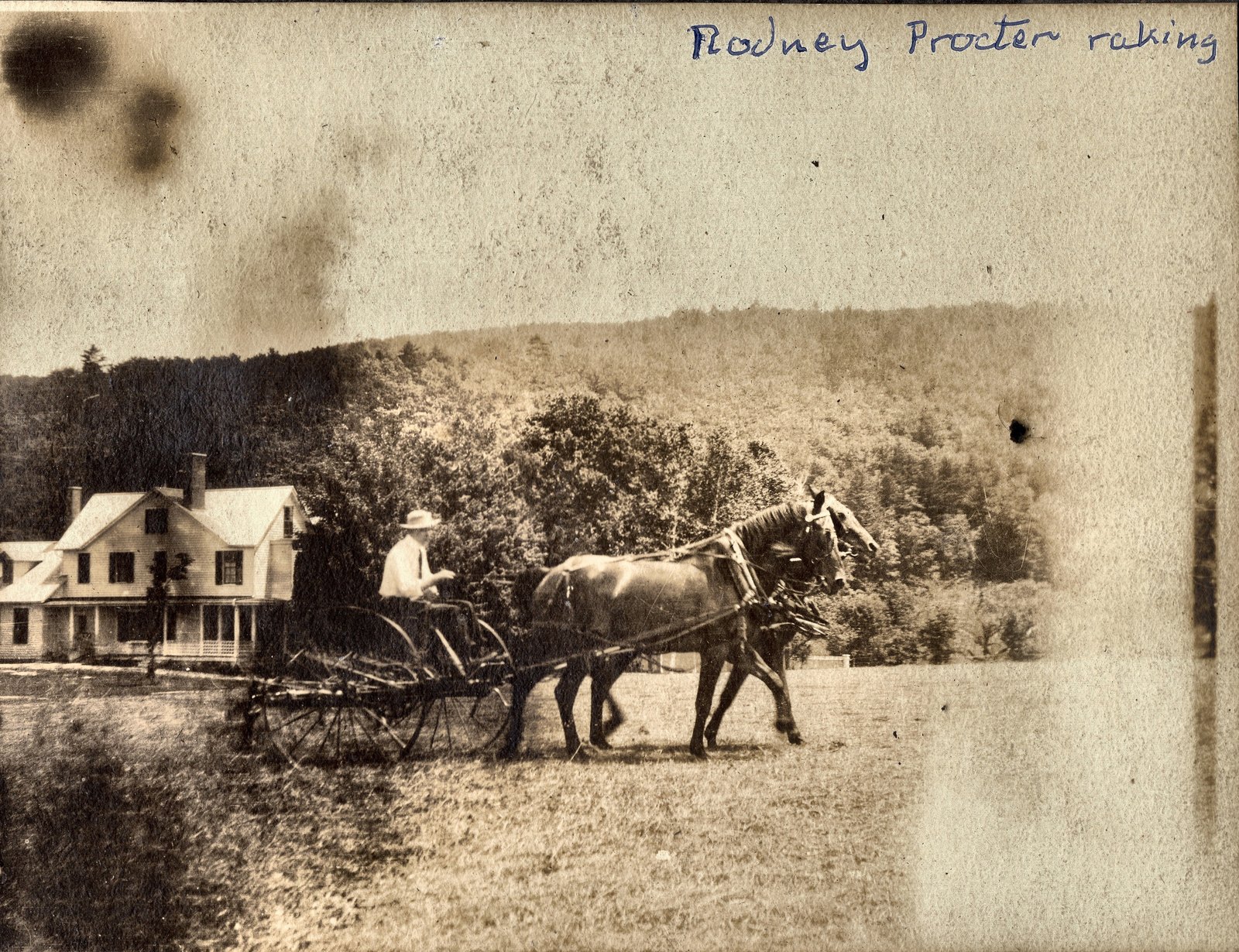
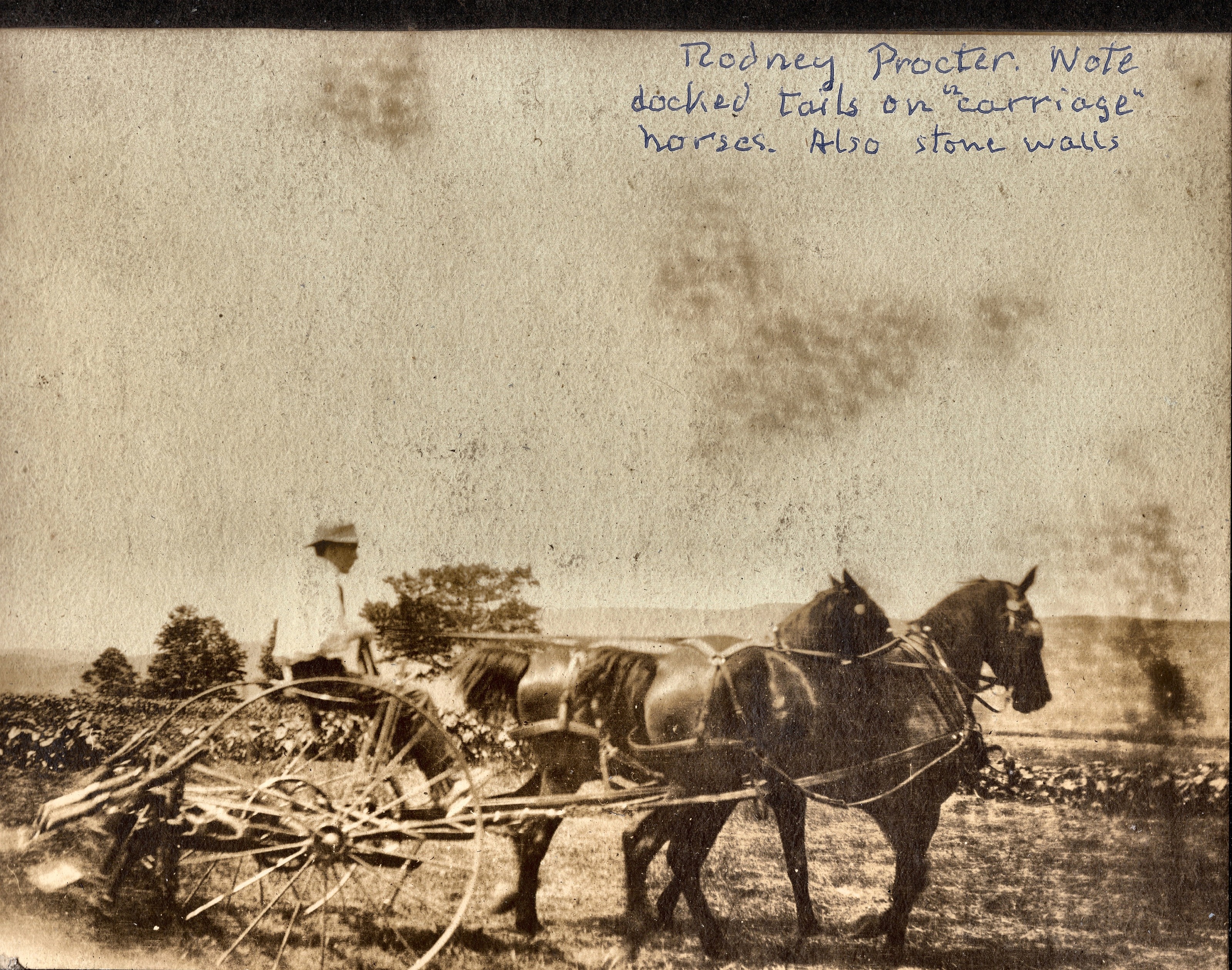
And in July 1906, twice: Rodney Procter. Note docked tails on carriage horses. Also stone walls. And Rodney Procter raking — a team, a man, a hayfield, the house behind.
Count the fortunes these people were heirs to. Rodney Procter had the soap. His daughters married into three more — Phelps Dodge on one side; on the other, Peter Ballantine’s brewery and George Griswold’s China-trade merchant house. And here they are, tending the pigs and the sheep and the horses.
Then the farm starts losing buildings, and a second hand writes it onto the same pages decades later. 1916, and a long note: the barn that burned, which stood along the road to the farm house and covered the vegetable garden. Chicken house. Later (1931) moved down near stables. All torn down 1961. 1974 many barns gone. Torn down or burned. Note present stables (1974) in background. A construction album turned into an inventory of what was lost, kept by someone who was there for both halves of it.
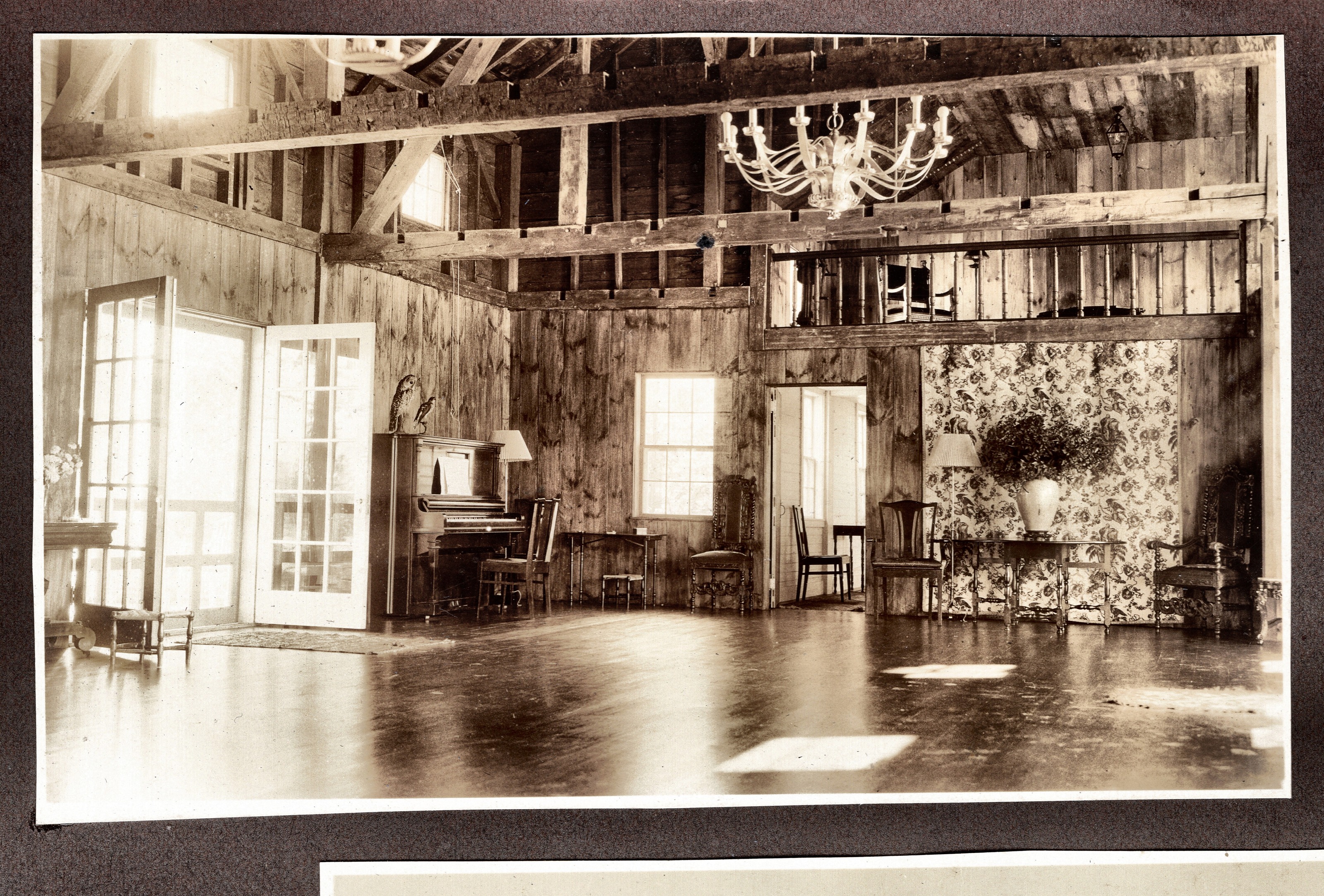
One barn did not come down. It became a hall, with French doors and a chandelier under the old framing, and the family calls it what it was — a dowry, for a daughter’s wedding.
VII. Across the Bowl
From these hayfields you could once see Shadow Brook. Not the roof of it — the whole house, four hundred feet of front, across open water and open land, because the hills had been cut over and the second growth had not yet come back. The album shows it: bare slopes running down to Stockbridge Bowl with the lake wide open, captioned Note lake & open land.
Now it is all forest and you cannot see an ounce of water. You cannot see a thing.
The family keeps a joke about that view. The Swanns did the hay here, and Jack Swann was a sailor. It was open enough that he could be out on these fields and see sails going round the lake — and when he did he took his whole crew and left, hay or no hay, because there was a breeze.
Hope Procter, raised on this farm, married Anson Phelps Stokes III — the future Bishop of Massachusetts, and grandson of the man who built the house she could see from the hayfield. They did not meet until they were in their late thirties and early forties.
Shadow Brook burned in 1956 and several Jesuits died in it. Kripalu stands on the ground. Of the two houses that faced each other across Stockbridge Bowl, the hundred-room one is gone, and the farm is still a farm, still in the family, still full of horses.
VIII. The rare part
Mary Stokes Waller descends from both of them.
Through her mother, Hope Procter Stokes, she comes down from the Procters who bought this farm in 1901, and from the William Procter who went into business with James Gamble in Cincinnati in 1837. Through her father she comes down from the Stokeses who built Shadow Brook, the hundred-room house on the far shore. Two cottage-era families, two houses that could see each other across the water, and one person descended from both of them.
She lives on the one that is still there.
That is the part worth sitting with. Read the estates on this site and the endings run to a pattern: sold out of the family, broken up, burned, or turned into something else. Shadow Brook burned and the Jesuits rebuilt and Kripalu has it now. Erskine Park is gone from the ground entirely. Wheatleigh, Blantyre and Bellefontaine take guests. Ventfort Hall is a museum, Naumkeag belongs to the Trustees, Tanglewood to an orchestra. Some of the houses survive, but rarely do the same families stay with them over the long sweep of time.
Orleton Farm has not changed hands since 1901. Harley Thomas Procter to his son Rodney, who wanted to run it; Rodney to his daughter Hope; Hope to the woman who is on it now. A hundred and twenty-five years, four generations, one deed. There is no second Berkshire place this site has worked through where that is true.
And the reason is in the first word of the title. This was never a cottage. The Procters did not buy a view with a house attached to it; they bought a farm that had been breeding and working horses since before the Revolution, and then one of them wanted to run it, and then the next one did. A house that exists to be admired has nothing to hand down but itself, and sooner or later nobody can afford to admire it. A farm has work in it, and work is the thing a family can inherit.
My feeling is that you can’t own a place like this and not share it. There’s no appreciation, and you can’t do anything back for the town and the community if you don’t invite people.
Mary Stokes Waller runs a four-in-hand drive weekend every other year and a driving show every August, about a hundred entries, open to anyone who comes. Friends walk their dogs on the place daily. A hundred and fifty-three years after two hundred people stood on this hill with six watches to time a trotting stallion, they still come up here to watch horses.
The family’s account, the album and the papers: Mary Stokes Waller, recorded at Orleton Farm, Stockbridge, 3 October 2026, with her written family notes and the pedigree chart kept with them, and the Procter family album, all reproduced by permission. Quotations in italic blocks are from the recordings. Album captions are transcribed as written, including vegitable and accross. The 1790 census: An Enumeration of the Inhabitants of the town of Stockbridge, page 590, from a photocopy in the family’s papers; name readings and column totals are read off that sheet, and several of the names are uncertain. The six columns of the 1790 schedule were fixed by the Act of 1 March 1790. Brom and Bett v. Ashley, tried at Great Barrington on 21 August 1781: Massachusetts Historical Society, The End of Slavery in Massachusetts. Elizabeth Freeman’s burial in the Sedgwick plot is as recorded in the standard accounts of her life. Edge-Hill Farm: two stallion advertisements over the name Henry W. T. Mali, Edge-Hill Farm, near Stockbridge — “Robert Bonner. Fall Season, 1873,” dated Stockbridge, 11 September 1873, and “Season of 1874,” which also advertises the stallion Americus; clippings in the family’s papers, with no publication named on them. Harley T. Procter: the Advertising Hall of Fame, for the Psalm 45:8 naming of Ivory, the averaging of the chemists’ reports into “99 44/100% pure,” his joining the firm in 1868 and his retirement at forty-five; his birth, death, parents, spouse and children from the Woodlawn Cemetery memorial, Bronx, New York. The founding of Procter & Gamble and the Norris sisters: Fox Business, “Who started Procter & Gamble?” Anson Phelps Stokes III (1905–1986), eleventh Bishop of the Episcopal Diocese of Massachusetts, and his marriage to Hope Procter: Wikipedia, “Anson Phelps Stokes (bishop).” Shadow Brook — built 1893, a hundred rooms, a 410-foot façade, briefly the largest private dwelling in the United States, Carnegie in 1917, the Jesuits from 1922, the 1956 fire and the four deaths: Kripalu Center, “About Shadowbrook.” Beatrice Sterling Procter and Peter H. B. Frelinghuysen II, married 1940: Wikipedia, “Peter H. B. Frelinghuysen.” The Ballantine brewery, the 1881 Frelinghuysen–Ballantine marriage and the Griswold China-trade fortune: Wikipedia, “George Griswold Frelinghuysen.” Map: Atlas of Berkshire County, Massachusetts, Barnes & Farnham, 1904, Boston Public Library copy through Digital Commonwealth, no known copyright restrictions — Stockbridge plate 27 for Mrs. J. A. Babcock, Williamstown plates 44–47 for H. T. Proctor and ORLETON FIELDS. Directory entries from Crowley & Lunt, South Berkshire Directory, 1923–’25, and the Central Berkshire County Directory, 1926, both reproduced on this site. The spelling Proctor is the atlas’s and the directories’ and is reproduced as printed; Procter is the family’s own and is the spelling used in this site’s prose. The site search matches both. Disclosure: Orleton Farm and Wheatleigh stand on the same road, nine households apart in the 1926 street list, and the author owns the north gatehouse at Wheatleigh.