I. The same five men, twice
This section has spent a long time on the trades that are missing from the record. Here is one that is present twice, under two names, and means one thing.
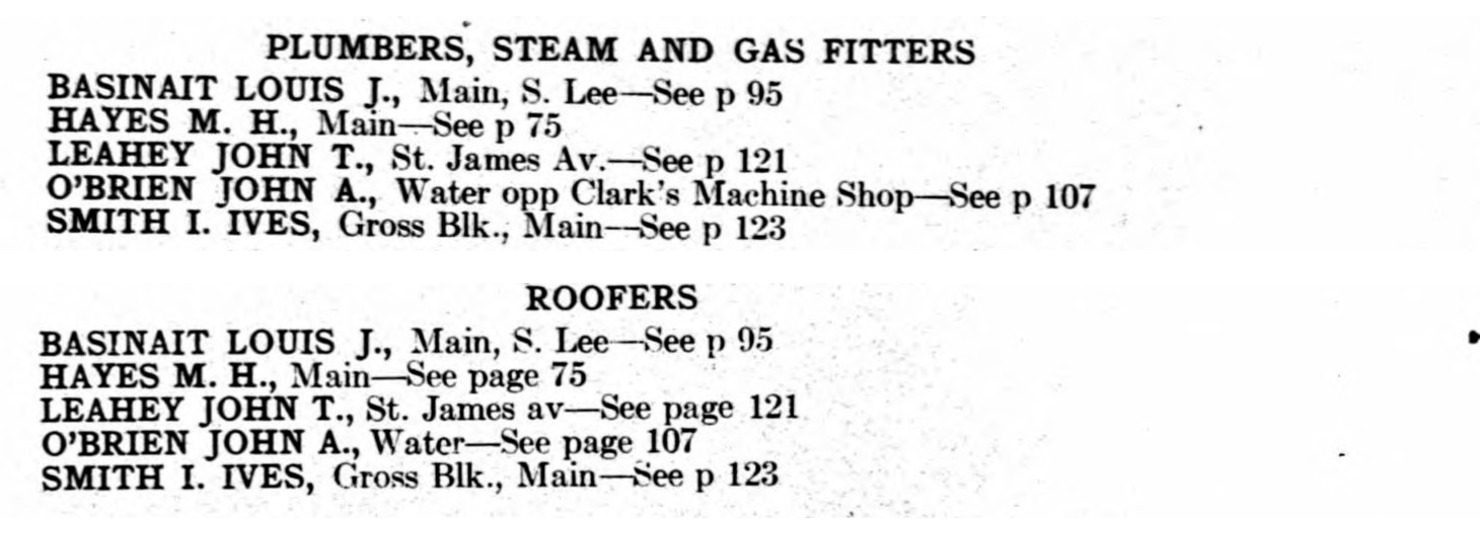
Page 142 of the 1926 Lee classified directory lists the town’s plumbers, steam and gas fitters. Page 143 lists its roofers. Basinait, Hayes, Leahey, O’Brien, Smith — the same five names, in the same alphabetical order, pointing at the same five advertisements.
Turn to one of them and the reason is printed across it.
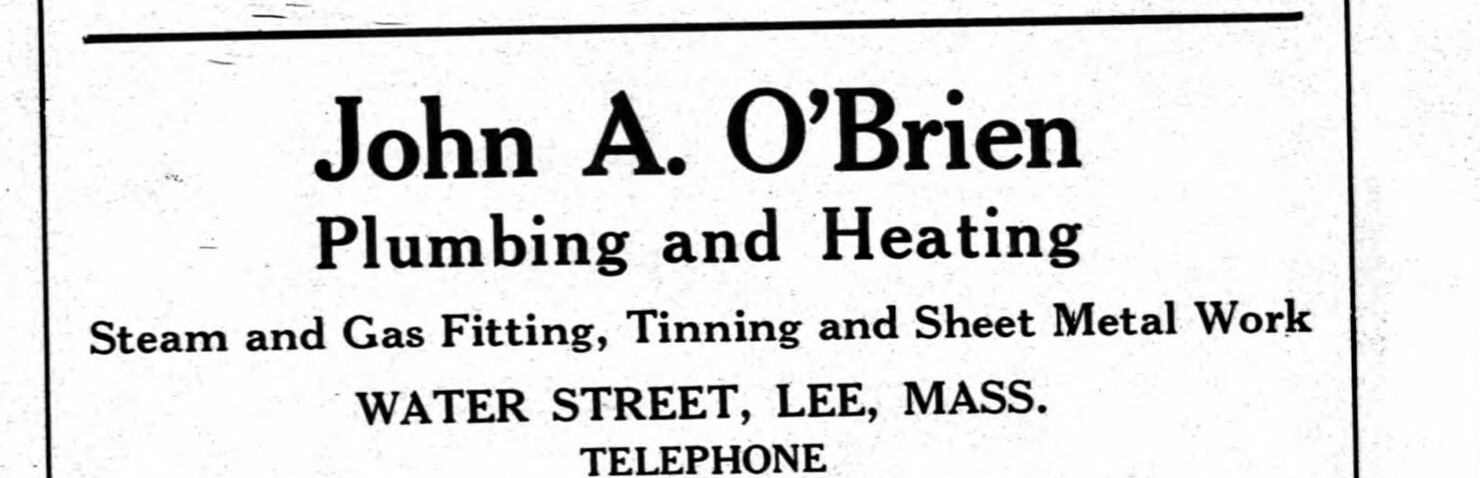
Plumbing and Heating. Steam and Gas Fitting, Tinning and Sheet Metal Work. The pipe and the roof are the same business because they are the same material and the same hands. A man who could seam, solder and flash lead and copper for a bathroom could seam, solder and flash it for a valley and a gutter, and the shop that stocked the sheet stocked it for both.
II. Lenox has one, and he lives somewhere else
The Lenox classified section has the same heading and one name under it.
ROOFERS
ROY ADOLPHUS H., 134 Howard St. Pittsfield—See p 165
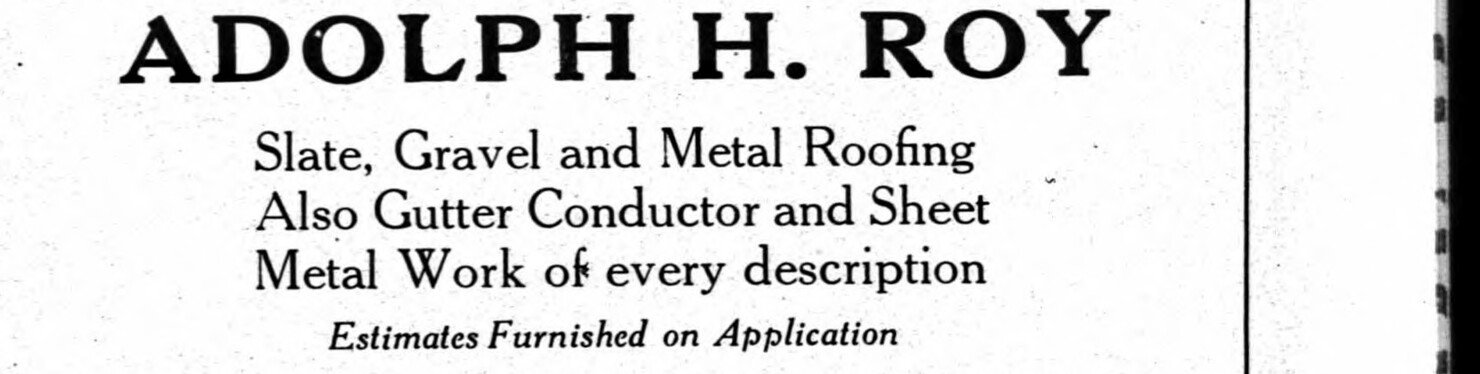
Adolph H. Roy, of 134 Howard Street, Pittsfield, telephone 1765-R. In the town that had just spent forty years covering slate and tile roofs over some of the largest houses in America, the trade directory lists no roofer living in it.
And read what he sells. Slate, Gravel and Metal Roofing. Also Gutter Conductor and Sheet Metal Work of every description. Roofing first, then the metalwork that goes with it. It is the same combination as the Lee men, drawn the other way round.
Dalton, the third town with a classified section, gets one name too: Ford & Parker, of Union Block, 397 Main. They are also the town’s plumbers, its stove dealers and tinsmiths, its steam fitters, and its hot-water heating men. Five headings, one shop.
III. What the metal shop actually made
The clearest statement of the trade in the whole volume is not a directory entry at all. It is an advertisement in the front of the book.
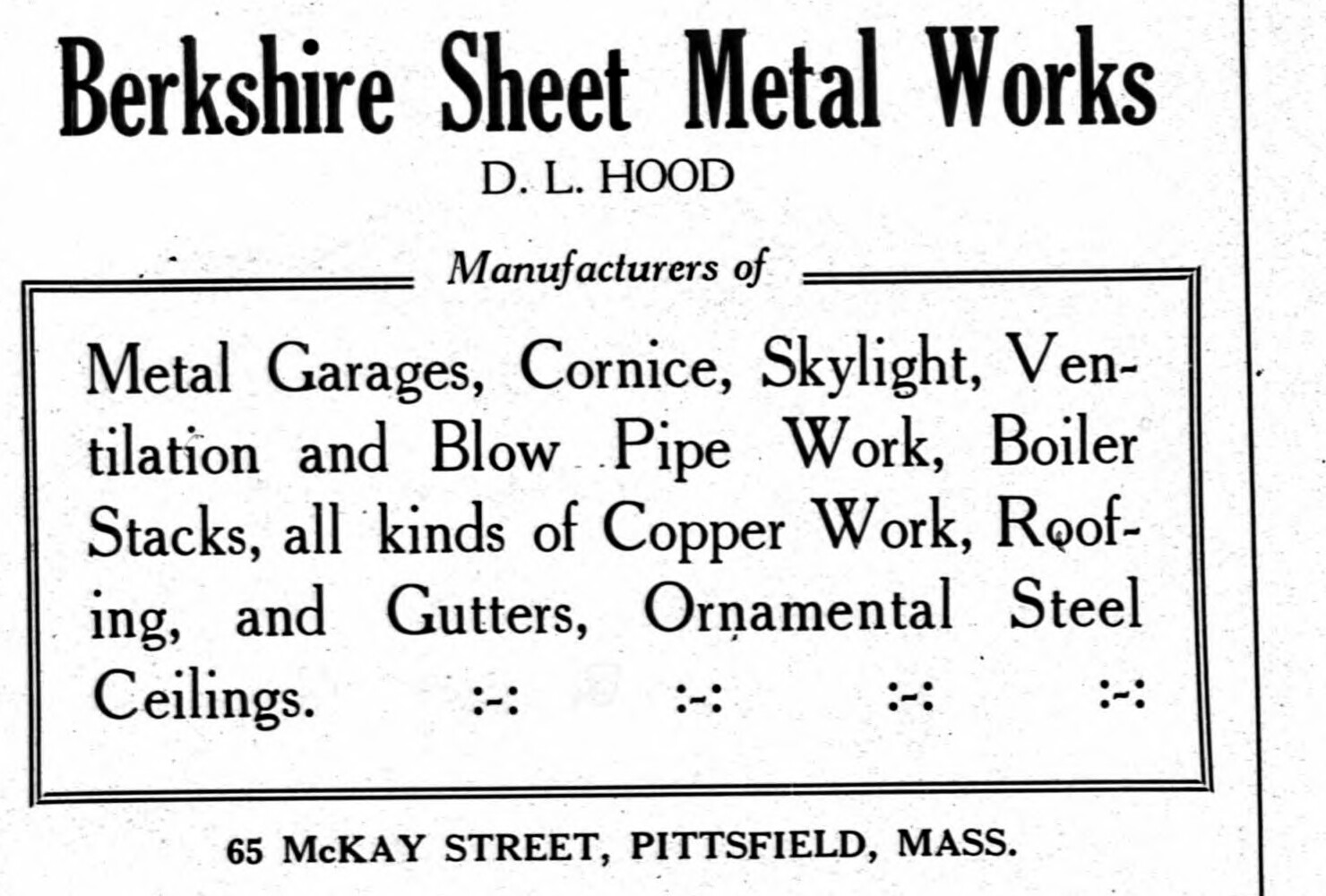
Berkshire Sheet Metal Works — D. L. HOOD — Manufacturers of
Metal Garages, Cornice, Skylight, Ventilation and Blow Pipe Work, Boiler Stacks, all kinds of Copper Work, Roofing, and Gutters, Ornamental Steel Ceilings.
65 McKAY STREET, PITTSFIELD, MASS.
Cornice. Skylight. Copper work. Roofing. Gutters. Ornamental steel ceilings. Every piece of architectural metal on a Berkshire cottage is in that list — and the list also contains boiler stacks, blow pipe work and metal garages, because the same shop did all of it and there was not enough cornice work in the county to live on.
That is the general shape of the thing. The ornamental metal trade existed, it was competent, and it was not a separate trade. It was a department of a jobbing sheet-metal works in Pittsfield.
IV. One man in ten towns
The 1923–’25 South Berkshire volume canvassed ten towns door to door. Searched for a man who describes his own occupation as roofing, it yields exactly one:
Call Arthur J slate and metal roofer Main bds Mrs E J Call’s do p o Hartsville
New Marlboro, page 281. A slate and metal roofer — both words again — boarding at Mrs E. J. Call’s, which is to say at home, in Hartsville.
One man, in the same volume that turns up a hundred and forty-four carpenters and seven hundred and fifty-six farmers. He is the counterpart of John Valinaggi, the single plasterer in the same ten towns, and he means the same thing: the trade was not absent, the classification was. Roofing was filed under plumbing, as plastering was filed under masonry.
V. The iron, and what it was for
Iron is the other half of this story and it goes the same way, only harder.
There are two foundries in the county worth the name in these books, and neither of them is in the architectural trade.
The Clark-Aiken Co., of Water Street, Lee — H. Archer Clark, and Walter S. Aiken, mfrs. of all kinds of paper mill machinery, office and shops, Water — is the one the directory files under Foundry and Machine Works. Its men are in the Lee alphabet with trades printed: Sohl Henry, moulder; Sohles Jacob F., moulder; Frederick C. Jahn, machinist; Aleric P. Le Sage, draftsman; Frank W. Hopkins, superintendent; and a dozen more listed only as emp Clark-Aiken Co. It stands on Water Street directly opposite John A. O’Brien’s shop — the foundry and the sheet-metal man, facing each other, neither of them working on a house.
The other is A. M. Chapel Machine Co., Iron Founders and Machinists, corner of Fenn and Second Streets, Pittsfield, whose advertisement offers automobile cylinders re-ground, new pistons, rings and wrist pins, flywheel steel ring gears, and experimental and job work of all kinds.
Paper-mill machinery and motor-car engines. That is what the county’s iron capacity was for in the 1920s, and there is no reason to think it was different in the 1890s, when the same mills were the same customers.
The blacksmiths confirm it from below. Every one of them in both volumes is described in the same two ways: blacksmith and horseshoer, or blacksmith and wagon maker. James E. Quinn of Lenox gets the fullest entry of any of them — blacksmith and horseshoer, wagon maker and general repairing — and there is not an architectural word in it. Joseph Rondot at Elm Court was a blacksmith on the staff of an estate, and what an estate blacksmith did was shoe horses and mend iron, not make gates.
No entry anywhere in either book reads ornamental iron.
VI. What this means for the houses
Set the two halves together and the conclusion is narrow but firm.
The roof was within local reach. Slate, gravel and metal roofing, gutters, conductors, flashing and cornice could all be had from a Pittsfield sheet-metal works or a Lee plumbing shop, and they were: the trade is in the book, under the wrong heading, doing the work under another name.
The architectural iron was not. Anything beyond a shod horse and a mended wheel — a wrought gate, a stair balustrade, a conservatory frame, a marquee — has no supplier anywhere in these volumes. It came from the city, the way the decorated rooms and the carving came from the city, and for the same reason: there was no continuing market here to keep such a shop alive between commissions.
Which leaves the useful thing to look for. Roofing and metalwork on a Berkshire house should be attributable, because the men who did it were local and their names are printed. Ironwork should not be, and if a gate on one of these places ever does get a name attached to it, the name will not be in this county.
Classified headings and entries from the Lee (pages 134–145), Lenox (pages 219–225) and Dalton (pages 413–419) sections of the Central Berkshire County Directory, 1926, reproduced page by page here; the identity of the plumbers and roofers lists was read off the page images, not the machine-read text. Advertisements for Berkshire Sheet Metal Works, Adolph H. Roy, John A. O’Brien and A. M. Chapel Machine Co. from the advertising department of the same volume. Clark-Aiken Co. and its moulders, machinists and draftsman from the Lee alphabet. Arthur J. Call from the New Marlboro section, page 281, of Crowley & Lunt, South Berkshire Directory, 1923–’25, reproduced in full here. All entries quoted exactly as printed. No roof or ironwork on any Berkshire house is attributed to a named hand here, because no source consulted attributes one.