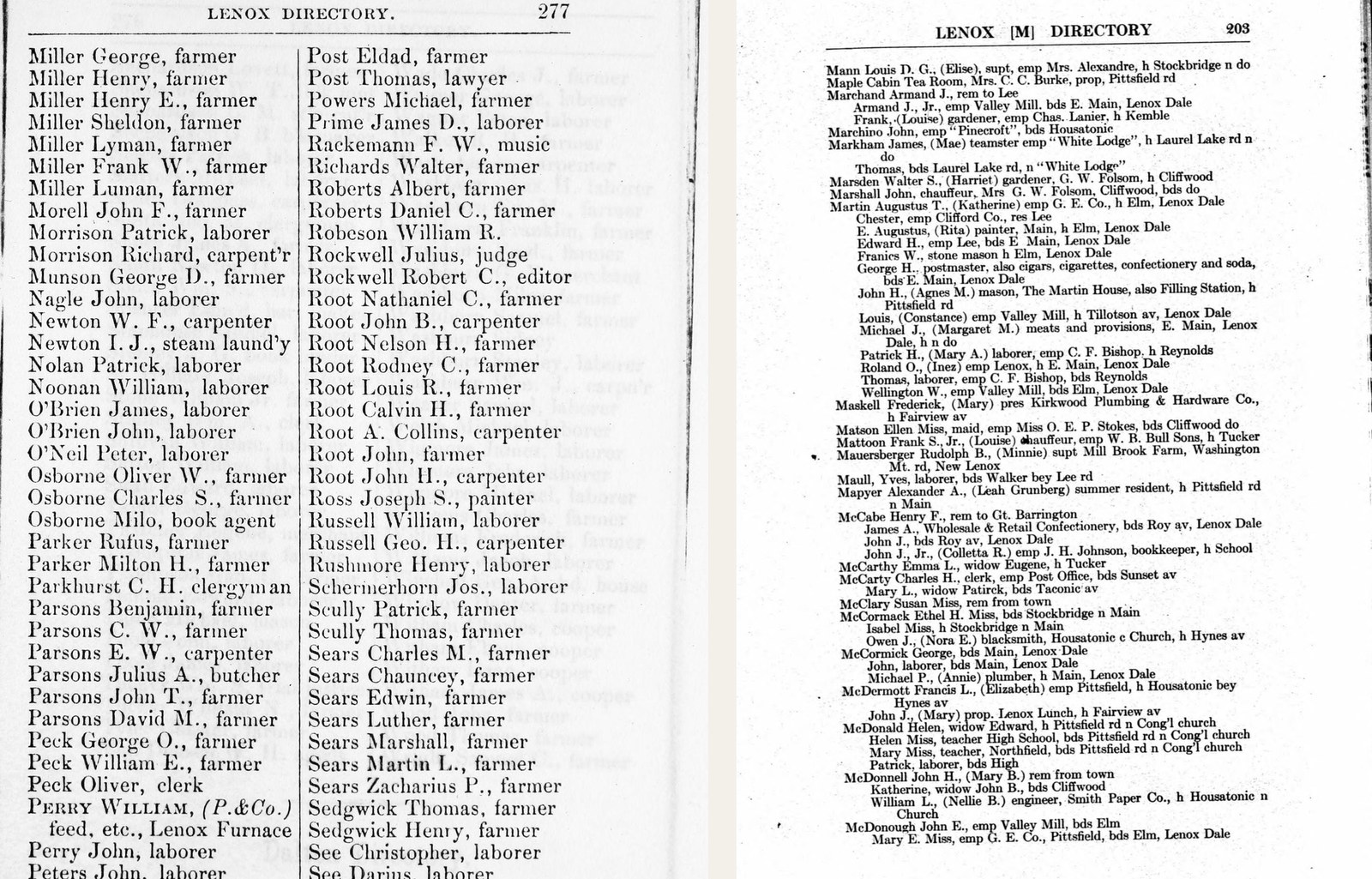
This site now reproduces three county directories. Two of them cover Lenox, and they are fifty-two years apart. That is close enough to a controlled experiment as this county is ever going to offer.
I. One rule, two books
Briggs & Co. canvassed the whole of Berkshire County in 1874. The Central Berkshire directory canvassed the hill towns in 1926. Both went door to door; both printed a trade after a name. What follows counts the trade as the book prints it, in the Lenox section of each volume and nowhere else, by the same rule applied twice.
The two sections are not the same length — twelve pages in 1874, sixty-four in 1926 — but they yield comparable numbers of people with an occupation printed against them: 428 in 1874, 515 in 1926. That is the denominator for everything below, and it is close enough that the proportions can be read directly.
Two cautions before the table. The 1874 book prints a name and a trade and stops; the 1926 book prints a name, a spouse, a trade, an employer and a street, which is why this site has been able to do so much with it. And the counts come from the machine-read text of the scans, so a handful of entries are missed and a handful of spellings are folded in. Neither of those moves a number enough to change what the table says.
II. The table
| Occupation, as printed | Lenox, 1874 | Lenox, 1926 |
|---|---|---|
| farmer | 158 | 79 |
| laborer | 120 | 70 |
| carpenter | 17 | 42 |
| painter | 5 | 15 |
| merchant | 6 | — |
| paper maker | 17 | — |
| glass maker | 4 | — |
| cooper | 4 | — |
| lime burner | 6 | — |
| blacksmith | 2 | 6 |
| mason | 1 | 5 |
| clerk | 4 | 6 |
| teacher | 2 | 9 |
| chauffeur | — | 25 |
| teamster | — | 17 |
| gardener | — | 13 |
| superintendent | — | 8 |
| plumber | — | 7 |
| electrician | — | 7 |
| butler | — | 5 |
| caretaker | — | 4 |
| coachman | — | 3 |
| maid | — | 2 |
| housekeeper | — | 1 |
| nurse | — | 1 |
| student | 1 | 32 |
Occupation as printed in the Lenox section of each volume. 428 occupation lines in 1874; 515 in 1926. A dash means the trade does not appear in that book’s Lenox section at all.
III. What Lenox was in 1874
Farmers and laborers are sixty-five per cent of the town. Two hundred and seventy-eight people out of 428, and the page reads like it — a column of farmer, farmer, laborer, farmer with a name in front of each.
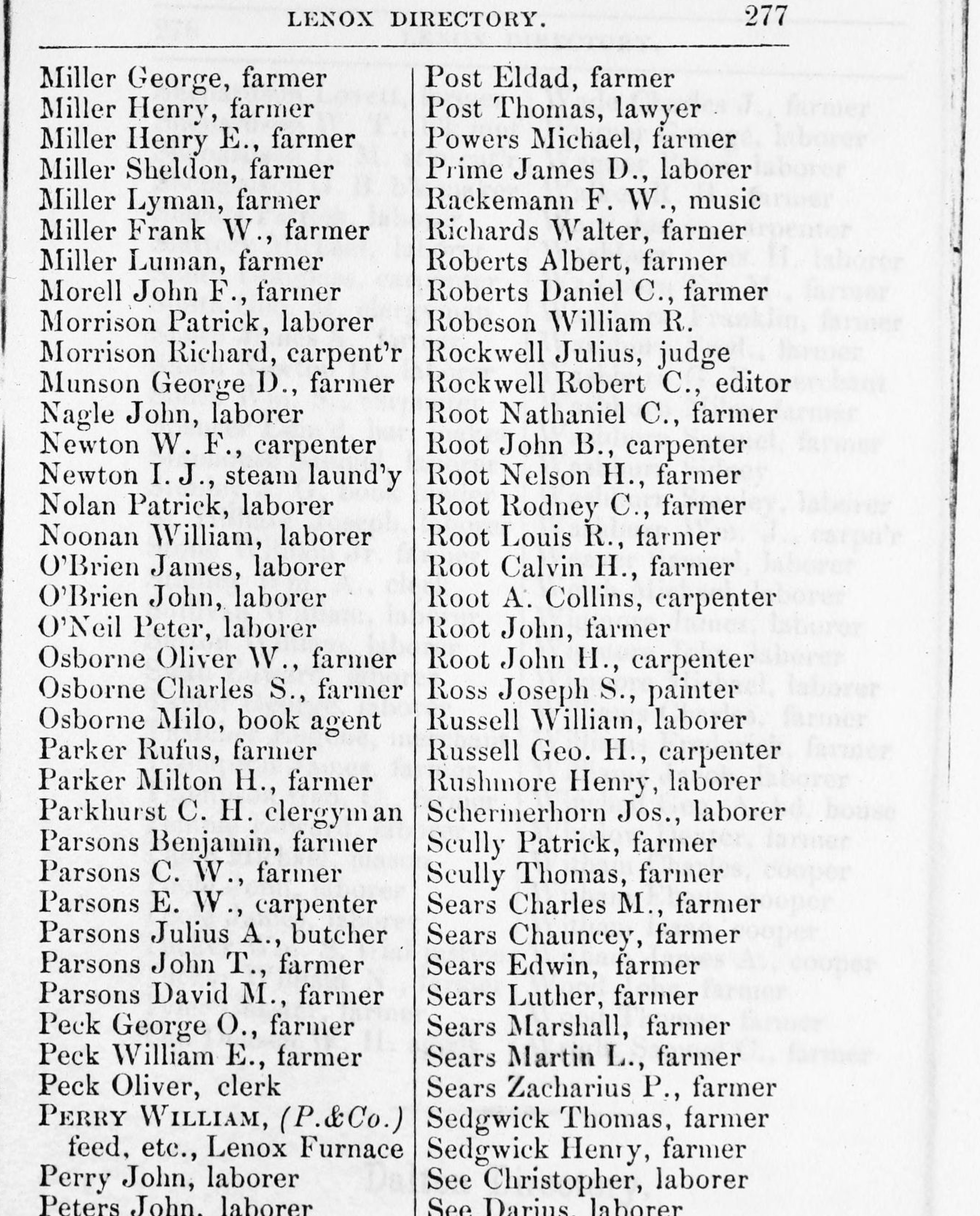
Behind the farms there is a manufacturing town. Seventeen paper makers and paper manufacturers. Four glass makers. Four coopers. Six men in lime — the kilns and the quarries. This is the Lenox the mill story is about, before the houses came.
And then the absences, which are the point. Nineteen years before Wheatleigh was drawn, twenty before Shadow Brook, the town that would shortly be described in the national press as a resort of great estates had no gardener, no coachman, no chauffeur, no butler, no housekeeper, no maid, no caretaker, no superintendent and no nurse. Not one, in 428 people.
One student.
IV. What Lenox was in 1926
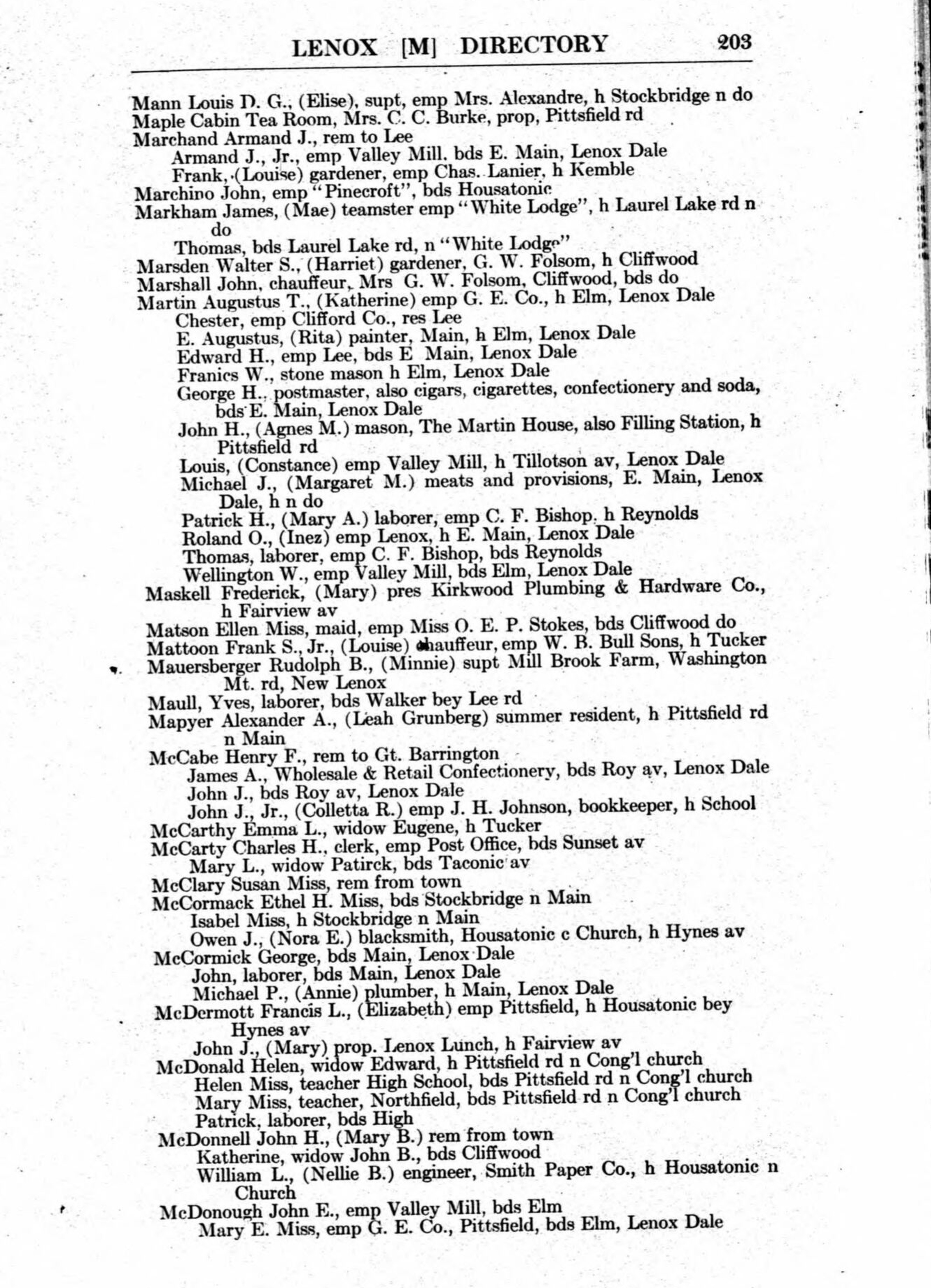
Twenty-five chauffeurs. Seventeen teamsters. Thirteen gardeners. Eight superintendents, five butlers, four caretakers, three coachmen, two maids, a housekeeper, a nurse. Every one of those trades stood at zero in 1874.
The coachmen story reads the three coachmen against the twenty-five chauffeurs and finds one body of knowledge replacing another inside a working life. Set beside 1874, something larger is visible: the whole category is new. There was nothing for the motor car to replace in Lenox in 1874, because nobody in Lenox was driving anybody.
V. The trades that went to zero
Read the table downward and the reverse migration is just as sharp. Paper maker seventeen to none. Glass maker four to none. Cooper four to none. Lime six to none. Merchant six to none.
The paper did not stop — it moved. The 1926 book has Lenox men employed at the Valley Mill and at the Smith Paper Company, but their entry says emp Valley Mill and the mill is in Lenox Dale, or over the Lee line, or in Dalton. What vanished from the Lenox section is not the work but the trade name: in 1874 a man in Lenox was a paper maker, and in 1926 he is a man employed at a mill. The other payroll is where that goes.
The glass makers and the coopers did not move. They stopped.
VI. Farmers, who did not go anywhere
The easy story would be that the estates displaced the farms. The table does not say that. Lenox had 158 farmers in 1874 and 79 in 1926 — halved in a book with a slightly larger denominator, so down from thirty-seven per cent of the town’s printed occupations to fifteen. They are a minority now. They are not gone.
Laborers behave the same way: 120 to 70. Carpenters go the other direction, seventeen to forty-two, which is what a building boom looks like fifty years after it starts and twenty years after it stops — the houses still have to be kept up. Painters treble.
The single largest gain in the table is not a trade at all. Student goes from one to thirty-two.
VII. What the drift actually is
Between these two books Lenox stopped making things and started keeping houses. That is the sentence, and the table is the evidence for it, and it is worth being careful about what it does not say.
It does not say the town got richer or poorer; a directory prints no wages. It does not say how many people worked at the great houses, because the Eastover story shows the book catching one employee in eight and the boarding story shows why — the indoor staff slept in the house and were invisible to a canvasser at the door. The thirteen gardeners and twenty-five chauffeurs are the men with cottages of their own. They are the bottom of the count, not the top.
And it does not say the cottage era arrived in Lenox between 1874 and 1926. It arrived in the 1880s and was substantially over by 1926, which makes the 1926 figures a reading of the aftermath. What the 1874 book gives is the thing no later source can: the town immediately before, in its own words, with the trades that were about to be created standing at zero.
All figures from the Lenox sections of the two volumes reproduced on this site: Briggs & Co., Berkshire County Directory for 1874, from the Allen County Public Library copy at the Internet Archive., printed pages 274–282 (images 513–523), and the Central Berkshire County Directory, 1926, from the Pittsfield + Berkshire County MA Directory Collection at the Internet Archive., Lenox alphabetical section, printed pages 181–245 (images 191–253). The counts are of the occupation as printed, taken from the machine-read text of the scans by one rule applied to both books: in 1874, the field after the last comma in an entry; in 1926, the field following the spouse. That yields 428 occupation lines in 1874 and 515 in 1926, and those are the denominators throughout. Where the machine reading produces an obvious variant of the same word — fanner and larmer for farmer, chaufeur for chauffeur — the variants are folded into the one entry; paper maker and paper manf are counted together, as are lime and lime burner, and supt with superintendent. Entries the rule does not fit are not counted in either book, so both columns are undercounts of the same kind rather than of different kinds. The reading is imperfect and both volumes can be searched on this site, so any figure here can be checked against the page. The two plates are unretouched crops from the Internet Archive scans, neither of which is in copyright, enlarged. Neither book is a census: a directory records the people a canvasser found at a door, which is a different population from everyone who was in the town, and the census story says what the difference costs.