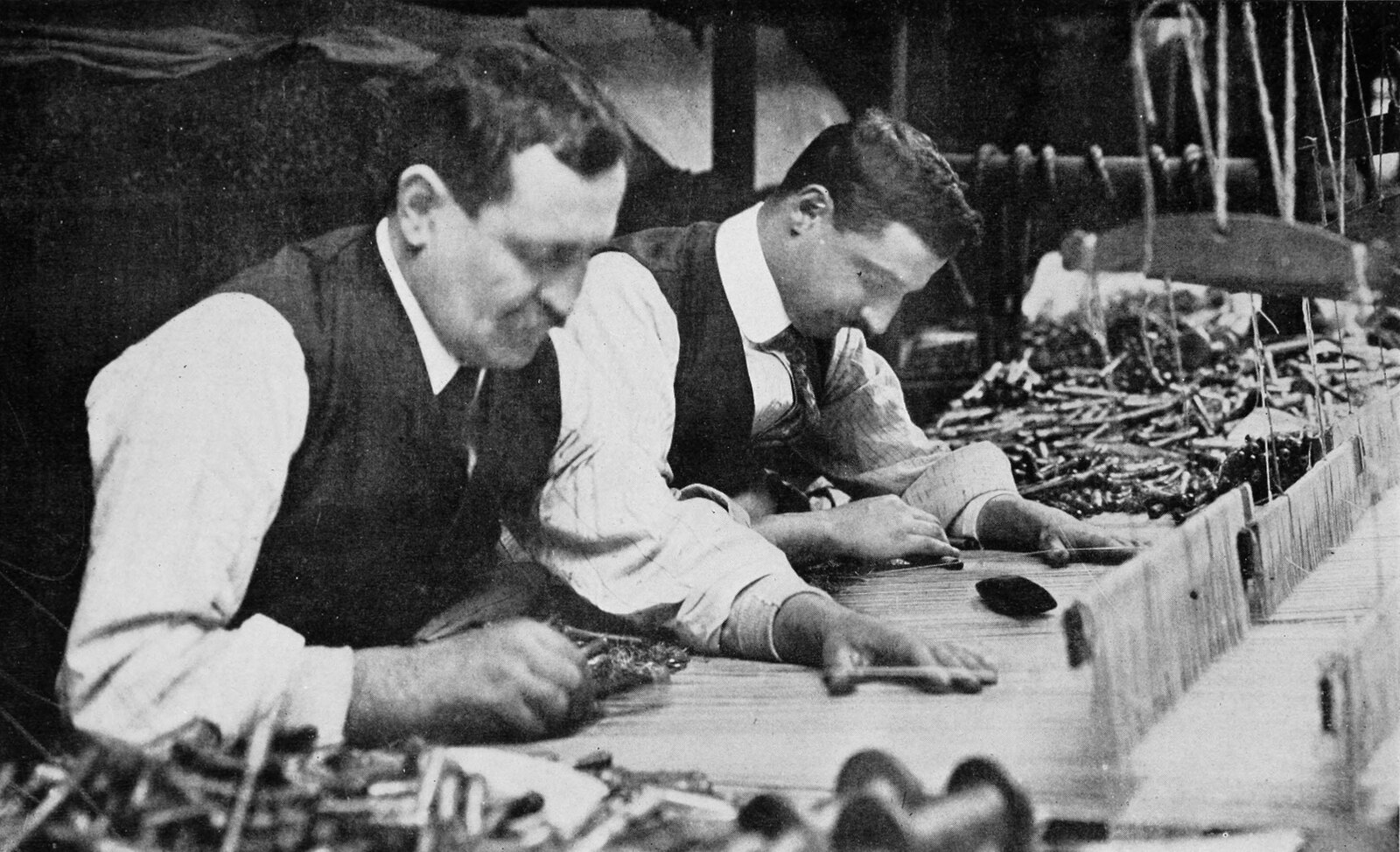
I. Three photographs
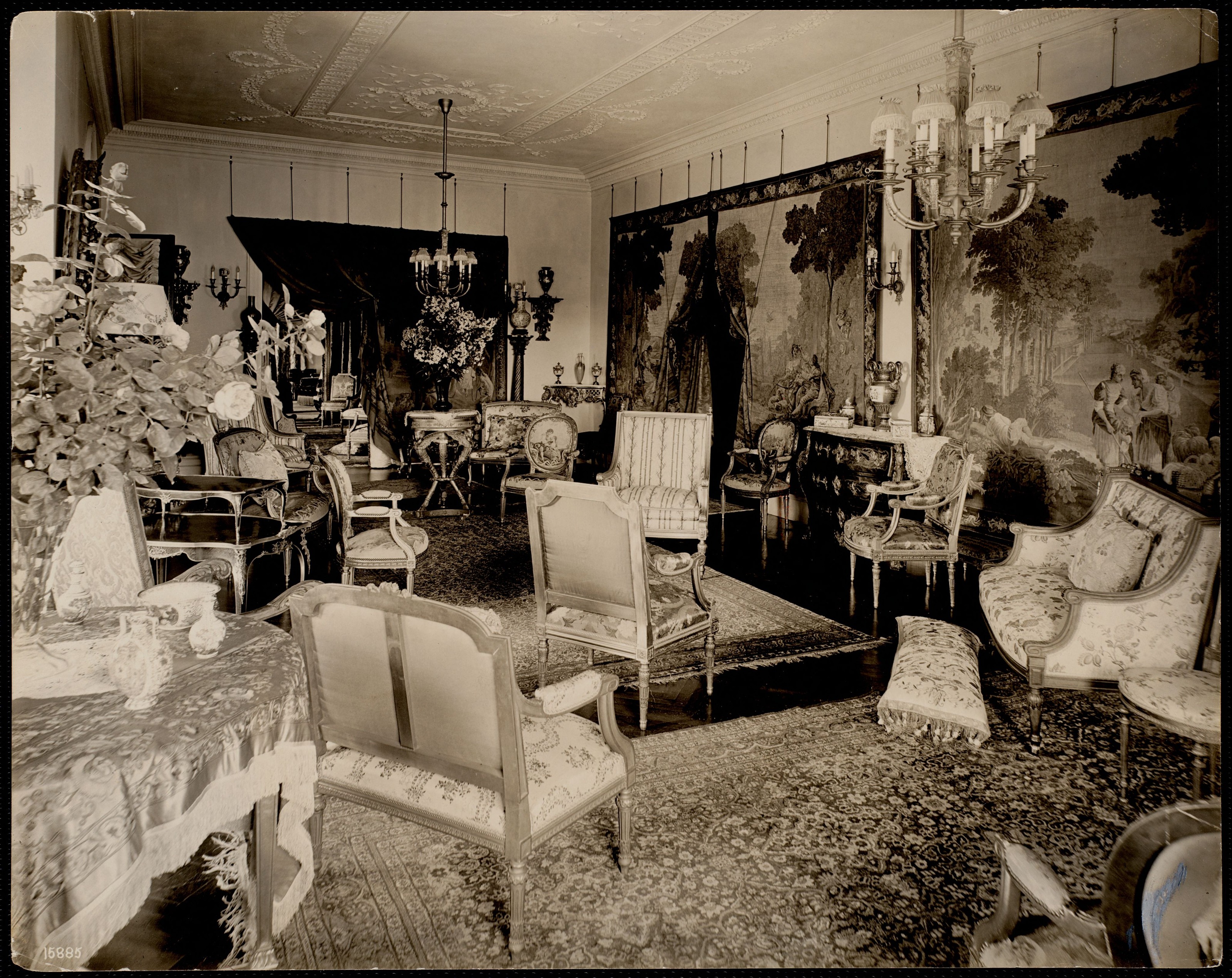
The Lenox Library holds three interior views of Wheatleigh, taken some time between 1892 and 1910, and the cataloguer who titled them had no doubt about what was on the walls. Wheatleigh: interior with tapestries and chairs. Wheatleigh: interior with dining table and tapestries. Wheatleigh: interior with dining tables and tapestries and fireplace. Three titles, and the word appears in all three.
Search the whole Lenox collection for that word and those three photographs are almost everything you get. Search it for dining rooms and you will be there all afternoon. Tapestry is not a thing these houses lacked. It is a thing nobody thought to write down, because everybody who walked into the room could see it.
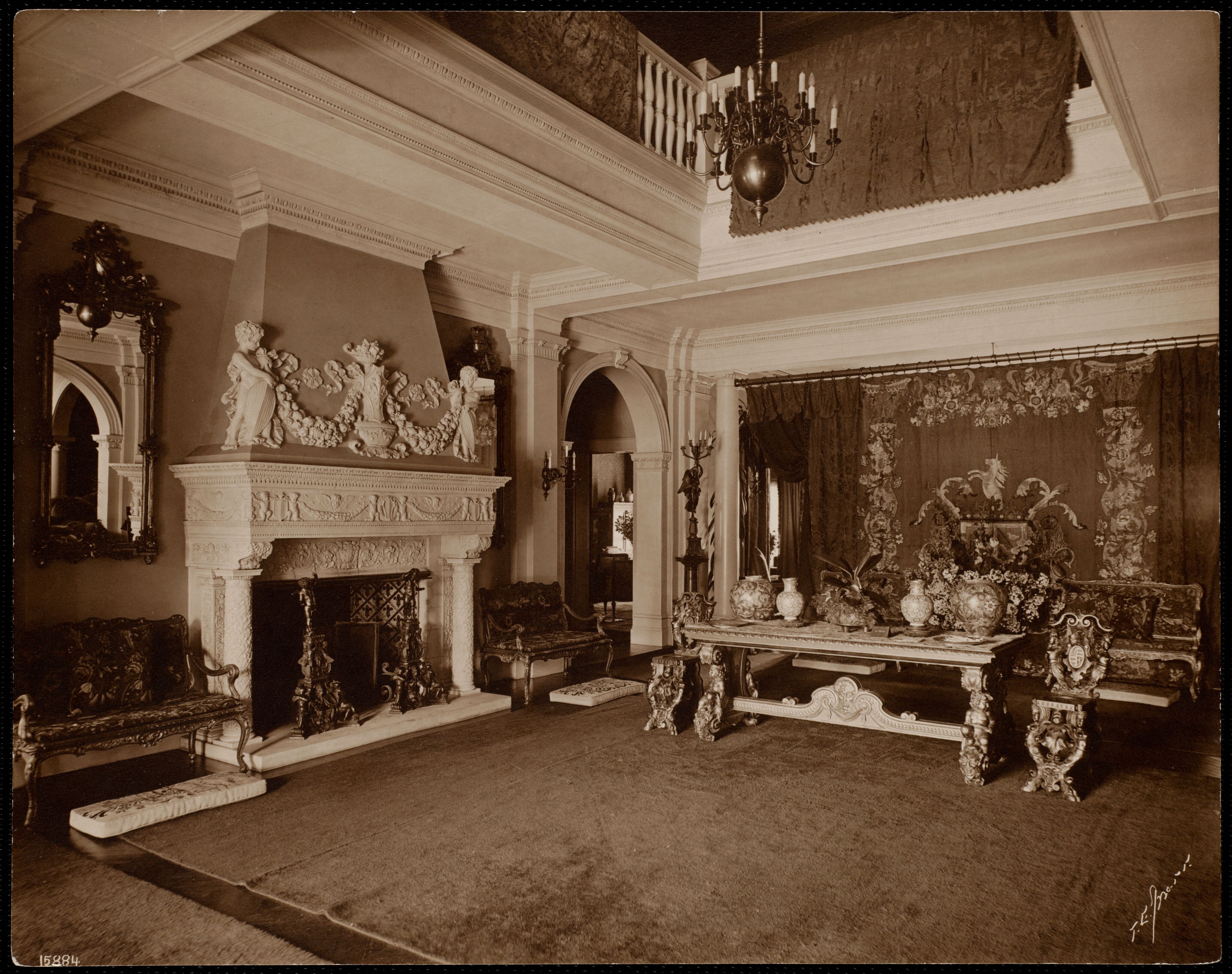
So this story cannot tell you what was hanging at Wheatleigh. What it can tell you is what it took, in 1893, to put a woven picture on a wall in America — because that turns out to be one of the stranger stories in the whole of this trade, and because the year is exactly right.
II. What had happened to the craft
Tapestry is the oldest of the luxury trades and by the end of the nineteenth century it had very nearly stopped. William Baumgarten, a New York decorator who had spent twenty years going to Europe to buy the stuff, stood up in front of the National Sculpture Society in April 1894 and gave the numbers.
Brussels, about 1600: more than a hundred masters, employing over fifteen thousand men. Louvain: over fifty thousand. Ghent: twenty-seven streets of weavers. Arras, Bruges, Ypres, Oudenarde, Tournai, Lille, Valenciennes, Douai — towns whose populations were almost exclusively weavers, taking their orders from emperors, popes, kings and princes, and making work that, as he put it, has never been surpassed.
And in 1894, in all of Brabant: not one loom working, except a few at Mechelen, kept going by a Paris firm with men imported from Aubusson.
France was the last of it. The two government works, the Gobelins and the Beauvais, employed between them — artists, artisans, apprentices, helpers and the entire Bureau of Administration included — not more than seventy-five people. Two private houses at Aubusson made perhaps two hundred more. Add a few isolated weavers around Paris, and that was the world supply.
Baumgarten had two explanations, and they are worth having. The first was that fortunes no longer lasted: estates were split at every death, and a tapestry is not a thing you buy for a house you might not have. The second was cost. Hand labor had got dear and the Gobelins had got slow, and the two together had “raised the price of tapestries to enormous proportions.”
How slow? In 1885 Baumgarten bought a painting off the Salon wall and hired M. Lavaut, reckoned the best artisan at the Gobelins, to weave it. Lavaut worked short hours at the government works, so he set up a loom in his own house and did it in the evenings. It took him four years. It won a gold medal at the Paris Exhibition of 1889, by which time the painting it copied was four years old and the weaver had spent a fifth of a working decade on one picture.
III. The old ones
What Americans wanted, overwhelmingly, was the old work — and they could have it, because Europe was selling. Morris had watched it happen as early as 1877: “there is a great sale now on in Paris of some of the finest ever turned out; much too splendid for anybody save the biggest pots to buy.”
The biggest pots, increasingly, were in New York, Philadelphia and Cleveland. By 1912 a New York dealer, P. W. French & Co., could supply the photographs for five plates of the standard American book on the subject, and the great collections being formed on this side of the Atlantic were the reason the book existed at all.
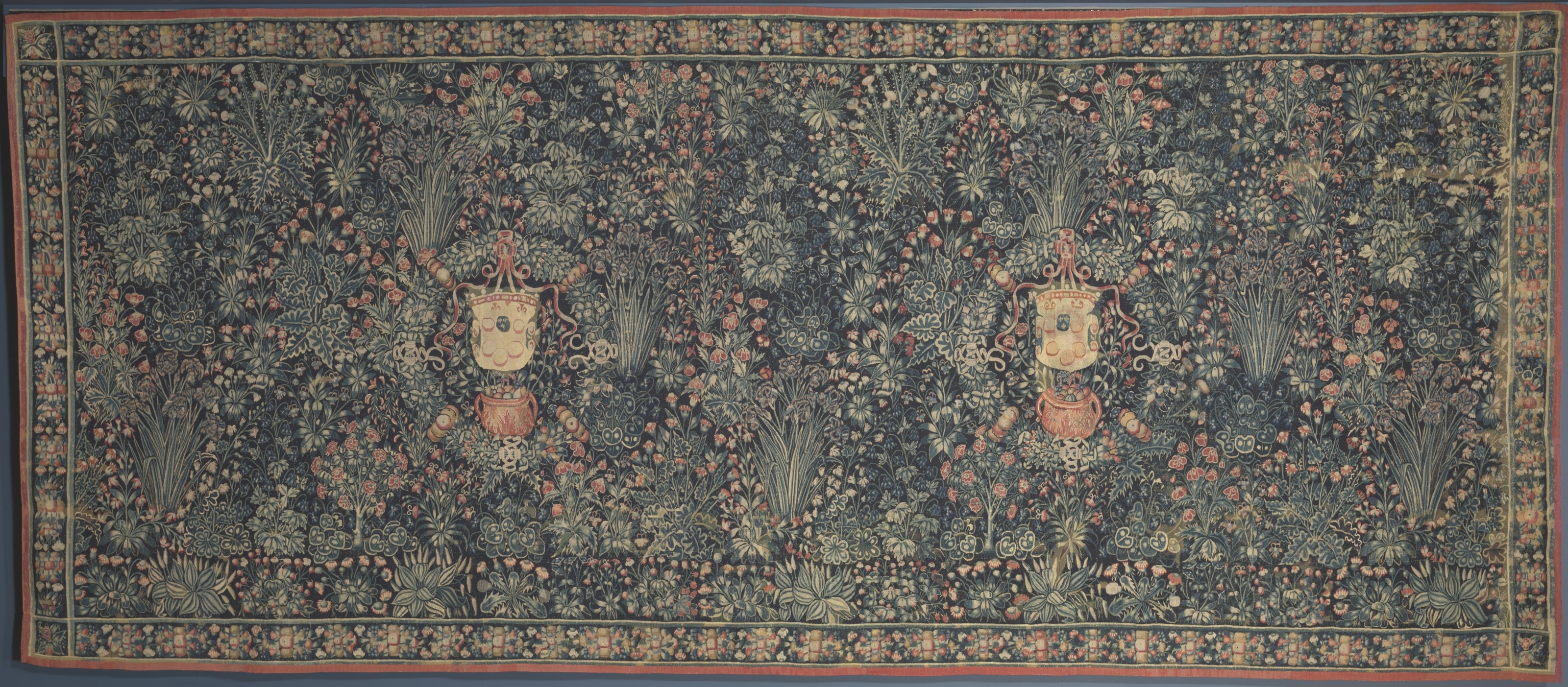
Look at what that piece actually is. Twenty-one feet of dark ground sown with identifiable flowering plants — the millefleurs pattern, in fashion from about 1450 and woven for a hundred years after — with two coats of arms set into it so that everyone in the room knows whose room it is. It is a wall, a garden, a pedigree and a portable fortune, all at once, and it is four hundred years old before it ever crosses an ocean.
That is what the American buyer of the 1890s was competing for, and that is the standard against which anything new had to be sold.
IV. Faded on purpose
Which produced the detail that gives this story its title.
Baumgarten, having set up his own looms, found himself in an argument about color. He was proud of his dyes. He tested them by leaving finished pieces in direct sunlight for weeks at a stretch and could find no fading at all. And he noted, drily, that he had “frequently seen with my own eyes in France, manufacturers put new pieces of tapestry in the sun in order to fade the colors and make them more delicate and to resemble the old.”
There it is. An art form that had run without a break from the fifteenth century was, by the 1890s, in the position of having to counterfeit its own past in order to sell its present. The looms still turned. The wool was still dyed by hand. And then the finished thing was laid out in a French courtyard to be bleached, because the market wanted 1520 and it was 1894.
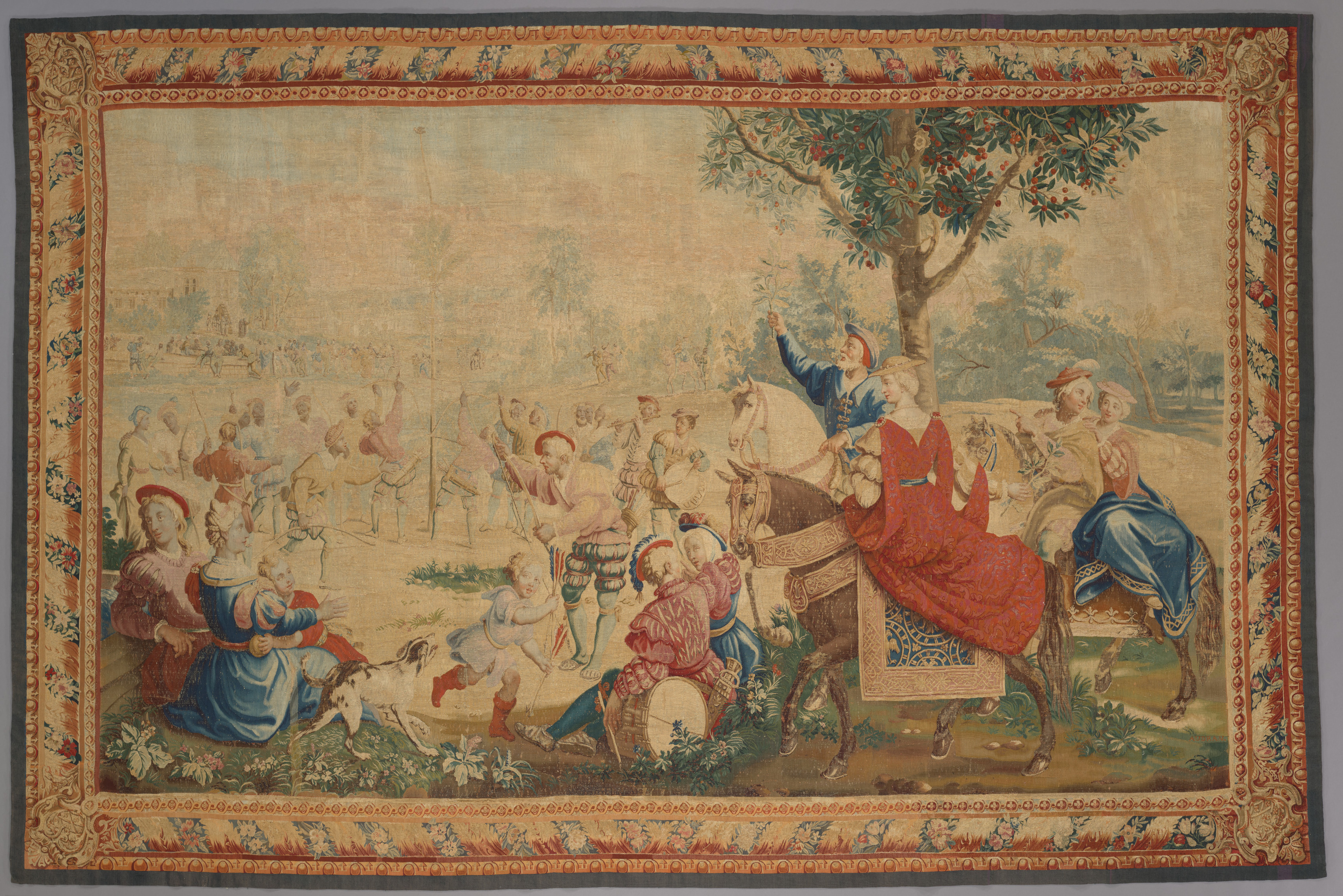
Baumgarten thought the eighteenth century was where the rot had set in, and he did not soften it. Since 1800, he said, French tapestry had “gradually drifted into the copying of paintings, landscapes and portraits, which are all made with the utmost skill and incredible patience, but which from the aesthetic point of view are in very bad taste and a ridiculous misuse of this noblest of all textile arts.”
He then went out and took an order for thirteen panels in the manner of Boucher. A man has to eat.
V. Up at five thirty, three hours tapestry
There were two revivals, and they could not have been less alike.
The first was William Morris. Every other revival in the history of the craft — Flanders to Italy in the fifteenth century, Flanders to Paris and Mortlake in the seventeenth, Beauvais to St Petersburg and Madrid in the eighteenth, Aubusson to Windsor and to New York in the nineteenth — worked the same way: you hire the Frenchmen. Morris hired nobody. He went to the Gobelins to look at the machinery, worked out the rest from an old French handbook printed before the Revolution, put a loom in his bedroom at Kelmscott House, and taught himself.
His diary for the Cabbage and Vine tapestry, begun 10 May 1879, is a record of a man in his mid-forties getting up in the dark to learn a trade. In four months of that year he spent five hundred and sixteen hours at the loom. 12 March 1881: “up at 7:30, about four hours tapestry.” A week later: “up at 6½, four hours tapestry.” Then, as the mornings lengthened: “up at 6, two hours tapestry”; “up at 5:30, three hours tapestry.”
He opened the Merton works that same year, and he was scathing about everyone else’s. On the Royal Windsor Tapestry Works, founded under the Queen’s patronage: it had “most unluckily gone on the lines of the work at the Gobelins, and if it does not change its system utterly, is doomed to artistic failure, whatever its commercial success may be.” On the Gobelins themselves, where the weavers were the sons and grandsons and great-grandsons of weavers: “their ingenuity is put to the greatest pains for the least results … a more idiotic waste of human labor and skill it is impossible to conceive.”
He was right about Windsor, at least commercially. It collapsed when the royal subscriptions stopped.
VI. The Bronx against the Bièvre
The second revival happened on a river in the Bronx, and its founding year was 1893.
That is the same year Wheatleigh was finished, and the same year Tiffany lit the furnaces at Corona. Something was in the air in 1893, and most of it was the conviction that American money was now large enough to buy American art industries into existence.
Baumgarten’s brother Emile went to France in the autumn of 1892 to find men willing to emigrate. They were all unwilling. They came only for higher wages, a guarantee of steady work for a year, and free passage over — and back, in case it did not answer. The one piece of luck was finding M. Foussadier, lately master workman of the collapsed Windsor works, at liberty.
Foussadier and his family landed in the first days of January 1893. A French loom came with them and was set up in a room at 321 Fifth Avenue. The first piece made on it was a chair seat. It took two weeks. Baumgarten kept it; it was not for sale, and he meant it to stay in the family as the first tapestry woven in America. The second one, identical, went to the Field Museum.
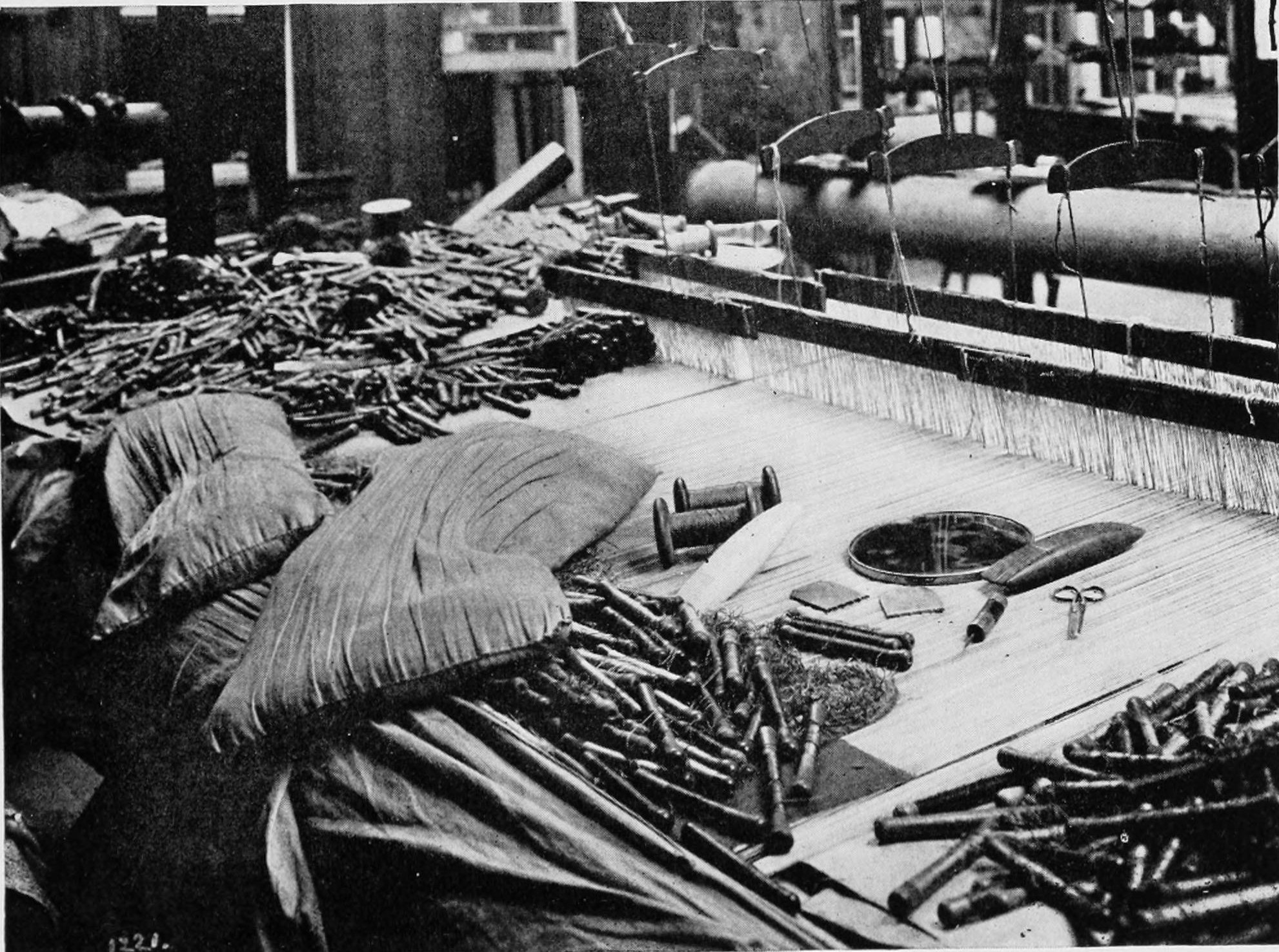
By May he needed room and found it at Williamsbridge, in a house on the Bronx River that had been a French restaurant and hotel, and where — he told the story himself, thirty years on — he had spent many a happy Sunday in the springtime of his Bohemian days. There was a French settlement nearby. He thought his men would feel at home. They did: he says they found a little paradise.
Then came the discovery that pleased him more than any of it. Foussadier, who dyed as well as he wove, put the Bronx water to the test and reported that it was the best he had ever used, better than anything in France or England, on account of the dissolved vegetable matter in it. Every dyer in Europe knew that the Gobelins owed their color to the Bièvre, the little river in the Faubourg Saint-Marcel where a family named Gobelin had set up their dye works in the fifteenth century. Aubusson said the same about the Creuse. And here was a Frenchman in the Bronx announcing that his dyes were now better than the Gobelins’.
Baumgarten reported this to a room full of sculptors with visible pleasure, and you can hardly blame him.
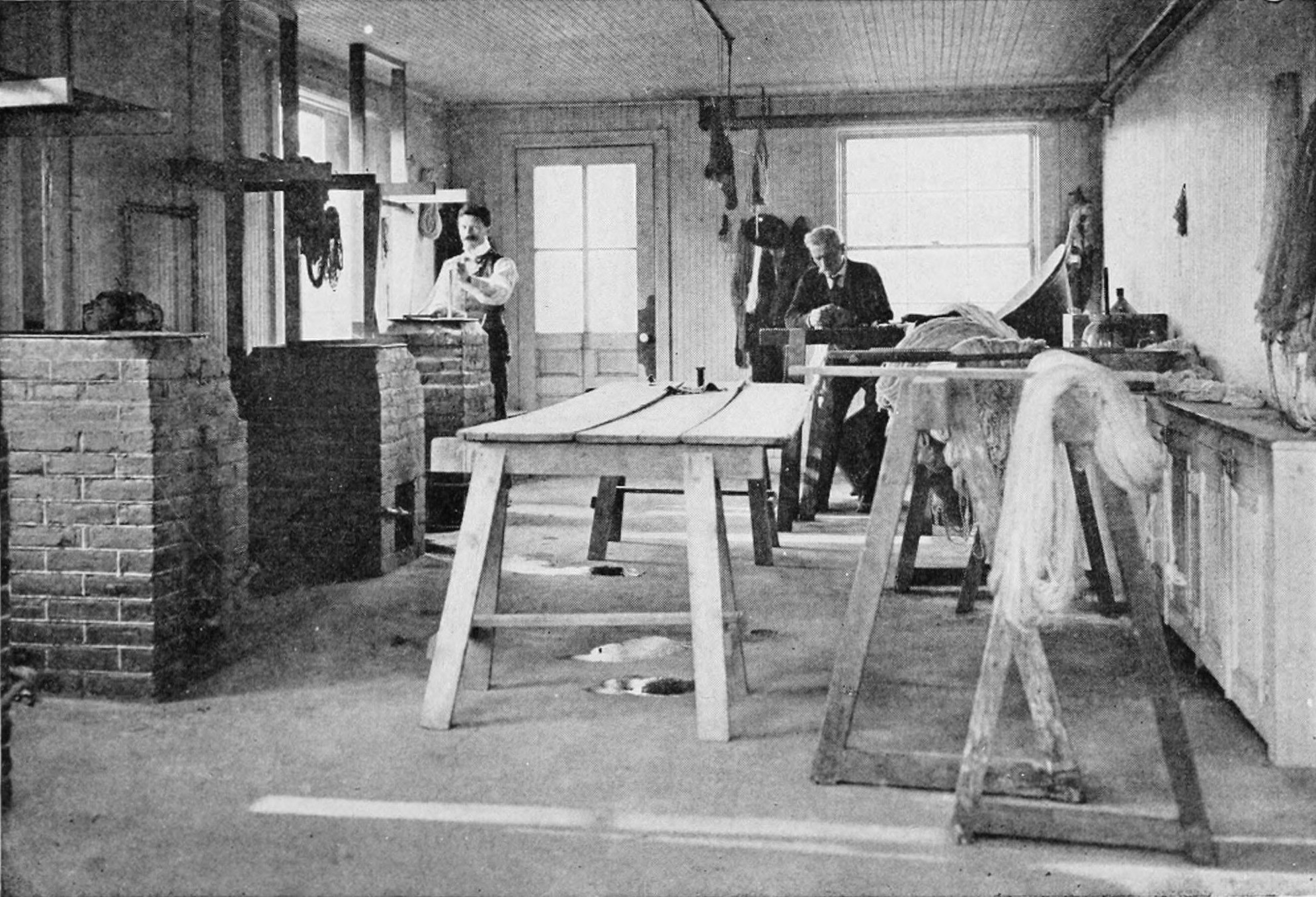
VII. Two dollars a week
The part of this he could not solve was the apprentices, and the passage where he tries is the most revealing thing he said.
The aim, he told the sculptors, was to make this a native industry: to bring up American boys to it so that in five or six years he could stop importing Frenchmen. The obstacle was that American boys would not serve. In Europe a boy bound himself for three or four years at no pay or nearly none. Here, he said, a boy leaving school is made to earn three or four or five dollars a week at once, which drives him into the stores as a cash boy or an errand boy or into a messenger office — “and thus they grow up to be men remaining common laborers or worse.”
He tried anyway. Through the interest of John D. Crimmins he took boys from the Catholic Orphan Asylum and promised them two dollars a week the first year, four the second, six the third and eight the fourth. Five were at the looms when he gave the lecture. By 1897 there were six, and the first two, he said, were already doing quite good work.
Weigh that how you like. An orphanage boy, aged perhaps fourteen, sitting down at a loom in the Bronx to learn a Flemish craft from a Frenchman for two dollars a week, and four years later earning eight. It is the exact mechanism by which any of these trades continued, stated plainly, with the numbers attached — which is more than the Berkshire record ever gives us for a mason or a plasterer.
VIII. The gentleman from Philadelphia
In May 1894 Baumgarten hung the first year’s output in one of his warerooms and sent out cards. Among those who came was a gentleman from Philadelphia who mentioned, on arrival, that he liked to take in shows that cost nothing.
He looked carefully. Then: “So you would like to make more ambitious things, wall panels with figure compositions, eh? Do you think you could do as well as those old fellows of a hundred or two hundred years ago?” Baumgarten answered that he would try, if he had the opportunity. “Well,” said the visitor, “I will give you the opportunity. Come over to Philadelphia next week and I will show you the room.”
The room wanted thirteen panels, all in the genre of Boucher, plus the furniture coverings and two pairs of portières. Colored sketches took a month. The weaving took about fifteen months and was done by the first of December 1895. The bill was over twenty thousand dollars, and the man who paid it was P. A. B. Widener.
To meet the order Baumgarten imported six more weavers in a batch, and the six were promptly detained at the port as contract laborers. He was summoned before a board of six commissioners who had never heard of tapestry and would not believe there were no American tapestry weavers to be had. He gave them, by his own account, a most exhaustive lecture with historical and statistical data, while his Frenchmen sat there like prisoners, not knowing what any of it was about. The Treasury let them in a few days later.
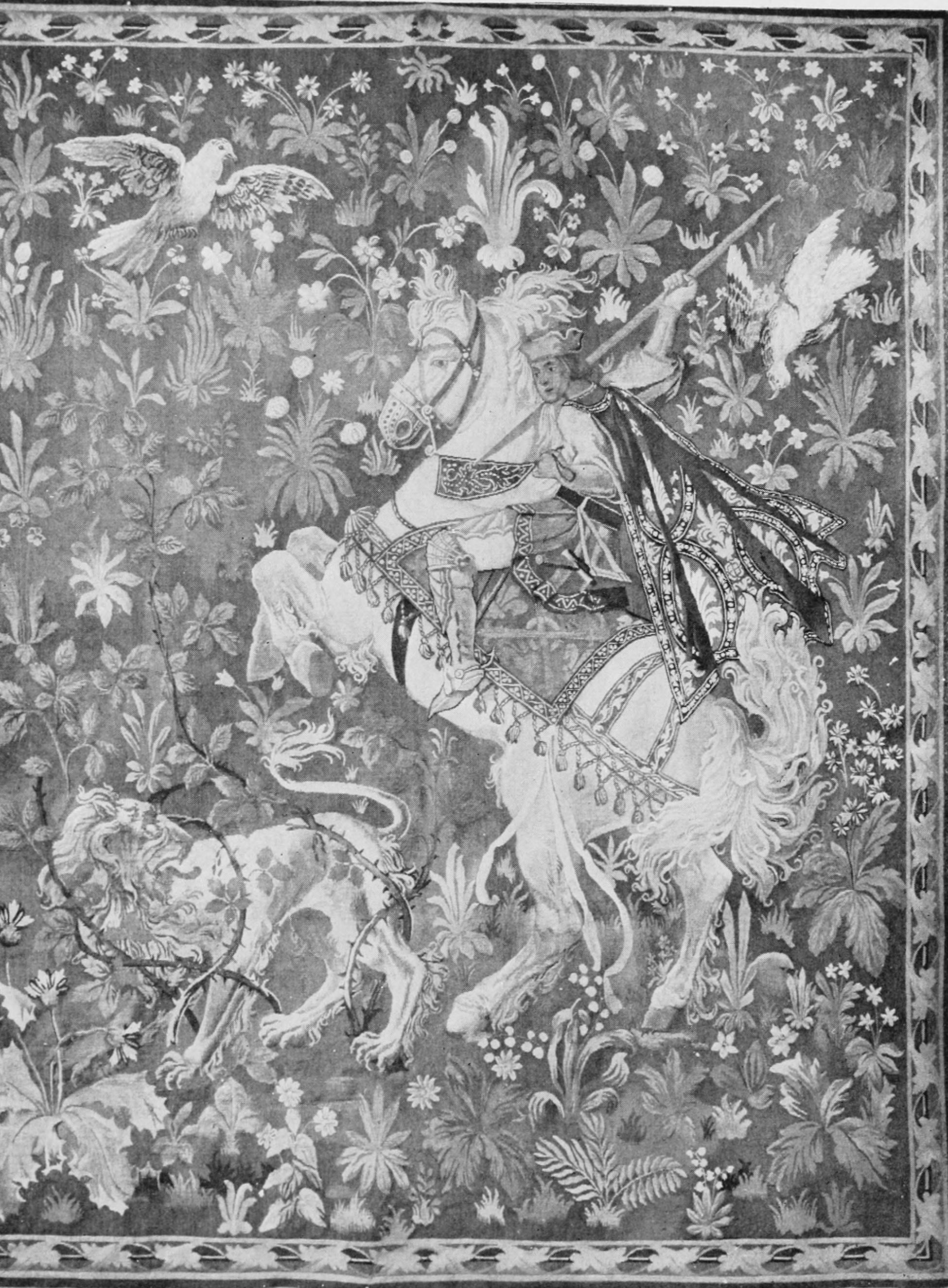
It worked. Williamsbridge took a Grand Prize at the St Louis Exposition in 1904. By 1912 it was running thirty-six looms, with two to four weavers at each, and the standard book could describe the world as having six large tapestry plants in it — the Gobelins, the Beauvais, three at Aubusson, and Williamsbridge — with the American one by no means the least of them in quality or quantity.
Nineteen years from a chair seat in a back room to that. It is one of the fastest things in this whole section.
IX. The B with a shield
The Williamsbridge weavers signed their work, in the way of the trade: a mark in the selvage. On a set of portières woven for the dining room of a New York house, one panel for each season, the mark sits in the right-hand selvage — a B with a shield.
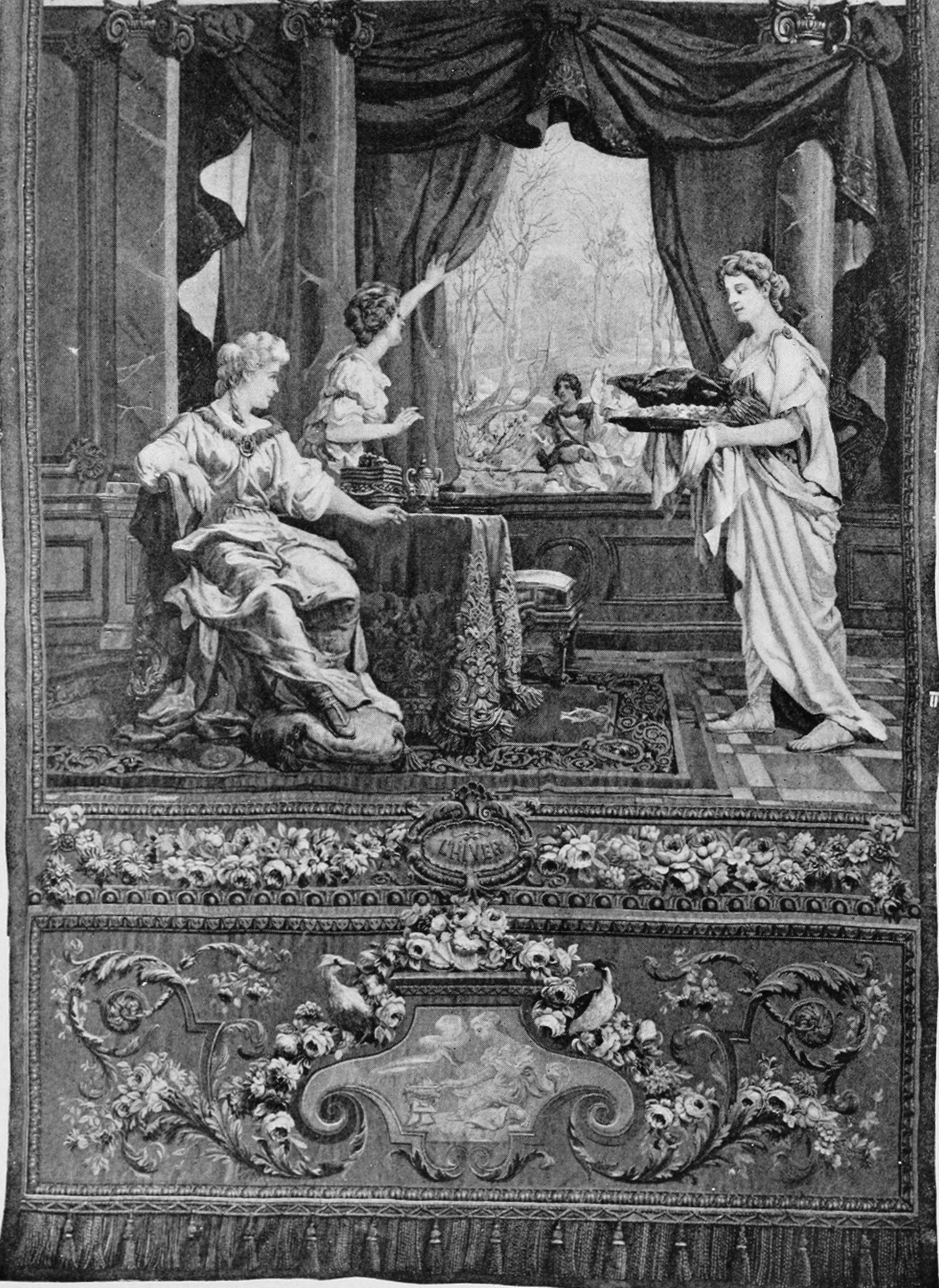
This matters for the Berkshires more than it looks. A mark in a selvage is the same kind of evidence as a founder’s name cast into a radiator, a quarry stamp on the underside of a step, or a modeler’s initials in the back of a plaster boss. These houses are full of such marks, and hardly anyone has read them. When somebody eventually goes through the surviving Berkshire interiors with a torch and a notebook, the selvages are where the tapestries will give up their makers.
X. Fifty feet of local wildlife
The last turn in the story is the one that should have happened here and, so far as the record shows, did not.
In February 1908 Albert Herter — a painter, not a manufacturer — set up looms on East 33rd Street and began weaving in the manner of the Netherlands in the time of Charles V. Like Morris, he worked at the loom himself. Like Morris, he loved the late Gothic verdure, the woven wood full of leaves and animals with figures moving through it.
And for the hall of Mrs E. H. Harriman’s house at Arden he wove one fifty feet long and five feet high, filled with American dryads and nymphs of forest and fountain, and with the trees and flowers, the birds, the rabbits and the foxes native to Arden itself.
That is a country house having its own woods woven into its own hall. Every element of it was available in Lenox: the money, the architects, the hall, the woods, the foxes. Nobody, so far as the Lenox record shows, ordered one.
XI. The men who sold it
Which is odd, because the trade was closer to these towns than to almost any others in America.
John Sloane and William Douglas Sloane were brothers, and the firm was W. & J. Sloane — carpets, rugs, upholstery, antiques and whole-house furnishing, on Broadway, to the Vanderbilts, the Whitneys and the Rockefellers. William married Emily Thorn Vanderbilt and built Elm Court from 1885. John bought Wyndhurst for fifty thousand dollars in 1893 and had Peabody & Stearns — his brother’s architects — put up a thirty-four-room Tudor house on it in 1894.
So in one decade, at two ends of one town, the two principals of the largest furnishing house in the United States each built himself a Berkshire cottage. Whatever hung in those halls, nobody had to go far to order it.
XII. So was it still an art
The answer the sources give is: barely, and only because of the collecting.
Baumgarten said it flatly in 1894, and it is the most useful sentence in his lecture. In his early years the tapestries he imported sold slowly. Then old tapestries started coming into the country and being bought by wealthy citizens for large sums — and the demand for modern tapestries, he says, received an impetus it had never had before. The antiques made the market for the new work. Without Widener buying dead Flemings, there is no Williamsbridge.
He knew exactly how precarious it was. He opened that lecture by calling his own industry “a little waif seeking a home in a foreign country, looking for friends and wishing to make itself agreeable and useful.” He listed the four things a tapestry works needs. The first was the royal purse of a Louis XIV or a Queen Victoria, and he said straight out that he did not have it. The second was an art-loving public among whom heavy bank accounts are not a rarity — and that one, he said, “we have in abundance in this blessed country of ours.”
He was standing in front of a room of artists, so he put the rest of it the way artists would understand: no art can flourish where the artists starve, where the best work of the chisel and the brush goes unborn for want of the fructifying contact.
Between them, Morris and Baumgarten had proved two things at once. The craft was not dead — a man could still learn it from a book, and another could still put thirty-six looms in the Bronx and take a Grand Prize with them. And it could not any longer stand on its own legs. It needed a Widener, or a Harriman, or a Vanderbilt-Sloane. In the Berkshires it had all three within four miles of each other, and what we have to show for it is three photographs with the word in the title.
William Baumgarten, Tapestry Making in America, a lecture before the National Sculpture Society, New York, 10 April 1894, printed in The Decorator and Furnisher, May 1894; the Brabant and French figures, the Lavaut commission, the sun-fading of new tapestry, the four conditions and the “little waif” are all his. George Leland Hunter, Tapestries: Their Origin, History and Renaissance (New York, 1912), for Baumgarten’s 1897 Chicago lecture (Foussadier, the Bronx water, the apprentices, the gentleman from Philadelphia, the immigration hearing), for the Morris diary entries and lectures as quoted there from Mackail, for the Herter Looms and the Arden hanging, and for the Williamsbridge photographs, which the firm supplied to Hunter. Millefleurs hanging with the Medici arms, Hainault, 1520s, and the French Month of May, 1723–1774: Cleveland Museum of Art, published as public domain. Wheatleigh interiors, Lenox Library Association, titles quoted as catalogued. Sloane brothers and the two houses: see Elm Court and Wyndhurst. No tapestry now or formerly in a Berkshire house is identified here, because no source consulted identifies one.