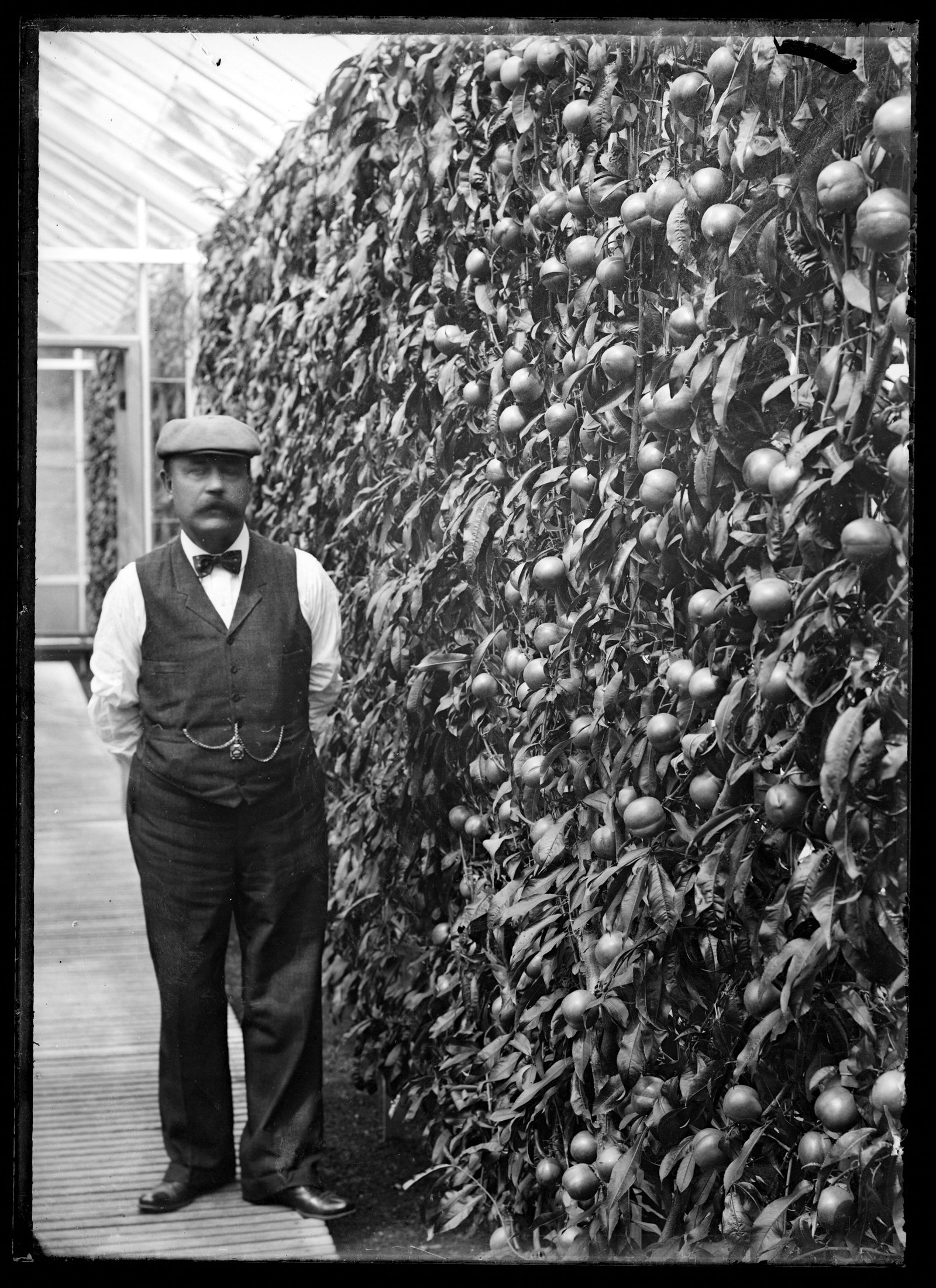
Stand in front of that photograph for a moment. A man in waistcoat and flat cap, hands at his sides, beside a wall of tomatoes that goes over his head and out of frame — ripe, dense, trained flat against the glass, hundreds of them. He is not smiling. He does not need to. The catalogue gives his name: Blantyre: Thomas Proctor in greenhouse.
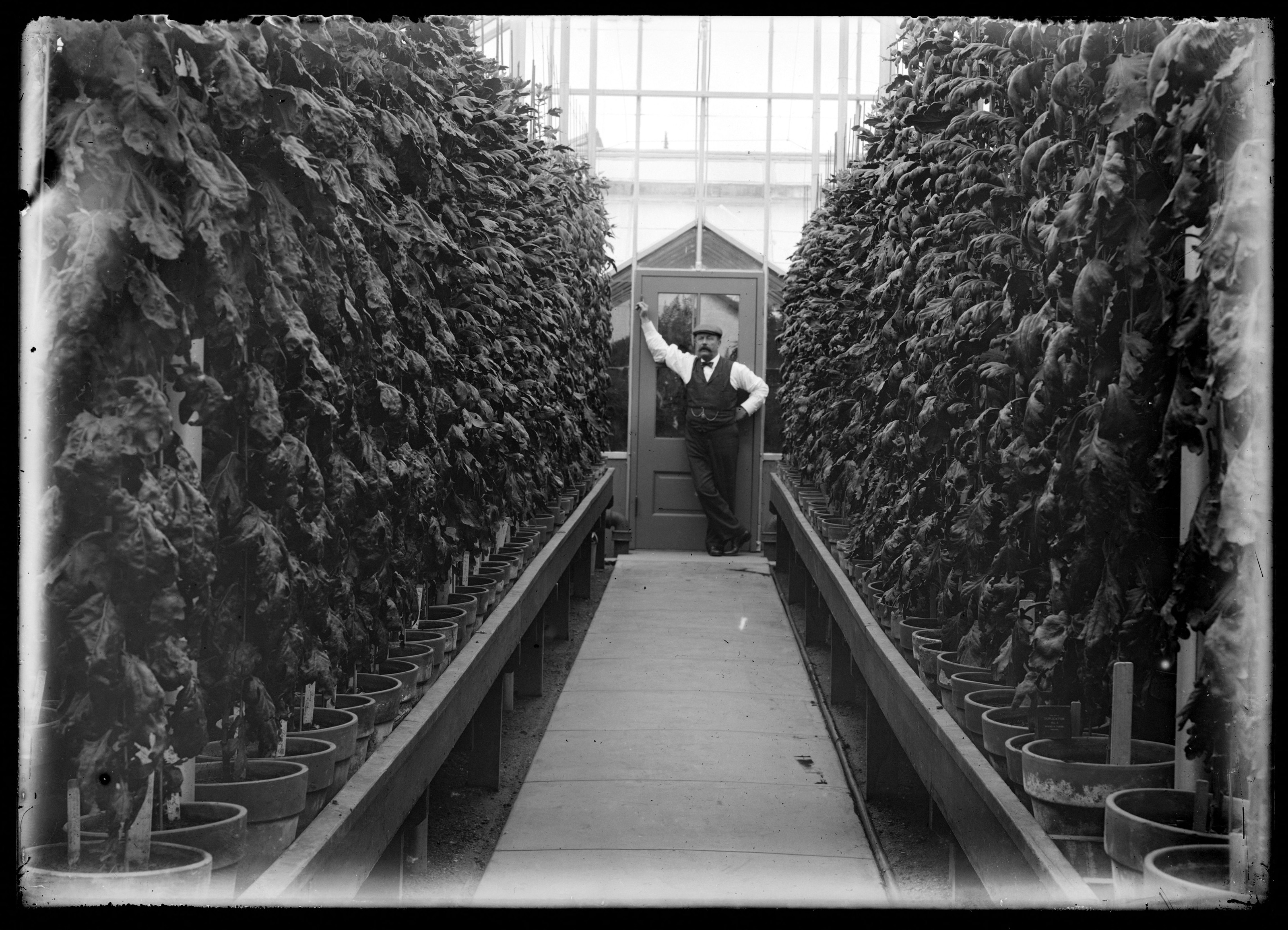
In the other plate, below, he is at the far end of a long aisle, a hundred feet of tomato vines on both sides trained to the roof, pots in ranks along the staging, the door open behind him and the light coming through. He has put one arm up against the frame. It is the posture of a man who has been asked to stand still in his own building.
I. What the glass was for
A Berkshire winter runs to twenty below and the growing season is short at both ends. The point of a greenhouse range on one of these estates was to defeat that, completely and expensively, so that a house which opened in June could put its own grapes, peaches, melons, figs, orchids and cut flowers on the table in a month when nothing outside was alive.
That required a plant engineer who happened to garden. Coal-fired boilers running day and night through a February gale. Hot-water pipe runs balanced so that no bench ran five degrees cold. Ventilation opened and shut by hand against wind and sun, several times a day, every day. Soil made, not bought. And under all of it the horticulture proper: grafting, stopping, thinning, forcing, the propagation of stock that had to be right twelve months ahead of the dinner it was for.
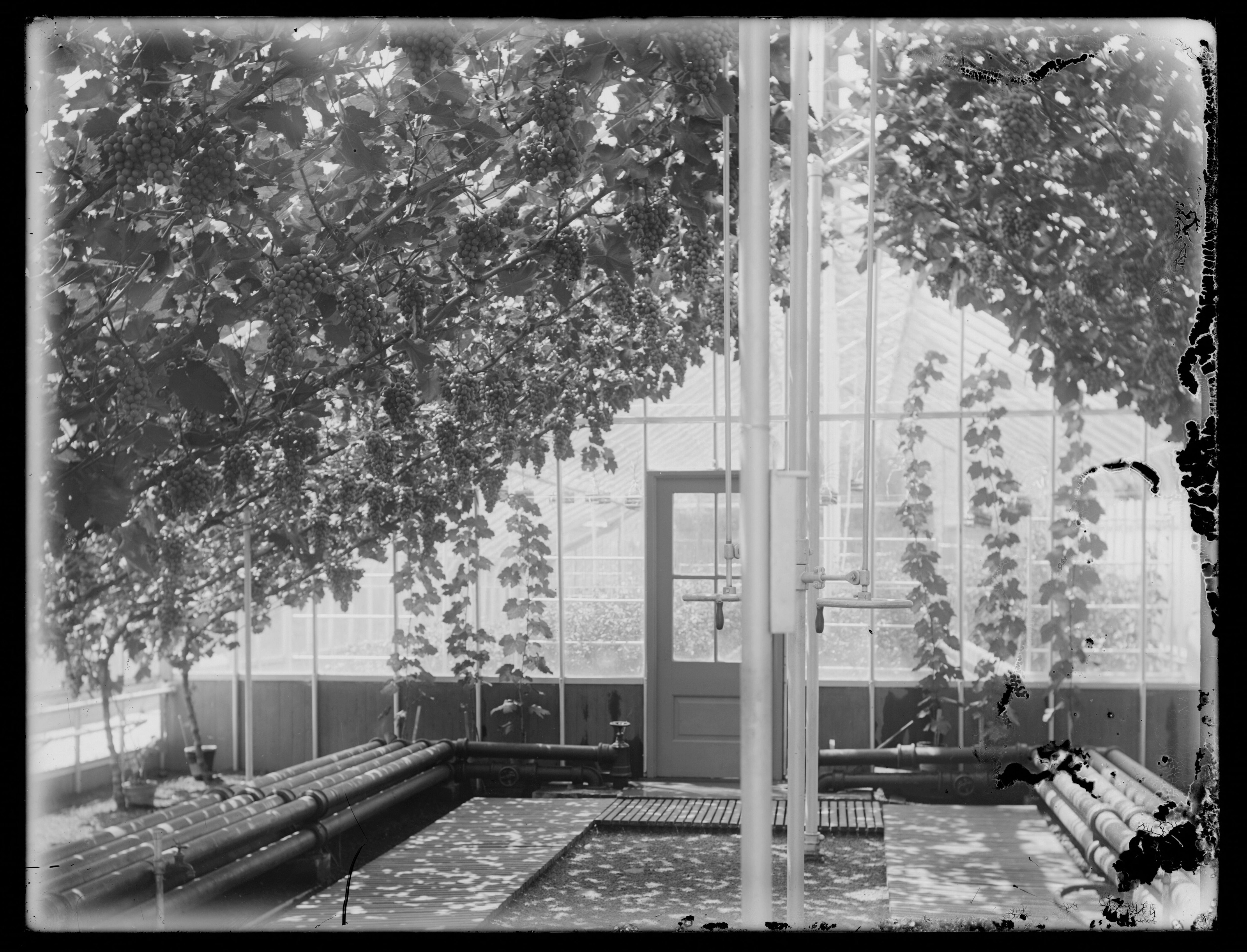
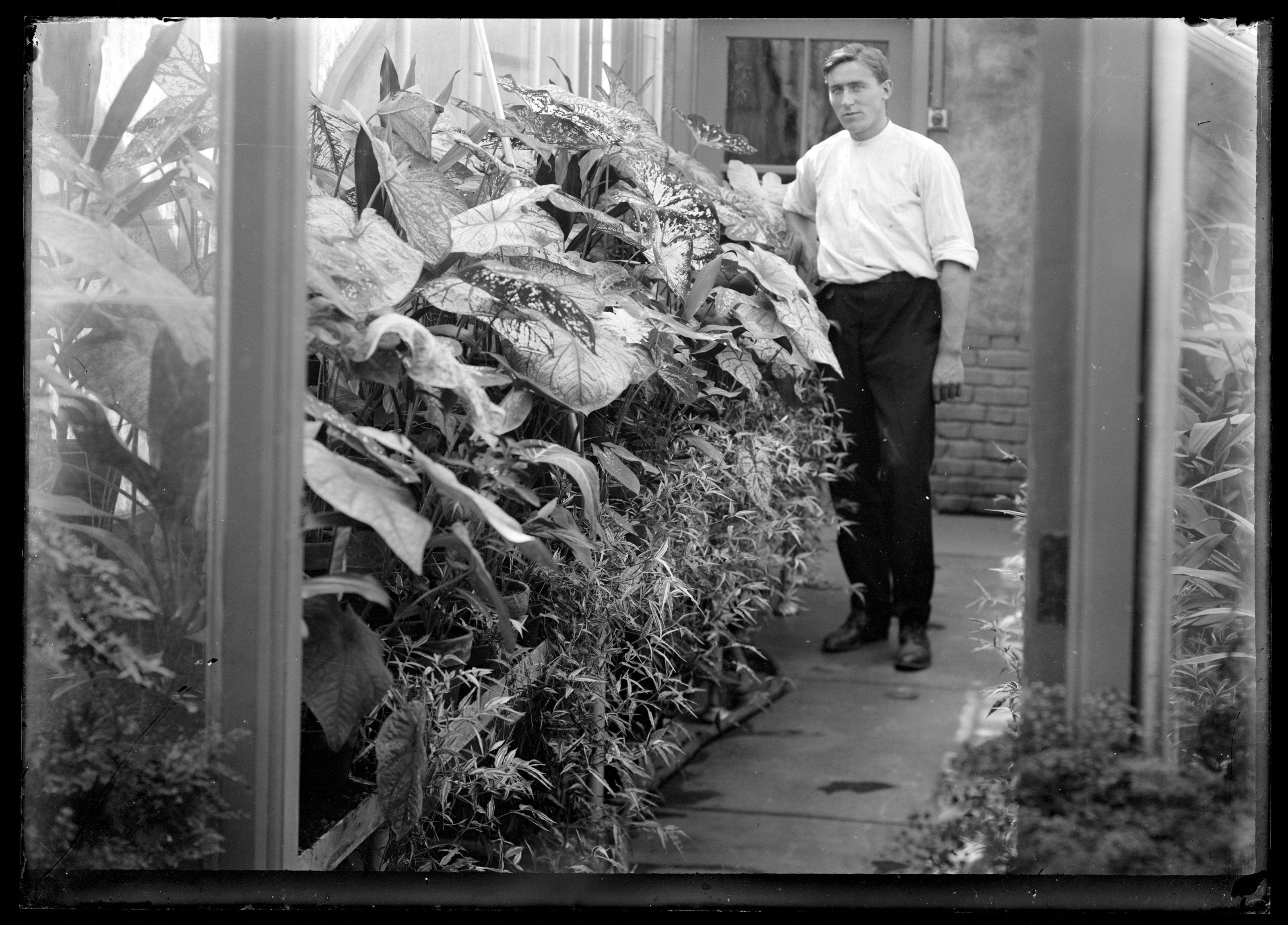
The vinery is in the second of those plates, grape canes trained the length of the glass and the floor swept clean enough to eat from. In the third, a younger man in shirtsleeves stands in the palm house among the foliage plants, halfway through something, caught by the camera. Nobody wrote his name down.
II. They had a society, and it had medals
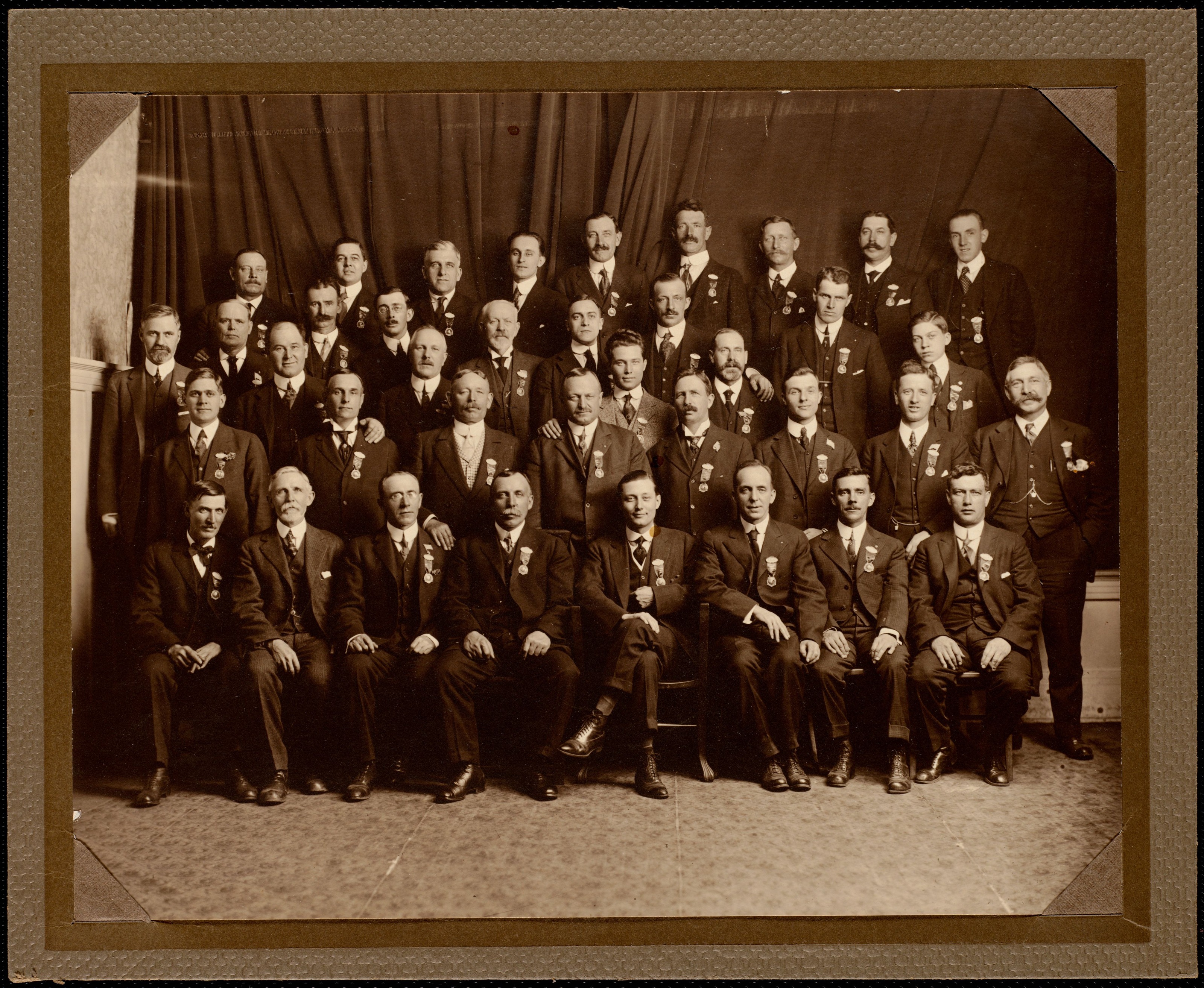
This is the photograph that rearranges the story. Forty-odd men in dark suits, seated and standing in formal rows against a studio curtain, most of them with a medal or a rosette on the lapel: Lenox Horticultural Society: judges at New York International Spring Flower Show.
Not servants at the back door. A professional body, incorporated, meeting through the winter, running its own shows, and sending its members down to Manhattan to judge the largest flower show in the country — to stand over other people’s exhibits and rank them. The Society brought in outside lecturers too, and one of their printed addresses survives at Cornell, its title page dated in pen Mch 1903.
C. L. Allen opened that lecture by telling the room exactly where he stood with it:
“Mr. Chairman and Gentlemen — it would be an unpardonable presumption on my part to attempt to instruct you in the principles or practice of general horticulture. Your reputation as gardeners is too well known to permit of what would seem an impertinence.”
The whole pamphlet is here, thirty-six pages of it, exactly as Cornell holds it. He goes on to talk about trees as an inheritance, about the geranium in the tenement window, and about what it is to be a thinker as well as a worker — which is not the lecture you would expect a trade body of employees to have booked, and is precisely the one they did.

Thirty-six pages. Arrow keys turn the spread when it is in view.
That is a visiting expert, in print, opening with an apology to a room of Berkshire estate employees. It is worth sitting with.
The men in that photograph were, most of them, employees. They were also the people other employees deferred to, the ones who hired and trained the under-gardeners, who negotiated with the owner over what the borders would do that year, and who could leave for another estate at a better wage and frequently did. A head gardener was a professional with a reputation that traveled — which is a materially different thing from a servant, and the lapels in the photograph are making exactly that point.
III. The under-gardeners
Below them the numbers were large and the record is thin. The 1923–’25 directory lists thirty-four gardeners and five florists across the southern towns, most with an employer attached and no more said: Dillon Peter gardener Brookside Farm. Kinnell Alexander asst gardener Brookside. Page Thomas F (Anna L) gardener “Brookside”. Foley John gardener Mrs Irene A Cowdrey’s.
At Wheatleigh in the same book there are twelve entries, among them a superintendent living on the place with his wife Celia, a florist, a gardener, a chauffeur, a teamster and several laborers — and, a few lines away in the same alphabet, the Countess de Heredia, widow of Carlos, at the same address. The directory does not rank them. It runs A to Z and lets the reader work it out.
IV. Where it went
The greenhouse ranges went first, because they were the most expensive thing on the property to keep and the first thing to look absurd once the family stopped coming up. Glass breaks, boilers fail, and a vinery unheated for one winter is finished. Most of the ranges in these photographs no longer exist in any form.
What Proctor knew went with them, and it was not a small thing: how to bring a crop to the table in a month when the ground outside is iron, in a building he heated by hand, for people who would eat it without asking how it got there. He is standing beside the evidence in the only two pictures of him anyone kept.
Photographs, Lenox Library Association, through Digital Commonwealth; titles quoted as catalogued. Gardener and florist counts from Crowley & Lunt’s South Berkshire Directory, 1923–’25, reproduced in full here; that volume covers the southern towns and not Lenox. The 1926 Central Berkshire directory does cover Lenox, and turns up fifty-nine gardeners and fourteen florists across its nine towns. The 1903 address before the Lenox Horticultural Society is C. L. Allen’s, held by Cornell. Thomas Proctor has not yet been traced beyond the catalogue entry.