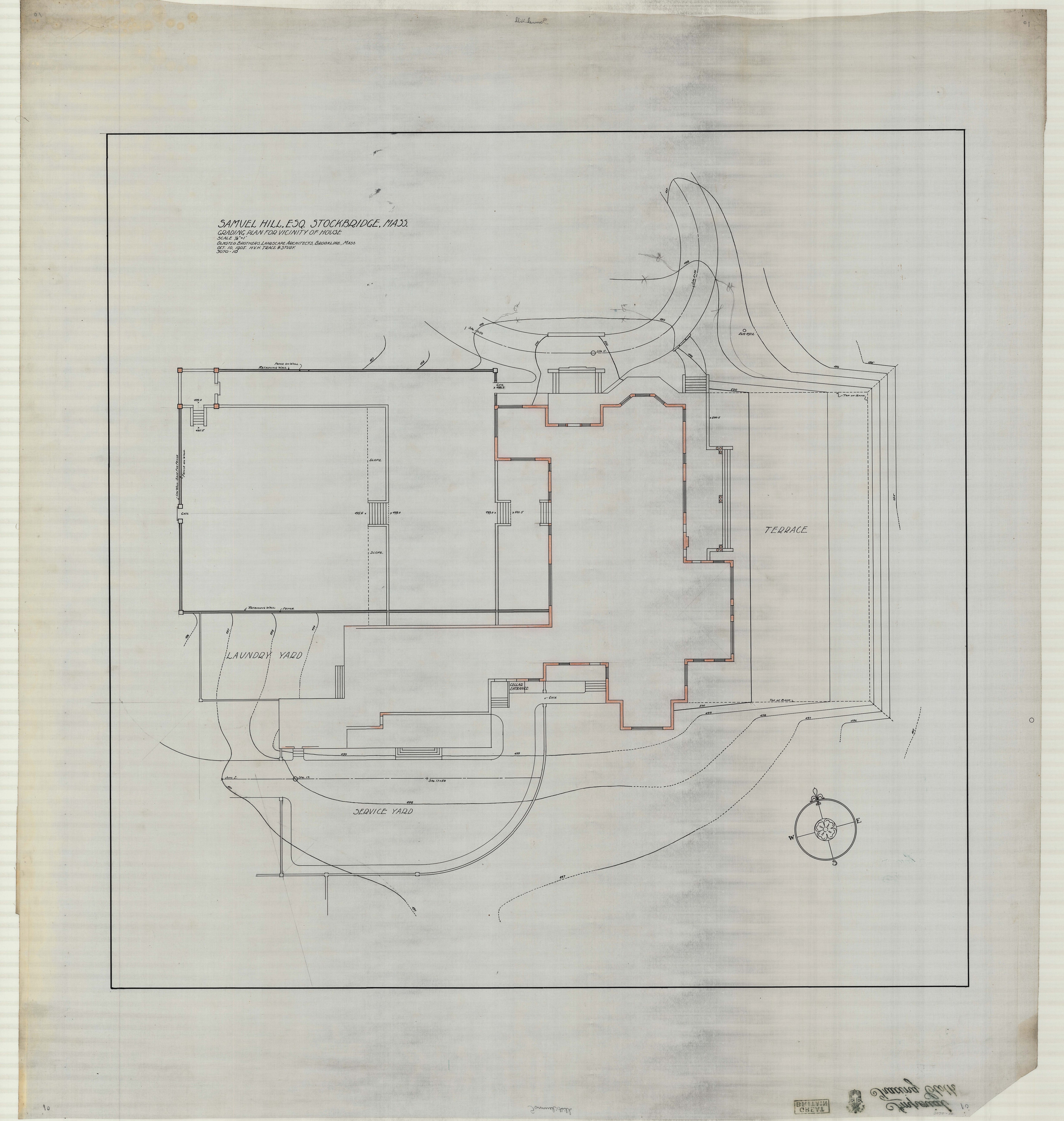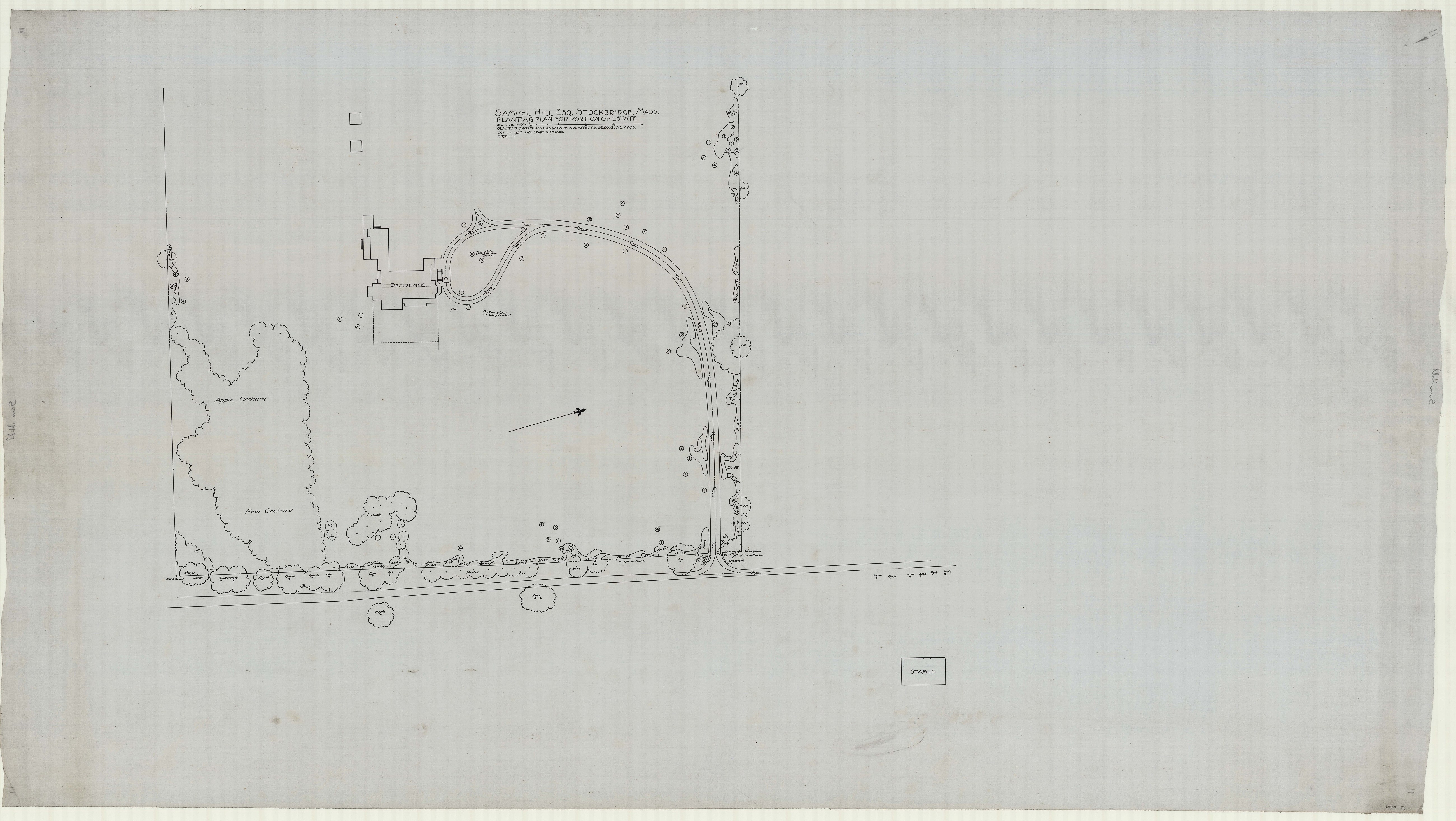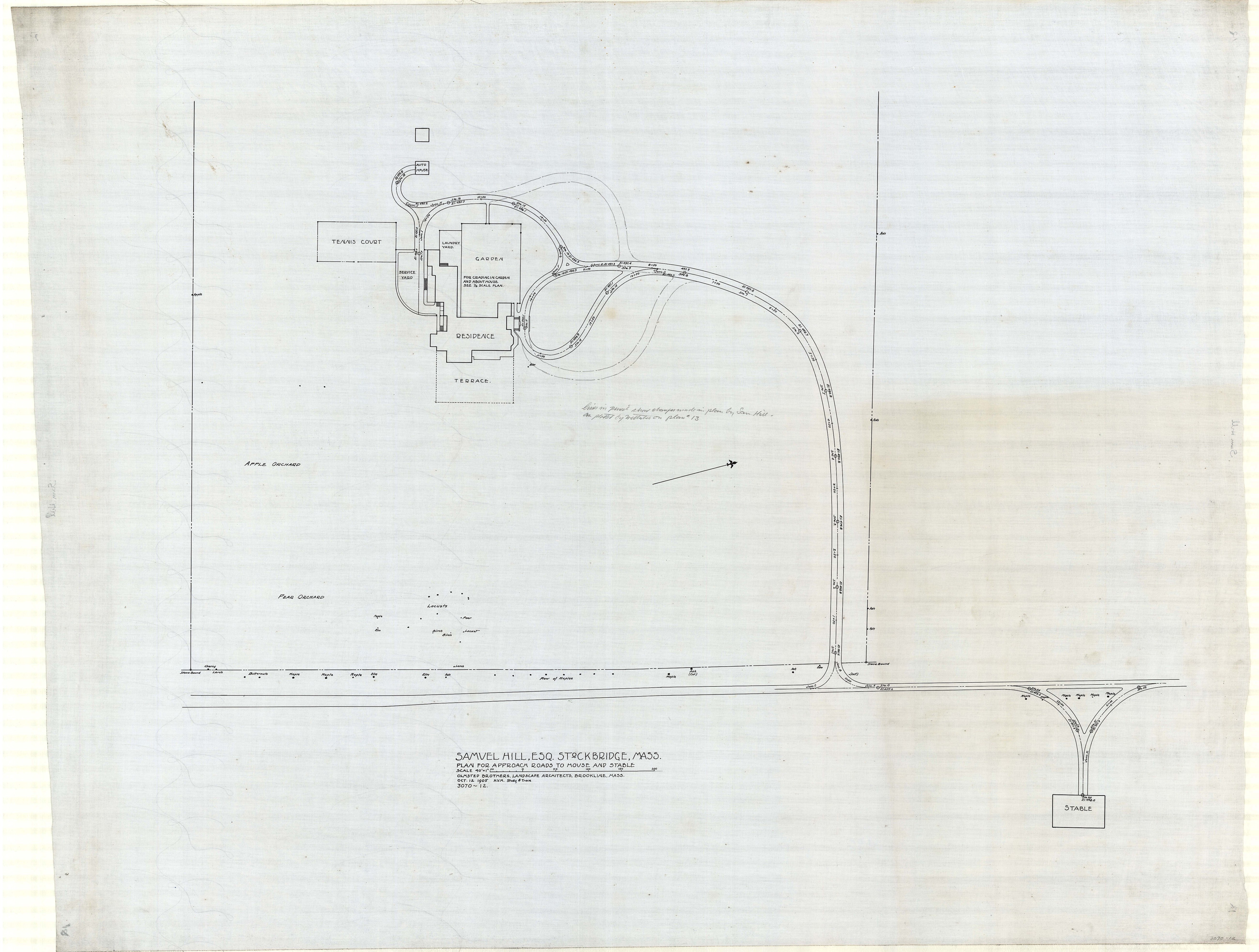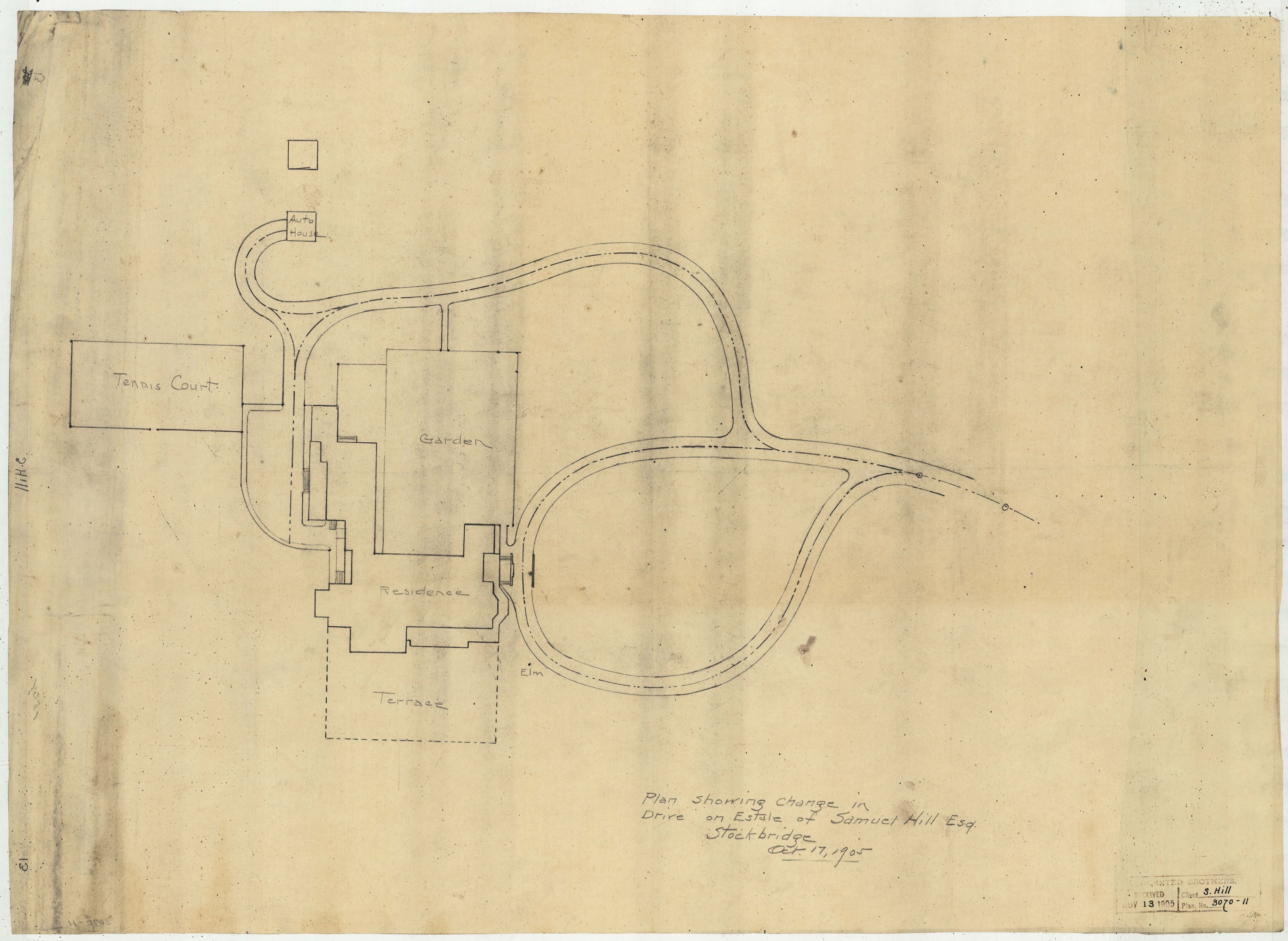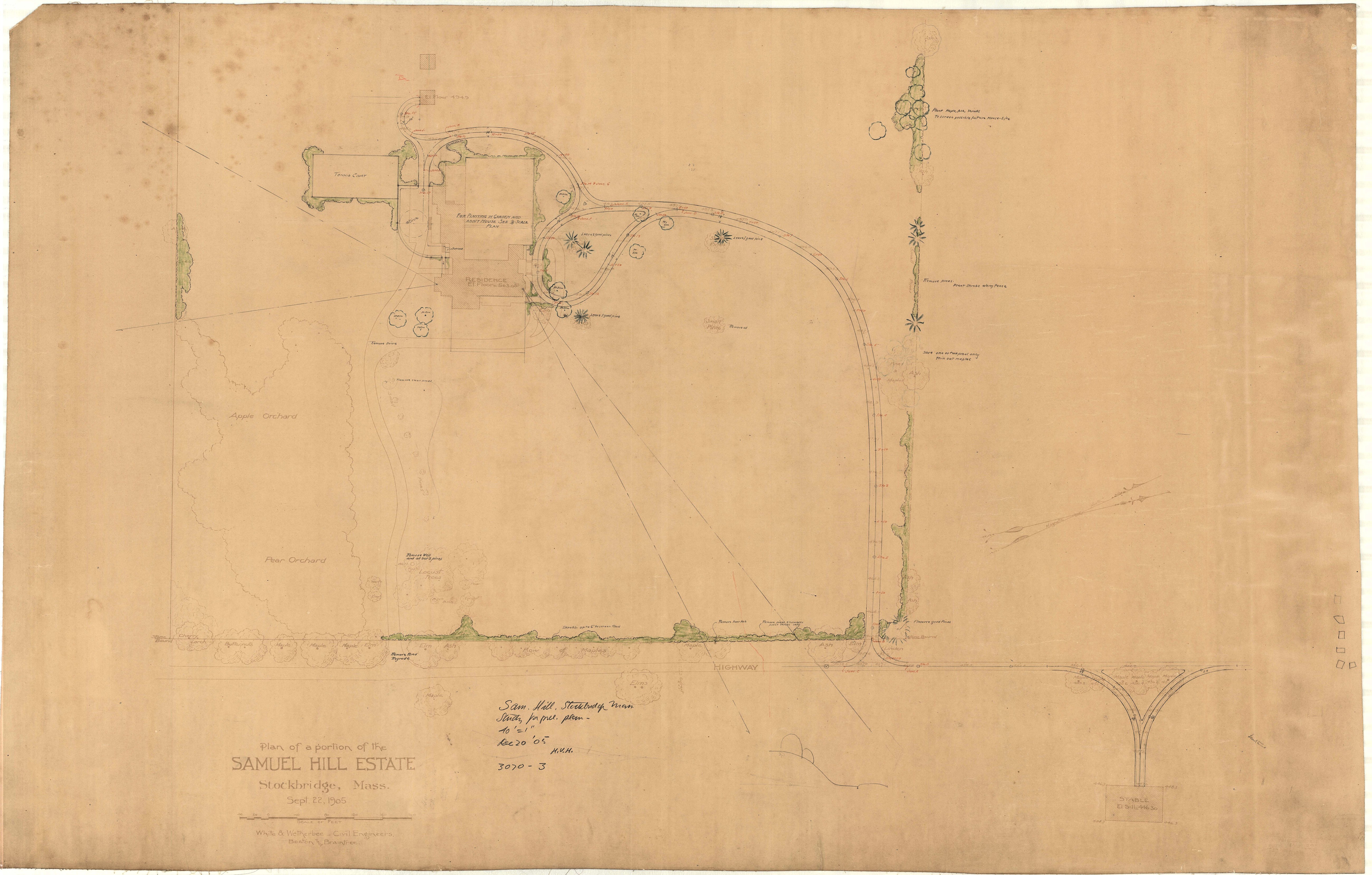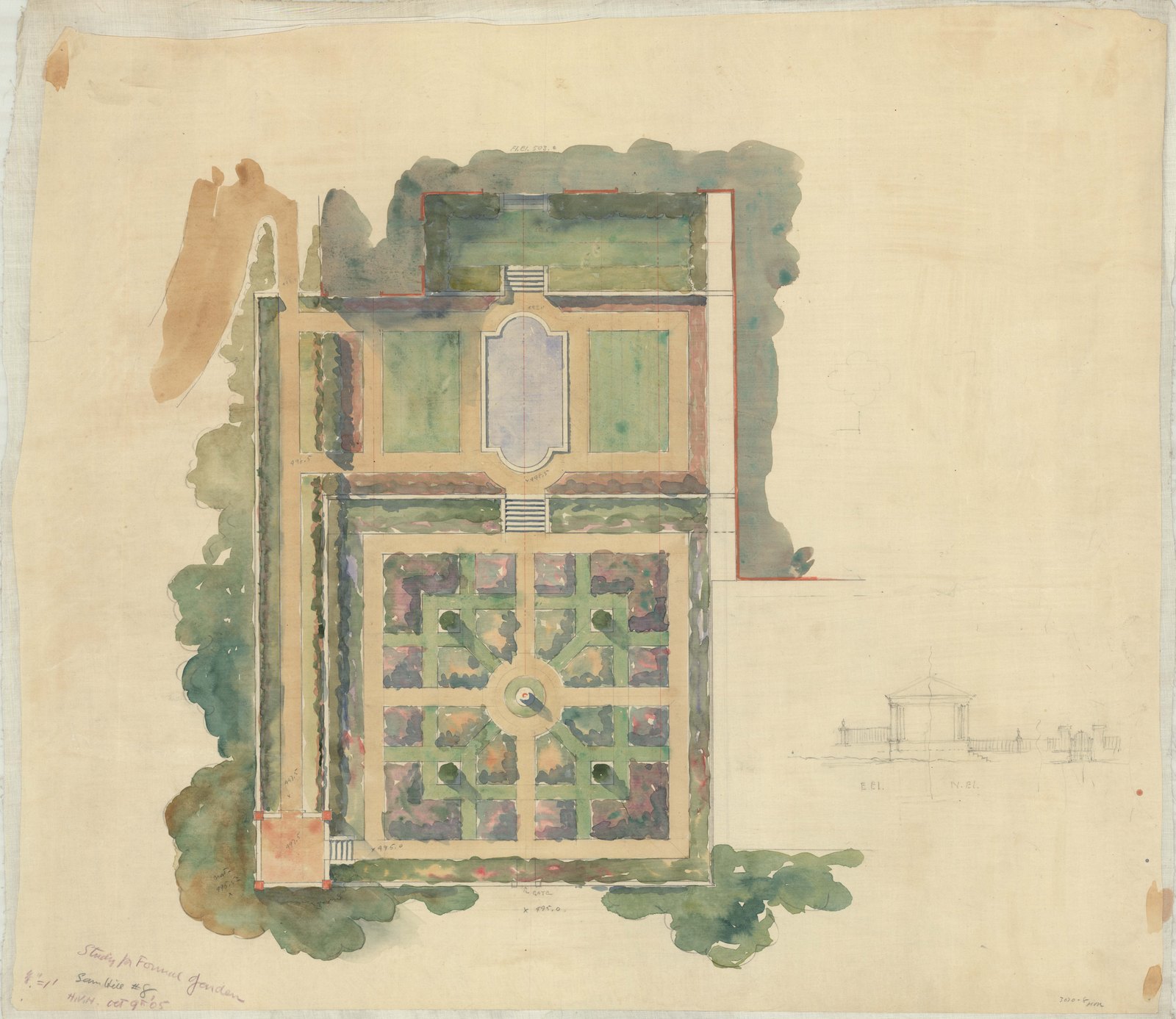
The estate known now for the school that closed on it was drawn by the Olmsted firm in the autumn of 1905. Nine sheets, September to December, for a new owner named Samuel Hill: the drives, the grading around the house, a tree plan, a planting plan, and a formal garden laid out in watercolor. It was not called Bonnie Brier then. It was called Shaughlin — which is why no sheet in the job carries the name this page is filed under.
I. The file
Olmsted job 03070 is filed as Hill, Sam — Stockbridge, MA, type “Private Estate & Homesteads.” Nine plans survive, every one of them dated between 22 September and 20 December 1905, and the job file at the Library of Congress carries the same year.
The sheets are large. Plan 1 measures 52½ by 48½ inches; the planting plan is 37 by 65.
II. Which house, and what it was called
The house was built in 1892 for Leonard Forbes Beckwith and Margaretta Pierrepont Beckwith, and it was called the Manor of Beckwithshaw — the name cut into the hall fireplace. It had thirty-one rooms and cost about $100,000, on an estate the Berkshire Eagle puts at some 1,800 acres taking in the village of Curtisville and a pulp mill. Beckwith, a consulting engineer to the Empire City Subway Company, claimed the design as his own; both the Eagle and the Berkshire Edge credit H. Neill Wilson of Pittsfield — the architect of Shadow Brook and of Blythewood. By 1895 Beckwith had been committed.
The property then went to the Hill family. The two accounts differ on the detail: the Eagle says James J. Hill, the railway magnate, bought it in 1904 for his daughter Mary, of Seattle, who renamed it Shaughlin; the Berkshire Edge says Sam Hill bought it in 1905 for $90,000 and renamed it Shaughlin. Mary Hill was James J. Hill’s daughter and Samuel Hill’s wife, so the two versions describe one transaction from different ends. Sam Hill was a Quaker lawyer and railway executive who, by the Edge’s account, disliked both the cottage and New England, and held that real estate was “a liability and not an asset.”
Which makes the Olmsted file read very clearly. The job is entered as Hill, Sam — Stockbridge; the drawings begin on 22 September 1905; the Edge dates Sam Hill’s purchase to 1905. The owner, the town and the year all agree, and the absence of the name Bonnie Brier from the title blocks is no longer a difficulty — in 1905 the place was Shaughlin. Bonnie Brier is a later name, and belongs to the Hannas from 1916.
The identification still rests on the owner’s name, the town and the year rather than on a sheet that names the property, and a deed search would settle it outright. But it is now a good deal more than very likely.
III. What the firm drew, autumn 1905
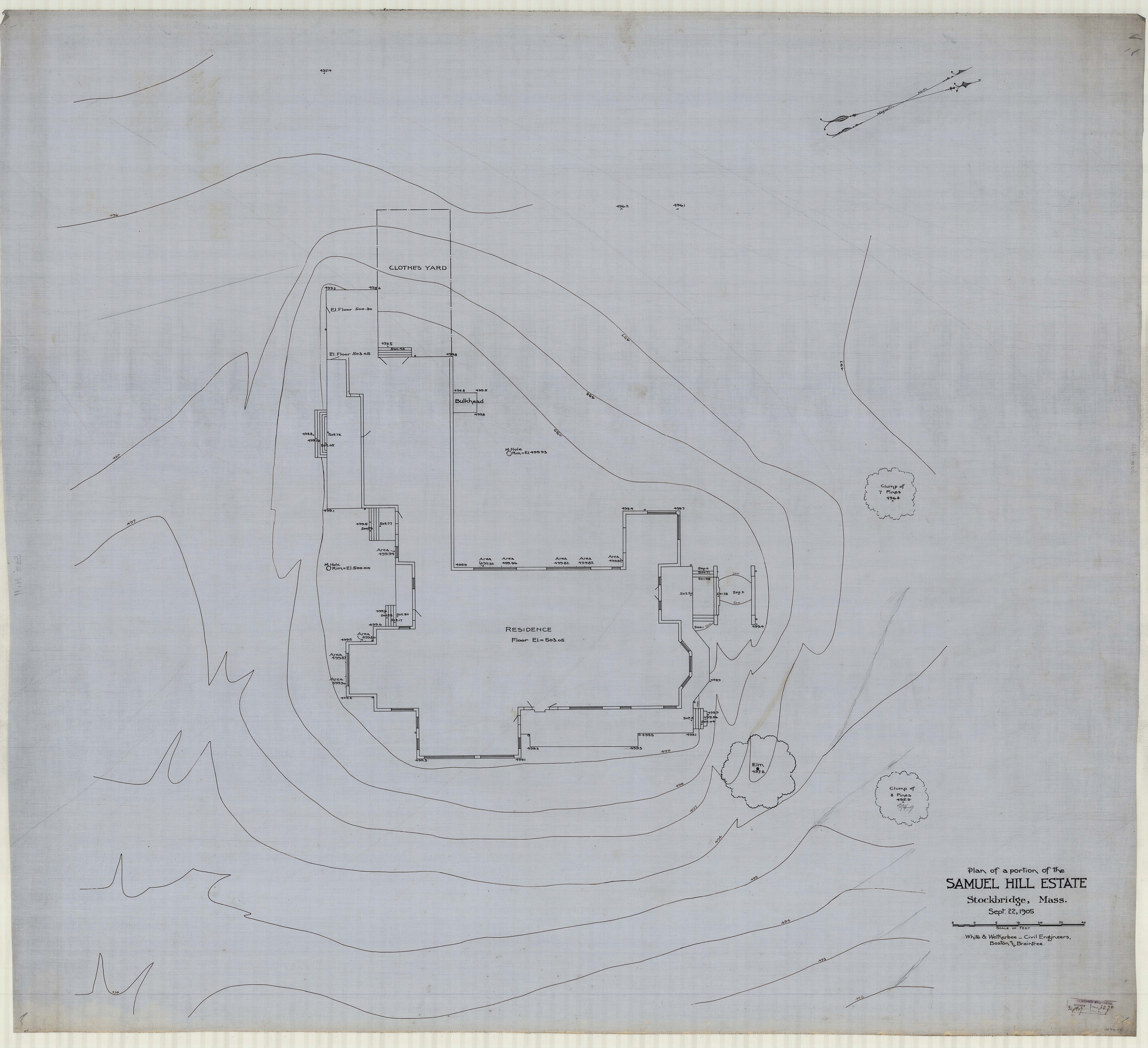
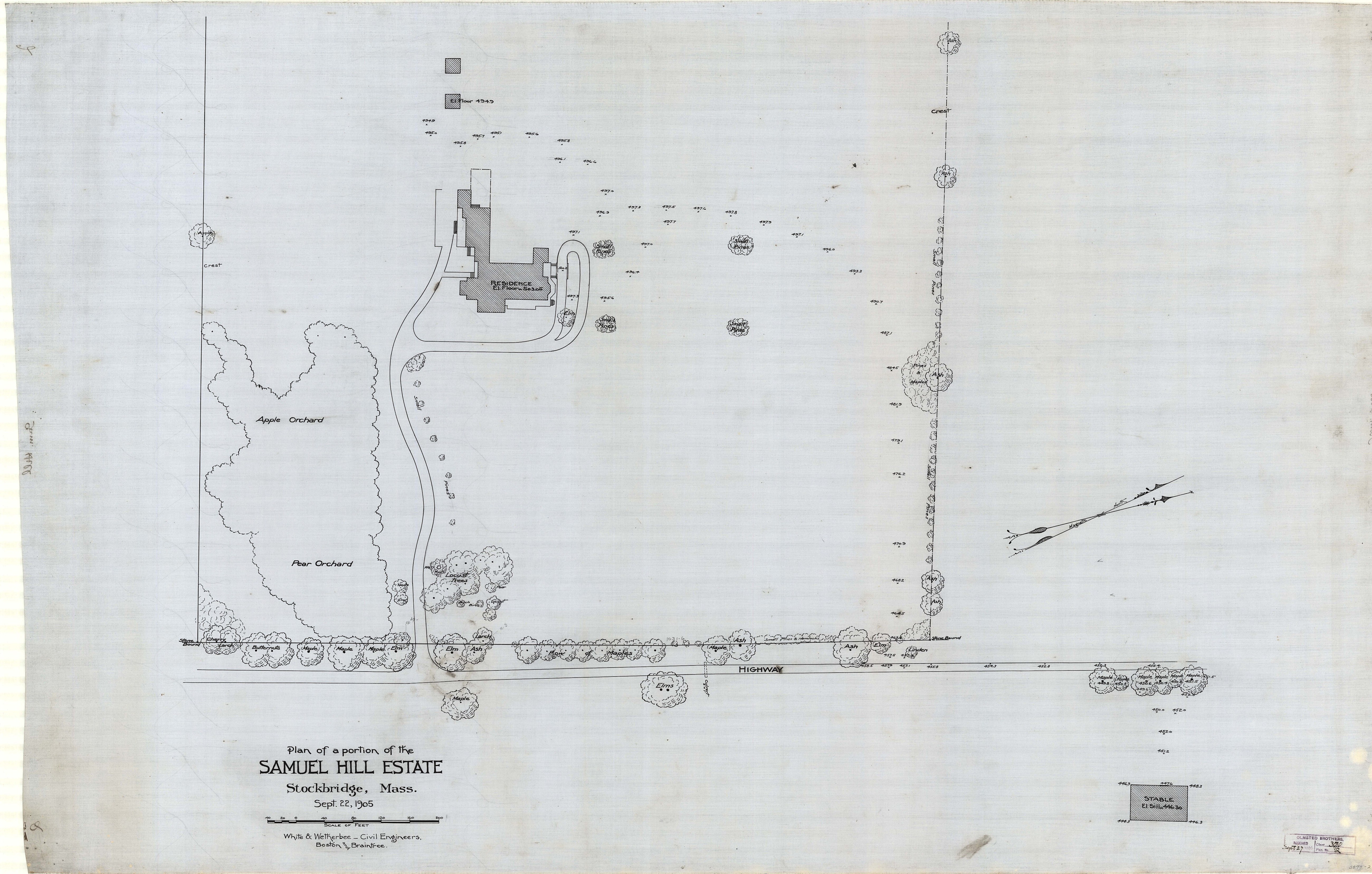
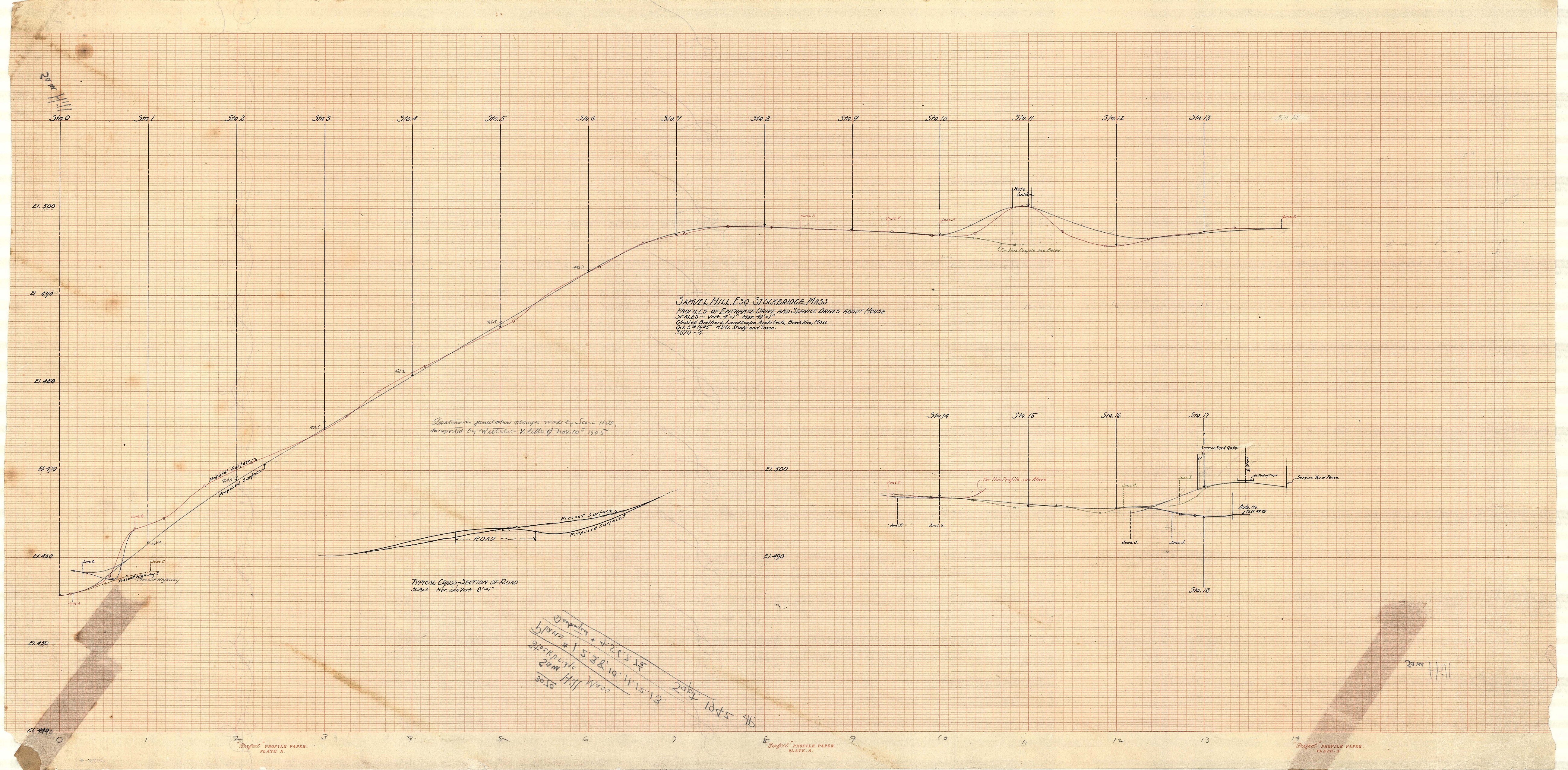
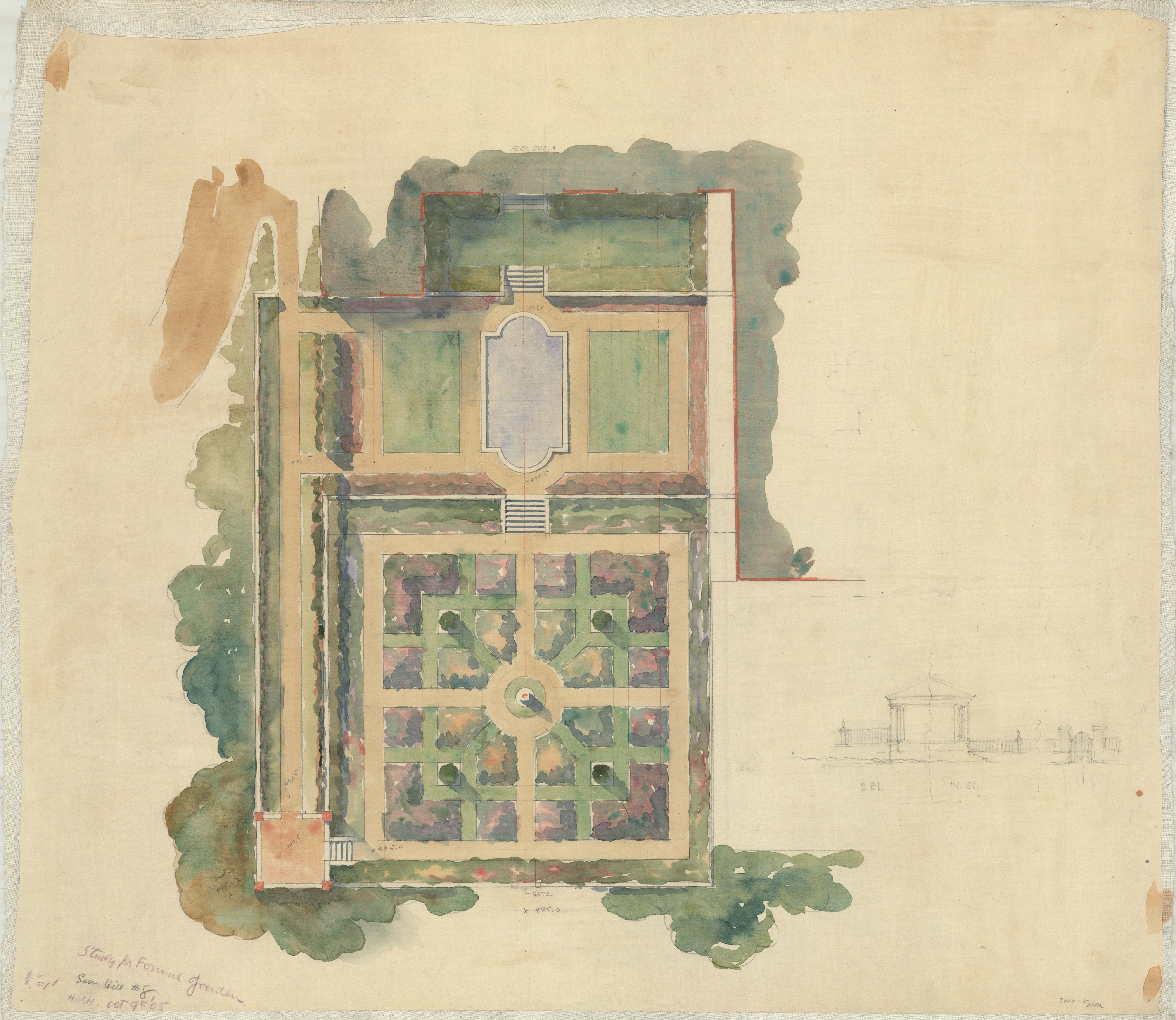
The sequence reads like a season of work. Two survey plans of portions of the estate on 22 September. A profile of the entrance drive and the service drive about the house on 5 October. The formal garden study on 9 October — beds, a pool, hedges, drawn in color. The grading plan for the vicinity of the house and the planting plan, both on 10 October. Approach roads to the house and stable on 12 October. A change in the drive on 17 October, the inventory noting the features involved: “Auto House, Tennis Courts.” Then, on 20 December, a study for a tree plan.
An automobile house in 1905, drawn into the same sheet as the tennis courts. The estate was equipping itself for the new century while the trees were still being sited.
IV. The Hannas, and the name
In 1916 the estate was bought by H. R. “Dan” Hanna — Daniel Rhodes Hanna, son of the Ohio businessman and senator Mark Hanna, and the owner of Cleveland newspapers. The Berkshire Edge says he paid $500,000 and gave it as a wedding present to his fourth wife; the Eagle records the purchase as 978 acres, five hundred of them from the Beckwith estate, for a cattle farm. It is Molly Hanna who renamed it Bonnie Brier, and by the Eagle’s account the name settled on the place under her after their divorce in 1921. It was auctioned in 1926. Hanna built a barn of twenty thousand square feet for a hundred horses; it burned in 1955.
And this ground is where Tanglewood started. The first Berkshire Symphonic Festival concerts were given on 23, 25 and 26 August 1934 in Dan Hanna’s horse-show ring here, by sixty-five members of the New York Philharmonic under Henry K. Hadley. The third festival, in August 1936, moved to Holmwood, the house built on the Erskine Park site; the Boston Symphony came to Tanglewood the year after. Among the founders of that festival was Georgie Cook de Heredia of Wheatleigh.
In 1948 Hans and Ruth Maeder bought the place — Wikipedia gives the price as $60,000 for 1,100-plus acres with 2,500 feet of frontage on the Stockbridge Bowl — and opened the Stockbridge School, which ran until 1976. The DeSisto School followed from 1978 until it closed in 2004. In 2009 the parcel sold at auction to the Sheehan Health Group for about $1.35 million.
The buildings have been empty for two decades and the estate has been through several development proposals. The 1905 drawings are the earliest designed record of the grounds that anyone can consult.
Sources
Olmsted Archives, Frederick Law Olmsted National Historic Site, National Park Service: job 03070, nine plans, titles, dates and sheet sizes as inventoried at olmstedonline.org; scans from the Olmsted Archives on Flickr. The Berkshire Eagle, “The Cottager: Beckwithshaw: A look behind the walls,” for Beckwith, the thirty-one rooms, the $100,000, the 1,800 acres, H. Neill Wilson, James J. Hill’s purchase in 1904 for his daughter Mary, the name Shaughlin, and the Hannas’ 978 acres, the 1921 divorce and the 1926 auction. The Berkshire Edge, “Dateline Stockbridge: The story of a great Stockbridge estate,” for the Manor of Beckwithshaw and the fireplace inscription, Beckwith’s commitment by 1895, Sam Hill’s purchase in 1905 for $90,000, his view of real estate, Dan Hanna’s $500,000 in 1916 and the wedding present, Molly Hanna and the name Bonnie Brier, and the twenty-thousand-square-foot barn that burned in 1955. Boston Symphony Orchestra, “A Festival Is Born: 1934–1936,” for the first concerts of 23, 25 and 26 August 1934 on the Hanna property, the sixty-five players of the New York Philharmonic under Henry K. Hadley, and the move to Holmwood in August 1936. Wikipedia, “Stockbridge School” and “DeSisto School,” for the Maeders, the acreage and the later sales. The Eagle and the Edge disagree on whether James J. Hill or Samuel Hill was the buyer and on whether the year was 1904 or 1905; both readings are given above. No period photographs of this estate were found in Digital Commonwealth.