The last sheet in this job is dated 4 August 1939. Nineteen days later the client was dead, killed by his own tractor in the yard the drawing was made for. Sidney Howard had won a Pulitzer Prize for the theater and had just finished the screenplay of Gone with the Wind; the Academy Award he won for it, in 1940, was the first ever given to someone who was not alive to take it. This is the smallest job on the site, and the most exactly dated.
I. The file
Olmsted job 09545 is filed as Howard, Sidney — Tyringham, MA, type “Private Estate & Homesteads.” Four plans, five scans. The firm was Olmsted Brothers, working sixty years after the office’s first Berkshire commission at The Homestead.
It is not an estate job in the Lenox sense. There is no formal garden here, no terrace, no gate lodge. The features the surveyor recorded are a highway, a driveway, a house, a cow barn, a tennis court, woods, and an old mill site with its dam.
II. October 1938
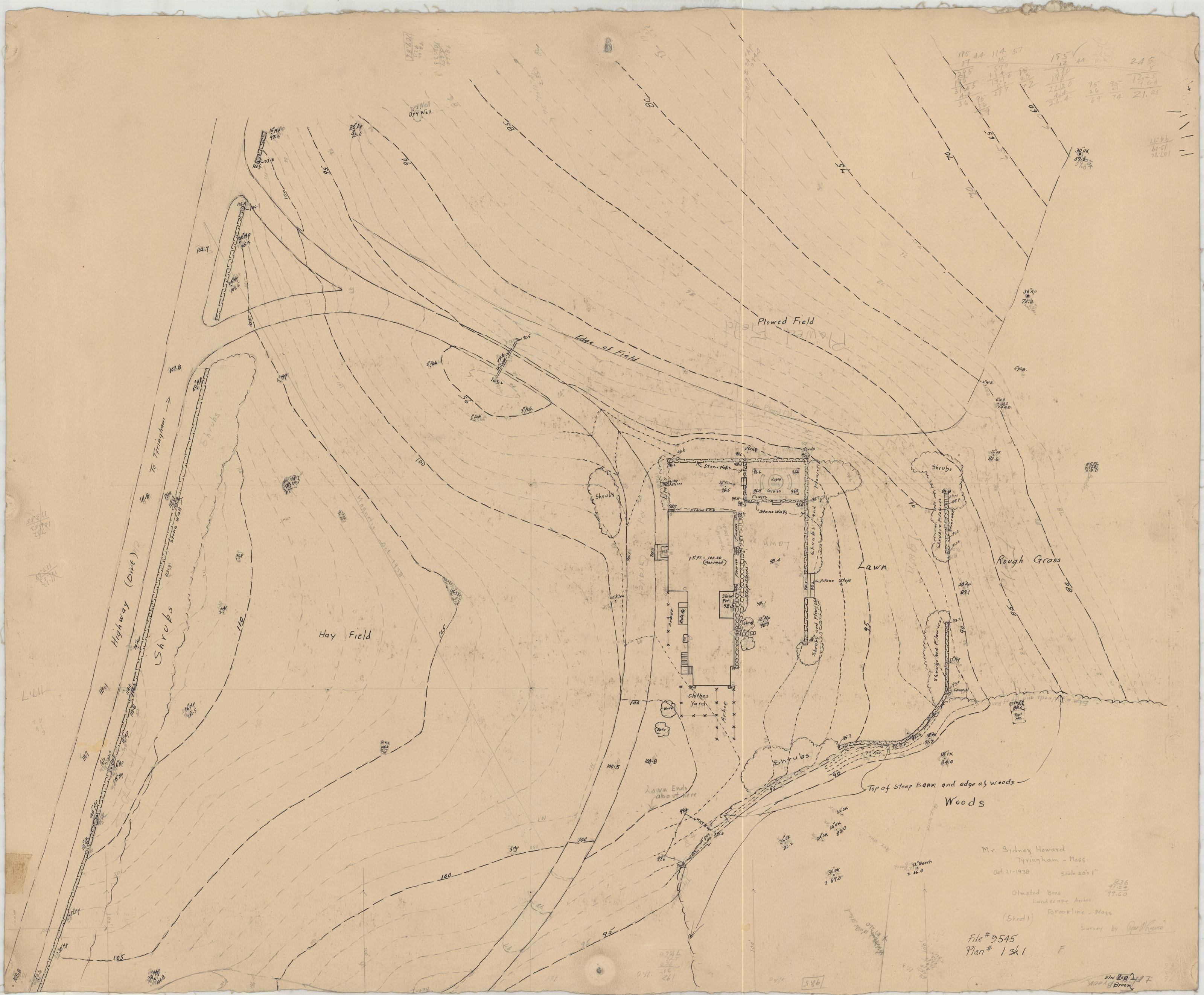
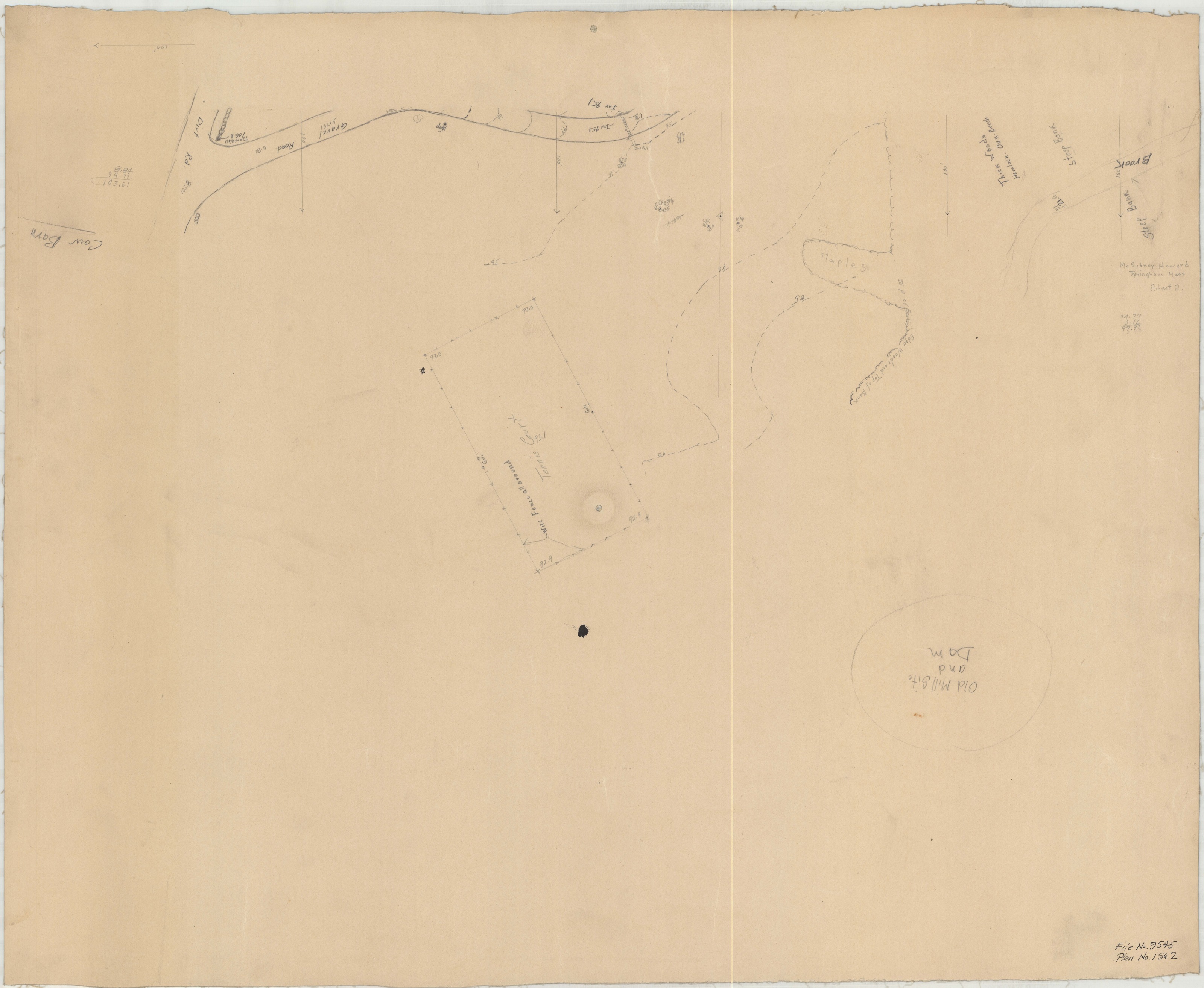
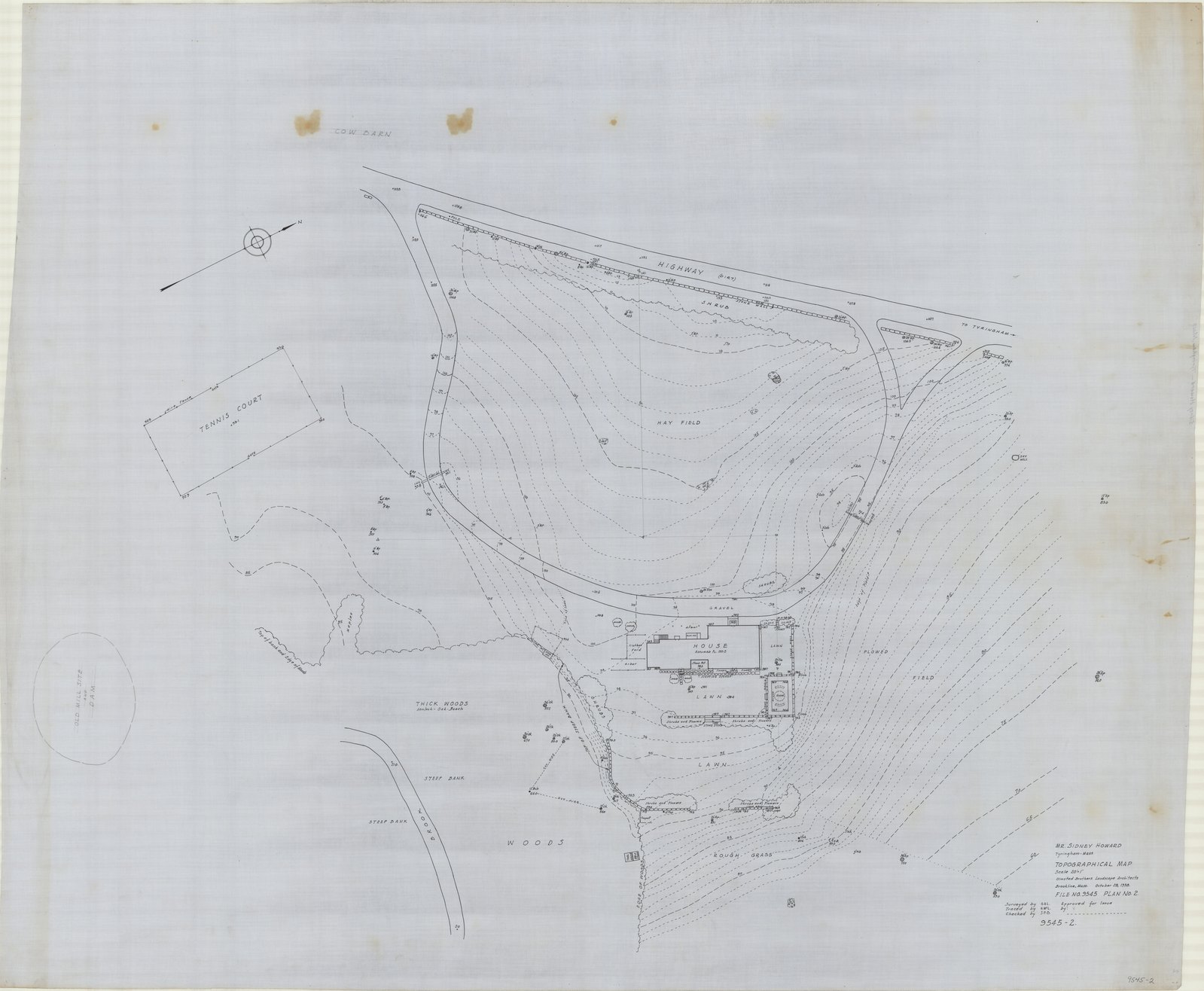
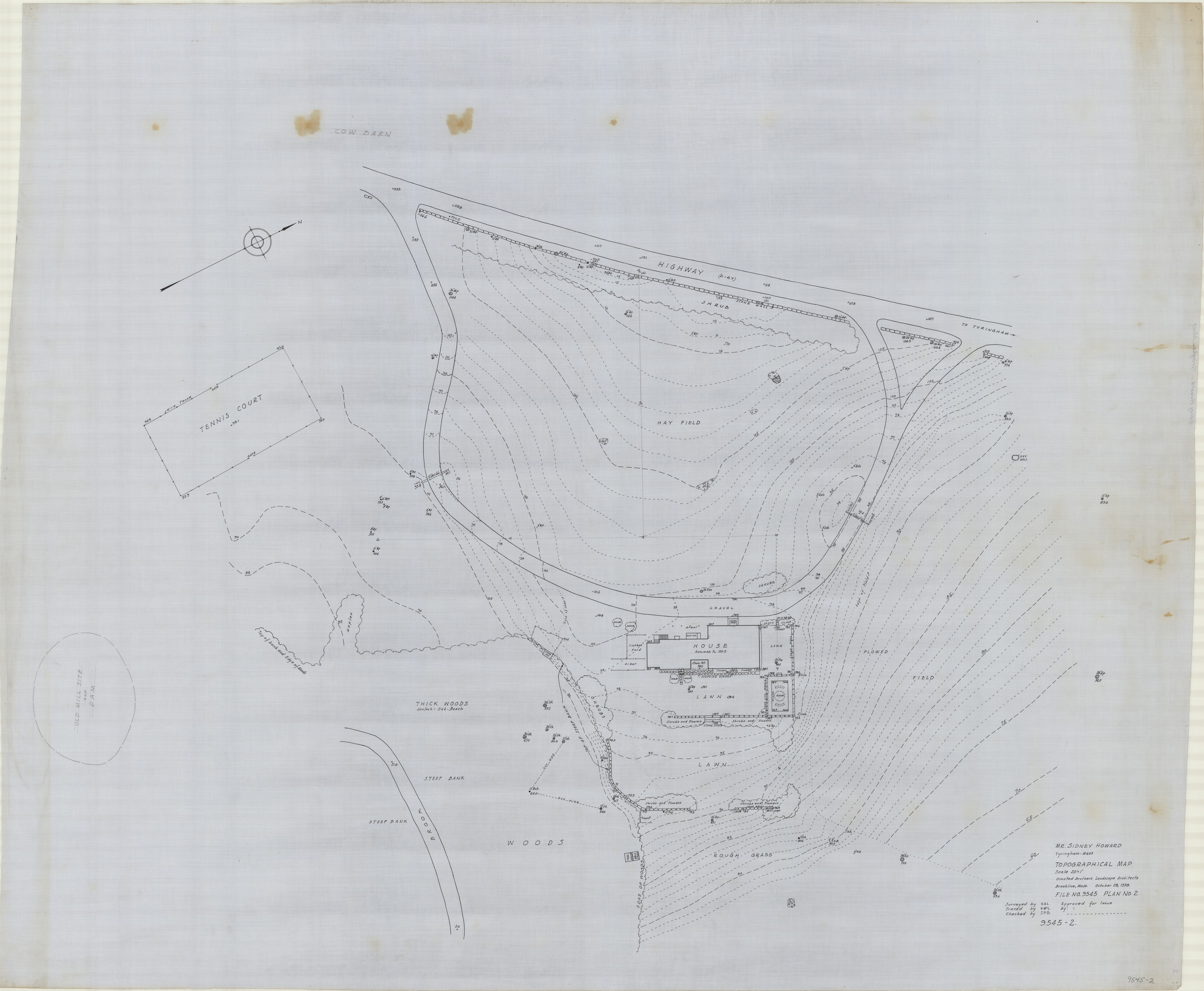
The work begins with two plane table sheets at twenty feet to the inch, the first dated 21 October 1938 and credited in the inventory to a named surveyor: “Survey by Geo. A. Lewis.” The first sheet takes in the highway to Tyringham, the driveway and the house. The second carries the driveway again, the cow barn, the tennis court, and the old mill site and dam.
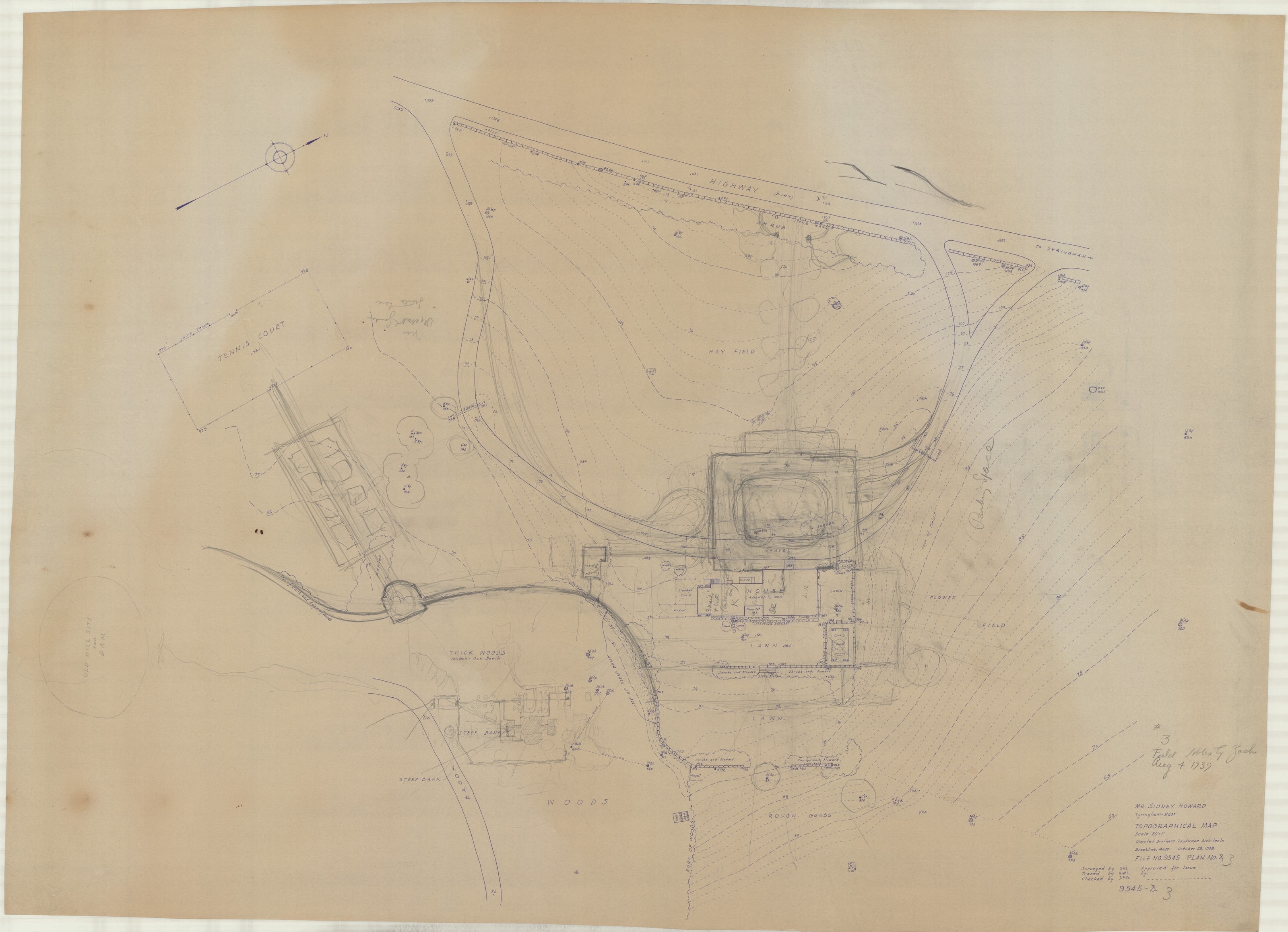
A week later, on 28 October 1938, those sheets were worked up into a topographical map thirty-seven and a half inches by thirty-four and a half. The inventory lists what it shows in the order a walker would meet it: highway, cow barn, tennis court, house and shrubs, woods, old mill site and dam.
III. The client
Sidney Coe Howard was born at Oakland, California, on 26 June 1891. He won the Pulitzer Prize for Drama in 1925 for They Knew What They Wanted. He married the actress Clare Eames in 1922; she died in 1930, and their daughter Jennifer Howard became an actress herself. In 1931 he married Polly Damrosch, and they had three children.
By the late 1930s he was working in Hollywood as well as on Broadway, and the adaptation he wrote of Margaret Mitchell’s novel became the screenplay of Gone with the Wind. The farm at Tyringham ran to seven hundred acres. The Olmsted Brothers were surveying it in the autumn of 1938, and the film opened in December 1939.
IV. August 1939
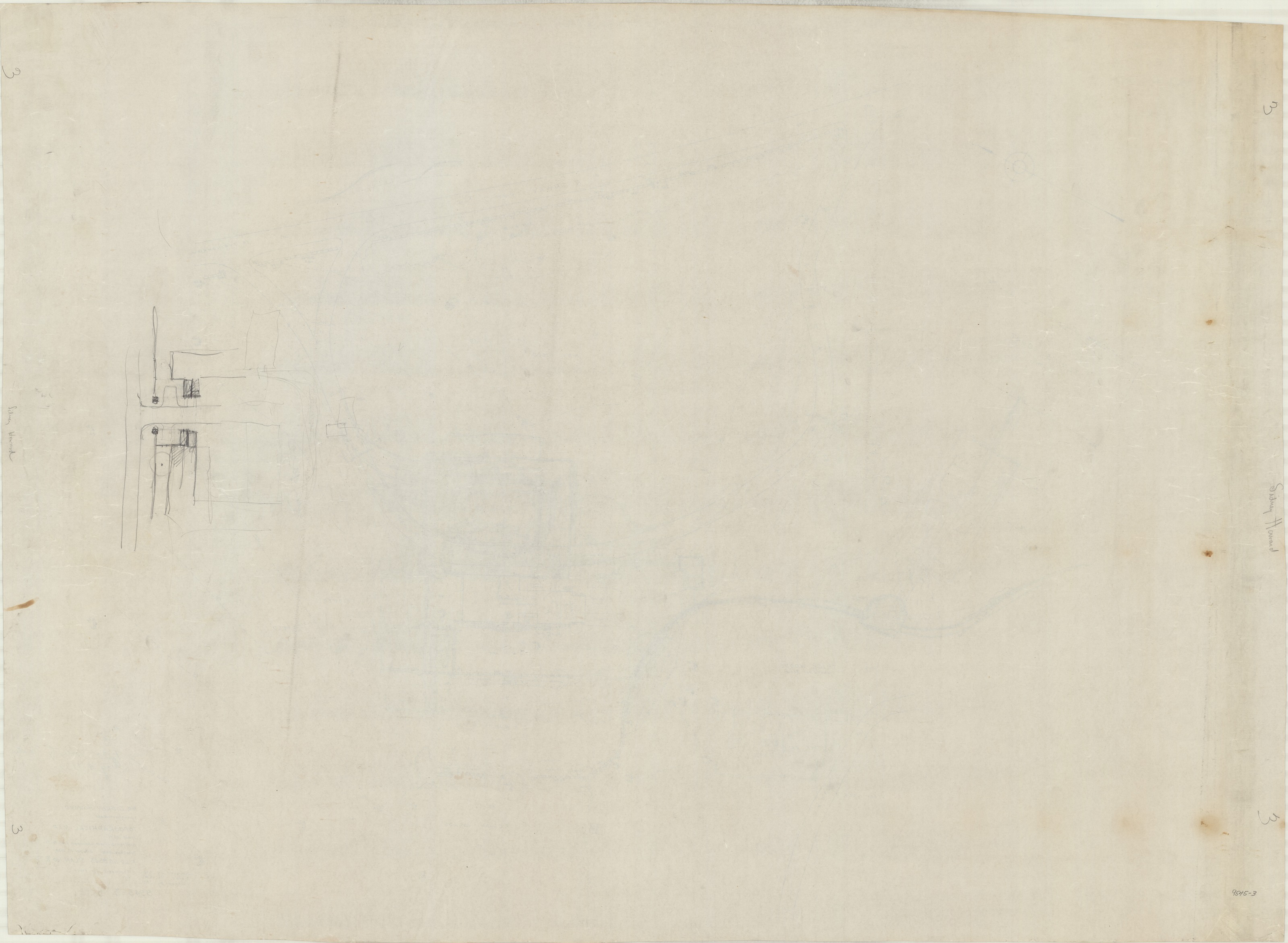
The last sheet in the file, plan 3, is dated 4 August 1939. It is titled “Field Notes by Zach” — an office hand recorded by first name only — and the inventory describes it as a sketch for the entry, with further notes and another sketch on the back. Someone was standing in the drive at Tyringham that day working out how people would arrive.
On 23 August 1939 Sidney Howard was starting his tractor on the farm when it lurched forward and crushed him against the wall of the garage. He was forty-eight. Brooks Atkinson wrote that his death was a calamity for Broadway. His friends founded the Sidney Howard Memorial Award; in 1940 the Academy gave him its award for the Gone with the Wind screenplay, the first posthumous Oscar in any category; and in 1981 he was elected to the American Theatre Hall of Fame.
The job stops there. There is no planting plan, no revision, nothing after the fourth of August. Four sheets and a sketch of an entrance is the whole of what the Olmsted office did at Tyringham, and it reads now less like a landscape commission than like a date stamp.
Sources
Olmsted Archives, Frederick Law Olmsted National Historic Site, National Park Service: job 09545, four plans and five scans, with titles, dates, sheet sizes and inventory notes as recorded at olmstedonline.org, including the credits to Geo. A. Lewis and to “Zach”; scans from the Olmsted Archives on Flickr. Titles and notes are quoted as catalogued. Wikipedia, “Sidney Howard,” for his birth at Oakland on 26 June 1891, the Pulitzer Prize for Drama of 1925 for They Knew What They Wanted, the marriages to Clare Eames in 1922 and Polly Damrosch in 1931 and his children, the seven-hundred-acre Tyringham farm, the circumstances and date of his death on 23 August 1939 at the age of forty-eight, Brooks Atkinson’s remark, the Sidney Howard Memorial Award, the posthumous Academy Award of 1940 for the Gone with the Wind screenplay and its being the first in any category, and his election to the American Theatre Hall of Fame in 1981. No photographs of this farm were found in Digital Commonwealth or in the Library of Congress collections searched for this survey.