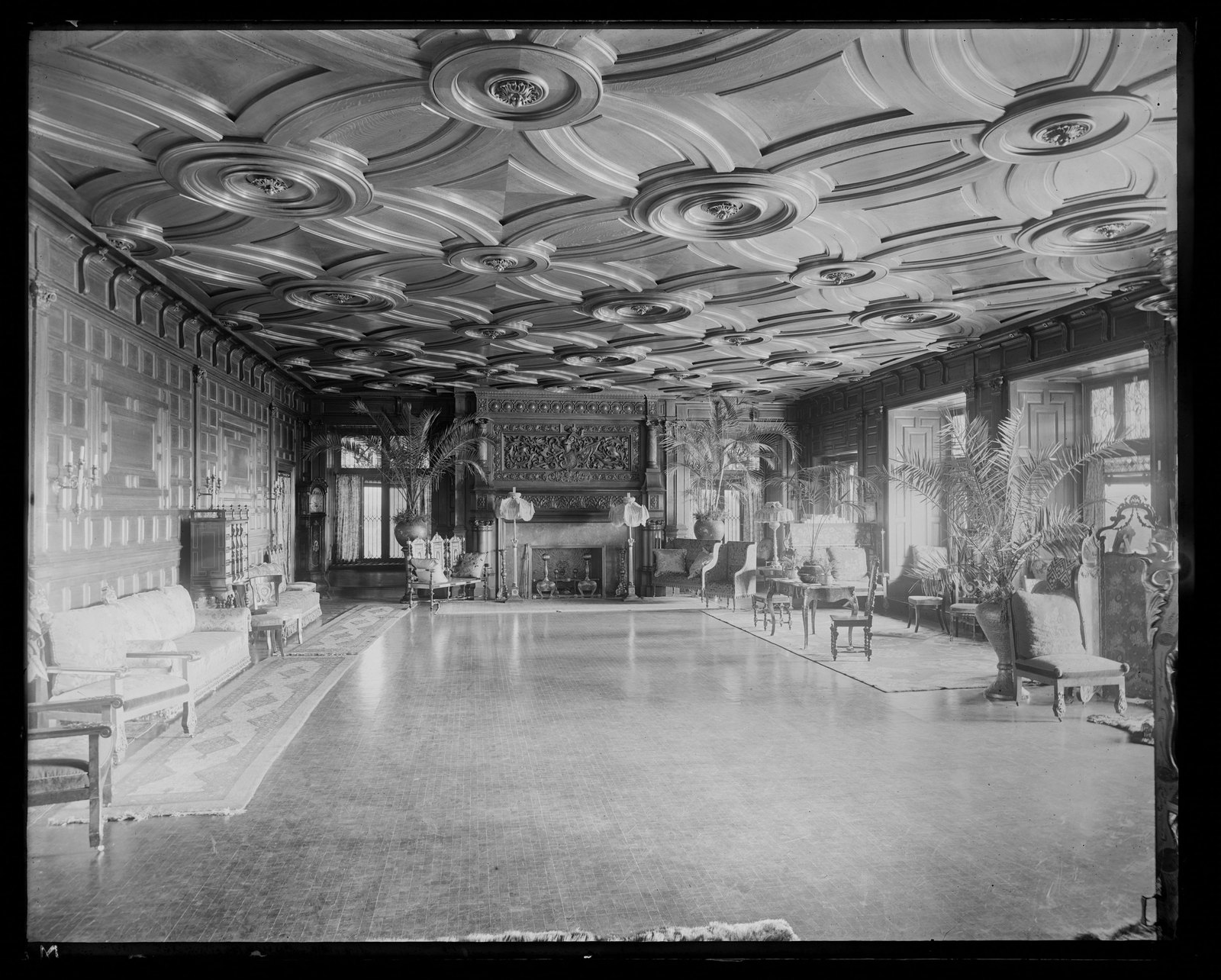
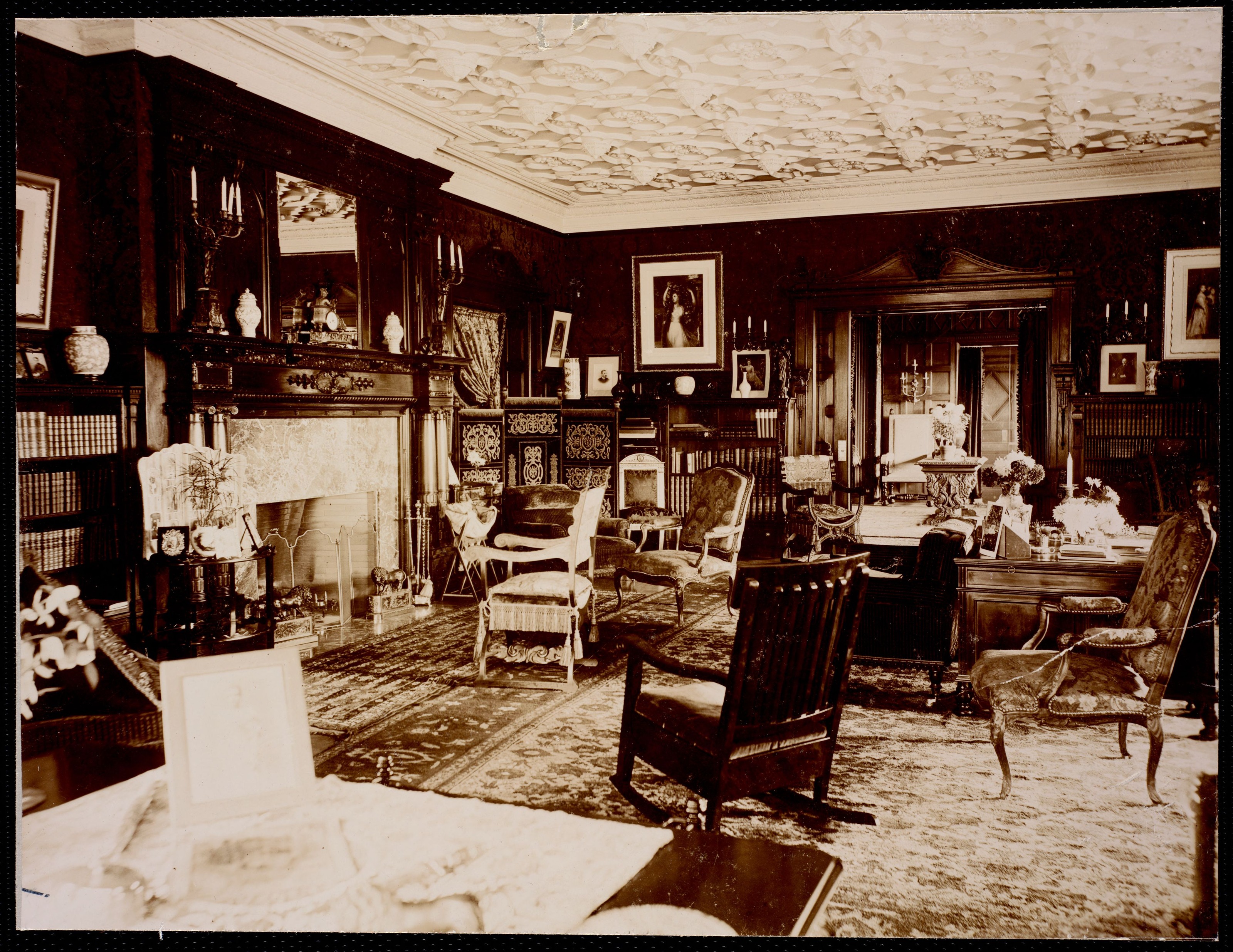
Look up in the ballroom at Shadow Brook. The ceiling runs the length of the room in a deep coffered grid with a great ornamented boss at the center of every panel, and the whole of it is plaster — run in place along a rule, or cast in molds in a shop and set, and then modeled by hand where the molds met.
Now consider that every square foot of it went up as wet mud on wooden lath, by men standing on planks, working above their heads, in a room with no heat, and that it then had to dry.
I. Three coats and a season
Plastering was not one operation. The lather went first, nailing thousands of thin wooden strips across the studs and joists with a gap between each — the gap is the point, because the first coat is pushed through it and curls over behind the lath, and those curls are what hold the ceiling up for a century.
Then the plasterer, three times. The scratch coat, coarse and haired, scored while soft to give the next one a grip. The brown coat, floated flat and true. And the finish coat, a thin skin of lime putty and fine sand, polished with a trowel and water to something like marble. Each had to set before the next went on, and the whole wall had to give up its water before anything could be painted or papered.
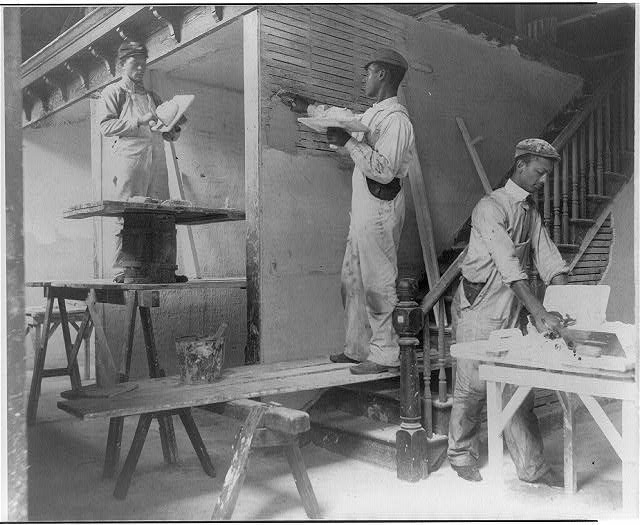
In a Berkshire house of any size that meant a winter. The frame closed in, the glass in, stoves or salamanders burning to keep the work from freezing — because plaster caught by a hard frost before it sets is finished, and comes off the wall in sheets — and the owners in New York, waiting.
II. The ornament
The enriched work was a separate skill again. Cornices were run in place: a zinc template cut to the profile, fixed to a wooden horse, and dragged along the angle of wall and ceiling through wet plaster, again and again, building the molding up in passes until the template rode clean. A long run had to be done in one working session by men moving in step, because a joint in a cornice shows forever.
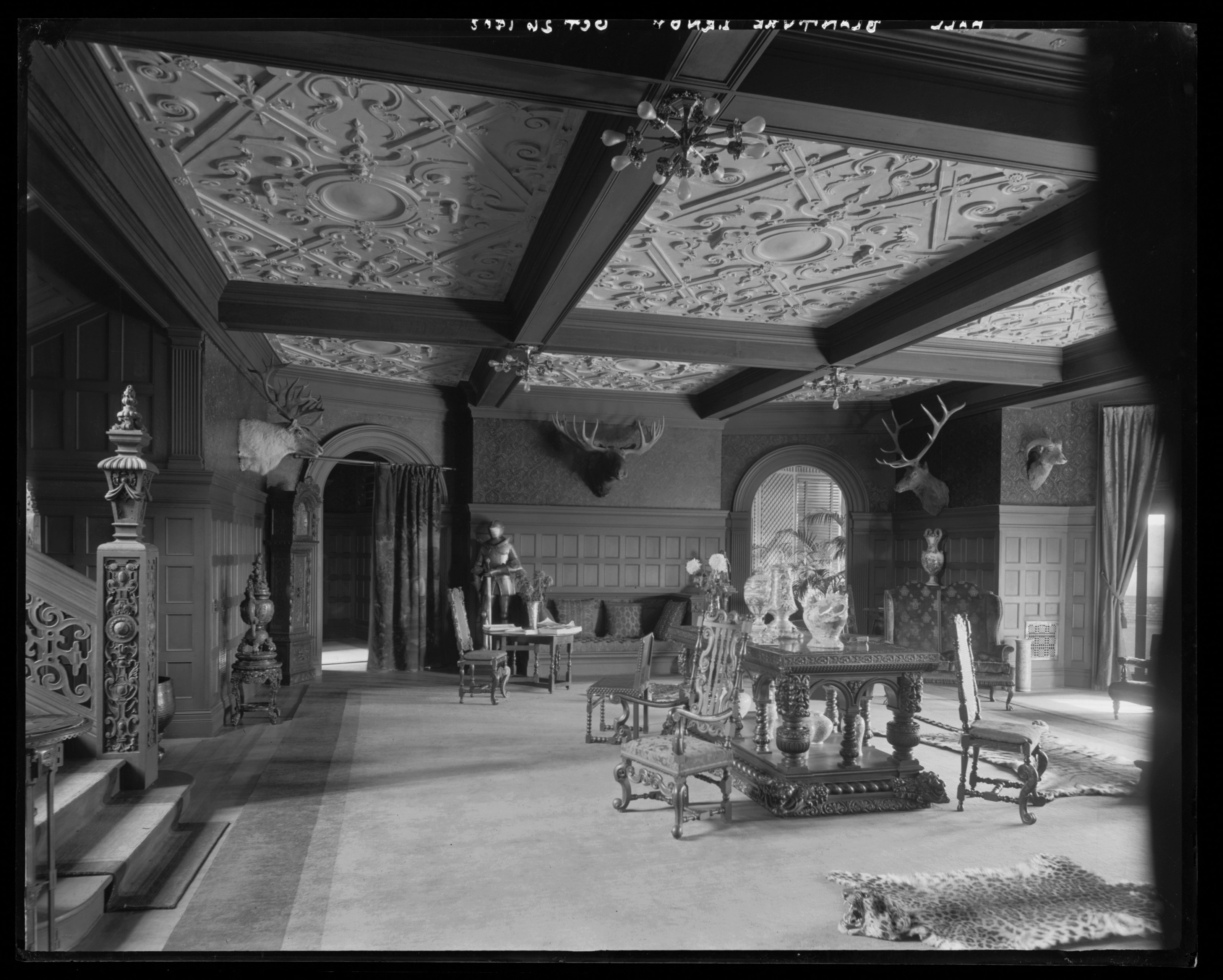
Anything repeated — the bosses in that ballroom ceiling, the strapwork in the hall at Blantyre, the ribs in the Ventfort library — was cast in reverse molds and set with plaster of Paris, and then the joins were modeled out by hand, wet, working fast, by somebody who could match a cast pattern freehand while standing on a board.
III. Brick, lime and the kilns
Behind all of it sat the lime. Mortar and plaster both begin as limestone burned in a kiln to quicklime, slaked with water — which it does violently, boiling — and aged as putty before use. The Berkshires had the limestone and the kilns; the directory still lists the Allyndale quarry and its superintendent thirty years later.
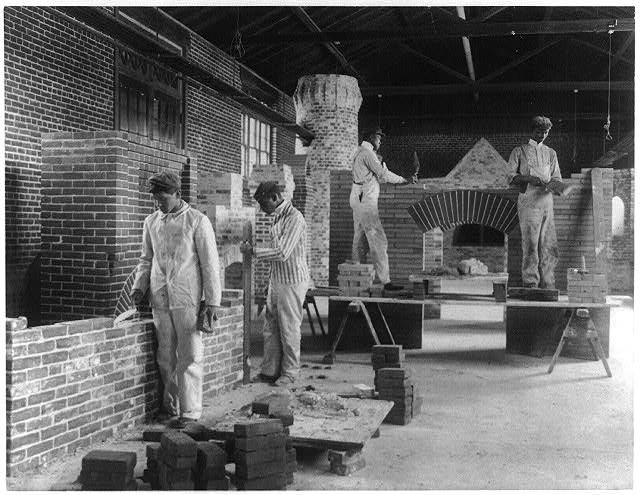
The bricklayers worked to the same clock. Mortar has a working life measured in hours and a curing life measured in weeks, and brickwork laid in a frost is brickwork laid twice.
IV. What the directory says, and what it does not
Here is the strange thing. The 1923–’25 directory lists fifty-seven masons and two hundred and ninety-six laborers across the southern towns — and exactly one plasterer.
Be careful with that number. Briggs’s Berkshire County Directory for 1874 — a generation before the cottage boom — also lists exactly one plasterer against two hundred and two masons, which suggests the directories simply under-record the trade: a man who plasters may well be entered as a mason, or as a laborer, or under whichever description he gave the canvasser at the door.
What the two books together do show is the shape of the thing. The wet trades are the trades of new building. A mason can point a wall, rebuild a chimney, lay a path; there is maintenance work in stone forever. A plasterer whose skill is a three-coat ceiling in a forty-foot ballroom has nothing to do in a county that has finished putting up ballrooms. He follows the work, or he gives the canvasser a different word for himself.
His name is John Valinaggi. The entry reads Valinaggi John (Louise) plasterer h off Main EC p o do — East Canaan, a wife called Louise, a house off Main Street. One man, in ten towns, holding a trade that had been enormous thirty years earlier and had evaporated inside a generation.
That single line is the fossil.
V. Still up there
Go back to the ballroom photograph. Every boss in that ceiling is a cast somebody set overhead, wet, on a plank, in a cold room, and then finished by hand so the seam would not read from the floor. It has hung there since the 1890s. Shadow Brook burned in 1956 and that ceiling went with it, but the ones at Blantyre and Ventfort Hall are still up, and nobody looking at them is thinking about frost.
Interiors — the Shadow Brook ballroom, the main hall at Blantyre, the library at Ventfort Hall — Lenox Library Association, through Digital Commonwealth; titles quoted as catalogued. Plastering and bricklaying photographs by Frances Benjamin Johnston at Hampton Institute, about 1899, Library of Congress; they are not Berkshire sites and stand for the trades rather than the places. Trade counts from Crowley & Lunt’s South Berkshire Directory, 1923–’25, reproduced in full here; that volume does not cover Lenox, which is in the 1926 Central Berkshire directory instead.