I. What this is
Every other story in this section works from one directory, or two. This one works from seventy-two.
The Internet Archive holds a run of Pittsfield city directories — nearly every year from 1882 to 1943, from the same publishers, canvassing the same city. Count a fixed list of occupation words through all of them and you get something nobody in this county has had before: a year-by-year series of who did what, across sixty years, through the exact span in which the cottage era began, peaked and ended.
Pittsfield is not Lenox. It is a manufacturing city with General Electric in it, and its trade mix is its own. But it is the only place in Berkshire County with an unbroken annual record, and the trades this section cares about — coachman, gardener, blacksmith, chauffeur — are in it, counted the same way every year.
II. The crossing
The first chauffeur appears in 1904. One man, in a book with four thousand trades in it.
Coachmen had peaked nine years earlier, at 49 in 1895, and were already drifting down. In 1904 there were 29 of them against that one chauffeur.
Then: 3 chauffeurs, 3, 4, 11, 15, 20 — and in 1911, twenty-two coachmen and twenty-three chauffeurs. Seven years from the first to the crossing.
After that it is not a competition. 1913: 21 coachmen, 51 chauffeurs. 1917: 11 against 90. 1920: 4 against 84. The last coachmen in the Pittsfield book are two men in 1924. From 1925 the word does not appear again.
Twenty years, first to last. A man who took up the reins as an apprentice in 1900 was in a trade at its height; by the time he was forty it did not exist. That is the arithmetic behind the coachmen story, and here it is with a date on it.
III. It was not just the coachmen
The reason to trust that line is that it does not move alone.
The horse supported a whole economy, and every part of it turns at the same moment. Hostlers peak at 60 in 1895 and are down to one by 1943. Blacksmiths hold near 50 through the nineties and end at 9. Harnessmakers peak at 18 in 1893 and reach zero. Teamsters — 170 of them in 1895 — end at one.
Five independent words, five different pages of the book, all describing the same animal, all falling together. That is not a cataloguing wobble. That is a technology leaving.
Each panel runs 1882 to 1943 on the same scale of years but its own scale of numbers, so the shapes are comparable and the heights are not. The figure at the top right is the peak and its year, marked with a dot; the two small figures under the baseline are the first and last counts in the run. Select any panel to open it full size, with a year-by-year readout on hover.
The horse
Coachmen in the Pittsfield directory, 1882–1943
Hostlers in the Pittsfield directory, 1882–1943
Blacksmiths in the Pittsfield directory, 1882–1943
Harnessmakers in the Pittsfield directory, 1882–1943
Teamsters in the Pittsfield directory, 1882–1943
The machine
Chauffeurs in the Pittsfield directory, 1882–1943
Machinists in the Pittsfield directory, 1882–1943
Electricians in the Pittsfield directory, 1882–1943
Engineers in the Pittsfield directory, 1882–1943
Plumbers in the Pittsfield directory, 1882–1943
Moulders in the Pittsfield directory, 1882–1943
The house
Butlers in the Pittsfield directory, 1882–1943
Cooks in the Pittsfield directory, 1882–1943
Housekeepers in the Pittsfield directory, 1882–1943
Gardeners in the Pittsfield directory, 1882–1943
The office
Stenographers in the Pittsfield directory, 1882–1943
Bookkeepers in the Pittsfield directory, 1882–1943
Clerks in the Pittsfield directory, 1882–1943
Salesmen in the Pittsfield directory, 1882–1943
Teachers in the Pittsfield directory, 1882–1943
Nurses in the Pittsfield directory, 1882–1943
The old trades
Shoemakers in the Pittsfield directory, 1882–1943
Dressmakers in the Pittsfield directory, 1882–1943
Milliners in the Pittsfield directory, 1882–1943
Tinsmiths in the Pittsfield directory, 1882–1943
Barbers in the Pittsfield directory, 1882–1943
Painters in the Pittsfield directory, 1882–1943
Building the place
Carpenters in the Pittsfield directory, 1882–1943
Masons in the Pittsfield directory, 1882–1943
Laborers in the Pittsfield directory, 1882–1943
Farmers in the Pittsfield directory, 1882–1943
Superintendents in the Pittsfield directory, 1882–1943
IV. What arrives
The replacement set starts at or near nothing.
Electricians: zero in 1882, one in 1884, 42 by 1931 — and, unlike almost everything else here, they hold through the Depression. Machinists run from 44 to a peak of 121 in 1913, which is General Electric arriving. Chauffeurs you have already seen.
And the largest new thing in the book is not a trade at all in the old sense. Stenographers: zero until 1887, four in 1888, 106 by 1907, 266 by 1919. Bookkeepers follow the same curve. Nurses go from 4 to 503. These are the occupations that put large numbers of women into a directory under their own names for the first time, and they arrive faster than anything the horse economy ever did.
V. Where the chart lies
Two lines in this data are not about work at all. They are about what the publisher was willing to print, and they are worth more than the rest put together.
Maid. The word appears zero times a year from 1882 to 1906. Then 87, 145, 166, 138, 103 — and by 1914 it is back to single figures for twenty years.
Pittsfield did not acquire 166 maids in 1909 and lose them by 1915. What happened is that for about six years the canvassers wrote the word down. Before and after, a woman in domestic service is entered like this, from the 1908 volume:
Alma K. Miss, emp 261 South, bds do
Employed at 261 South Street. Boards there. No trade. Compare the same book’s treatment of a man three lines away — Alexander G., coachman — and the asymmetry is the whole point. The men get a trade. The women get an address.
For those six years someone decided otherwise, and the result is that we know the names of a hundred and sixty-six women who worked in Pittsfield houses in 1909 and almost nothing about the ones on either side of them.
Laundress never exceeds eight in any year of sixty-one. There were obviously more than eight laundresses in Pittsfield. The word simply was not used.
Neither line is plotted above. They are not measurements; they are evidence about the instrument. And they are the same phenomenon as the single plasterer in South County, filed under masonry, and the hundred men on the steps at Shadow Brook with no names — work that was done, by people who existed, that the record declined to describe.
VI. How this was counted, and what it cannot do
Plainly, so anybody can check it or disagree with it.
Each volume’s full text was searched for a fixed list of occupation words, matched whole-word and case-insensitively, and the hits counted. No sampling. The counts are of words in the book, not of people: a man listed twice appears twice, an advertisement using the word “carpenter” counts, and OCR errors go uncorrected in both directions.
The series is cut at 1943 on purpose. From 1946 the publisher largely stopped printing occupations: the total across all counted trades halves from 3,596 to 1,941 in one step, and stenographers drop from 135 to 3. Nothing happened to stenography in 1946. The book changed, and any line carried past that point is measuring the book.
Two volumes, 1859 and 1885, are partial scans and are excluded. Years the collection lacks — 1896, 1899, 1900, 1912, 1927, 1942 — are simply absent; the lines join across them.
And the underlying denominator moves: the book had about 1,500 counted trade-words in 1882 and about 4,800 in 1914, because the city grew and the canvass got better. So a rising line is not automatically a rising trade. The reason the horse trades are safe to read as real is that they fall while the book is getting bigger, and fall together.
The numbers, trade by trade
| Trade | 1882 | Peak | Peak year | 1943 |
|---|---|---|---|---|
| Barber | 23 | 237 | 1940 | 205 |
| Blacksmith | 50 | 54 | 1895 | 9 |
| Bookkeeper | 4 | 240 | 1931 | 118 |
| Butler | 11 | 103 | 1907 | 68 |
| Carpenter | 167 | 442 | 1911 | 165 |
| Chauffeur | 0 | 142 | 1924 | 28 |
| Clerk | 226 | 720 | 1919 | 452 |
| Coachman | 10 | 49 | 1895 | 0 |
| Cook | 11 | 74 | 1910 | 46 |
| Dressmaker | 7 | 162 | 1910 | 33 |
| Electrician | 0 | 42 | 1931 | 33 |
| Engineer | 17 | 186 | 1914 | 176 |
| Farmer | 162 | 245 | 1887 | 109 |
| Foreman | 10 | 138 | 1895 | 51 |
| Gardener | 17 | 81 | 1916 | 37 |
| Harnessmaker | 7 | 18 | 1893 | 0 |
| Hostler | 10 | 60 | 1895 | 1 |
| Housekeeper | 0 | 87 | 1936 | 62 |
| Janitor | 6 | 104 | 1940 | 98 |
| Laborer | 338 | 579 | 1907 | 44 |
| Laundress | 0 | 8 | 1909 | 2 |
| Machinist | 44 | 121 | 1913 | 30 |
| Maid | 0 | 166 | 1909 | 33 |
| Mason | 45 | 135 | 1914 | 63 |
| Milliner | 3 | 44 | 1910 | 4 |
| Moulder | 13 | 40 | 1911 | 0 |
| Nurse | 4 | 503 | 1943 | 503 |
| Painter | 72 | 218 | 1926 | 122 |
| Plumber | 3 | 71 | 1911 | 36 |
| Salesman | 8 | 256 | 1932 | 136 |
| Shoemaker | 57 | 129 | 1884 | 13 |
| Stenographer | 0 | 266 | 1919 | 135 |
| Superintendent | 14 | 134 | 1931 | 125 |
| Teacher | 15 | 421 | 1931 | 352 |
| Teamster | 52 | 170 | 1895 | 1 |
| Tinsmith | 19 | 24 | 1894 | 2 |
| Waiter | 1 | 64 | 1941 | 52 |
VII. What it is for
Every story in this section has had to say some version of we do not know how many. This one does not.
It will not tell you who the Berkshire coachmen were. For that you still need the directories, the backs of prints and the marks on the work. What it tells you is when — precisely, with a year attached — and when turns out to be much later and much faster than the story usually goes.
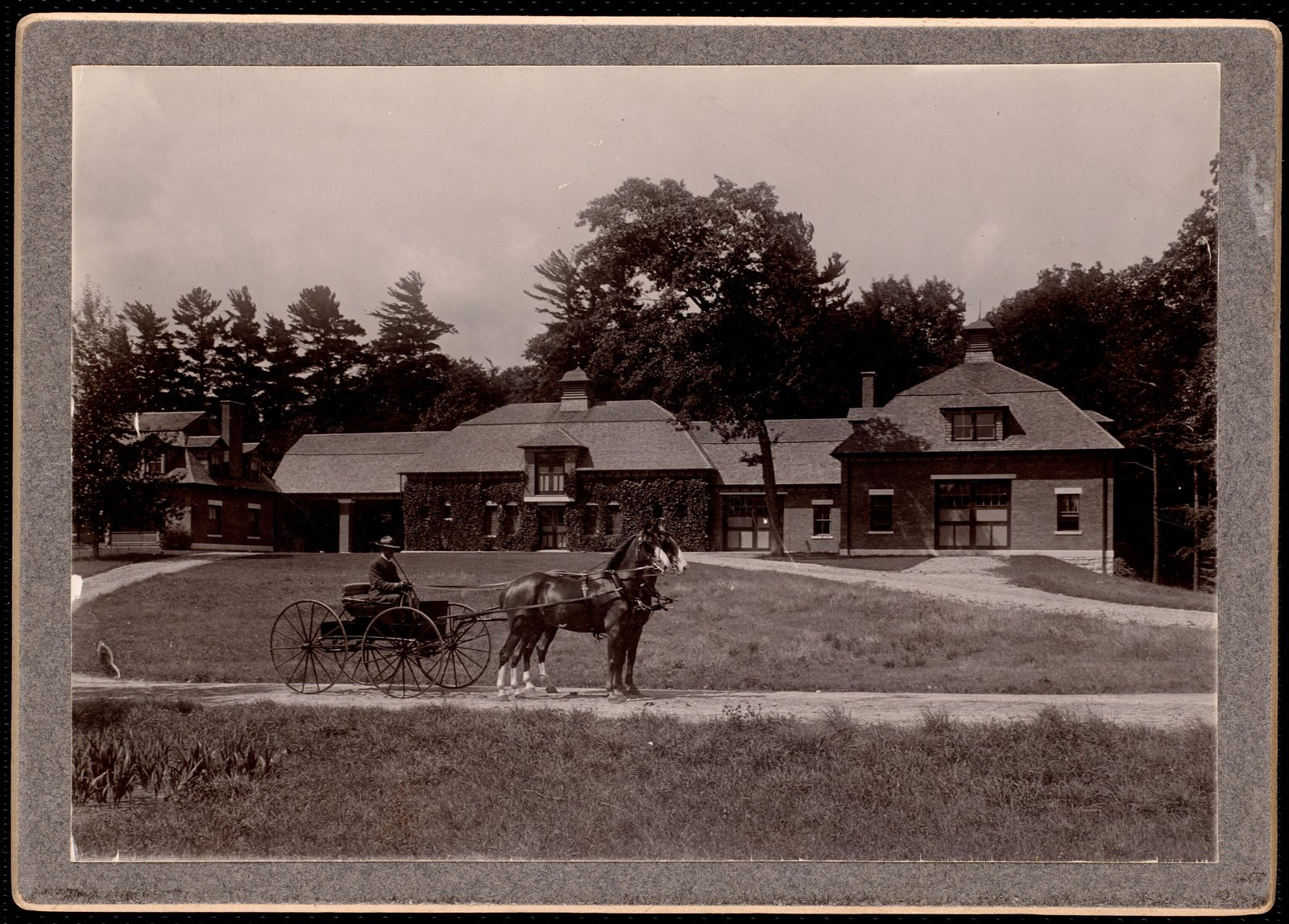
These houses were built in the 1880s and 1890s, at the absolute peak of the horse. Wheatleigh went up in 1893, two years before the county had more coachmen, hostlers, blacksmiths, harnessmakers and teamsters in it than it ever would again. The stables, the carriage houses, the harness rooms and the manure pits were specified at the exact moment the thing they were for stopped growing.
Nobody in 1893 could have known that. The first chauffeur was eleven years away.
Counted from the Pittsfield city directories held in the Pittsfield + Berkshire County MA Directory Collection at the Internet Archive: 55 volumes between 1882 and 1943, using the Archive’s own OCR text. Method as stated in section VI; the full per-year, per-trade table is in the panel above, and the underlying counts are published as a tab-separated file so the work can be checked. Directory lines quoted as printed. James Renfrew photograph, Lenox Library Association, via Digital Commonwealth.