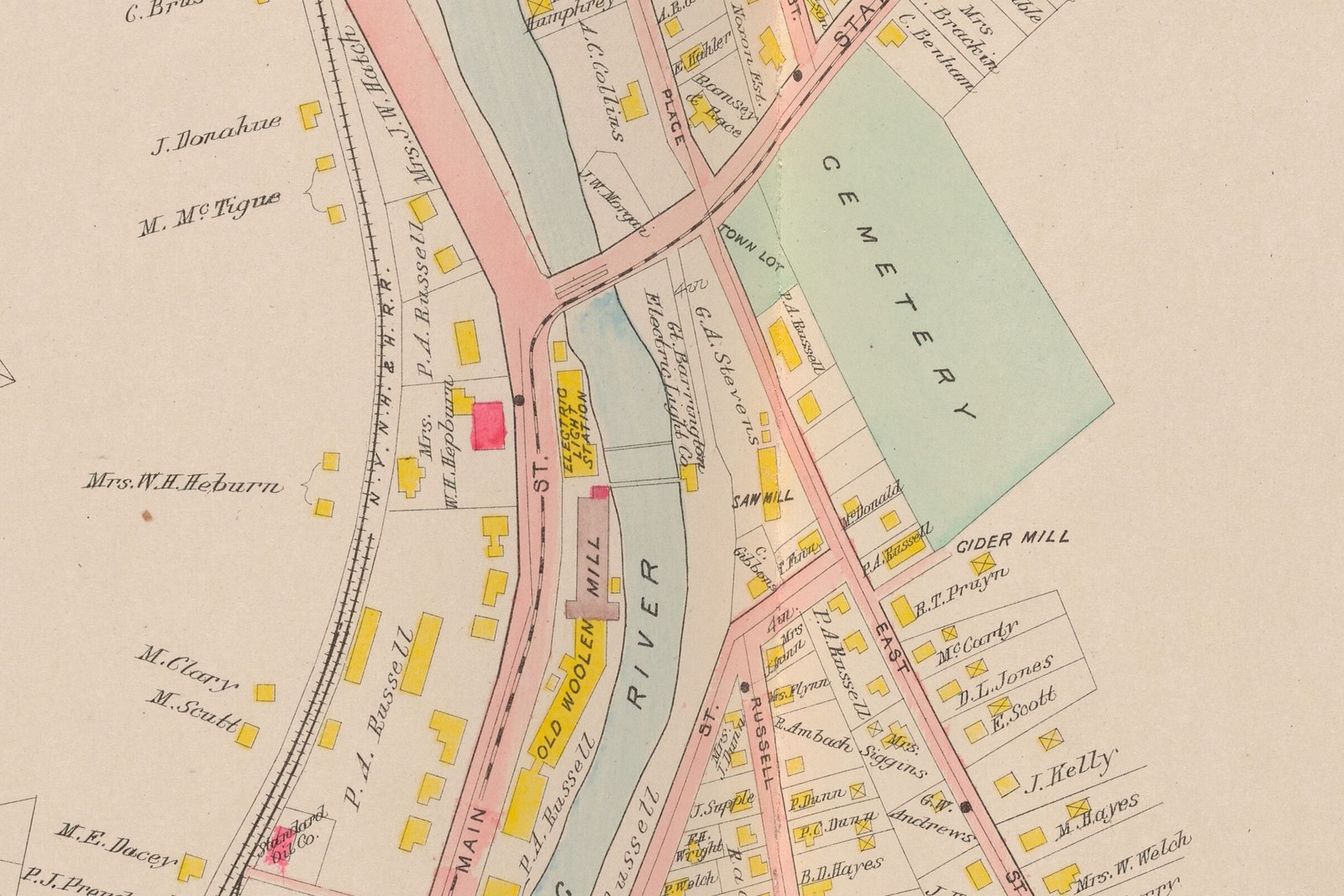
The services story on this site tells it in a paragraph, because it is one line in a longer argument about what a big house needed in its cellar. This page is the story itself, with the sources laid out, because on inspection they do not agree with each other and the version in general circulation is not the one the primary account supports.
I. What the bronze says
There is an IEEE Milestone plaque in Stanley Park in Great Barrington, at the corner of Cottage and Mill Streets, dedicated 2 October 2004. The whole of it reads:
“On 20 March 1886 William Stanley provided alternating current electrification to offices and stores on Main Street in Great Barrington, Massachusetts. He thus demonstrated the first practical system for providing electrical illumination using alternating current with transformers to adjust voltage levels of the distribution system.”
Note what is not on it. There are no voltages on the plaque. Every number in the popular retelling comes from somewhere else.
II. Five hundred, not three thousand
Here is the version you will find on the Westinghouse corporate blog and in a Great Barrington heritage brochure: Stanley stepped his generator’s output up to three thousand volts for the run along Main Street, then back down to a hundred at the lamps.
Here is William Stanley, speaking to the American Institute of Electrical Engineers at Pittsfield in 1911:
“As there were no alternating-current machines at hand, I borrowed a Siemens machine of Mr. George Westinghouse that he had imported from England, and constructed about a dozen transformers… each of which was wound to reduce the 500 volt main-line potential to 100 volts in the secondary circuit.”
Five hundred on the line. A hundred at the lamp. And the Electrical Review of August 1902, written while Stanley was alive and present at an engineers’ convention in the town, says the same: “alternating current at 500 volts pressure was generated and led to the town proper, where transformers were connected and installed for the purpose of lighting part of the business section.”
So where does the three thousand come from? It is real, and it is a different experiment. The IEEE’s own supporting narrative for the Milestone — written by Thomas J. Blalock, who was a General Electric engineer in Pittsfield — separates the two in consecutive paragraphs:
“Stanley designed and built his own transformers for this installation. He demonstrated their ability to both raise and lower voltage by stepping up the 500-volt output of the Siemens generator to 3000-volts, lighting a string of thirty series-connected 100-volt incandescent lamps, and then stepping the voltage back down to 500-volts.”
That was a bench proof, and a good one: it showed the transformer would work both ways. It never went out of the building. What went out of the building, along the elm trees, was five hundred volts.
The difference matters more than a factor of six. The whole claim of the Great Barrington system is the ratio — that you can generate and transmit at one pressure and consume at another, which is what makes central generation possible at all. The three-thousand-volt version makes it sound like a feat of high tension, which is a different and lesser thing, and it gets the principle backwards. It is also self-refuting in one of its own sources: the Great Barrington brochure that prints the 3,000-volt account states two paragraphs earlier that Stanley “installed a 500-volt, single-phase alternator.” Its author set the record straight himself in a longer piece for the Berkshire County Historical Society, where Stanley’s own sentence is printed plain.
III. The winter, and the night
The Berkshire Courier — the Great Barrington weekly, and the nearest thing to a running record of this — has it from the beginning. 4 November 1885:
“William Stanley Jr. has leased the ‘Rubber Factory’ for a term f [sic] years, and will occupy it at an early day. It is to be a laboratory for experimental work, in conjunction with Messrs. Westinghouse of Pittsburgh, Pa. A boiler and a 5-horse power engine will be at once set up, and some fine testing machinery, all of which will be under Mr. Stanley’s direction.”
The Rubber Factory is the disused india-rubber works Horace H. Day had put up on the east bank of the Housatonic near Cottage Street in 1847. The five-horsepower engine was superseded before it did anything; on 27 January 1886 the paper records “A Westinghouse Automatic engine, of 25 horse power… received here on Friday, and will be used by William Stanley Jr., the electrician, in the laboratory he is fitting up in the building known as the rubber mill.”
Stanley on that engine, twenty-five years later: “I have never encountered any mechanism, of any kind whatsoever, that possessed so profound a genius for going wrong as this engine.”
The plant was energised on or about 6 March. Two weeks of adjustment followed. On the evening of Tuesday 16 March, by the Courier of the following day, R. I. Taylor’s store was lit before an invited audience: “Two of the lights in the store made it as light as noon-day. A large number of business men were present to witness the effect, and were unanimous in their praise thereof.”
Then Saturday 20 March, the public test, and the thing that makes it a test: it was run against Edison. Stanley’s lamps were in C. H. Lillie’s drug store, in Dr. F. P. Whittlesey’s office and in Taylor’s store. And, in the Courier’s words, “H.A Brewer’s store was lighted by eighteen 16 candle power Edison lights, making 288 candle power in all.”
The verdict was not a verdict. The paper, which had every local reason to be enthusiastic, wrote that dividing the power among so many lamps “failed to show how strong it would be if concentrated into two or three single lights, so that a comparison of the two systems was difficult, although the majority of those who viewed the results, seemed to favor the Stanley lights.” The night that is now a Milestone was, on the evening itself, inconclusive.
One disagreement to record: the Engineering and Technology History Wiki’s biography of Stanley gives the official test as 16 March, which contradicts both the Courier and the Milestone page on that same site. The 20th is better supported. The 16th is in print.
IV. Counting it
Almost every quantity in this story comes in more than one size. The spread is set out here rather than a single figure chosen out of it.
- Wire on the elms. About 4,000 feet, along Main Street, fastened to the trees. The gauge is genuinely contested: No. 6 in the Berkshire County Historical Society’s narrative and on the Engineering and Technology History Wiki; No. 8 in the Great Barrington historian Charles J. Taylor’s account, quoted in that same publication, and in the 2011 brochure. One source carries both readings on different pages.
- Transformers in the street. Six, in the cellars of Main Street buildings. This one is agreed.
- Transformers built. “About a dozen” (Stanley, 1911); 26, of which ten went to Pittsburgh (Stanley, 1911, in a different retelling); the first 19, which he called “exhorters” (the Engineering and Technology History Wiki); 26 built and 16 used in Great Barrington (Edison Tech Center). These do not contradict the six in the cellars, and they do contradict each other.
- What was lit. Twenty business establishments (IEEE). Or: thirteen stores, two hotels, two doctors’ offices, one barber shop, the telephone and post offices — Stanley’s own count in 1911, which comes to twenty if the telephone and post offices are counted as two. Or: twenty-five subscribers (Engineering and Technology History Wiki). Or: seven offices, two hotels and thirteen stores (Edison Tech Center).
- Lamp sizes. 16, 50 and 150 candlepower in most accounts; 16, 50 and 250 in one.
It ran until 16 June 1886. Stanley: “The plant was operated every night the engine felt like it from April 6 to June 16.” And, separately: “no dangers, other than a small fire, were reported until an attendant dropped a screwdriver into the armature of the Siemens machine and entirely ruined it.” The Courier of 23 June reports only that “the armature of their large dynamo” broke on the Wednesday evening — which is the 16th — and says nothing about a screwdriver. The date and the screwdriver are both Stanley’s; joining them is an inference, and a reasonable one, but an inference.
Blalock adds the detail that stops it being a tragedy: publicly Stanley mourned the plant, privately he was relieved, being thoroughly tired of keeping the Westinghouse engine running.
V. Who paid for it
This is not settled and the two sides are a newspaper and the man himself.
Stanley, in a letter of 1915 to Charles F. Scott: “Mr. Westinghouse declined to furnish me the money to build and try out this system.” And to his biographer: “I finally made up my mind to employ my own money for the construction of a plant which would demonstrate beyond peradventure the value of my work.”
The Courier, announcing the lease in November 1885, calls the laboratory “for experimental work, in conjunction with Messrs. Westinghouse of Pittsburgh, Pa.”
Both can be true — consent is not funding, and a small-town paper reporting a lease is not reporting a balance sheet. What the Westinghouse organization thought of it is on the record from inside: H. M. Byllesby, writing in 1922, said that “no one in the organization, excepting Mr. Westinghouse himself and dear old Frank Pope… had any real expectation of anything coming out of the alternating current system.”
Frank Pope is Franklin Leonard Pope, a Great Barrington man and president of the American Institute of Electrical Engineers in 1886. In 1895 he went down into his own cellar and was killed by the 2,000-volt wires feeding his transformer. That is the other half of what this technology was in its first decade, and it belongs in the same story as the plaque.
VI. What the atlas draws, eighteen years later
The 1904 atlas is the only source on this site that puts the whole industry on the ground at once, and it draws both ends of it.
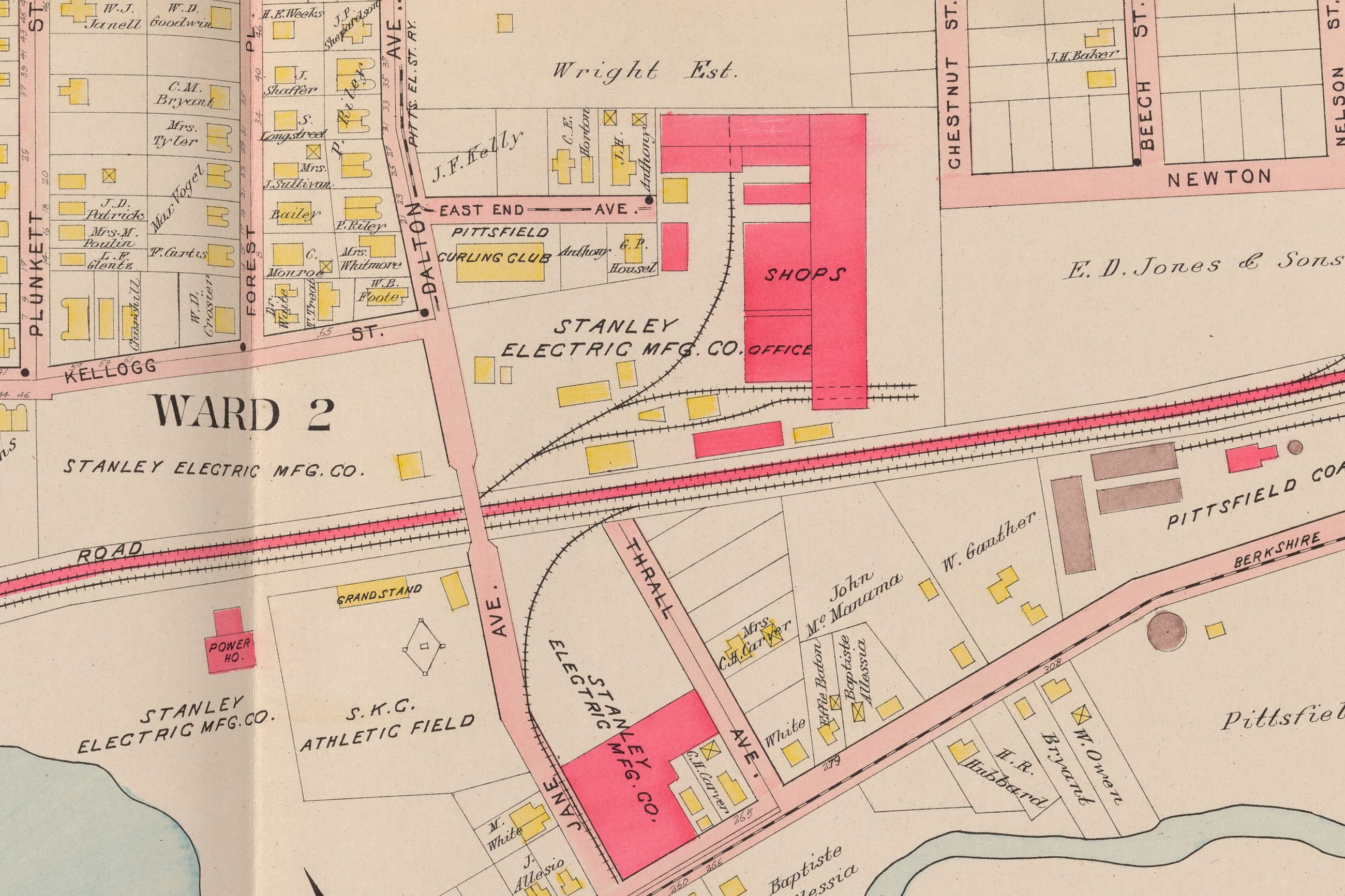
Those three letters on the ball field are the point of it. S.K.C. was the name the company’s transformers shipped under from 1 April 1891. By 1904 it is on a baseball diamond.
The Pittsfield chronology, with its disagreements marked. Subscriptions of $25,000 were raised, and two companies organized — a laboratory company and a manufacturing company — with Charles Atwater as first president. The works opened on Clapp Avenue: in January 1891 by one account, January 1892 by another, with the first S.K.C. transformers shipped in April either way. Sixteen people worked there in 1892. In 1893 it moved to Renne Avenue and employed three hundred. In 1899 a controlling interest went to John A. Roebling’s Sons of Trenton. In 1903 it became a subsidiary of General Electric, and in 1907 the plant became the Pittsfield Works of the General Electric Company.
The General Electric Review of October 1908 explains why the company chose Pittsfield for transformer manufacture: the area afforded, in its own words, “opportunities for the acquisition of skilled labor of American extraction.” That is the company’s published reasoning, printed in its own journal. It is quoted here without comment because it is the sort of sentence that stops being visible once somebody paraphrases it. The trade counts from the Pittsfield directories are the other side of the same subject.
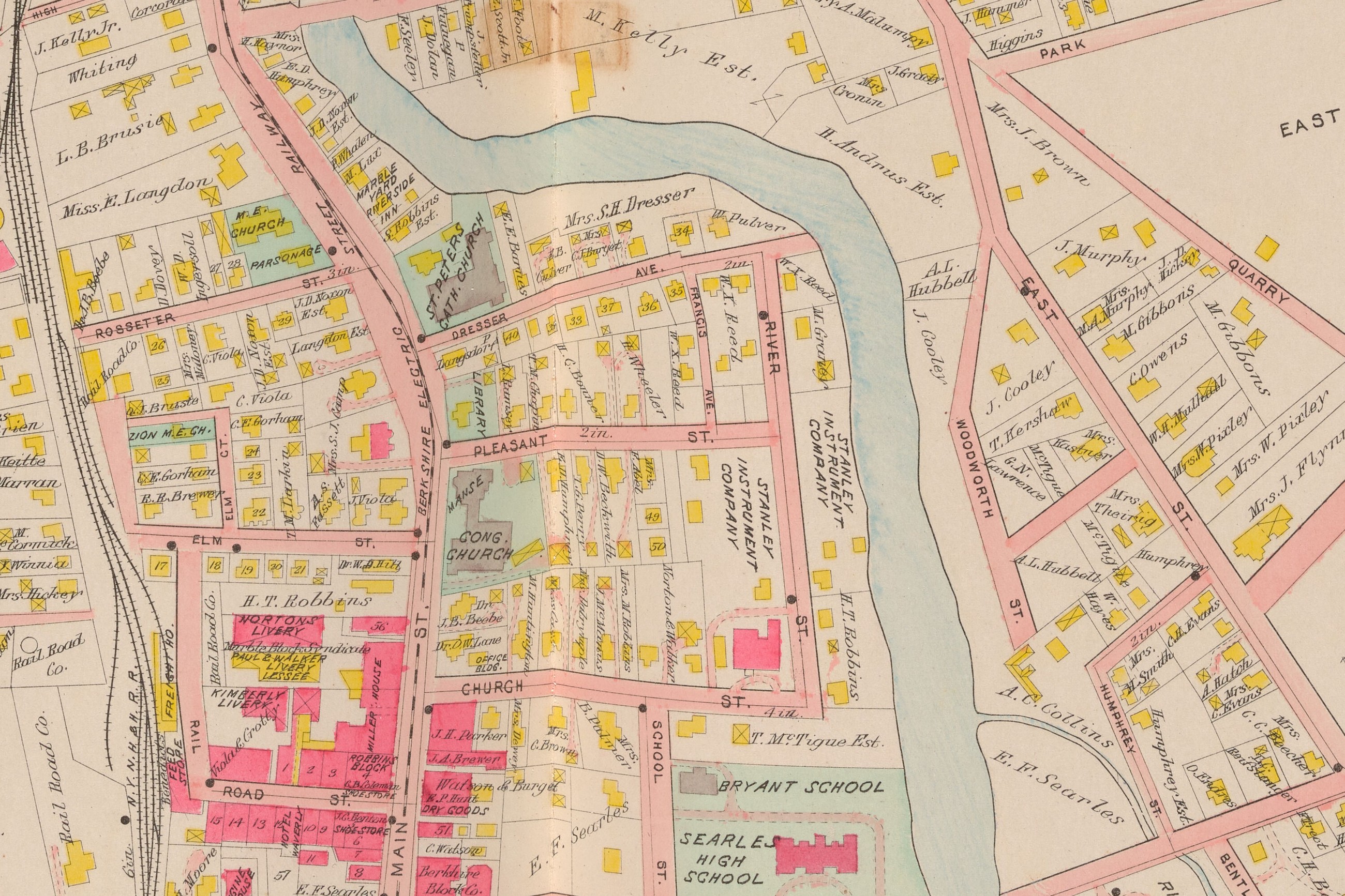
The Stanley Instrument Company was organized in 1897 with a capital of $75,000, and by the town history a shop was built at the corner of Church and River Streets, with work starting in the summer of 1898. In October 1899 the Westinghouse Electric Manufacturing Company sued it for infringement of a patent on an alternating-current meter. The decision went against it, and in 1907 the shops closed permanently and the company was dissolved.
So the atlas catches it in the middle of that, in 1904 — and what it draws on the company’s two blocks is land, houses, and one unlettered brick building standing exactly where the town history puts the shop. The plate makes no identification and neither does this page.
VII. Where the plant was
This is the part the atlas answers with a blank, and the blank is worth publishing.
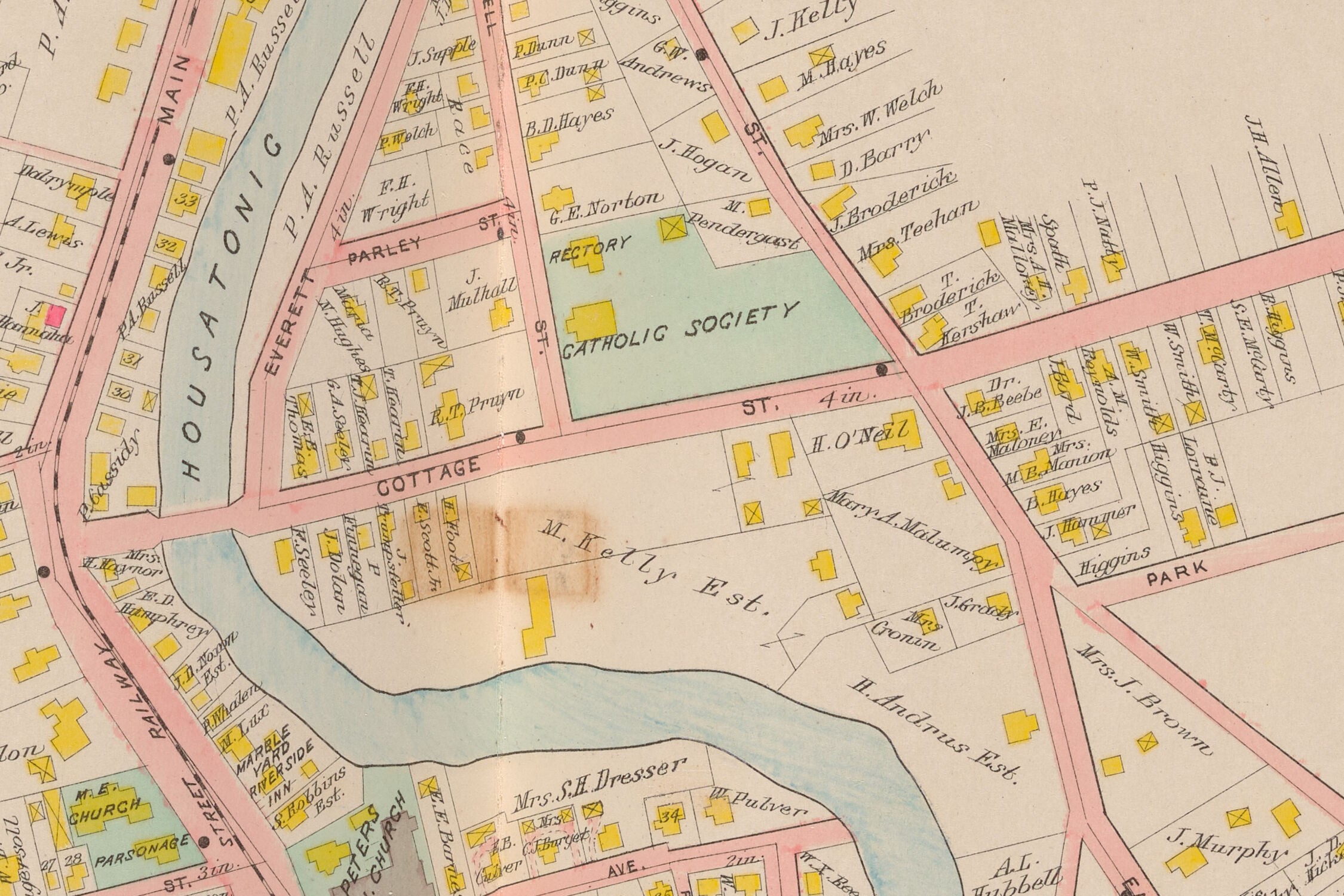
The secondary accounts put the 1886 laboratory on the east bank of the Housatonic near Cottage Street, in Day’s old rubber works. Both of those streets were searched on the Great Barrington sheets. Cottage Street is lettered on plate 34; Mill Street is not lettered anywhere on either Great Barrington village plate, and the street running along the east bank at that point is lettered EVERETT. The ground itself is drawn as house lots — a triangle of small wooden dwellings north of Cottage Street and a row of six narrow lots south of it — with one unlabeled wooden building, about twenty-eight feet by sixty-five at the plate’s scale, standing on the river bank in an open parcel lettered M. Kelly Est.
That is tenement or shop scale, not factory scale, and the atlas gives it no name. It is not identified here as anything. If the 1886 building was still standing in 1904 the plate does not say so, and if it had gone the plate would look exactly the same. Eighteen years after the most consequential thing that ever happened on that riverbank, the county’s own survey of who owned what drew it as ordinary back lots and lettered eleven families across it.
There is also no photograph. The picture that circulates of Main Street lit in 1886 is captioned by the people who published it: IEEE Power & Energy Magazine, July/August 2012, figure 2, “Illustration of William Stanley’s 1886 lighting of Main Street in Great Barrington (image courtesy of the General Electric Company).” An illustration, and labeled as one. No photograph of the plant, the rubber mill or the laboratory has been found here, which is not the same as saying none exists — two places have not been asked: the Great Barrington Historical Society, which holds an 1849 plan of the Day property, and the William Stanley Jr. collection in the Schaffer Library at Union College, which holds his notebooks.
VIII. Up the county, the private version
What Great Barrington proved in 1886, the cottages bought for themselves inside ten years, and the most complete case is the one built by the man whose generator Stanley borrowed.
Erskine Park in Lenox had a powerhouse on the shore of Laurel Lake, sheathed in marble, with an ornate crenellated top to its stack. The mansion held at least fifteen hundred incandescent lamps and was said to be the largest private lighting installation of its day. By 1892 it was supplying roughly three hundred more at Elm Court. The Lenox Electric Company was formed in 1894, and in early 1895 current from the Laurel Lake plant reached the center of Lenox by underground conduit — a private country-house generating station selling to a village.
It was retired in 1915. George and Marguerite Westinghouse had both died in 1914; the new owner had no interest in running a power plant, and a 1912 installation of step-up transformers had put an 11,000-volt line into Lenox from Stockbridge. The building stood until about 1949, when its marble was taken off for a chapel in Stockbridge. All of that rests on one author, Thomas J. Blalock, across two magazine columns, and is marked as single-sourced here for that reason.
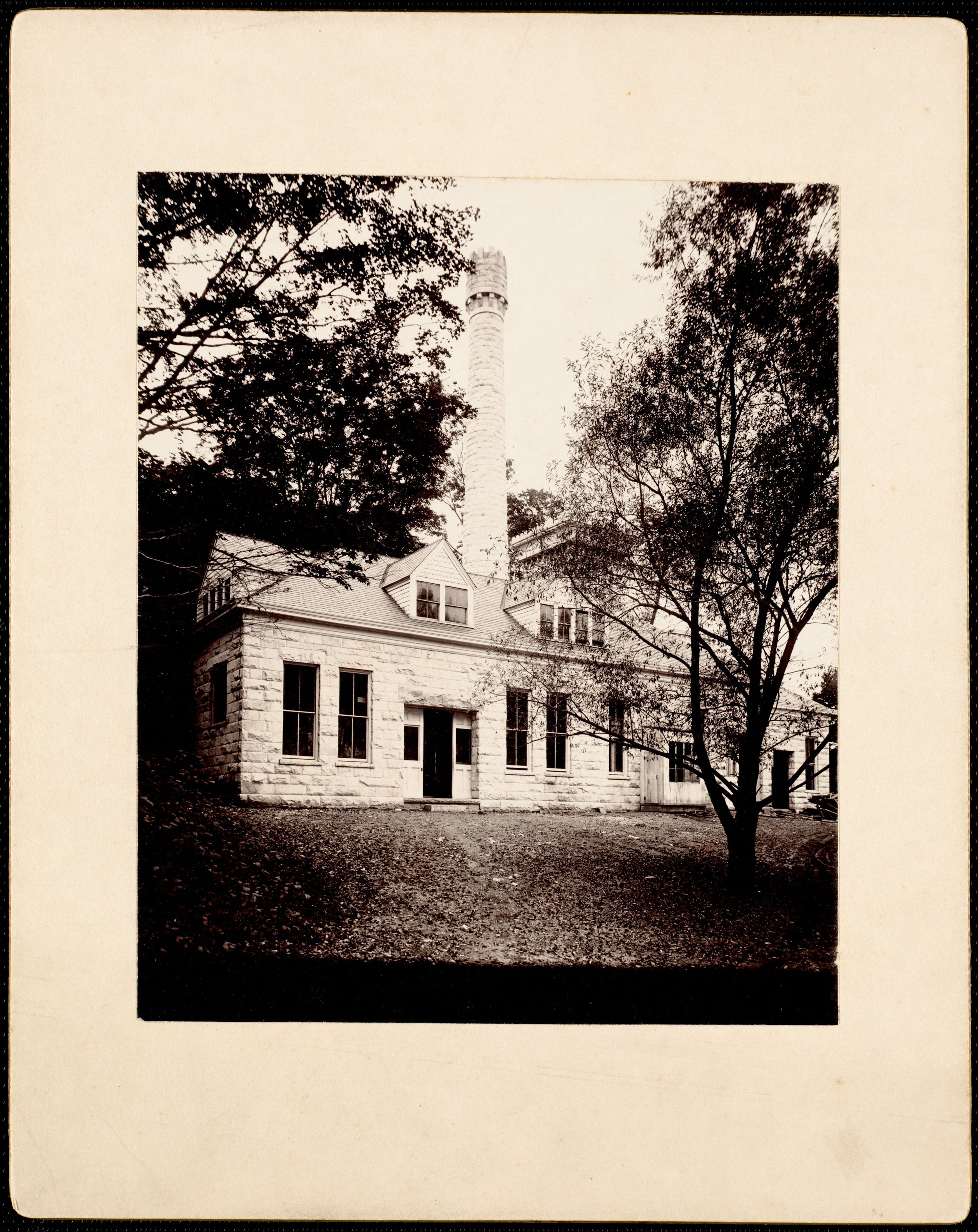
The rest of it — the boilers, the annunciator boards, the resident engineers, the houses that kept gas lines in beside the wiring because the plant went down — is in Wires on the elm trees, and starts from the same March evening in 1886.
Stanley’s 1911 words to the American Institute of Electrical Engineers, the Berkshire Courier items of 4 November 1885, 27 January 1886, 17 March 1886, 24 March 1886 and 23 June 1886, the Charles J. Taylor account, the 1915 letter to Charles F. Scott and the Byllesby letter of 1922 are all quoted as reproduced in Bernard A. Drew and Gerard Chapman, William Stanley Lighted a Town and Powered an Industry, Berkshire History vol. VI no. 1, Berkshire County Historical Society, which prints the Courier week by week from April 1885 to July 1886. The underlying AIEE printing of the 1911 address has not been consulted here. The Milestone citation, the 500-to-3,000-volt bench demonstration, the six transformers in Main Street cellars, the twenty establishments and the Pittsfield company chronology: IEEE Milestone Alternating Current Electrification, 1886 and the Engineering and Technology History Wiki, supporting narrative by Thomas J. Blalock; the 1902 quotation is from Electrical Review, August 1902. Erskine Park, the screwdriver and Stanley’s relief, and the General Electric Review of October 1908: Thomas J. Blalock’s History columns in IEEE Power & Energy Magazine, July/August and September/October 2012 — a single author, and the Erskine Park material is single-sourced to him. The Stanley Instrument Company dates are from Taylor and Maclean’s history of Great Barrington as quoted in the Berkshire History article. The 3,000-volt account of the Main Street line appears on the Westinghouse corporate blog and in the 2011 Great Barrington Wired brochure; it is set against the primary sources here rather than repeated. Plates: Atlas of Berkshire County, Massachusetts, Barnes & Farnham, 1904. Boston Public Library copy, via Digital Commonwealth. No known copyright restrictions. Reproduced in full here; the Great Barrington sheets are plate 34 and plate 35, Pittsfield is plate 6. Erskine Park workshop: Lenox Library Association. Owners and place names are transcribed as the plates letter them, spellings and abbreviations included; one name south of Cottage Street reads J. Hungpstetter and is left as read rather than corrected to a likelier surname.