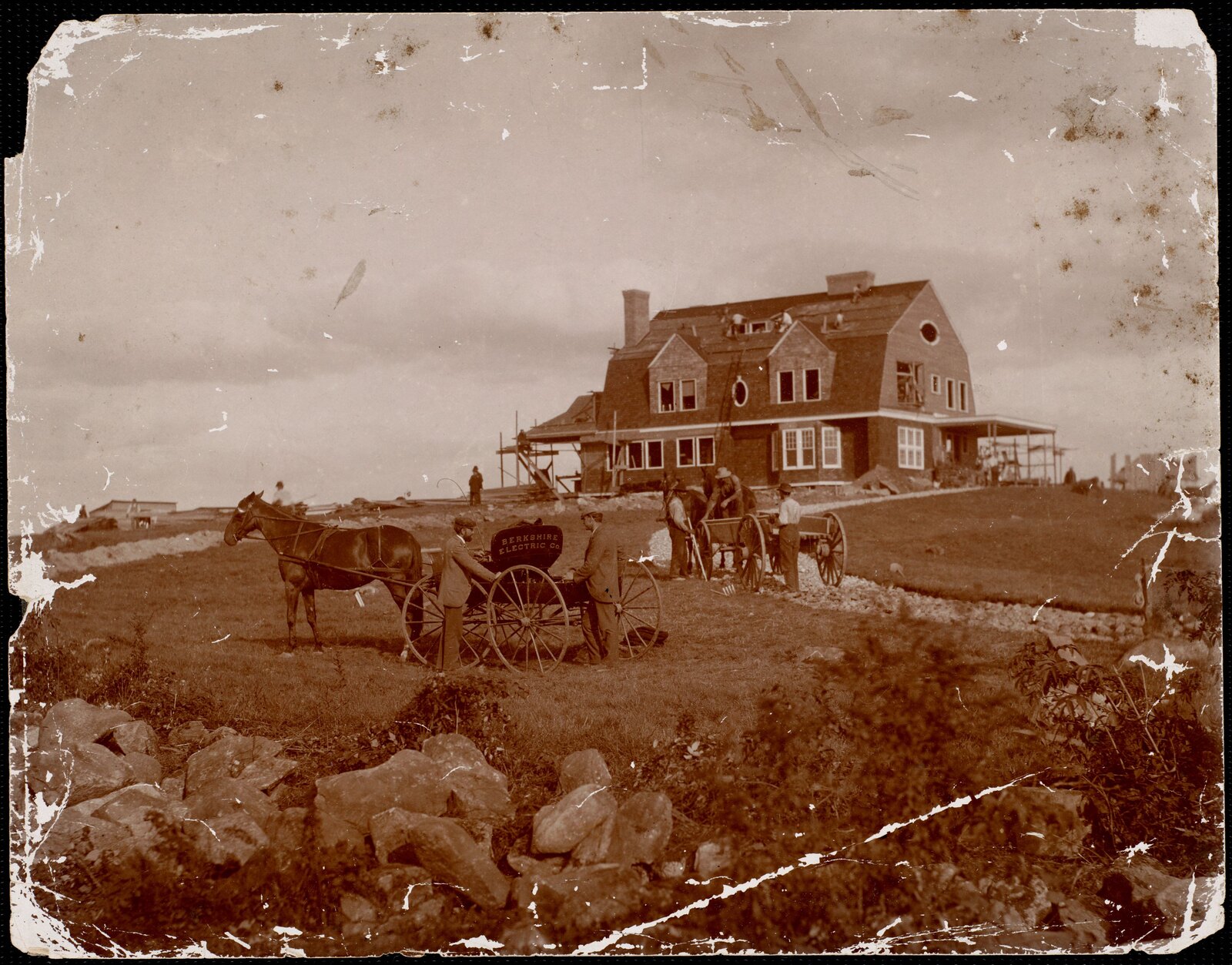
I. A buggy with a name on the side
Almost nothing in this section comes with a company name attached. The masons on the steps at Shadow Brook are anonymous. The plasterers are a single line in a directory. And then there is this photograph, taken on October Mountain in 1896, in which a contractor has parked his buggy where the camera will see the lettering.
Berkshire Electric Co. The house behind it is still open to the weather. The roofers are working. And the electrical men are already on site, because by 1896 you did not wire a house at the end — you wired it while the studs were still showing, and if you missed your moment the lath went on and you were chasing plaster.
Somebody who knew them wrote on the back of the print: Benjamin Rogers at the left, Edward B. Rogers at the right. Two names, one trade, one job, one afternoon. It is the single most complete record of a building service in the whole Berkshire collection, and it survives because a man wanted his wagon in the picture.
II. 20 March 1886
The reason a Berkshire electrical contractor existed in 1896 at all is that the county had been first.
On 6 March 1886 a system went into operation in Great Barrington, and on 20 March it was demonstrated publicly. A Siemens alternator, driven by a steam engine, stood in the disused Day rubber mill on the Housatonic near Cottage Street. It generated at five hundred volts, ran five hundred down the line into the village, and six transformers in the cellars of Main Street buildings brought it to a hundred at the lamps. Twenty business establishments were lit.
Five hundred, not the three thousand that usually gets quoted — that figure belongs to a bench demonstration with thirty lamps in series, and the difference is the whole point of the thing. Five hundred volts is the long version, with the sources set against each other.
The engineer was William Stanley, and the point being proved was the transformer: that you could send current a distance at high pressure and bring it down to a safe one where it was used, which is why the electrical world looks the way it does. The Institute of Electrical and Electronics Engineers marks the spot. Its citation calls it “the first practical system for providing electrical illumination using alternating current with transformers to adjust voltage levels of the distribution system.”
And the detail that ought to be on a plaque somewhere by itself: the wires ran from the station along Main Street fastened to the elm trees that lined it.
The entire future of electrical power in the world, strung on the elms of a Berkshire village. The elms are gone now, which is its own comment.
Stanley went on to live at Brookside in Great Barrington, lose the house to a fire, rebuild it in concrete so that it could not happen twice, and then lose the money in a patent fight with George Westinghouse — who, as it happens, summered four miles up the road.
III. What a big house had to have
Strip the marble off one of these places and what is left is a small industrial plant with bedrooms over it.
It needed heat, which in the 1890s meant a coal-fired boiler in a cellar, a coal bin outside it big enough to take a winter, steam or hot water in iron pipe to every room, and somebody to bank the fire at night and carry the ash out in the morning. It needed water, which in a house standing on a hill meant a pump, a spring or a stream that had been developed, a reservoir or a tank high enough to give pressure at the top floor, and pipework that would not freeze in an unheated attic in February. It needed drainage, which meant a run to somewhere — and a great deal of thought about where, since the somewhere was usually a lake with other people’s houses round it. It needed light. And it needed bells.
The bells are the part nobody thinks about and the part that made the house work. A wire from a push in every principal room to an annunciator board in the servants’ hall, each drop lettered with the room it came from, so that a flag fell and a bell rang and somebody went. It is a communications system, installed before the telephone, running on a battery in a cupboard. The whole social arrangement of a fifty-room house depends on it.
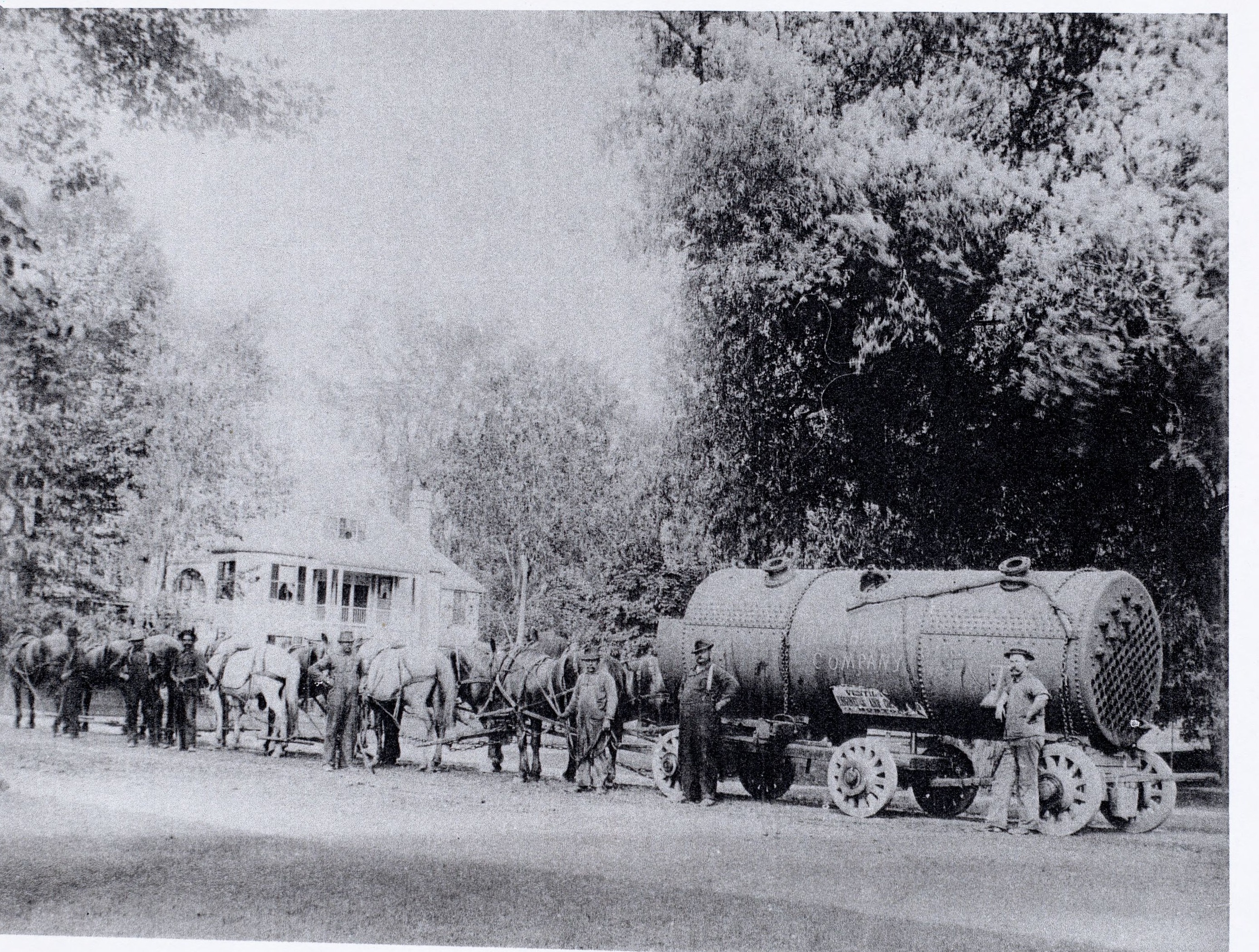
Look at what it took to get one boiler up one hill. Ten horses. A purpose-built low wagon with cast wheels. Five men on the road, and more at the top. A hotel is larger than a cottage, but not by as much as you would think, and every one of these houses had its own version of this afternoon — an object too heavy for the road it had to travel, arriving before the building that would hide it.
IV. Belt and braces
The interesting thing about the light is that for about twenty years nobody trusted it.
Ventfort Hall, built for Sarah Morgan, had an elevator, central heating, and — the phrase in the record is exact — gas and electric light together. Not gas replaced by electricity. Both, at once, in the same house, on the same evening, because a gas fixture works when the plant is down and the plant went down.
It also had seventeen fireplaces, which tells you what the owners thought of the central heating.
Wyndhurst, finished in 1894 for John Sloane, had electric light from the start. So did Blythewood. By the middle nineties it had stopped being a novelty and started being a specification — but the gas pipe often went in beside it anyway, and the candles stayed in the drawer.
V. The house that made its own current
There was no grid to plug into. A country house outside a village either generated its own electricity or did without, and the ones that could afford it built a plant.
That means, in practice, another boiler, an engine, a dynamo, a switchboard, and — in the better installations — a room of storage cells so the engine did not have to run all night to keep one landing lit. It means a building to put all of it in, usually downhill and downwind of the house and usually not photographed. And it means a man.
Not a visiting contractor: a resident engineer, on the payroll, living on the place, who started the plant in the afternoon and shut it down when the house went up to bed, and who was the only person for several miles who could tell you why the lights had gone yellow.
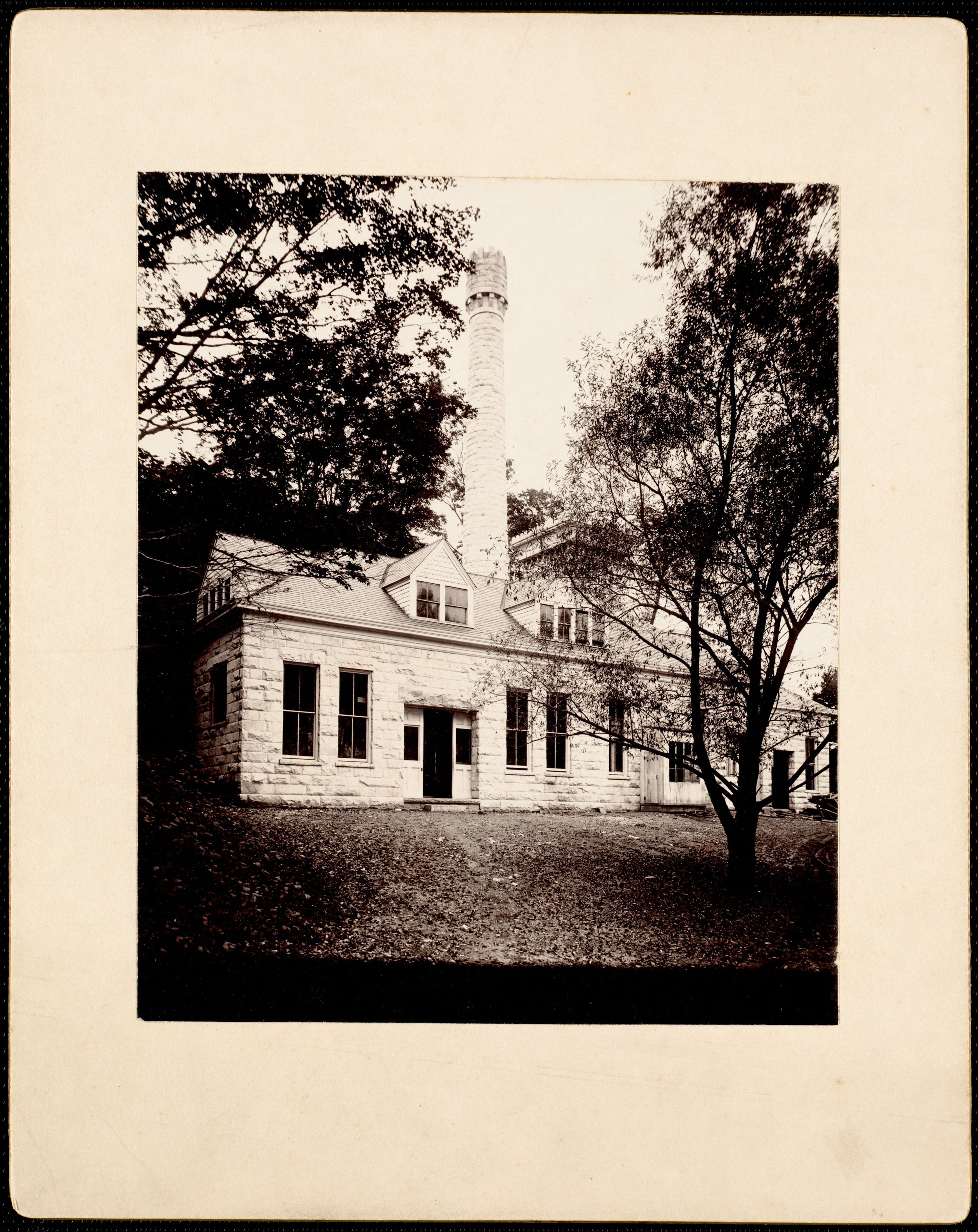
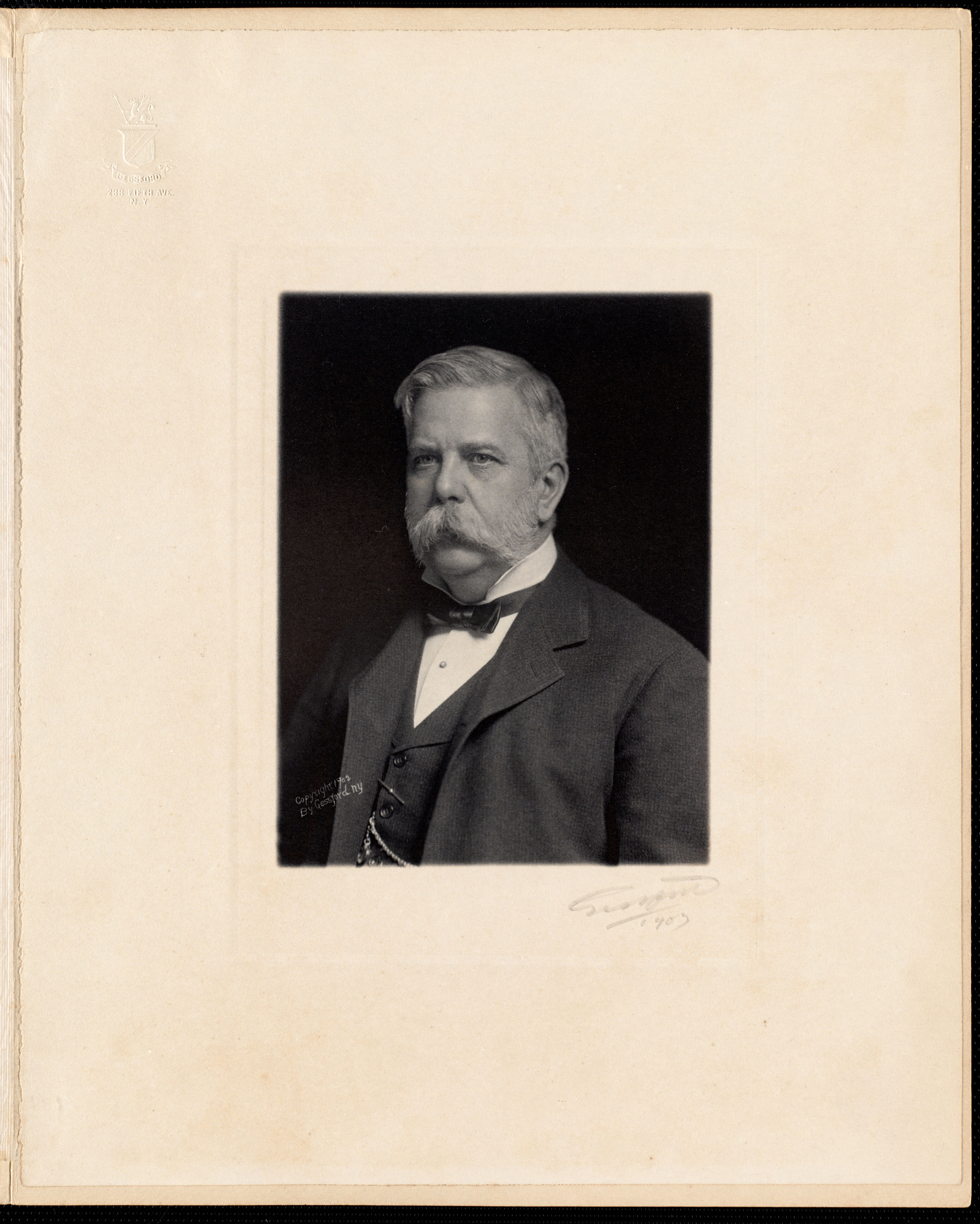
The clearest Berkshire case is Erskine Park, finished by 1893 for George Westinghouse and Marguerite Erskine Walker, and lit by its own generator. Of all the men in America who might have had an opinion about how a private house should be wired, Westinghouse was the one, and he built his summer house in Lenox and ran it on his own current.
The house is gone — sold in 1917 and pulled down — and what survives is photographs, a great many of them, of a white house, pale drives of crushed Lee marble, and ponds. Nobody photographed the dynamo.
VI. Thirty-one engineers
The directory gives the trade its numbers, with the usual caution attached.
Crowley & Lunt’s canvass of South Berkshire in 1923–’25 turns up thirty-one engineers, twenty plumbers, fifteen firemen, nine machinists, seven electricians, two millwrights and one tinsmith. That is a real services trade, in ten towns, a generation after the houses went up.
But read the employer column before you use the figure. Many of those engineers are railroad men — CNERR, NYNH&HRR, CNE yd — running locomotives, not house plants. Others are at the mills. The men who kept the estates lit are in there, but they are not separable from the men who kept the trains moving, and anybody who quotes thirty-one as a count of country-house engineers is quoting a number that has not been read.
What the list does show plainly is the shape of it. Seven electricians in ten towns. In 1886 there had been none anywhere, and the trade did not exist. Inside forty years it was an ordinary occupation you could be listed under, alongside blacksmith and teamster, both of which were on their way out as it came in.
VII. The other side of it
Every system in this story is also a risk, and the houses learned that.
Shadow Brook — for a while the largest private house in America — burned on 9 March 1956, and the fire began in the boiler room. The plant that made the house habitable was the thing that took it.
Brookside burned in November 1904. The report of the time says the fire “originated among bundles of kindling wood in the basement,” and that the family “had no time to dress” before getting out. Stanley rebuilt in concrete.
These are not freak events. A house with a coal fire under it, a hundred feet of hot pipe in its walls, early wiring in dry old timber and a mile of road between it and any help was a house with a clock running in the cellar, and the people who lived in them knew it.
VIII. The holdouts
Not everyone wanted any of it.
Ellen Schermerhorn Auchmuty lived at The Dormers in Lenox until 1927 and never took to motor cars, or the telephone, or steam heat. She outlived her husband by thirty-four years, ran her money shrewdly to the end, and gave the town a great deal — and she did it in a house that stayed on open fires while every neighbor on the hill was putting in a boiler.
There is no lesson in that, except that the technology arrived as a choice and some people looked at it and said no, and that the cottage era was not one thing happening to everybody at the same speed.
IX. What is left
The stone survives and the machinery does not. Boilers were scrapped in the war drives. Dynamos went for the copper. Annunciator boards came off servants’-hall walls when the servants’ halls became laundry rooms, and the wires behind them were cut flush and plastered over.
What is left is the shape of the buildings. The odd low structure down the hill with a tall chimney and a wide door. The stone tank on the ridge behind the stable. The coal chute in the foundation wall, bolted shut. The brick tunnel between the service wing and something that is no longer there.
And one photograph from 1896 in which the electrical contractor is on the job before the roof is finished, with his name on the side of the buggy, in a county that had been using alternating current for ten years already because the wires went up on the elm trees on Main Street.
The 1886 Great Barrington installation: IEEE Milestone, Alternating Current Electrification, 1886, and the Engineering and Technology History Wiki, for the dates, the rubber mill on Cottage Street, the six transformers, the twenty establishments and the wires on the elm trees; the Milestone citation is quoted verbatim. The five hundred and one hundred volt figures are Stanley’s own, from his 1911 address to the American Institute of Electrical Engineers, and are set out with the rest of the evidence in Five hundred volts. Whitney house under construction, October Mountain, 1896, with Benjamin and Edward B. Rogers of Berkshire Electric: Lenox Library Association, title supplied by the cataloguer, the names taken from the cataloguer’s note recording what is handwritten on the back of the print. Aspinwall boiler at the foot of Church Hill: Lenox Historical Society, via Digital Commonwealth. Westinghouse portrait and the workshop at Erskine Park: Lenox Library Association. Trade counts from Crowley & Lunt, South Berkshire Directory, 1923–’25, reproduced in full here; that volume does not cover Lenox, which is in the 1926 Central Berkshire directory instead, and the employer abbreviations are the directory’s own. House details, fires and dates are as set out on this site’s pages for the estates named, with their sources.