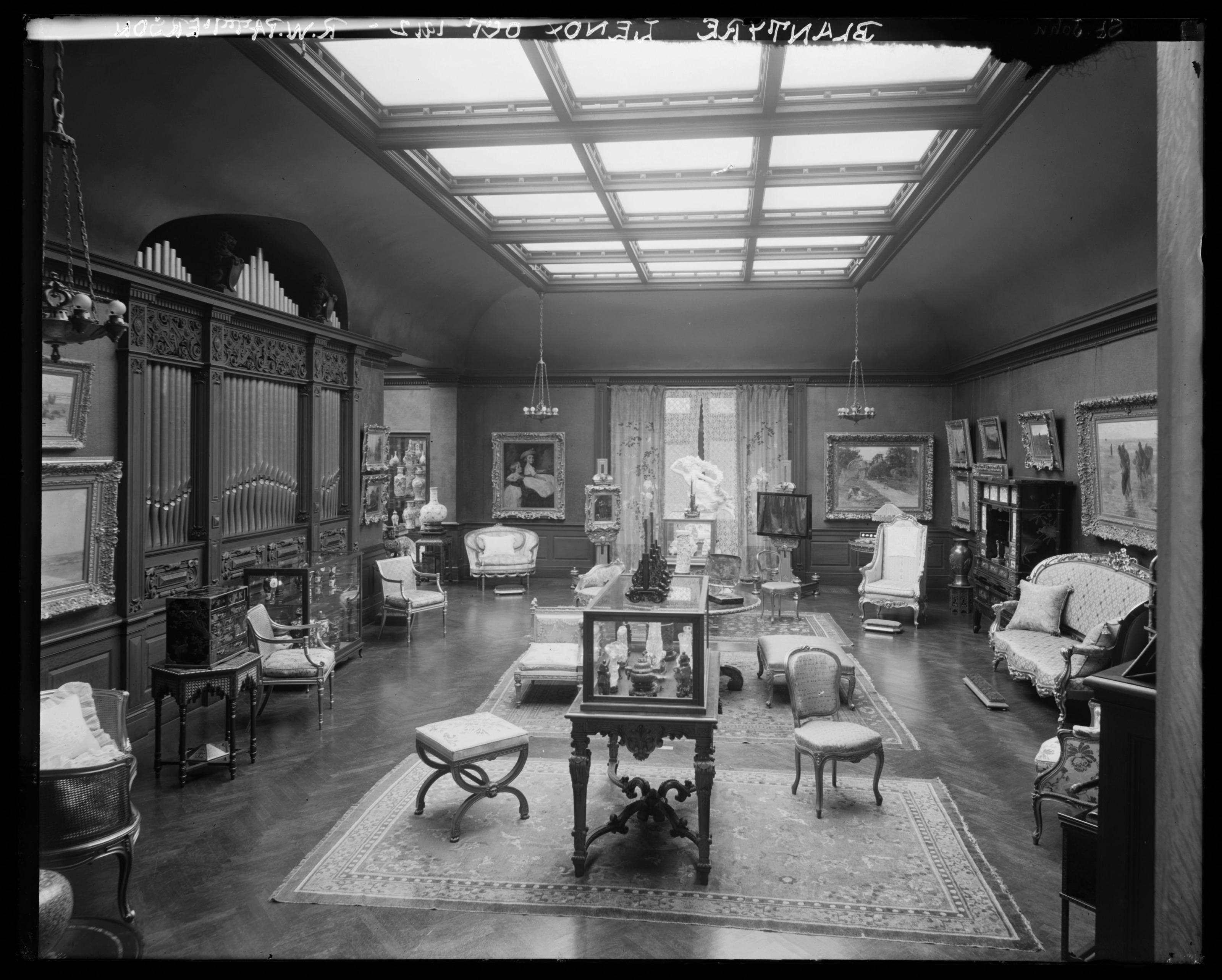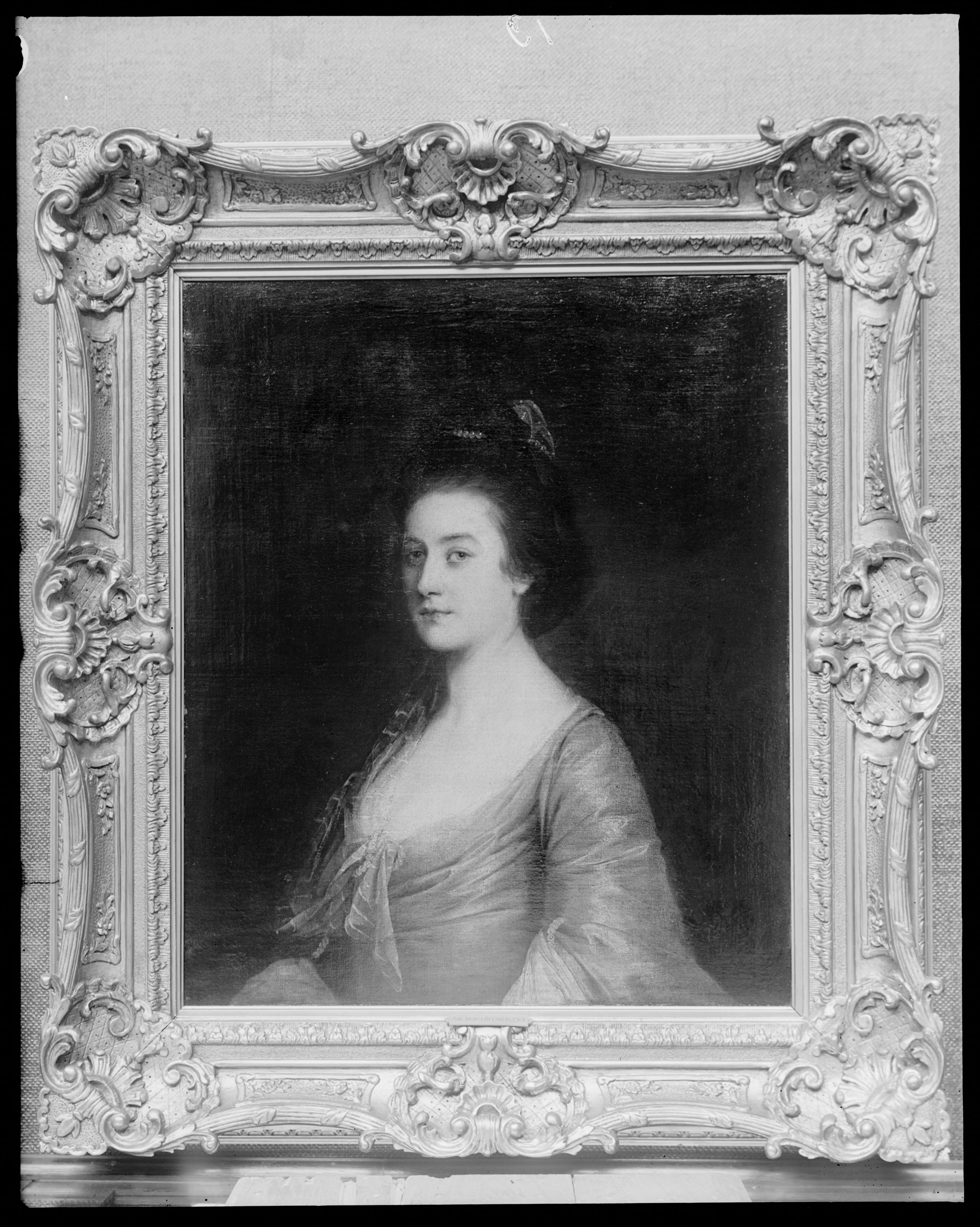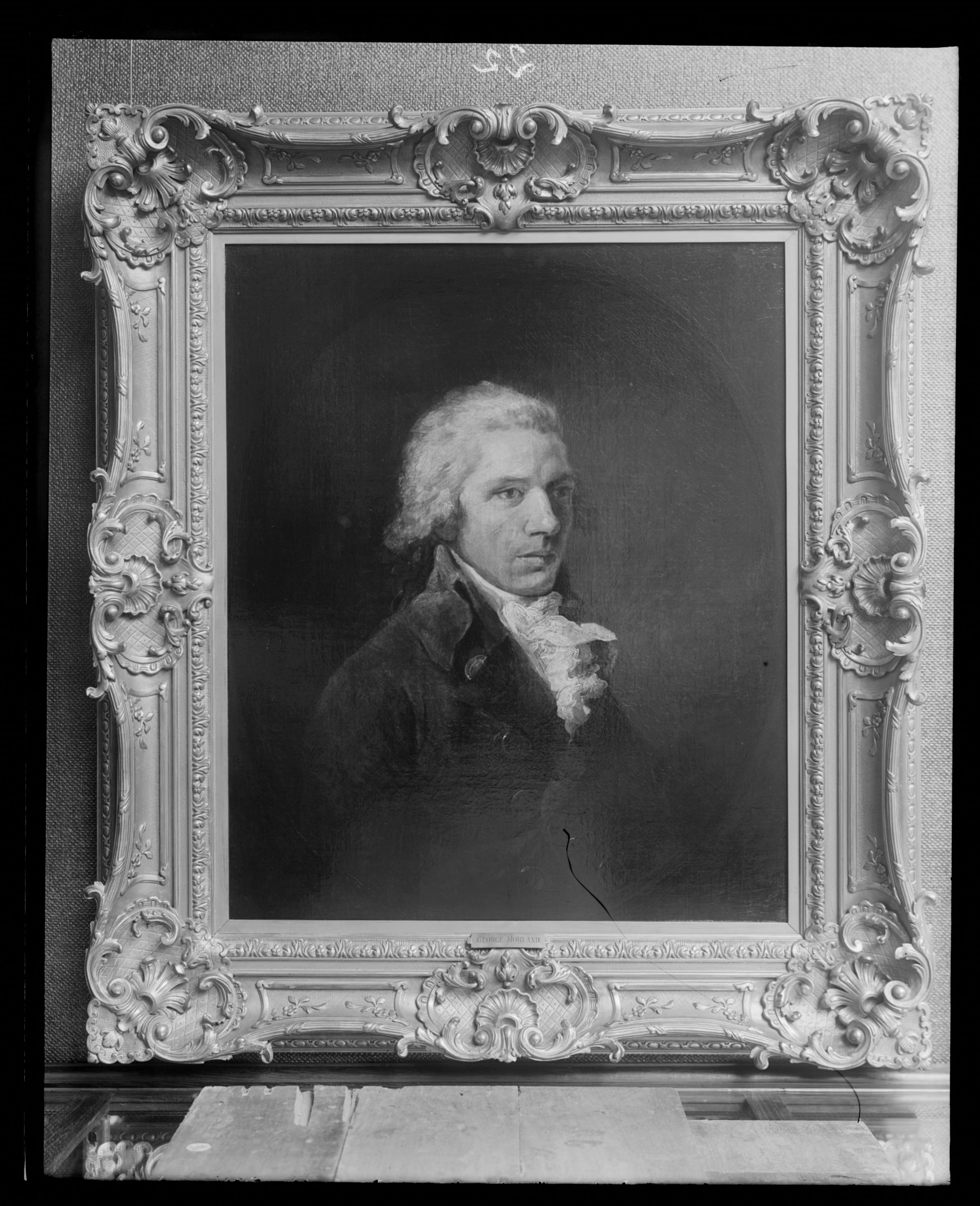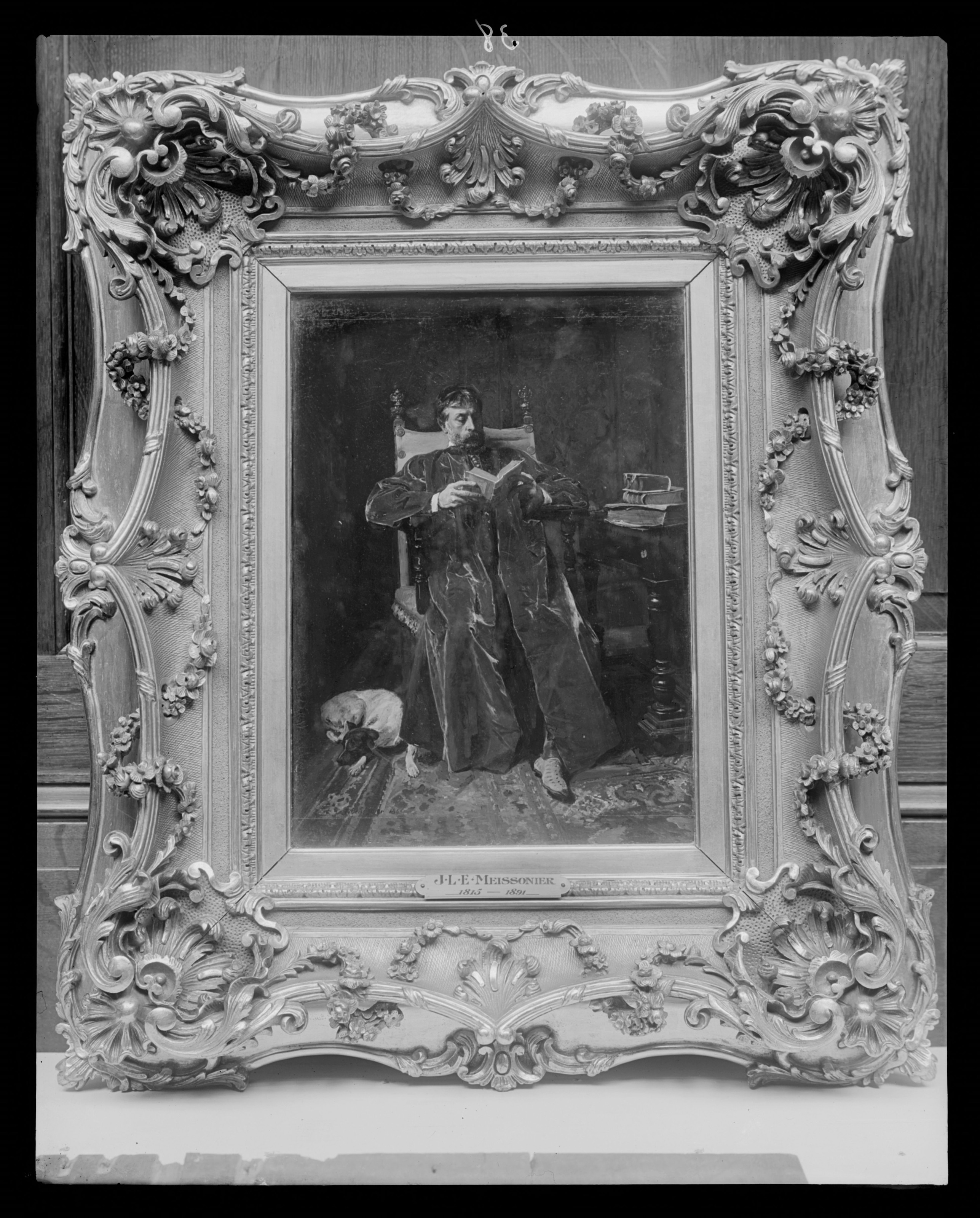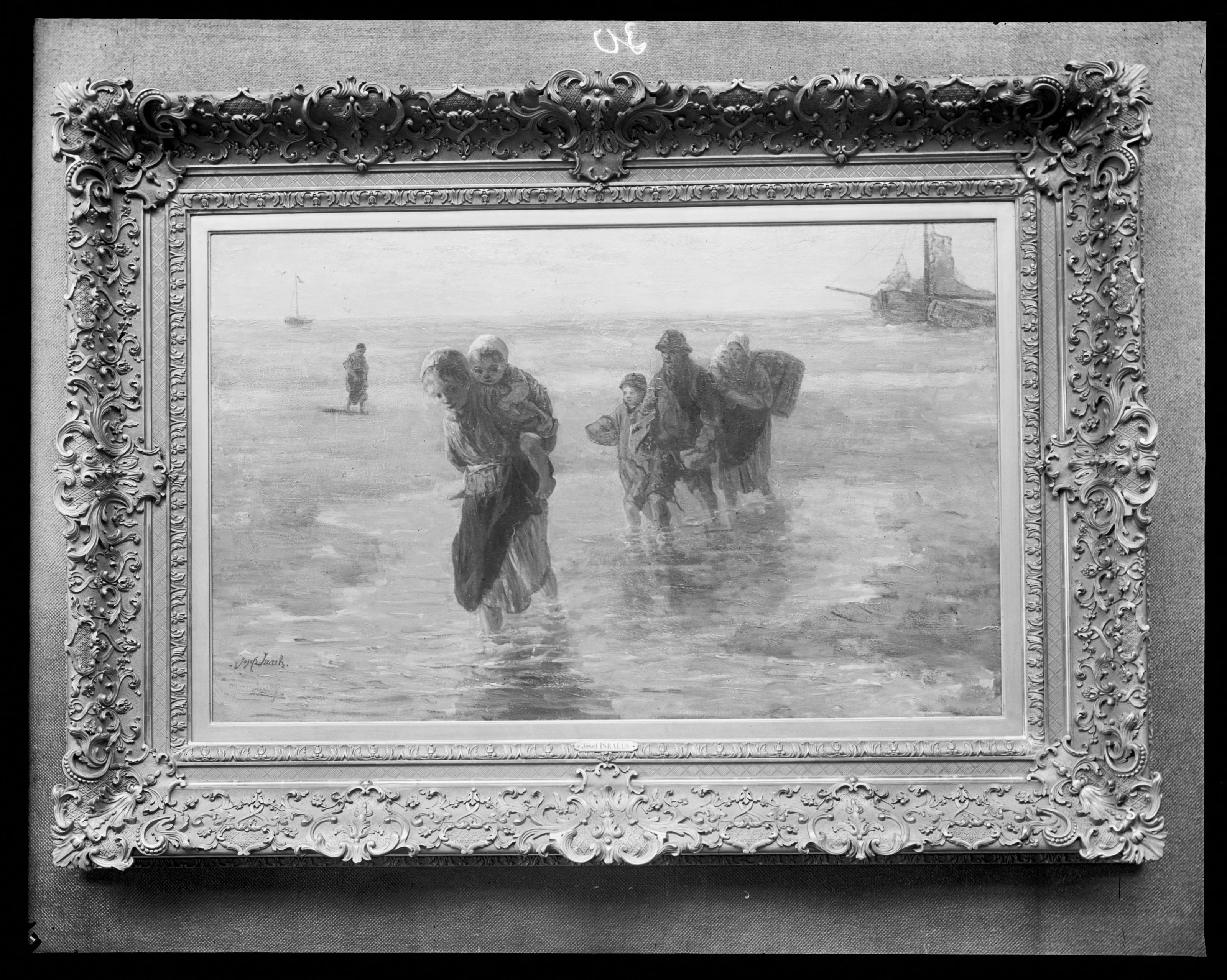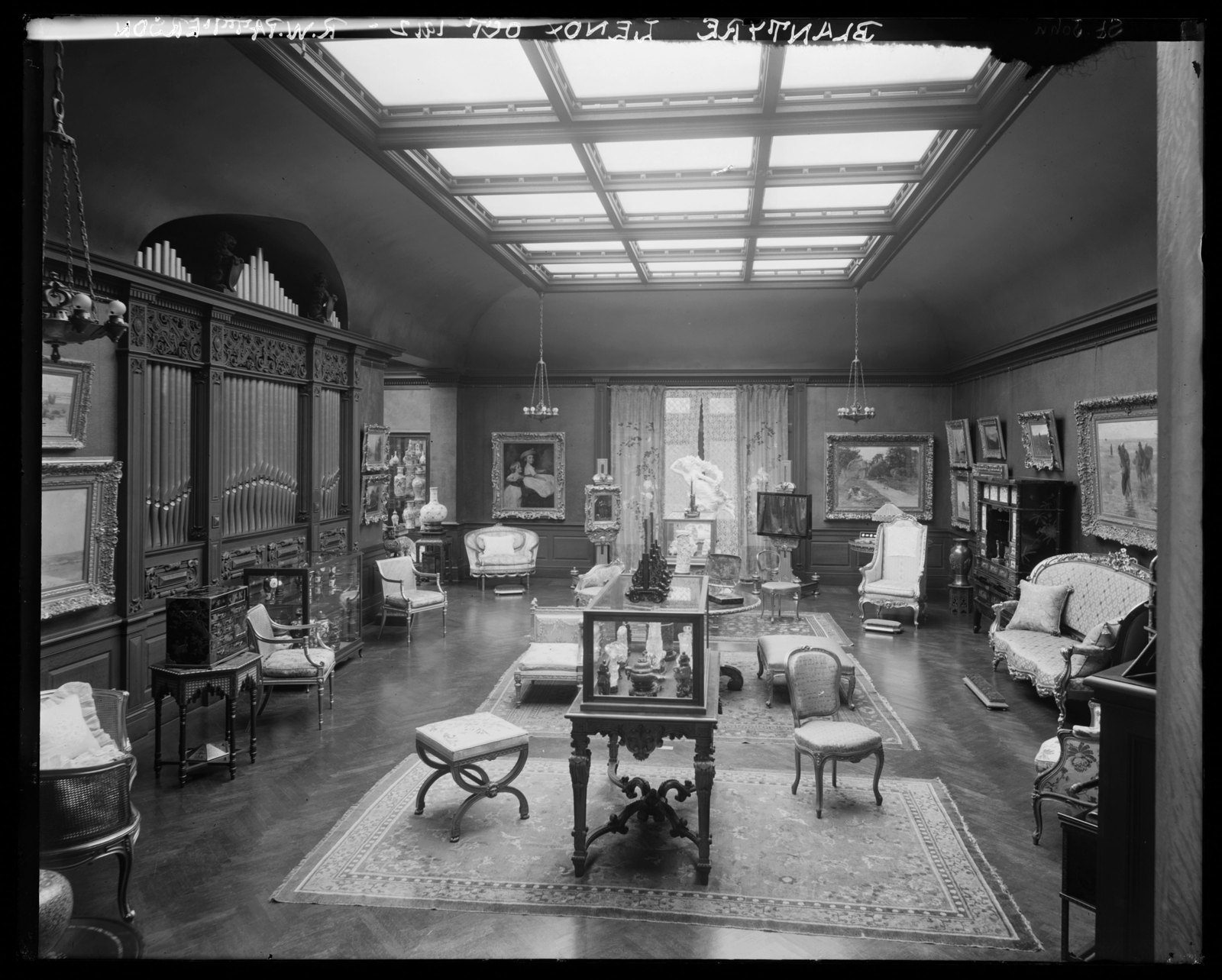
The Blantyre page says that no artist is named on any of the negatives, and that attributing them is work for somebody else. That was half right. No artist is named in the Lenox Library’s catalogue — but nearly every frame in the house carries an engraved brass plaque, and at full resolution the plaques read. Forty-two painters, named by the Patersons’ own framer.
I. What the brass says
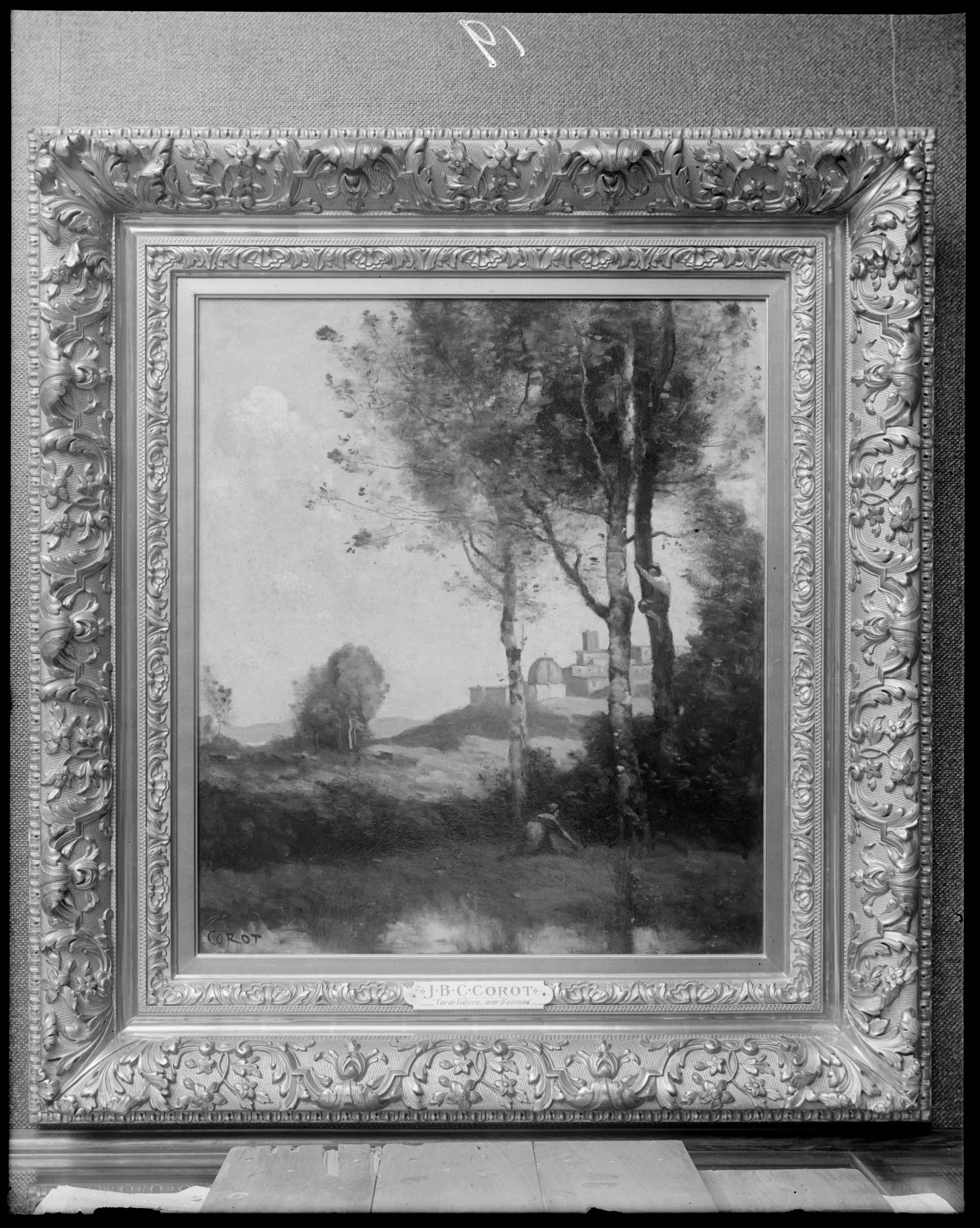
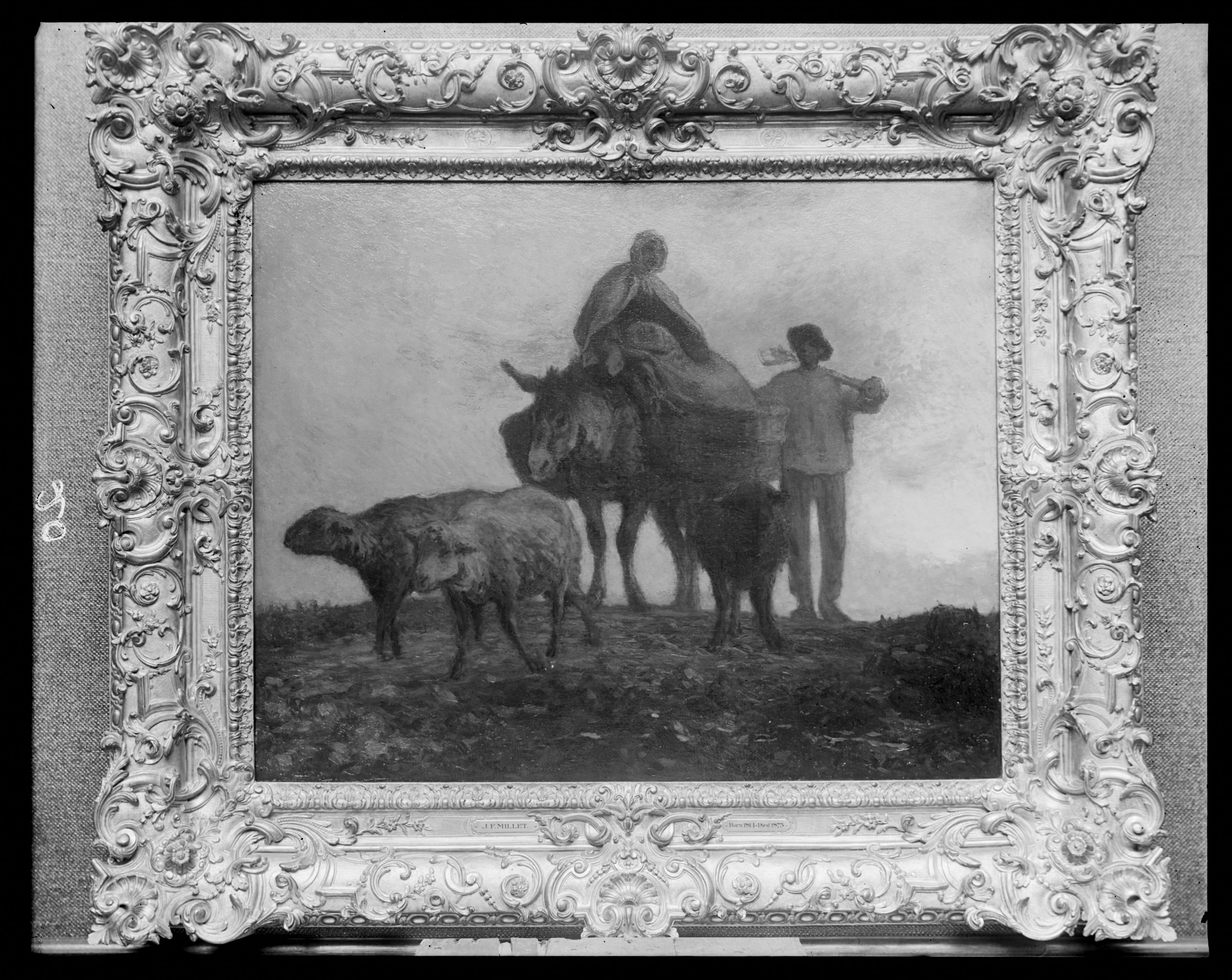
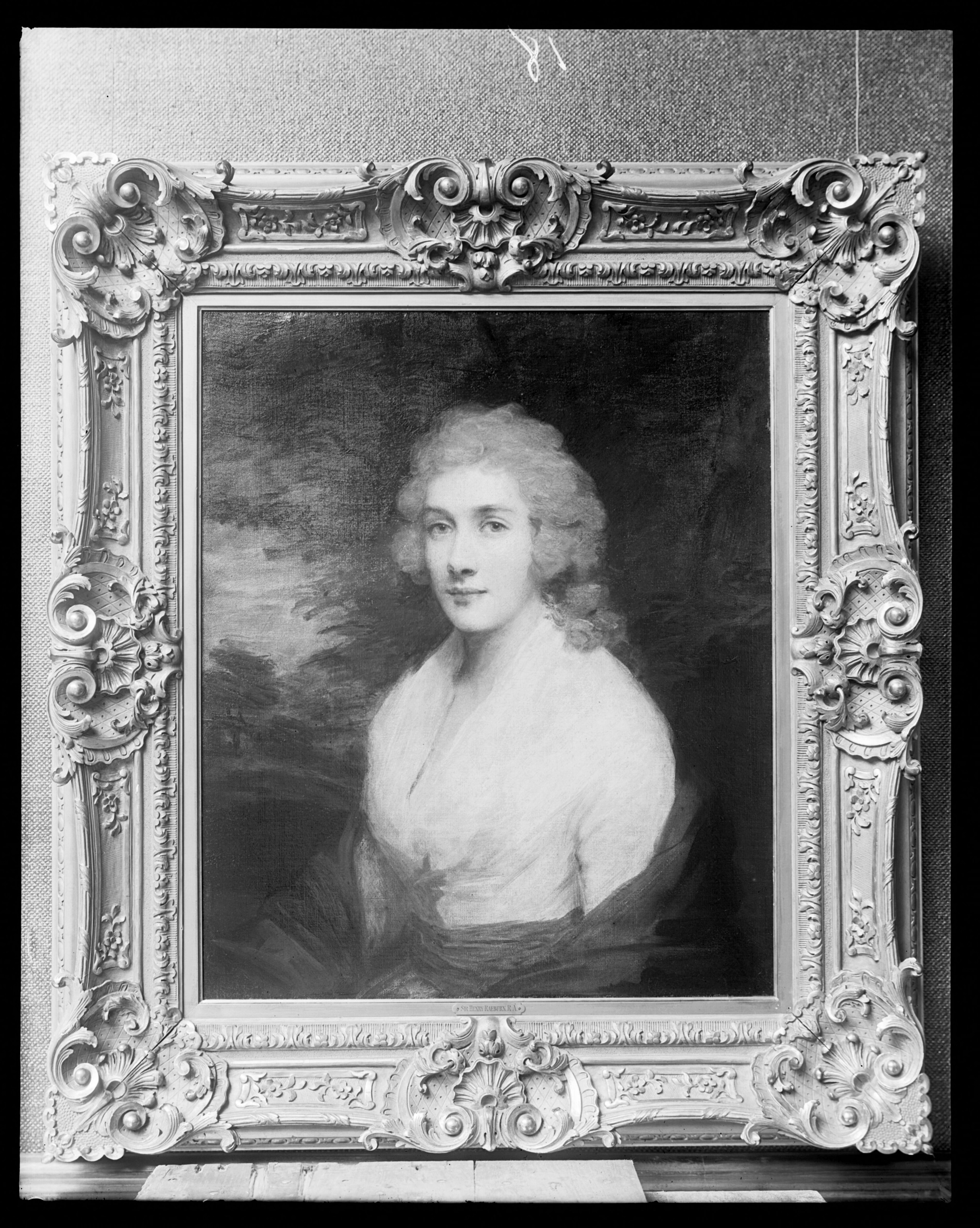
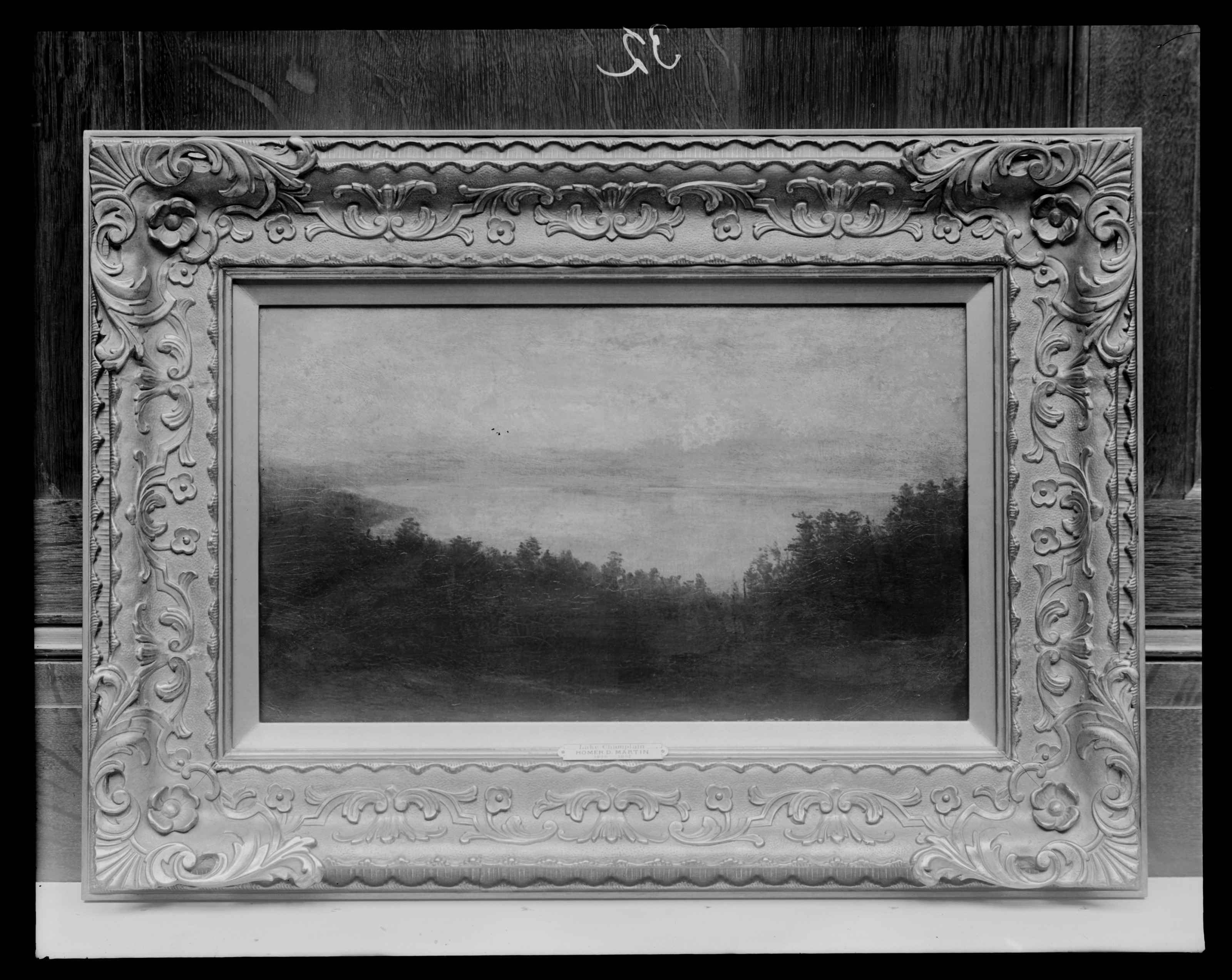
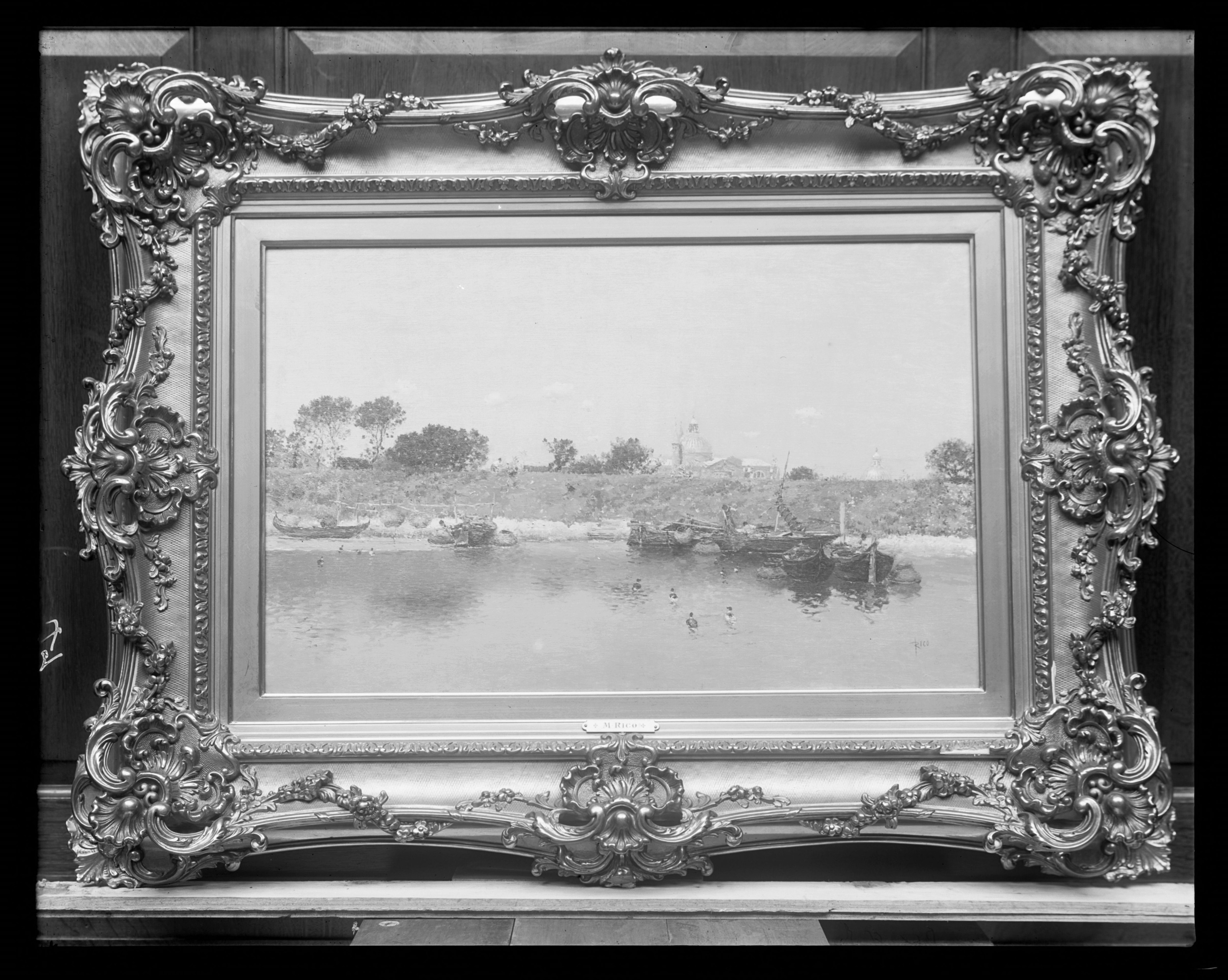
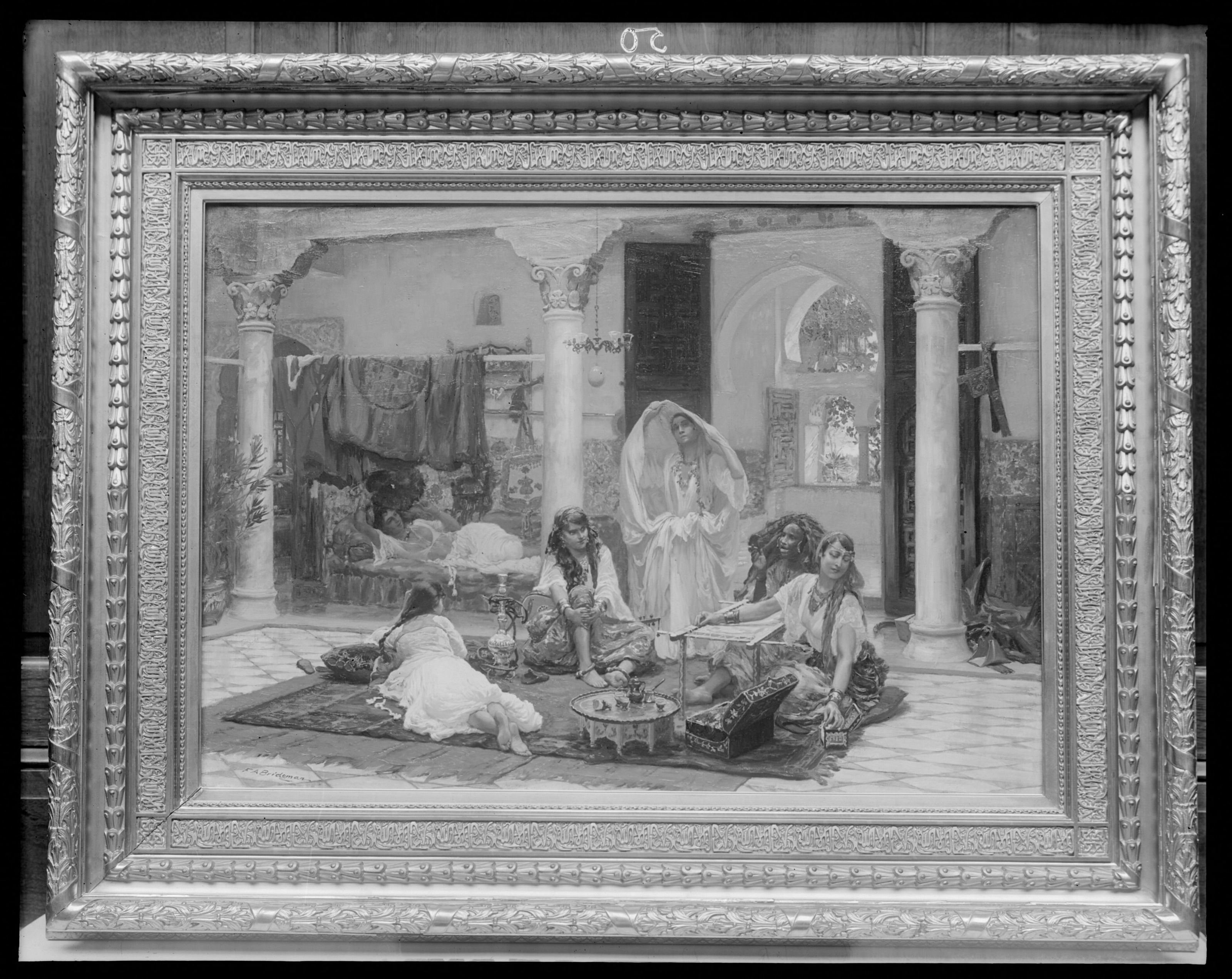
In October 1912 the pictures were taken down one at a time, stood against a dark cloth and photographed. The camera was close enough, and the negatives fine enough, that the plaque on the lower rail of each frame is legible — and where the plaque is missing, the signature on the canvas usually is not.
Everything in the tables below is transcribed from the photographs: the plaque exactly as engraved, and the signature where one can be read. No attribution here rests on style or subject. Where a plaque and a signature disagree, both are given.
II. The Barbizon wall
Marie Paterson collected the paintings, and what she collected first was Barbizon — the French landscape school of the 1830s to 1870s that American money bought harder than any other. The roster in this house is close to complete.
Corot twice. Millet. Théodore Rousseau. Daubigny twice. Díaz twice. Dupré. Charles Jacque. Decamps. Harpignies. If you were assembling the school in 1905 with a New York dealer’s advice and no ceiling on spending, this is the list you would end up with.
| On the frame | Artist | Dates | Where the work stands now |
|---|---|---|---|
| J·B·C·COROT · 1796–1875 | Jean-Baptiste-Camille Corot | 1796–1875 | In the Louvre, the Metropolitan, the National Gallery in London and the National Gallery of Art. Never out of the canon. |
| J·B·C·COROT / Vue de Volterra, near Ravenna | Jean-Baptiste-Camille Corot | 1796–1875 | A second Corot. The title is engraved on the plaque; Volterra is in Tuscany, about a hundred and fifty miles from Ravenna. |
| J·F·MILLET · Born 1814 Died 1875 | Jean-François Millet | 1814–1875 | Musée d’Orsay, Boston, the Metropolitan. The Angelus is one of the most reproduced pictures ever painted. |
| Th. ROUSSEAU · 1812–1867 | Théodore Rousseau | 1812–1867 | The leader of the Barbizon painters. Held by the Louvre and most large American museums. |
| C·F·DAUBIGNY · 1817–1878 | Charles-François Daubigny | 1817–1878 | Signed and dated 1865 on the canvas. Daubigny’s river pictures are read now as a bridge to Monet. |
| C·F·DAUBIGNY 186– / Bords de la … | Charles-François Daubigny | 1817–1878 | A second Daubigny, signed. The title on the plaque is partly obscured. |
| N·DIAZ · 1808–1876 | Narcisse Virgile Díaz de la Peña | 1807–1876 | The plaque gives 1808; the year usually given is 1807. |
| N·DIAZ | Narcisse Virgile Díaz de la Peña | 1807–1876 | A second Díaz. |
| Jules Dupré · 1812–1889 | Jules Dupré | 1811–1889 | The plaque gives 1812; the year usually given is 1811. |
| CHAS·JACQUE 187– / from the Fop Smit Collection | Charles Émile Jacque | 1813–1894 | The plaque records an earlier owner: the Rotterdam shipping family Fop Smit, whose pictures were dispersed in the 1890s. |
| DECAMP[S] | Alexandre-Gabriel Decamps | 1803–1860 | Monogrammed DC on the canvas. A founder of French orientalist painting. |
| H·HARPIGNIES | Henri-Joseph Harpignies | 1819–1916 | The longest-lived of the group; he outlasted Impressionism by a generation. |
One plaque carries more than a name. The Charles Jacque is engraved “from the Fop Smit Collection” — the Rotterdam shipping family whose pictures were sold off in the 1890s. It is the only line of provenance anywhere in the house, and it was put on the frame deliberately, because provenance was part of what had been bought.
III. The English portraits
The Blantyre page describes “eighteenth-century English portraits in the Gainsborough manner.” They are not in the manner of Gainsborough. They are plaqued as Gainsborough — three of them — and as Reynolds, Raeburn, Romney and Morland, with four panels under Constable’s name and a Turner titled Zurich.
One of the Gainsboroughs carries an inscription on the canvas itself rather than the frame: Mrs Burroughs at the left, and at the right Thos Gainsborough R.A. with the year 1769. It is the only date written on any picture in the building.
| On the frame | Artist | Dates | Where the work stands now |
|---|---|---|---|
| THOS·GAINSBOROUGH R·A· / “Mrs BURROUGHS” | Thomas Gainsborough | 1727–1788 | The canvas is inscribed Mrs Burroughs and signed and dated 1769 — the only date visible on any picture in the house. |
| THOMAS GAINSBOROUGH R·A· | Thomas Gainsborough | 1727–1788 | A second portrait, photographed twice from the same angle. |
| THOS·GAINSBOROUGH R·A· | Thomas Gainsborough | 1727–1788 | A third work under his name. |
| SIR JOSHUA REYNOLDS P·R·A· | Joshua Reynolds | 1723–1792 | First President of the Royal Academy. |
| SIR HENRY RAEBURN R·A· | Henry Raeburn | 1756–1823 | The portraitist of Edinburgh. |
| GEORGE ROMNEY R·A· / The Stanhope Children | George Romney | 1734–1802 | A group portrait, titled on the plaque. |
| GEORGE MORLAND | George Morland | 1763–1804 | Rustic and stable subjects; enormously copied, which makes attribution hard. |
| J·CONSTABLE R·A· · B.1776 D.1837 | John Constable | 1776–1837 | Two works photographed side by side. |
| J·CONSTABLE R·A· | John Constable | 1776–1837 | Two further works, again photographed as a pair. |
| “Zurich.” / J·M·W·TURNER R·A· | J. M. W. Turner | 1775–1851 | Titled on the plaque. Turner’s late Swiss subjects, Zurich among them, are among the most sought-after works on paper in the world. |
IV. The Hague School
The Dutch contemporaries came next, and they came as a set: Israëls, Jacob Maris, Mauve twice, Weissenbruch, Neuhuys, de Bock. With them, and older than all of them, a Jongkind signed and dated 1870.
| On the frame | Artist | Dates | Where the work stands now |
|---|---|---|---|
| Josef ISRAELS | Jozef Israëls | 1824–1911 | Signed upper left. The senior figure of the Hague School. |
| Jacob Maris | Jacob Maris | 1837–1899 | Signed lower right. |
| A·MAUVE | Anton Mauve | 1838–1888 | Signed. Van Gogh’s cousin by marriage and his first teacher in oils. |
| A·Mauve | Anton Mauve | 1838–1888 | A second Mauve. |
| WEISSENBRUCH | Jan Hendrik Weissenbruch | 1824–1903 | Signed and dated 94. |
| Alb·NEUHUYS | Albert Neuhuys | 1844–1914 | Cottage interiors; much bought in America in these years. |
| Th. de Bock | Théophile de Bock | 1851–1904 | Signed. |
| J·B·JONGKIND · 1819–1891 | Johan Barthold Jongkind | 1819–1891 | Signed and dated 1870. Monet named him the man who taught him to see. |
V. The Salon, and a household joke
The French Salon painters are here too, led by Ernest Meissonier — in his lifetime the most expensive painter who had ever lived — with a second picture by his son Charles, who was still alive when the shutter opened.
And a quieter pairing. Émile van Marcke painted cattle standing in water, and sold a great many of them in America. So did Marie Dieterle, who was his daughter and his pupil. Both hang in the same room, painting the same cows.
| On the frame | Artist | Dates | Where the work stands now |
|---|---|---|---|
| J·L·E·MEISSONIER · 1815–1891 | Ernest Meissonier | 1815–1891 | In his lifetime the highest-priced painter alive. The twentieth century reversed that judgment more completely than for any other name in this house. |
| CH·MEISSONIER | Charles Meissonier | 1848–1917 | Signed. Ernest’s son, and still living when the photograph was taken. |
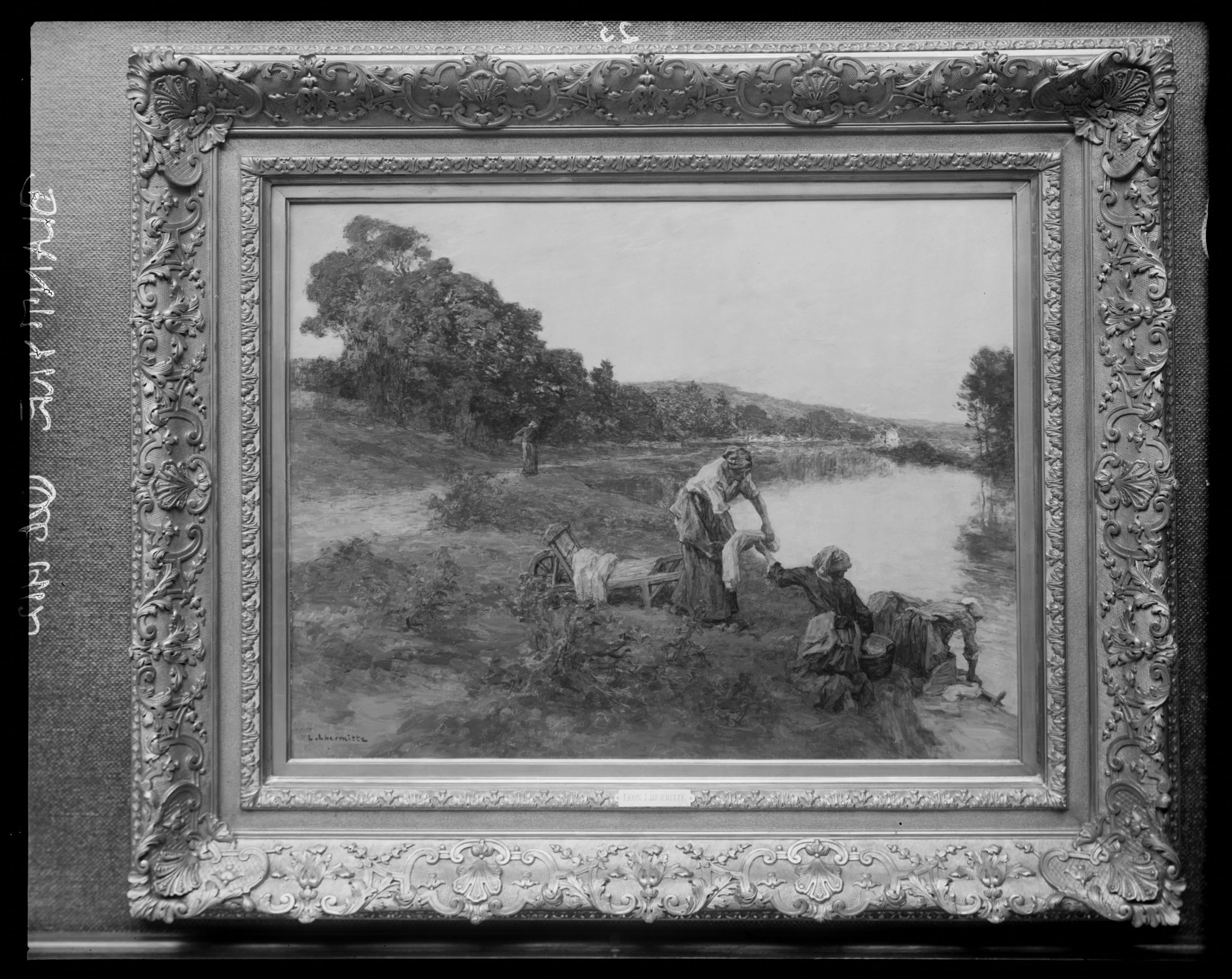
| LEON LHERMITTE | Léon Augustin Lhermitte | 1844–1925 | Signed. Washerwomen at a river. |
| LEON L’HERMITTE | Léon Augustin Lhermitte | 1844–1925 | Signed and dated 1895. A second Lhermitte. |
| Em·VAN MARCKE | Émile van Marcke de Lummen | 1827–1890 | Signed. Cattle watering — the single most saleable subject in America in the 1880s. |
| MARIE DIETERLE | Marie Dieterle | 1856–1935 | Van Marcke’s daughter and pupil, painting the same cattle. Both hang in the same room. |
| Joseph BAIL | Joseph Bail | 1862–1921 | Signed. Copper pans and a scullery floor. |
| J·C·CAZIN | Jean-Charles Cazin | 1841–1901 | Signed. |
| E·ISABEY | Eugène Isabey | 1803–1886 | Signed and dated 70. |
| Adolf Schreyer | Adolf Schreyer | 1828–1899 | Signed. German; horses and Arab riders. |
| P·J·CLAYS | Paul Jean Clays | 1819–1900 | Signed. Belgian; shipping on flat water. |
| P·J·CLAYS | Paul Jean Clays | 1819–1900 | A second Clays. |
| M·RICO | Martín Rico y Ortega | 1833–1908 | Spanish. The Venetian view. |
| ERSKINE NICOL | Erskine Nicol | 1825–1904 | Scottish; Irish subjects. |
| ERSKINE NICOL | Erskine Nicol | 1825–1904 | A second Nicol. |
VI. The Americans
Six painters the Blantyre page does not mention at all, because the Library’s titles do not name them. Two of them were alive and working when the photograph was taken: J. Francis Murphy signed his canvas in 1910, Horatio Walker his in 1907. This was not only a collection of dead Europeans. Some of it was bought new.
| On the frame | Artist | Dates | Where the work stands now |
|---|---|---|---|
| “Lake Champlain” / HOMER D·MARTIN | Homer Dodge Martin | 1836–1897 | Titled on the plaque. |
| A·H·WYANT · 1836–1892 | Alexander Helwig Wyant | 1836–1892 | Of the Hudson River painters who turned tonalist. |
| J·FRANCIS MURPHY | John Francis Murphy | 1853–1921 | Signed and dated 1910 — two years before the photograph. |
| Henry G·Dearth | Henry Golden Dearth | 1864–1918 | Signed. |
| HORATIO WALKER | Horatio Walker | 1858–1938 | Signed and dated 1907. Canadian-born; Quebec farm subjects. |
| F·A·Bridgman | Frederick Arthur Bridgman | 1847–1928 | Signed. The orientalist courtyard scene. |
VII. Where they went
Robert Paterson died in 1917 leaving about a million dollars. Marie sold Blantyre in 1925 for $25,000 — against the $135,000 the house alone had cost. A sum like that does not include forty-two painters. The pictures left the building first, and the photographs are what stayed behind.
Three tools would settle where they went. The Getty Provenance Index has digitised American auction catalogues of the period, which is where a dispersal sale would appear. The Frick Art Reference Library Photoarchive holds photographs of works in American private collections with, in its own description, “former and current attributions, title history, exhibition records, and color and condition notes.” And the Frick’s Archives Directory for the History of Collecting in America indexes collectors by name. The titled pictures are the ones to start on, because a title survives a change of owner: Mrs Burroughs, The Stanhope Children, Zurich, Vue de Volterra, Lake Champlain.
VIII. On what it would be worth
No valuation is offered here, and the reason is not modesty. A picture’s price turns on size, condition, quality within an artist’s output and an unbroken chain of ownership. What survives of this collection is forty-two photographs of frames. That supports a catalogue. It does not support a number, and a number produced from it would be a guess wearing a decimal point.
What the photographs do support is the shape of the thing, and the shape is the interesting part — because the market has not treated these forty-two names alike.
Take the year the taste in this room was formed. On 1 July 1889 Millet’s The Angelus sold in Paris for 553,000 francs, bid up between the Louvre and the American Art Association; the Americans won it and sold it on the following year for 750,000 francs. Eight years earlier it had changed hands for 168,000. That was the high-water mark of the taste the Patersons bought into, and The Angelus now hangs in the Musée d’Orsay, which is where the story of the Barbizon market ends: in museums, at prices no longer set by anybody.
Meissonier is the other end of it. No nineteenth-century reputation fell further in the twentieth. The English portraits and the Turner went the other way and stayed there.
So the collection is not one asset but three, moving in different directions from the moment the negatives were exposed — and none of that is a basis for pricing anything. I am not an appraiser. Anyone wanting a figure needs the pictures themselves, not photographs of them.
Sources
Photographs: Lenox Library Association, Edwin Hale Lincoln Photographs, via Digital Commonwealth — fifty-eight negatives of the picture gallery and its contents, October 1912 and 1912 undated, all titled by the cataloguer as “Blantyre: art collection,” “art gallery and organ” or “interior/gallery of paintings and china ware.” The Library gives their rights as “No known copyright restrictions,” asking that it be contacted about reuse. Every attribution in the tables above is transcribed from the frame plaque or the signature as it appears in the negative at full resolution; artists’ dates are the standard ones, and where a plaque disagrees with them the plaque’s figure is quoted and the difference noted. Wikipedia, “The Angelus (painting),” for the sale to Eugène Secrétan at the Wilson sale of 16 March 1881 for 168,000 francs, the sale at the Galerie Sedelmeyer on 1 July 1889 for 553,000 francs contested between the Louvre and the American Art Association, the resale to Alfred Chauchard for 750,000 francs in 1890, and the painting’s transfer to the Musée d’Orsay in 1986. The Frick Art Reference Library, “Provenance Research,” for the quoted description of what the Photoarchive records, and the Frick’s Archives Directory for the History of Collecting in America for its scope. Paterson’s death in 1917, the estate of about a million dollars, the 1925 sale of Blantyre for $25,000 and the $135,000 cost of the house are as sourced on the Blantyre page.