THE WHEATLEIGH PLANS — ONE
Seven Plants Olmsted Specified That Massachusetts Now Bans
The 1894 planting list for the Wheatleigh gate names roughly a hundred kinds of tree, shrub and vine. Seven of them can no longer be bought or planted in this state.
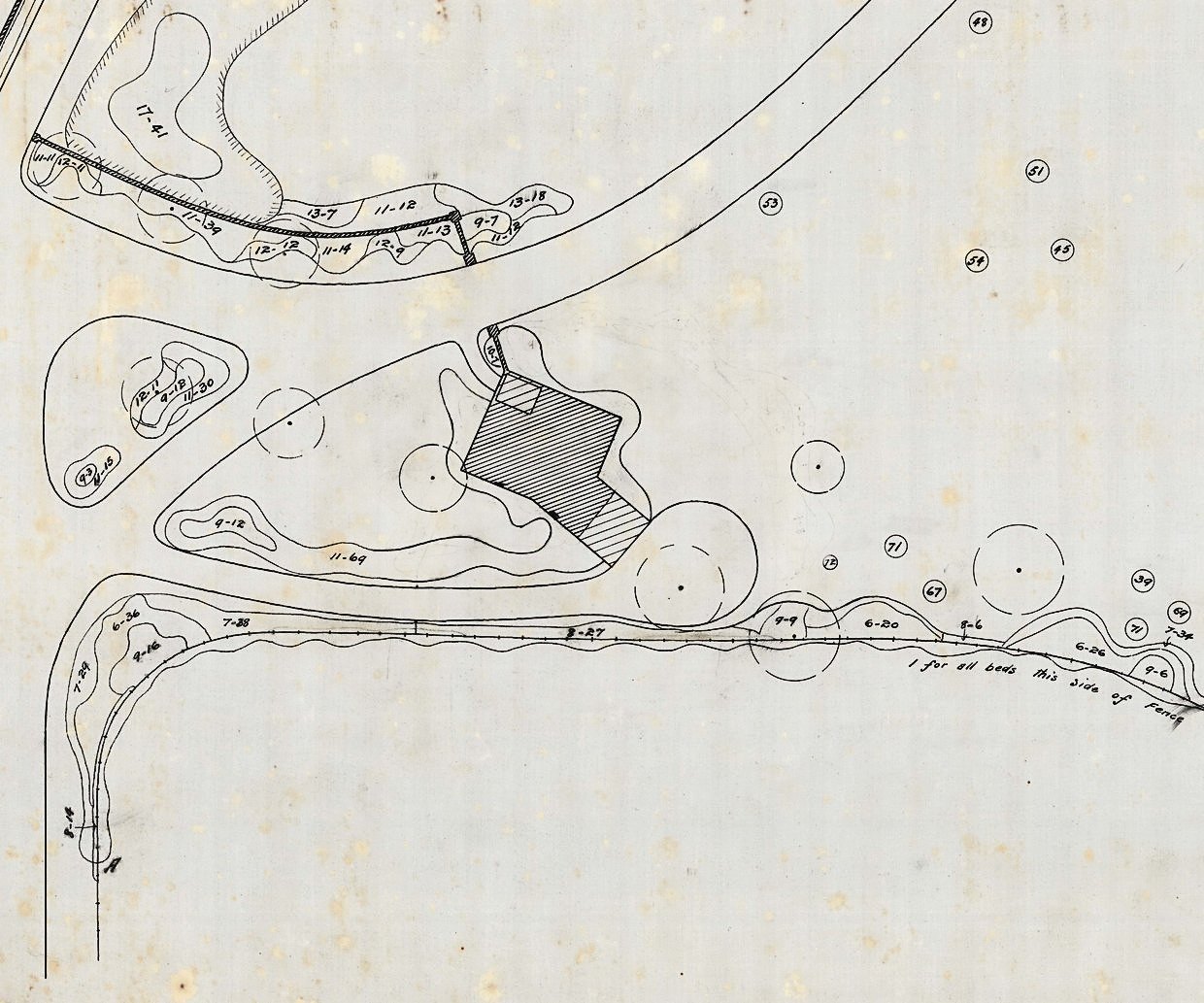
Olmsted, Olmsted & Eliot drew the planting plan for Henry H. Cook's Stockbridge estate in October 1894 and sent along a typed schedule to go with it. Every bed on the drawing carries a two-part label — a group number and a count. Bed 11-69 means sixty-nine plants of group eleven. The schedule then spells out what group eleven is: rose, hydrangea, spirea, forsythia, snowberry, viburnum, kerria, deutzia.
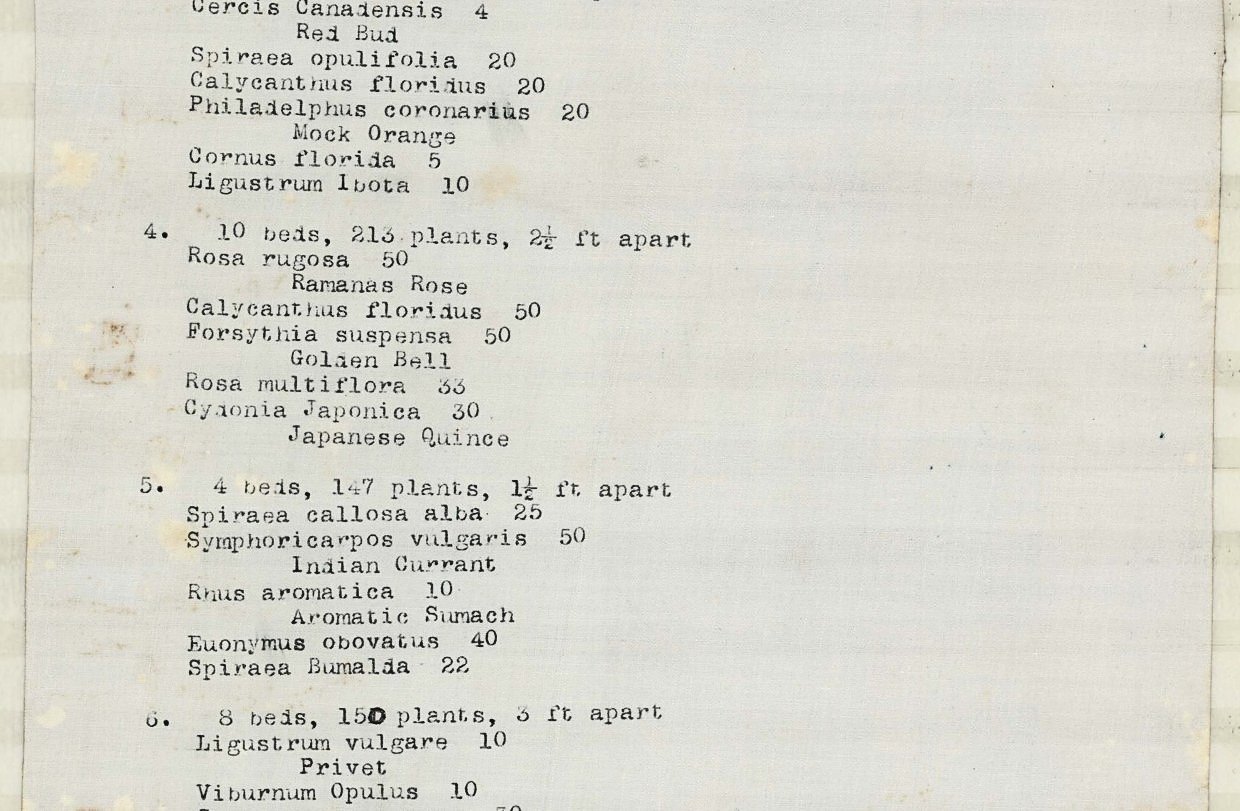
Thirty-one mixed groups and about forty numbered specimen trees make up the whole vocabulary of the place. Run that vocabulary against the Massachusetts Prohibited Plant List and seven entries come back flagged. They are not obscure filler. Group one alone — the eight beds of thicket that screen the road frontage, eight thousand plants at two feet on center — called for eight hundred multiflora rose and fifty common buckthorn.
I Banned Today
| 1894 list name | In modern terms | Groups | Status in Massachusetts |
|---|---|---|---|
| Rosa multiflora | Multiflora rose | 1, 2, 4, 7, 19 | Prohibited 2006 |
| Rhamnus catharticus | Common buckthorn | 1, 30 | Prohibited 2006 |
| Berberis vulgaris | Common barberry | 7, 13, 19, 28, 29, 30 | Prohibited 2006 |
| Ligustrum Ibota | Border privet (L. obtusifolium) | 3, 15 | Prohibited 2006 |
| Berberis Thunbergii | Japanese barberry | 10, 12, 14 | Import 2006; propagation 2009 |
| Lonicera Morrowii | Morrow's honeysuckle | 17 | Import 2006; propagation 2009 |
| Lonicera brachypoda | Japanese honeysuckle (L. japonica) | 8 | Prohibited |
The regulation bars sale, import, trade, purchase, propagation and distribution. It does not compel anyone to dig out what is already growing — which matters here, because a good deal of it almost certainly still is.
II Legal, But Watch Them
| 1894 list name | In modern terms | Groups | Note |
|---|---|---|---|
| Ligustrum vulgare, L. ovalifolium | Common and California privet | 6, 13, 15, 19, 29 | Legal; naturalizes readily |
| Euonymus Europeus | European spindle-tree | 6, 18, 29, 30 | Legal — not the banned burning bush |
| Euonymus radicans | Wintercreeper (E. fortunei) | 21, 26 | Legal; smothers ground layers |
| Vinca minor | Periwinkle — 300 plants | 21 | Legal; displaces spring ephemerals |
| Clematis paniculata | Sweet autumn clematis | 25 | Legal; self-sows aggressively |
| Rosa rugosa | Ramanas rose | 4, 11 | Legal; invasive on coastal dune systems |
Two entries look worse than they are. The Ampelopsis quinquefolia in group one is Virginia creeper, a native. The Ampelopsis Veitchii in group twenty-seven is Boston ivy. Neither is the porcelain-berry that carries the ban. And the plant the schedule calls Burning Bush is the European spindle-tree, not the winged euonymus that Massachusetts outlawed in 2006.
III What Survives Substitution
The species roster is the perishable part of these drawings. The structure is not. What the 1894 sheets actually encode is a set of spacings — eight inches for ground cover, eighteen inches for the broadleaf evergreens, two feet for the thicket, two and a half for the rose mixtures, three for the flowering layer, four for the trees — and a discipline about where a mass stops and lawn begins. Those bed outlines were drawn against contours that have not moved.
So the seven banned plants are a substitution problem, not an obstacle. Multiflora rose was in the list for arching habit and dense thorny cover at two feet on center; Rosa virginiana and Rosa nitida do the same work, and both are already in these beds — the schedule's Rosa lucida is R. virginiana under its old name. Common buckthorn was bulk screening; arrowwood and shadbush were doing that job too, in the very same beds. Morrow's honeysuckle appears once, in group seventeen, among ninebark, elder and flowering raspberry that carry the group without it.
Restore the geometry and the spacing and you have Olmsted's design. Restore the 1894 species list literally and you have a violation.
Sources: Olmsted Archives, Frederick Law Olmsted National Historic Site, job #01295, plans 121-sh1 through 121-sh4. Massachusetts Prohibited Plant List, Department of Agricultural Resources, revised January 2025. Images courtesy of the United States Department of the Interior, National Park Service, Frederick Law Olmsted National Historic Site.