INTRODUCTION
Three Families and a Firm
Who built Wheatleigh, who lived in it, and who drew the ground it stands on — and why the drawings are catalogued under the wrong name and the wrong town.
I The Cooks
Henry Harvey Cook was born in 1822 at Cohocton, in the Finger Lakes country of New York, the son of Constant Cook — a blacksmith and farmer who made himself a judge, a banker and a railroad contractor. The son went to an academy at Canandaigua, prospered in trade at Bath, married Mary E. McCay, and in 1875 moved the family to New York to do what his father had done, at scale.
He became a director of the Union Pacific; of the New York, Lake Erie & Western; of the Buffalo, New York & Erie. He built a mansion at 1 East 78th Street. He and Mary had four daughters — Maria Louise, Sarah McCay, Frances Howell, and Georgia Bruce, known as Georgie.
Mary died in July 1902. Henry's health went with her, and on 10 October 1905 he died of pneumonia at Wheatleigh, in the house he had built for his youngest daughter eleven years before.
II The de Heredias
On 4 February 1891 Georgie Cook married Carlos Manuel de Heredia — Cuban-born, of a Spanish family, and by title Count of Fuentes. The couple moved into the Cook house on Fifth Avenue, and two years later Henry Cook commissioned Peabody & Stearns of Boston to build them a summer house in the Berkshires in the manner of a sixteenth-century Florentine villa. Thirty-three rooms, finished in 1894. He named it Wheatleigh.
The de Heredias made it the center of Berkshire society for half a century — the Domino Ball of 1915 put a hundred and fifty guests in the house at once. Carlos died in 1918. Georgie stayed on until her death in 1946.
And then the part that matters most to anyone reading this from Stockbridge. Georgie Cook de Heredia was a founder of the Berkshire Symphonic Festival — the thing that became Tanglewood. After her death the estate went to a developer and from him to the Boston Symphony Orchestra; it became the Music Inn, then a country inn, and at last a hotel of nineteen rooms.
Which means the property now being sold is not merely a neighbor of Tanglewood. One of its owners helped invent it.
III Why the Drawings Are Hard to Find
The Olmsted job for this place is number 01295, and in the archive it is filed as:
“DeHeredia, Carlos M. Mrs. — Lenox, MA.”
Not Cook. Not Wheatleigh. Not Stockbridge. The estate is catalogued under the married name of the woman it was built for, in the town it was never in. Anyone searching the three obvious terms comes up empty, and that is worth knowing before concluding anything about what has or has not been looked at.
IV Olmsted
Frederick Law Olmsted was born in 1822, the same year as Henry Cook, and by 1893 he had already built most of what his name now means: Central Park and Prospect Park with Calvert Vaux, the Emerald Necklace in Boston, the grounds of the United States Capitol, the campus at Stanford, Biltmore in North Carolina, and — in that very year — the landscape of the World's Columbian Exposition at Chicago.
He was also seventy-one and failing. The practice at the time of this job was Olmsted, Olmsted & Eliot: the old man, his stepson and nephew John Charles Olmsted, and Charles Eliot, who would be dead at thirty-seven. Frederick Law Olmsted Sr. withdrew in 1895 and died in 1903.
So the reading these sheets support — and it is written on them — is that Wheatleigh is a partnership job. The species key of 4 October 1893 is initialled J.C.O.: John Charles Olmsted. What the drawings carry is the firm's method at its most disciplined, which is arguably more interesting than a signature would have been. They are working documents, made to be built from.
V What Else the Firm Did Here
Olmsted work in Berkshire County is not a curiosity. The firm completed more than sixty projects here between 1883 and 1979 — the great majority of them under the sons.
| Dates | Client | Town | Note |
|---|---|---|---|
| 1883–84 | Julia S. Appleton | Lenox | The firm's first Berkshire commission. |
| 1884–85 | J.H. Choate | Stockbridge | Naumkeag. The firm’s proposal was turned down; see below. |
| 1885–86, 1907, 1924–25 | Emily Vanderbilt Sloane White | Lenox | Elm Court. First as Mrs. W.D. Sloane; after his death she remarried and returned to the firm as Mrs. Henry White. |
| 1892–1919 | Mrs. Carlos de Heredia | “Lenox” | Wheatleigh. Job 01295. Filed under her husband's name. |
| 1897–1903 | Zenas Crane | Dalton | The first of four Crane commissions running to 1969. |
| 1902–62 | Williams College | Williamstown | Sixty years of campus work. |
| 1912–15 | Pittsfield Cemetery | Pittsfield | |
| 1913–21 | Miss Hall's School | Pittsfield | |
| 1952–56 | Cranwell | Lenox |
The Stockbridge entry on that list is the interesting one, because it is a job the firm did not get.
VI Naumkeag, and the Job Olmsted Lost
In 1884 Joseph Choate, building a summer house in Stockbridge, offered the landscape to Frederick Law Olmsted. Olmsted proposed setting the house halfway down the hill. That spot was occupied by an oak Choate was fond of, and Choate turned the proposal down.
The work went instead to Nathan Barrett (1845–1919), a self-taught designer who had grown up in his family’s nursery business and was then best known for municipal work — including George Pullman’s model town outside Chicago. Stanford White built the house in 1885 and 1886, and Barrett laid out the grounds around it over the following decade: formal flower gardens near the house, a meadow sloping down the hill, an orchard.
That is not the end of Barrett and the Olmsteds. On 4 January 1899, eleven people met in a Manhattan office and founded the American Society of Landscape Architects. Among them were John Charles Olmsted, who became its first president; Frederick Law Olmsted Jr.; Warren Manning; and Nathan Barrett, who was elected its president in 1903. The man who got Naumkeag and both of the younger Olmsteds were founders of the same society.
Thirty years on, the gardens were remade by Fletcher Steele (1885–1971), often called America’s first modernist landscape architect. Working with Joseph Choate’s daughter Mabel from the 1920s until 1956 — the longest commission of his career — Steele built the Afternoon Garden, the Chinese Garden and, in 1938, the Blue Steps. Mabel Choate left the whole place to The Trustees of Reservations when she died in 1958.
And here the line runs back to Olmsted after all. Steele learned the trade in a five-year apprenticeship with Warren Manning, and Manning had learned it in Olmsted’s office, where he worked from 1888 to 1896 as the firm’s horticulturist — on Biltmore, on the Chicago fair, and in the years the Wheatleigh planting lists were being drawn. Whether his hand is on those lists the drawings do not say. But the designer who made Naumkeag famous was trained by a man trained by Olmsted, four miles from the one Olmsted lost.
VII How Big Was It, Exactly
Every published account gives a different answer, and none of them agrees with the drawings.
| Source | Acres | |
|---|---|---|
| The general plan, job 01295 | 165 acres | What the drawings actually lay out. |
| National Park Service | 250 acres | “Cook purchased 250 acres in Lenox.” |
| American Aristocracy | 360 acres | |
| The Cultural Landscape Foundation | 380 acres | Taken from the Olmsted job record. |
| Today | 26 acres | What remains with the house. |
These are not all errors. A holding of three hundred and eighty acres can contain a designed landscape of a hundred and sixty-five; the general plan lays out ground, not title. But the published figures have plainly been copied from one another, and the one number none of them quotes is the one the office drew to.
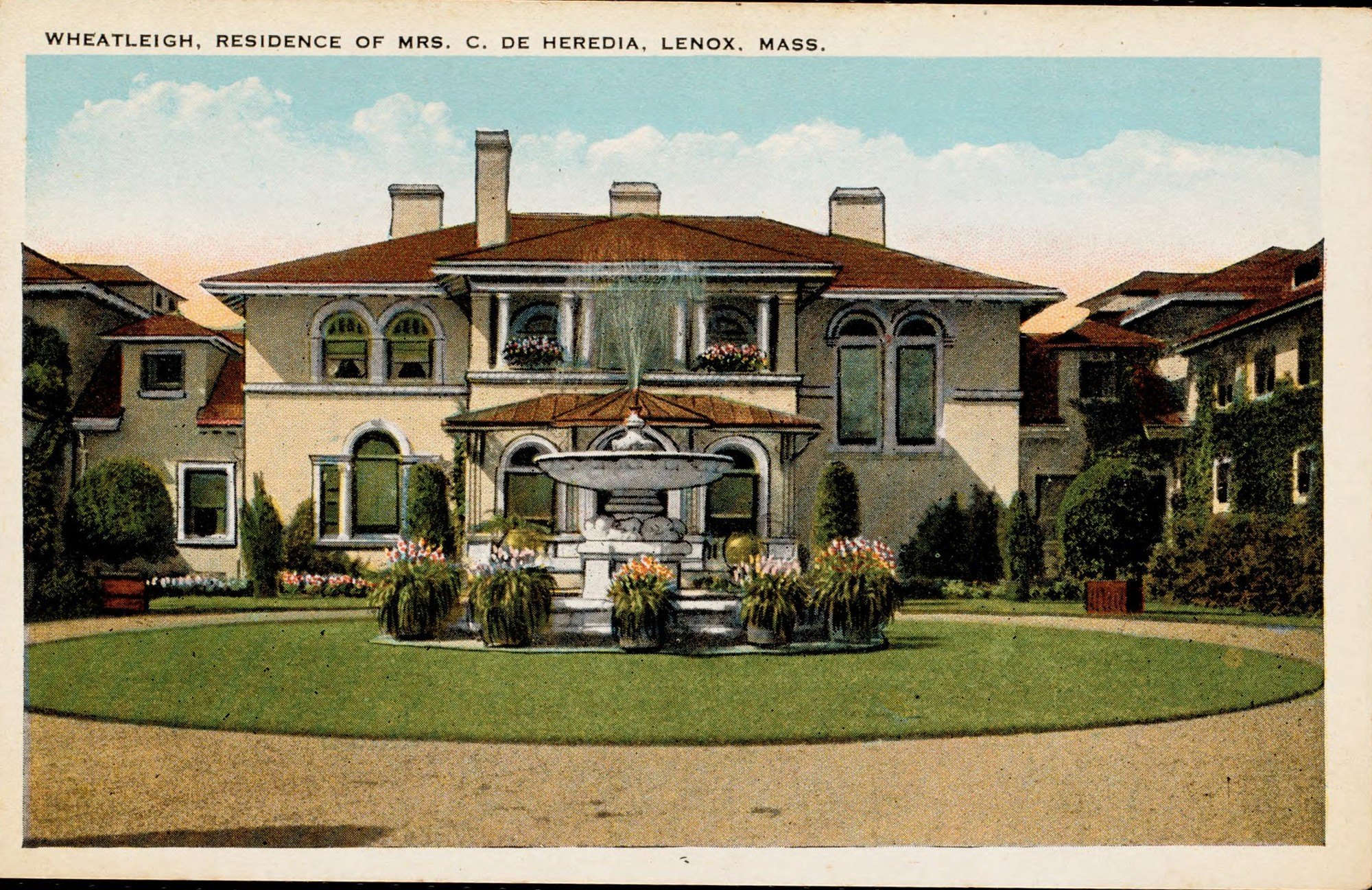
The same goes for the town. The archive says Lenox. The National Park Service says Lenox. The sheets say Stockbridge, Mass., in the title block of drawing after drawing — and Stockbridge is where the property is.
Sources: National Park Service, Frederick Law Olmsted National Historic Site — job 01295 and nps.gov/places/wheatleigh.htm. The Cultural Landscape Foundation, “The Olmsted Firm in the Berkshires.” Daytonian in Manhattan on the Henry H. Cook mansion at 1 East 78th Street. American Aristocracy on Wheatleigh. Lenox Library Association photographic records via Digital Commonwealth, whose subject headings name Cook, Henry Harvey (1822–1905), de Heredia, Carlos (d. 1918) and de Heredia, Georgie Cook (d. 1946). Where published sources disagree, the disagreement is shown rather than resolved.